Therapeutic Play at GHES

What is Therapeutic Play?
Therapeutic Play is a child-centred intervention that enables children to play out their difficulties and express themselves through story/metaphor. Talking can be hard for children – they may not understand what they’re feeling or have the words to explain. The part of the brain responsible for thinking, emotional and relational skills doesn’t fully develop until we’re in our mid-twenties. So, for children, toys are their words and play is their language.
Therapeutic play is non-directive. Children recreate in their play the things they’re finding challenging inside. As they externalise this, the play and the energy that arises from it becomes a mirror of their internal state. Children learn through observation so they create play outside of themselves so they can look at it and interact with it, potentially in new ways.
Therapeutic play empowers the child. Children play out their difficulties through symbols and this creates distance between the child and the experience, so it feels safer to explore. If something is challenging, they can change it, e.g. use animals instead of people. This allows children to stay within their window of tolerance because it removes them from the intensity of the feelings their play brings up.
Therapeutic play goes at the child’s pace. When a child experiences something traumatic some parts of that experience get integrated into the child’s emotional world, but other parts don’t. It’s like a funnel where the funnel represents the child’s window of tolerance – their capacity to cope with whatever comes up for them in that experience. If the traumatic experience is like a tap being turned on full blast, some of that water is going to go down the funnel but a lot of it is going to spill over the sides. In the playroom, children bring to life through their imagination, through their play, the parts that didn’t go down the funnel. And the mind cannot tell the difference between what is real and what is imagined. So, if a child has two characters fighting, their body responds in that moment as if they’re literally watching that fight in front of them; their nervous system activates as if it were real. So, the child needs to remain in control of the pace at which this happens, so they feel safe enough to bring something to life and integrate it into their psyche. And as the child moves through this process, they gradually widen their window of tolerance bit by bit.
Therapeutic play provides a safe space for trial and error. As children progress through the therapeutic play process, they start to realise that there are other perceptions and choices and they get to try these out, through their play, so they can figure out what strategies may or may not help them in real life.
How does Therapeutic Play work at GHES?
· Therapeutic Play is an intervention for children aged 4-13 years
· A minimum course is 12/16 sessions with a review around halfway. More sessions can be offered in consultation with parents and other professionals
· Sessions last 40 minutes and take place weekly on the same day and at the same time
· Sessions take place with the same allocated therapist in the playroom at GHES’s County Offices, Cheltenham
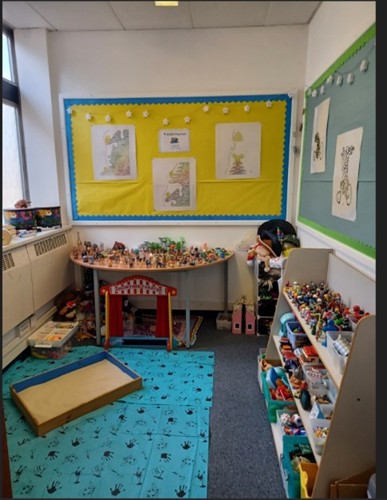
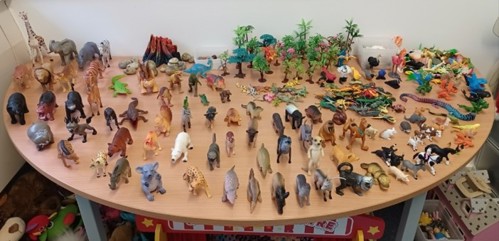
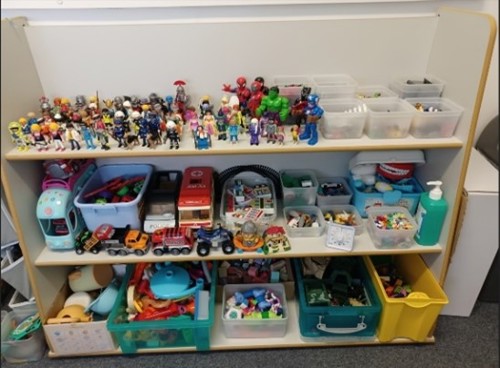
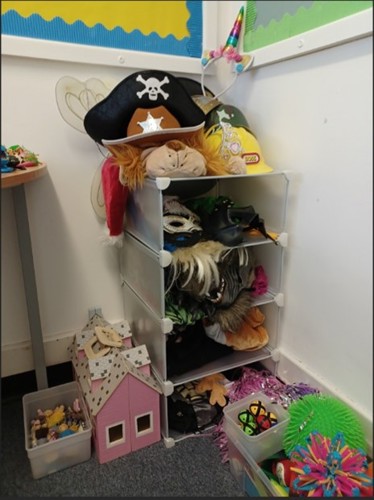
The GHES playroom
The photos below give an indication of what’s available in the playroom.