Skip to content

Post 16

The duty to promote the educational achievement of a children in care extends to looked-after young people aged 16 to the time that they leave care at age 18 yrs old. 

Post 16 Pupil Premium is available for young people in care who are engaged in ETE, as part of SMART target setting in PEP meetings. 

The Virtual School has good links with local school sixth forms, and further education (FE) colleges both in Gloucestershire and around the country. There are also good links with local universities, which regularly host aspirational events for children in care. Any young person who wishes to apply for higher education is fully supported by a Virtual School Education Adviser working alongside a variety of professionals, as part of the PEP process, to find the right establishment. 

Visit our training page to find a short bite-size video about various Post 16 pathways. 

This can be used by young people, schools, parents and professionals who are looking at various options after Year 11. Click here to go directly to the site. 

Thinking about Post 16  

Plan ahead - Get started in Year 10! 

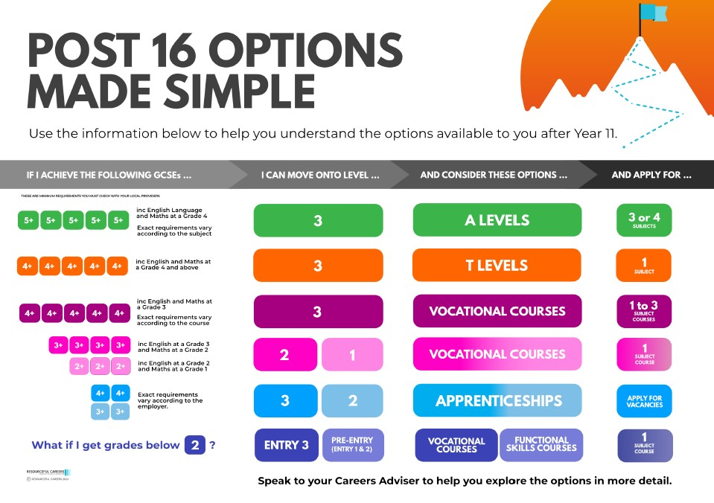
  • It is recommended that young people and their parents and carers start to look at their Post 16 options in Year 10 so that they are fully planned and prepared for when applications open in the early part of Year 11. The Virtual School has created a useful guide to take you through the basics options available and where to look for information. This is suitable for all young people not just those in care. Click here to access the guide. 

Schools are expected to provide strong support for children in care and may find it useful to use our Year 11 transition checklist to ensure that Year 11 pupils are aided as much as possible when making decisions about their next steps into Post 16. 

Some Year 11 students have a clear idea about what they want to do in the future and how to get there, but some have no idea at all.   Others are somewhere in the middle or have changed their minds a few times. This is all normal, so if you’re feeling confused, try not to worry. 

There is help and information out there. 

First off, here are a couple of points to note about options after Year 11: 

1. You must stay in learning until age 18. ‘Learning’ can mean a variety of things – not just full-time school or college (see below for more details). 

2. Whatever option you choose, if you don’t have a grade 4 (formerly C) in maths and/or English, you must keep studying these subjects until you achieve a 4 or equivalent (this applies until  your 18th birthday). 


Post 16 Option choices after GCSEs   Career pilot Careerpilot: Plan your future work & study 
📚 National Careers Week is the perfect time to explore your options! | CXK Careerpilot : Adviser Zone : Introduction to Careerpilot and the ... Our partners | Future Quest


So what are the options? 

 The main options available after year 11 are: 

  • school 6th form 

  • college 

  • apprenticeships 

  • traineeships(sometimes called other names, eg ‘pre-apprenticeships’).
    There are other less common options. For example, it’s possible to combine part-time learning with full-time employment, self-employment or volunteering. For young people with special educational needs or disabilities (SEND), there are also supported internships. 

Qualifications 

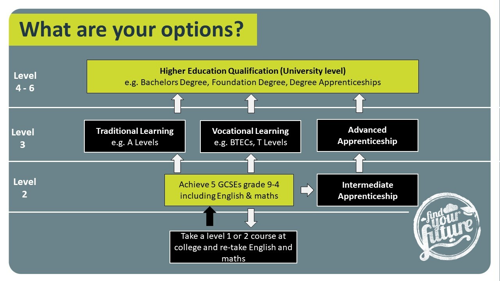
There are different levels and types of qualifications available after Year 11. Click the picture to view a video of a simple guide. 


 Qualification 

Academic (sixth form or college) 

General vocational (sixth form or college) 

Vocational (college or apprenticeship) 

Level 3 (usually two years) 

E.g. A-levels 

E.g. BTEC level 3, T-Levels qualifications 

E.g. NVQ level 3 

Level 2 (usually one year) 

E.g. GCSEs 

E.g. BTEC level 2 qualifications 

E.g. NVQ level 2 

Level 1 and entry level 

Foundation Learning  (can include a range of entry and level 1 qualifications) 

Foundation Learning (can include a range of entry and level 1 qualifications) 

Foundation Learning (can include a range of entry and level 1 qualifications) 


Some Year 11 students have a clear idea about what they want to do in the future and how to get there, but some have no idea at all.   Others are somewhere in the middle or have changed their minds a few times. This is all normal, so if you’re feeling confused, try not to worry. 

There is help and information out there. 

First off, here are a couple of points to note about options after Year 11: 

1. You must stay in learning until age 18. ‘Learning’ can mean a variety of things – not just full-time school or college (see below for more details). 

2. Whatever option you choose, if you don’t have a grade 4 (formerly C) in maths and/or English, you must keep studying these subjects until you achieve a 4 or equivalent (this applies until  your 18th birthday). 


Post 16 Option choices after GCSEs   Career pilot Careerpilot: Plan your future work & study 
📚 National Careers Week is the perfect time to explore your options! | CXK Careerpilot : Adviser Zone : Introduction to Careerpilot and the ... Our partners | Future Quest


So what are the options? 

 The main options available after year 11 are: 

  • school 6th form 

  • college 

  • apprenticeships 

  • traineeships(sometimes called other names, eg ‘pre-apprenticeships’).
    There are other less common options. For example, it’s possible to combine part-time learning with full-time employment, self-employment or volunteering. For young people with special educational needs or disabilities (SEND), there are also supported internships. 

Qualifications 

There are different levels and types of qualifications available after Year 11. Click the picture to view a video of a simple guide. 


 Qualification 

Academic (sixth form or college) 

General vocational (sixth form or college) 

Vocational (college or apprenticeship) 

Level 3 (usually two years) 

E.g. A-levels 

E.g. BTEC level 3, T-Levels qualifications 

E.g. NVQ level 3 

Level 2 (usually one year) 

E.g. GCSEs 

E.g. BTEC level 2 qualifications 

E.g. NVQ level 2 

Level 1 and entry level 

Foundation Learning  (can include a range of entry and level 1 qualifications) 

Foundation Learning (can include a range of entry and level 1 qualifications) 

Foundation Learning (can include a range of entry and level 1 qualifications) 


Post Year 11 qualifications 

Qualifications can normally be divided into three types.

For example, the International Baccalaureate Diploma is a level 3 academic qualification. Cambridge Technicals (CTECs) are general vocational qualifications. CACHE childcare qualifications, AAT accounting qualifications and City & Guilds qualifications are all vocational. Click here to find up to date info on functional skills v GCSEs.

Post Year 11 qualifications 

Qualifications can normally be divided into three types.

For example, the International Baccalaureate Diploma is a level 3 academic qualification. Cambridge Technicals (CTECs) are general vocational qualifications. CACHE childcare qualifications, AAT accounting qualifications and City & Guilds qualifications are all vocational. Click here to find up to date info on functional skills v GCSEs.

Academic qualifications 

Academic qualifications are usually based in the classroom, involve a lot of theory and are mainly assessed by exams. They are offered by schools and colleges. Subjects available include English, maths, sciences, languages, arts subjects and humanities subjects. 

A-levels are academic qualifications that are a popular choice for Year 11 leavers. Usually, students study three or four subjects over two years. If you are interested in doing A-levels, you need certain GCSE grades, including in English and Maths. Always check the exact entry requirements with the 6th forms or colleges you are interested in.

Some students go on to university after A-levels, some go into employment, some go on to graduate apprenticeships  but there are  many other options too. 

Academic qualifications 

Academic qualifications are usually based in the classroom, involve a lot of theory and are mainly assessed by exams. They are offered by schools and colleges. Subjects available include English, maths, sciences, languages, arts subjects and humanities subjects. 

A-levels are academic qualifications that are a popular choice for Year 11 leavers. Usually, students study three or four subjects over two years. If you are interested in doing A-levels, you need certain GCSE grades, including in English and Maths. Always check the exact entry requirements with the 6th forms or colleges you are interested in.

Some students go on to university after A-levels, some go into employment, some go on to graduate apprenticeships  but there are  many other options too. 

General vocational qualifications 

General vocational qualifications involve a mixture of practical and academic learning. They are offered by school and colleges, but colleges tend to offer a wider choice of subjects. The subjects available are related to broad job areas, eg business, performing arts, engineering, and health and social care. Usually, you study just one subject. 

BTECs are the most common type of general vocational qualification, but you may come across others, such as CTECs (Cambridge Technicals). BTECs will be phased out in the coming years. 

General vocational qualifications are offered at different levels, so Year 11 leavers can progress to a level 1, 2 or 3 course, depending on GCSE grades. Level 1 and 2 courses take one year. Level 3 courses are equivalent to A-levels, take two years and generally require certain GCSE grades. Always check the exact entry requirements with the 6th forms or colleges you are interested in. 

Level 3 general vocational qualifications are accepted by most universities for many of their courses. Research  the UCAS website, if you already have a university course in mind to check they accept  these general vocational qualifications.

General vocational qualifications 

General vocational qualifications involve a mixture of practical and academic learning. They are offered by school and colleges, but colleges tend to offer a wider choice of subjects. The subjects available are related to broad job areas, eg business, performing arts, engineering, and health and social care. Usually, you study just one subject. 

BTECs are the most common type of general vocational qualification, but you may come across others, such as CTECs (Cambridge Technicals). BTECs will be phased out in the coming years. 

General vocational qualifications are offered at different levels, so Year 11 leavers can progress to a level 1, 2 or 3 course, depending on GCSE grades. Level 1 and 2 courses take one year. Level 3 courses are equivalent to A-levels, take two years and generally require certain GCSE grades. Always check the exact entry requirements with the 6th forms or colleges you are interested in. 

Level 3 general vocational qualifications are accepted by most universities for many of their courses. Research  the UCAS website, if you already have a university course in mind to check they accept  these general vocational qualifications.

Vocational qualifications 

Vocational qualifications involve training for a specific job, eg catering, hairdressing, construction, engineering, childcare or business admin. You can’t normally combine more than one subject / job area. You can study them full-time at a college or other training centre. They can also be studied as part of an apprenticeship. 

Vocational qualifications are offered at levels 1, 2, 3 and higher. Entry requirements can vary, so always check with the college or provider you are interested in applying for . 

They can sometimes offer progression to university. There are also other pathways available, such as higher/degree level apprenticeships. 

V Levels Explained

Vocational Celebration Day 2026 - LIVE |  Steph on Skills: Powered by Enginuity 


Vocational qualifications 

Vocational qualifications involve training for a specific job, eg catering, hairdressing, construction, engineering, childcare or business admin. You can’t normally combine more than one subject / job area. You can study them full-time at a college or other training centre. They can also be studied as part of an apprenticeship. 

Vocational qualifications are offered at levels 1, 2, 3 and higher. Entry requirements can vary, so always check with the college or provider you are interested in applying for . 

They can sometimes offer progression to university. There are also other pathways available, such as higher/degree level apprenticeships. 

V Levels Explained

Vocational Celebration Day 2026 - LIVE |  Steph on Skills: Powered by Enginuity 


T-Levels 

T-Levels are a recognised 2-year qualification. It is an alternative option after GCSEs and equal to three A Levels. They prepare students for work by combining 80 per cent of their time in the classroom and 20 per cent at an industry placement. This equates to at least 45 days or 315 hours with a maximum of 2 placements.

Created by employers and businesses with over 250 businesses involved, the first T-Levels started in 2020, and are available in selected schools and colleges in 10 career areas: 

  • Building Services Engineering for Construction 

  • Design, Surveying and Planning for Construction 

  • Digital Business Services 

  • Digital Production, Design and Development 

  • Digital Support Services 

  • Education and Childcare 

  • Health 

  • Healthcare Science 

  • Onsite Construction 

  • Science 

More areas of study continue to become available and more recently have included, finance, engineering, hairdressing, barbering, beauty therapy and more. To search for a T Level course and to find out more, click on the T Level website.

The T-Level grades are:

  • Pass 

  • Merit 

  • Distinction or 'Distinction* with a Distinction*' (the same as 3 A levels at A*) 

After completing a T-Level, students can choose to continue studying after the course. Many universities recognise this qualification. Check universities accepting T-Levels for entry. There is also the option of moving into employment or onto an apprenticeship. 

For students who are not ready to progress onto a T-Level course, there is also a one-year post-GCSE T- Level Transition Programme to prepare students for a T-Levels. Speak to a T-Level provider to find out more and read the T-Level Transition Programme student guide which is delivered at Cirencester College.

T-Levels 

T-Levels are a recognised 2-year qualification. It is an alternative option after GCSEs and equal to three A Levels. They prepare students for work by combining 80 per cent of their time in the classroom and 20 per cent at an industry placement. This equates to at least 45 days or 315 hours with a maximum of 2 placements.

Created by employers and businesses with over 250 businesses involved, the first T-Levels started in 2020, and are available in selected schools and colleges in 10 career areas: 

  • Building Services Engineering for Construction 

  • Design, Surveying and Planning for Construction 

  • Digital Business Services 

  • Digital Production, Design and Development 

  • Digital Support Services 

  • Education and Childcare 

  • Health 

  • Healthcare Science 

  • Onsite Construction 

  • Science 

More areas of study continue to become available and more recently have included, finance, engineering, hairdressing, barbering, beauty therapy and more. To search for a T Level course and to find out more, click on the T Level website.

The T-Level grades are:

  • Pass 

  • Merit 

  • Distinction or 'Distinction* with a Distinction*' (the same as 3 A levels at A*) 

After completing a T-Level, students can choose to continue studying after the course. Many universities recognise this qualification. Check universities accepting T-Levels for entry. There is also the option of moving into employment or onto an apprenticeship. 

For students who are not ready to progress onto a T-Level course, there is also a one-year post-GCSE T- Level Transition Programme to prepare students for a T-Levels. Speak to a T-Level provider to find out more and read the T-Level Transition Programme student guide which is delivered at Cirencester College.

College or 6th Form: choosing where to study 

If you want to stay in full-time education, you will need to choose where to study. There are a range of things to consider, such as: 

  • Course choice 

  • Entry requirements 

  • Do you want a new start or to stay with what and who you know? 

  • Travel – is it a journey you can manage every day? 

  • Class sizes 

  • Facilities 

  • Atmosphere 

  • Teaching. 

Always go to open days to check out different schools and colleges. This is useful for getting information, but also, it means you get first-hand experience. You may feel more comfortable in some schools/colleges than others. 

Something else to consider is that many colleges are more of an ‘adult’ environment than schools. They may have more adult learners. They may also expect you to get on with your work independently. 

Here are some other resources: 

Compare different 6th forms and colleges near you  Help with choosing A-level subjects   A-level subjects (or equivalent) ‘top’ universities want

College or 6th Form: choosing where to study 

If you want to stay in full-time education, you will need to choose where to study. There are a range of things to consider, such as: 

  • Course choice 

  • Entry requirements 

  • Do you want a new start or to stay with what and who you know? 

  • Travel – is it a journey you can manage every day? 

  • Class sizes 

  • Facilities 

  • Atmosphere 

  • Teaching. 

Always go to open days to check out different schools and colleges. This is useful for getting information, but also, it means you get first-hand experience. You may feel more comfortable in some schools/colleges than others. 

Something else to consider is that many colleges are more of an ‘adult’ environment than schools. They may have more adult learners. They may also expect you to get on with your work independently. 

Here are some other resources: 

Compare different 6th forms and colleges near you  Help with choosing A-level subjects   A-level subjects (or equivalent) ‘top’ universities want

Apprenticeships 

Apprenticeships involve working and learning at the same time you gain vocational qualifications. 

They are available across the following job sectors: 

  • Agriculture, horticulture and animal care 

  • Arts, media and publishing 

  • Business, administration and law 

  • Construction, planning and the built environment 

  • Education and training 

  • Engineering and manufacturing technologies 

  • Health, public services and care 

  • History, philosophy and theology 

  • Information and communication technology 

  • Languages, literature and culture 

  • Leisure, travel and tourism 

  • Preparation for life and work 

  • Retail and commercial enterprise

Science and mathematics
  • Social sciences 


Please note: apprenticeship vacancies are more common in some job sectors than others, so it’s important to check on the find an apprenticeship website before deciding on an apprenticeship route. 

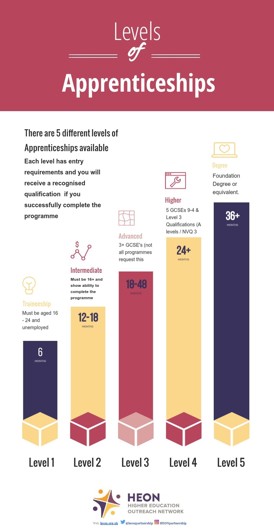
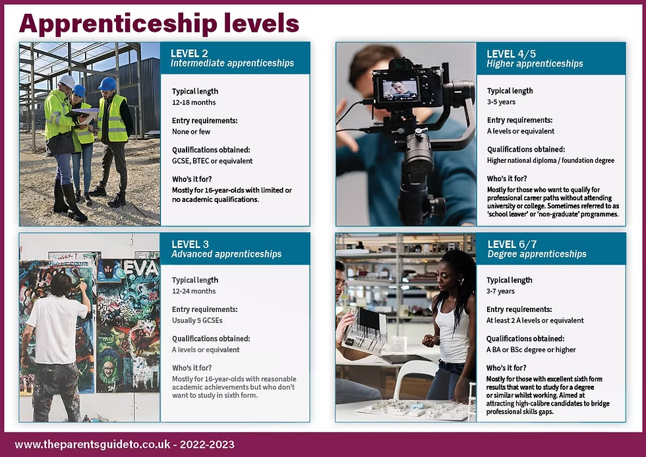
Apprenticeships are also available at different levels. 

Apprenticeship Type 

Level 

Equivalent to 

Intermediate 

GCSEs at grades 4 and above 

Advanced 

two A levels 

Higher 

4, 5, 6 and 7 

Foundation degree and above 

Degree 

6 and 7 

Bachelor’s or master’s degree 


Entry requirements for apprenticeships vary, so it’s important to check vacancies to see what qualifications, skills and experience may be required. Most require good GCSEs in English and maths. Apprenticeships can be very competitive – they are not an easy option. 

Apprentices earn a wage. There is a legal minimum wage for apprentices (depending on your age).  Many employers pay more than this. 

Apprenticeships are for anyone who is above school leaving age (you reach your official school leaving age on the last Friday in June in year 11). 

For more information on apprenticeships and to view and apply for vacancies on the national apprenticeships site

Whilst the main focus is on-the-job training, apprentices also spend at least 20% of their working hours completing classroom-based learning. This might be with a training provider, college or university and can lead to a nationally recognised qualification. 

Moving On Up - Amazing Apprenticeships    Apprenticeships or Traineeship   Apprenticeships | Learn About Apprenticeships And Find The Right One For You  Top Tips: Recruiting and supporting care experienced apprentices - Amazing Apprenticeships 

You will be supported to do this until the end of Year 13.  

Apprenticeships 

Apprenticeships involve working and learning at the same time you gain vocational qualifications. 

They are available across the following job sectors: 

  • Agriculture, horticulture and animal care 

  • Arts, media and publishing 

  • Business, administration and law 

  • Construction, planning and the built environment 

  • Education and training 

  • Engineering and manufacturing technologies 

  • Health, public services and care 

  • History, philosophy and theology 

  • Information and communication technology 

  • Languages, literature and culture 

  • Leisure, travel and tourism 

  • Preparation for life and work 

  • Retail and commercial enterprise

Science and mathematics
  • Social sciences 


Please note: apprenticeship vacancies are more common in some job sectors than others, so it’s important to check on the find an apprenticeship website before deciding on an apprenticeship route. 

Apprenticeships are also available at different levels. 

Apprenticeship Type 

Level 

Equivalent to 

Intermediate 

GCSEs at grades 4 and above 

Advanced 

two A levels 

Higher 

4, 5, 6 and 7 

Foundation degree and above 

Degree 

6 and 7 

Bachelor’s or master’s degree 


Entry requirements for apprenticeships vary, so it’s important to check vacancies to see what qualifications, skills and experience may be required. Most require good GCSEs in English and maths. Apprenticeships can be very competitive – they are not an easy option. 

Apprentices earn a wage. There is a legal minimum wage for apprentices (depending on your age).  Many employers pay more than this. 

Apprenticeships are for anyone who is above school leaving age (you reach your official school leaving age on the last Friday in June in year 11). 

For more information on apprenticeships and to view and apply for vacancies on the national apprenticeships site

Whilst the main focus is on-the-job training, apprentices also spend at least 20% of their working hours completing classroom-based learning. This might be with a training provider, college or university and can lead to a nationally recognised qualification. 

Moving On Up - Amazing Apprenticeships    Apprenticeships or Traineeship   Apprenticeships | Learn About Apprenticeships And Find The Right One For You  Top Tips: Recruiting and supporting care experienced apprentices - Amazing Apprenticeships 

You will be supported to do this until the end of Year 13.  

Traineeship 

From 1 August 2023, the government no longer funds a standalone national traineeships programme. It will be integrated into the 16 to 19 study programme or the adult education budget. Traineeships may still be available from local providers. 

Young people who are not quite ready for an apprenticeship can do a traineeship (sometimes called by other names, such as ‘pre-apprenticeship’).  

Traineeships are aimed at 16-24 year-olds and last up to six months. They offer the chance to do work experience, improve work skills and (if needed) gain English and maths qualifications. Traineeships are not paid, but financial help may be available. 

If you’re interested in a traineeship, you can search for vacancies online or get in touch with us. We can advise you on suitable traineeships that are available locally, as well as refer you. 

Traineeship 

From 1 August 2023, the government no longer funds a standalone national traineeships programme. It will be integrated into the 16 to 19 study programme or the adult education budget. Traineeships may still be available from local providers. 

Young people who are not quite ready for an apprenticeship can do a traineeship (sometimes called by other names, such as ‘pre-apprenticeship’).  

Traineeships are aimed at 16-24 year-olds and last up to six months. They offer the chance to do work experience, improve work skills and (if needed) gain English and maths qualifications. Traineeships are not paid, but financial help may be available. 

If you’re interested in a traineeship, you can search for vacancies online or get in touch with us. We can advise you on suitable traineeships that are available locally, as well as refer you. 

For Sixth Forms and Colleges, we strongly suggest you apply during the first term of Year 11.  

Some courses become full quite quickly. Some have early deadlines – make sure you check this. 

For most apprenticeships and traineeships, you can apply closer to the end of Year 11 or during the summer.  

Apprenticeships and traineeship vacancies come up all year round. Employers and providers tend to want someone who is available to start soon. 

It’s best to apply to several Sixth Forms and Colleges. Getting a place isn’t guaranteed. It’s important to have several possibilities, plus a back-up plan. 

Similarly, if you’re interested in apprenticeships, it’s a good idea to still apply for Sixth Forms and Colleges as a back-up. 

For most Sixth Forms and Colleges, you can apply through their websites. 

You can also apply for most apprenticeships through the national apprenticeships site. Applying for apprenticeships is similar to applying for jobs. 

Making the decision 

Hopefully, you are now clearer about what the options are after Year 11. 

However, to make your decision, you should also think about the following: 

  • What GCSE grades are you likely to get? 

  • What are you best at? 

  • What are you passionate about? 

  • How do you learn best? 

  • What jobs are you interested in doing in the future? 

It's also important to consider what future jobs you're interested in and what qualifications they require 

Finally, it’s a good idea to speak to people, such as: 

  • Teachers – they will know what subjects you are best at and what type of learning may suit you. 

  • Parents/carers or older family members – they know you well and may also have ideas (but remember: education pathways and the world of work have changed since they were your age).

  • Friends – it’s great to share ideas and information, but don’t choose something just because your friends are doing it.

  • Careers advisers –  they will have the latest information and are specially trained to help you decide what’s best for you. 

You will probably find that lots of people have different opinions. Some of these will be useful. However, it’s important to find out the facts by doing your research and seeing for yourself. Also remember that everyone is different. What is boring or hard for someone else, may be fun or interesting for you! 

For Sixth Forms and Colleges, we strongly suggest you apply during the first term of Year 11.  

Some courses become full quite quickly. Some have early deadlines – make sure you check this. 

For most apprenticeships and traineeships, you can apply closer to the end of Year 11 or during the summer.  

Apprenticeships and traineeship vacancies come up all year round. Employers and providers tend to want someone who is available to start soon. 

It’s best to apply to several Sixth Forms and Colleges. Getting a place isn’t guaranteed. It’s important to have several possibilities, plus a back-up plan. 

Similarly, if you’re interested in apprenticeships, it’s a good idea to still apply for Sixth Forms and Colleges as a back-up. 

For most Sixth Forms and Colleges, you can apply through their websites. 

You can also apply for most apprenticeships through the national apprenticeships site. Applying for apprenticeships is similar to applying for jobs. 

Making the decision 

Hopefully, you are now clearer about what the options are after Year 11. 

However, to make your decision, you should also think about the following: 

  • What GCSE grades are you likely to get? 

  • What are you best at? 

  • What are you passionate about? 

  • How do you learn best? 

  • What jobs are you interested in doing in the future? 

It's also important to consider what future jobs you're interested in and what qualifications they require 

Finally, it’s a good idea to speak to people, such as: 

  • Teachers – they will know what subjects you are best at and what type of learning may suit you. 

  • Parents/carers or older family members – they know you well and may also have ideas (but remember: education pathways and the world of work have changed since they were your age).

  • Friends – it’s great to share ideas and information, but don’t choose something just because your friends are doing it.

  • Careers advisers –  they will have the latest information and are specially trained to help you decide what’s best for you. 

You will probably find that lots of people have different opinions. Some of these will be useful. However, it’s important to find out the facts by doing your research and seeing for yourself. Also remember that everyone is different. What is boring or hard for someone else, may be fun or interesting for you! 

General advice and tips 

You can leave school on the last Friday in June if you are 16 by the end of the summer holidays. There are lots of things you do before and after you leave to help you work out what to do next: 

  • You can apply for more than one setting, course or training/apprenticeship. 

  • Attend skills fairs, open days and visit websites for colleges, 6th forms and training providers.
  • Aim to apply by the January before you are due to go into Year 12. 

  • Once you have applied to a college or other setting, there is usually some flexibility, if you want to change the course you have applied for. Just contact the setting as soon as possible.
  • If you don’t meet the entry requirements when you get your results, speak to the college as they may be able to help you find the appropriate level course. 


  • If you are still at school, you should have access to careers advice and guidance.
  • If you are not living in Gloucestershire, you can access your area’s local offer through the local authority's website. 


General advice and tips 

You can leave school on the last Friday in June if you are 16 by the end of the summer holidays. There are lots of things you do before and after you leave to help you work out what to do next: 

  • You can apply for more than one setting, course or training/apprenticeship. 

  • Attend skills fairs, open days and visit websites for colleges, 6th forms and training providers.
  • Aim to apply by the January before you are due to go into Year 12. 

  • Once you have applied to a college or other setting, there is usually some flexibility, if you want to change the course you have applied for. Just contact the setting as soon as possible.
  • If you don’t meet the entry requirements when you get your results, speak to the college as they may be able to help you find the appropriate level course. 


  • If you are still at school, you should have access to careers advice and guidance.
  • If you are not living in Gloucestershire, you can access your area’s local offer through the local authority's website. 


Gloucestershire Post 16 providers  

Post-16 Interactive Map

Prospect Training Services 

Gloucestershire College   


Bridge Training Ltd 

SGS College

Cirencester College – Sixth Form College 


Forest Sports Education  

Gloucester - MPCT

AccXel

Local offer video from  various colleges


Gloucestershire Post 16 providers  

Post-16 Interactive Map

Prospect Training Services 

Gloucestershire College   


Bridge Training Ltd 

SGS College

Cirencester College – Sixth Form College 


Forest Sports Education  

Gloucester - MPCT

AccXel

Local offer video from  various colleges


Functional Skills qualifications in the UK are available at different levels, including Entry Level 1-3, Level 1, and Level 2, designed to develop essential skills in English, maths, and ICT. 

Levels of Functional Skills Qualifications 

Entry Level 1-3: These levels are below GCSE level and are designed for learners who are beginning to develop their skills. Each entry level focuses on basic skills in English and maths, helping learners to build a foundation for further study or employment. 
Level 1: This level is equivalent to GCSE grades 1-3 (E-D). It assesses learners' ability to apply their skills in practical situations, preparing them for further education or entry-level jobs. Achieving Level 1 is often a requirement for certain vocational training programs. 
Level 2

This level is comparable to GCSE grade 4 (C) and above, up to grade 9 (A*). Level 2 qualifications are often required for higher education, apprenticeships, and many job roles. It demonstrates a higher level of proficiency in English and maths, equipping learners with the skills needed for the workplace. 

Useful up to date info on functional skills v GCSEs https://functionalskills.co.uk/hub/functional-skills-vs-gcse/ 


Functional Skills qualifications in the UK are available at different levels, including Entry Level 1-3, Level 1, and Level 2, designed to develop essential skills in English, maths, and ICT. 

Levels of Functional Skills Qualifications 

Entry Level 1-3: These levels are below GCSE level and are designed for learners who are beginning to develop their skills. Each entry level focuses on basic skills in English and maths, helping learners to build a foundation for further study or employment. 
Level 1: This level is equivalent to GCSE grades 1-3 (E-D). It assesses learners' ability to apply their skills in practical situations, preparing them for further education or entry-level jobs. Achieving Level 1 is often a requirement for certain vocational training programs. 
Level 2

This level is comparable to GCSE grade 4 (C) and above, up to grade 9 (A*). Level 2 qualifications are often required for higher education, apprenticeships, and many job roles. It demonstrates a higher level of proficiency in English and maths, equipping learners with the skills needed for the workplace. 

Useful up to date info on functional skills v GCSEs https://functionalskills.co.uk/hub/functional-skills-vs-gcse/ 


As Pupil Premium Grant is only available for statutory school age children, learners in Post 16 programmes are eligible for the Post 16-19 bursary. This bursary is designed to break down barriers to learning to enable young people to achieve their potential. 

As a child in care or care leaver, they are eligible for the Vulnerable Groups bursary. For more information about the bursary and how to apply visit the information from the Education and Skills Funding Agency on 16 to 19 education: financial support for students. 

As Pupil Premium Grant is only available for statutory school age children, learners in Post 16 programmes are eligible for the Post 16-19 bursary. This bursary is designed to break down barriers to learning to enable young people to achieve their potential. 

As a child in care or care leaver, they are eligible for the Vulnerable Groups bursary. For more information about the bursary and how to apply visit the information from the Education and Skills Funding Agency on 16 to 19 education: financial support for students. 

Gloucestershire Virtual School gathers data on the NEET ( Not in Employment, Education or Training)  and ETE (Education , Training or Employment) status of Post 16 young people every six weeks. We work alongside social workers, YST (Youth Support Team)  and the  NEET team to ensure that appropriate support is given to those young people who are in education or training. In addition, we support young people in care who are ready to transition into learning, so that the PEP is maintained as part of the pathway plan. 

The Virtual School offer a MY CHOICES PEP to Post 16 young people in care to support them to explore the routes and options to return to education, training and employment.    

Gloucestershire Virtual School gathers data on the NEET ( Not in Employment, Education or Training)  and ETE (Education , Training or Employment) status of Post 16 young people every six weeks. We work alongside social workers, YST (Youth Support Team)  and the  NEET team to ensure that appropriate support is given to those young people who are in education or training. In addition, we support young people in care who are ready to transition into learning, so that the PEP is maintained as part of the pathway plan. 

The Virtual School offer a MY CHOICES PEP to Post 16 young people in care to support them to explore the routes and options to return to education, training and employment.