Skip to content

Information for Schools and Colleges

Information for Schools and Colleges 

Schools and colleges play a vital role in helping unaccompanied asylum-seeking children (UASC) feel safe, welcomed and included. 

Many UASC have experienced disruption to their education and may be adapting to a new language, culture and education system. While every young person's journey is unique, educational settings can make a significant difference by providing stability, support and opportunities to succeed. 

This section provides guidance, resources and practical information to support schools and colleges working with UASC in Gloucestershire. 

Unaccompanied Asylum-Seeking Children (UASC) are children and young people who have arrived in the UK without a parent or legal guardian and are seeking asylum. 

Every young person's journey is different. Some may have experienced: 

Education 

Family & Relationships 

Change & Adjustment 

Interrupted education 

Separation from family 

Cultural differences 

Limited education opportunities 

Loss and uncertainty 

Learning English 

Different education systems 

New support networks 

Adapting to life in the UK 

While these experiences may create additional barriers, they can also bring considerable strengths, resilience and aspiration. Educational settings play an important role in helping young people feel safe, included and able to achieve their potential. 

Useful Resources 

New Designated Teacher training 

 Statutory Guidance for Designated Teachers


Unaccompanied Asylum-Seeking Children (UASC) are children and young people who have arrived in the UK without a parent or legal guardian and are seeking asylum. 

Every young person's journey is different. Some may have experienced: 

Education 

Family & Relationships 

Change & Adjustment 

Interrupted education 

Separation from family 

Cultural differences 

Limited education opportunities 

Loss and uncertainty 

Learning English 

Different education systems 

New support networks 

Adapting to life in the UK 

While these experiences may create additional barriers, they can also bring considerable strengths, resilience and aspiration. Educational settings play an important role in helping young people feel safe, included and able to achieve their potential. 

Useful Resources 

New Designated Teacher training 

 Statutory Guidance for Designated Teachers


A positive start can significantly influence a young person's engagement, attendance, wellbeing and sense of belonging. 

Many UASC may be unfamiliar with the English education system and may need information repeated, revisited and communicated in accessible ways. 

Consider: 

  • A welcoming induction process 

  • Tours of the school or college environment
  • Clear explanations of routines and expectations 

  • Access to interpreting support where appropriate 

  • Buddy or peer mentoring systems 

  • Visual timetables and translated information where helpful 

  • Regular check-ins during the initial transition period 


A structured induction can help young people build confidence, understand expectations and settle more quickly. 

Useful Resource 

Programme Tips to Aid a Smooth Start


A positive start can significantly influence a young person's engagement, attendance, wellbeing and sense of belonging. 

Many UASC may be unfamiliar with the English education system and may need information repeated, revisited and communicated in accessible ways. 

Consider: 

  • A welcoming induction process 

  • Tours of the school or college environment
  • Clear explanations of routines and expectations 

  • Access to interpreting support where appropriate 

  • Buddy or peer mentoring systems 

  • Visual timetables and translated information where helpful 

  • Regular check-ins during the initial transition period 


A structured induction can help young people build confidence, understand expectations and settle more quickly. 

Useful Resource 

Programme Tips to Aid a Smooth Start


UASC learners arrive with a wide range of educational experiences, qualifications, language backgrounds, strengths and aspirations. 

It is important to recognise that limited English proficiency does not indicate limited academic ability. Many learners may have strong first-language literacy skills, significant prior learning or qualifications that are not yet fully evident through English. 

Assessing Progress 

Progress may be demonstrated through: 

English Language Development  Engagement and Participation Academic Progress 
  • Progress through ESOL or EAL frameworks 

  • Improved speaking and listening skills 

  • Improved reading and writing 

  • Increased subject-specific vocabulary 

  • Improved attendance 

  • Greater participation in lessons 

  • Increased confidence 

  • Improved relationships with peers and staff 

  • Curriculum access 

  • Internal assessments 

  • Coursework completion 

  • Demonstration of knowledge over time

Useful Resources 

UASC Toolkit
The Bell Foundation
Refugee Council


UASC learners arrive with a wide range of educational experiences, qualifications, language backgrounds, strengths and aspirations. 

It is important to recognise that limited English proficiency does not indicate limited academic ability. Many learners may have strong first-language literacy skills, significant prior learning or qualifications that are not yet fully evident through English. 

Assessing Progress 

Progress may be demonstrated through: 

English Language Development  Engagement and Participation Academic Progress 
  • Progress through ESOL or EAL frameworks 

  • Improved speaking and listening skills 

  • Improved reading and writing 

  • Increased subject-specific vocabulary 

  • Improved attendance 

  • Greater participation in lessons 

  • Increased confidence 

  • Improved relationships with peers and staff 

  • Curriculum access 

  • Internal assessments 

  • Coursework completion 

  • Demonstration of knowledge over time

Useful Resources 

UASC Toolkit
The Bell Foundation
Refugee Council


Some UASC may have experienced difficult or traumatic events before, during or after their journey to the UK. 

These experiences may sometimes affect engagement, attendance, behaviour or learning. 

Emotional 

Learning 

Social 

  • Anxiety 
  • Difficulty concentrating 
  • Withdrawal from peers 
  • Low mood 
  • Tiredness 
  • Reduced engagement 
  • Stress 
  • Lower attendance 
  • Changes in behaviour 

These responses may reflect stress, uncertainty or adjustment rather than behavioural concerns. 

Schools and colleges should adopt trauma-informed approaches that promote: 

  • Safety 

  • Consistency 

  • Belonging 

  • Trusted relationships

Consistent, trusted adults often have the greatest impact on helping a young person feel safe, settled and ready to learn. 

Some UASC may have experienced difficult or traumatic events before, during or after their journey to the UK. 

These experiences may sometimes affect engagement, attendance, behaviour or learning. 

Emotional 

Learning 

Social 

  • Anxiety 
  • Difficulty concentrating 
  • Withdrawal from peers 
  • Low mood 
  • Tiredness 
  • Reduced engagement 
  • Stress 
  • Lower attendance 
  • Changes in behaviour 

These responses may reflect stress, uncertainty or adjustment rather than behavioural concerns. 

Schools and colleges should adopt trauma-informed approaches that promote: 

  • Safety 

  • Consistency 

  • Belonging 

  • Trusted relationships

Consistent, trusted adults often have the greatest impact on helping a young person feel safe, settled and ready to learn. 

The Personal Education Plan (PEP) is one of the most important tools for promoting the educational achievement of Children in Care. 

For UASC learners, the PEP should provide a holistic picture of educational progress, language development, wellbeing, strengths, aspirations and future planning. 

The PEP should:

Pupil Voice and Aspirations 

Progress and Support 

Future Planning 

  • Capture the young person's views 
  • Monitor educational progress 
  • Support post-16 and post-18 planning 
  • Promote high aspirations 
  • Identify strengths and barriers 
  • Explore progression routes 
  • Recognise individual successes 
  • Coordinate support and interventions 
  • Consider long-term goals 
  • Explore future ambitions 
  • Make effective use of Pupil Premium Plus 
  • Support transitions 


The Personal Education Plan (PEP) is one of the most important tools for promoting the educational achievement of Children in Care. 

For UASC learners, the PEP should provide a holistic picture of educational progress, language development, wellbeing, strengths, aspirations and future planning. 

The PEP should:

Pupil Voice and Aspirations 

Progress and Support 

Future Planning 

  • Capture the young person's views 
  • Monitor educational progress 
  • Support post-16 and post-18 planning 
  • Promote high aspirations 
  • Identify strengths and barriers 
  • Explore progression routes 
  • Recognise individual successes 
  • Coordinate support and interventions 
  • Consider long-term goals 
  • Explore future ambitions 
  • Make effective use of Pupil Premium Plus 
  • Support transitions 


PEP targets should be SMART: 

  • Specific - clear and focused 

  • Measurable - progress can be monitored 

  • Achievable - realistic for the young person 

  • Relevant - linked to identified needs and aspirations 

  • Time-bound - reviewed within an agreed timescale 

Targets may focus on: 

  • English language development 

  • Literacy and numeracy 

  • Attendance and punctuality 

  • Participation and engagement 

  • Confidence and independence 

  • Careers education and progression planning 

  • Employment, training or higher education goals 


When setting targets for UASC learners, consider progress across academic achievement, English language acquisition, wellbeing, independence and future aspirations. Where appropriate, targets should recognise small steps of progress and build towards longer-term outcomes. 

Useful Resources 

PEP SMART Target Examples 
Examples of effective SMART targets for Children in Care.

ESOL SMART Target Prompts 
Guidance to support target setting for learners developing English as an Additional Language.
Virtual School SMART Poster 
A practical guide to writing Specific, Measurable, Achievable, Relevant and Time-bound targets..


PEP targets should be SMART: 

  • Specific - clear and focused 

  • Measurable - progress can be monitored 

  • Achievable - realistic for the young person 

  • Relevant - linked to identified needs and aspirations 

  • Time-bound - reviewed within an agreed timescale 

Targets may focus on: 

  • English language development 

  • Literacy and numeracy 

  • Attendance and punctuality 

  • Participation and engagement 

  • Confidence and independence 

  • Careers education and progression planning 

  • Employment, training or higher education goals 


When setting targets for UASC learners, consider progress across academic achievement, English language acquisition, wellbeing, independence and future aspirations. Where appropriate, targets should recognise small steps of progress and build towards longer-term outcomes. 

Useful Resources 

PEP SMART Target Examples 
Examples of effective SMART targets for Children in Care.

ESOL SMART Target Prompts 
Guidance to support target setting for learners developing English as an Additional Language.
Virtual School SMART Poster 
A practical guide to writing Specific, Measurable, Achievable, Relevant and Time-bound targets..


Educational pathways should be ambitious, realistic and tailored to the individual learner's strengths, experiences and aspirations. 

Designated Teachers play an important role in helping young people understand their options and plan for the future. 

Key Considerations for UASC Learners 

Learning 

Future Planning 

Individual Circumstances 

English language development 

Career aspirations 

Immigration status 

Previous education 

Post-16 plans 

Leave to Remain considerations 

Qualifications achieved 

Post-18 progression 

Right to Work eligibility 

First language literacy 

Progression requirements 

Individual talents and ambitions 

When discussing educational pathways, it is important to consider all three areas to ensure planning is personalised, ambitious and realistic for each young person. 


Educational pathways should be ambitious, realistic and tailored to the individual learner's strengths, experiences and aspirations. 

Designated Teachers play an important role in helping young people understand their options and plan for the future. 

Key Considerations for UASC Learners 

Learning 

Future Planning 

Individual Circumstances 

English language development 

Career aspirations 

Immigration status 

Previous education 

Post-16 plans 

Leave to Remain considerations 

Qualifications achieved 

Post-18 progression 

Right to Work eligibility 

First language literacy 

Progression requirements 

Individual talents and ambitions 

When discussing educational pathways, it is important to consider all three areas to ensure planning is personalised, ambitious and realistic for each young person. 


Many UASC learners begin with ESOL before progressing to additional qualifications, training and employment opportunities. Pathways should be discussed regularly through the PEP and reflect the young person's strengths, aspirations and circumstances. 

Education 

Training & Employment 

Higher Education & Careers 

ESOL 

Apprenticeships 

University 

Functional Skills 

Vocational Qualifications 

Foundation Degrees 

GCSEs 

Work-based Learning 

Higher-Level Study 

College Courses 

Employment with Training 

Degree Apprenticeships 

Further Education 

Supported Internships / Traineeships 

Professional Careers 

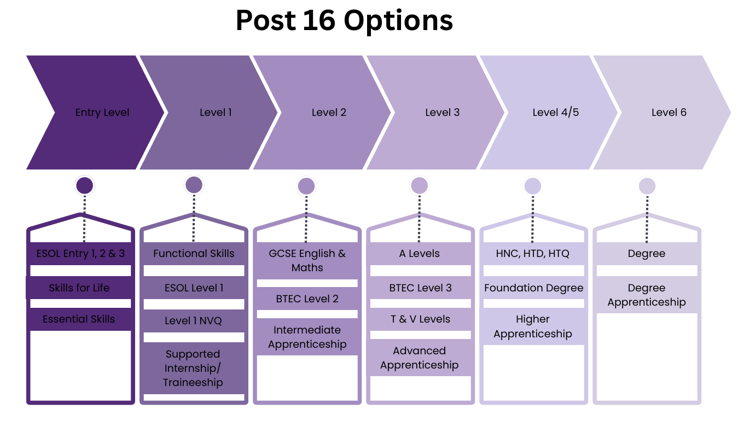
The progression pathways available to young people are shown in the guide below. 

Pathway planning should be reviewed regularly through the PEP process and take account of the young person's aspirations, progress, support needs and immigration circumstances. 

Many UASC learners begin with ESOL before progressing to additional qualifications, training and employment opportunities. Pathways should be discussed regularly through the PEP and reflect the young person's strengths, aspirations and circumstances. 

Education 

Training & Employment 

Higher Education & Careers 

ESOL 

Apprenticeships 

University 

Functional Skills 

Vocational Qualifications 

Foundation Degrees 

GCSEs 

Work-based Learning 

Higher-Level Study 

College Courses 

Employment with Training 

Degree Apprenticeships 

Further Education 

Supported Internships / Traineeships 

Professional Careers 

The progression pathways available to young people are shown in the guide below. 

Pathway planning should be reviewed regularly through the PEP process and take account of the young person's aspirations, progress, support needs and immigration circumstances. 

Pupil Premium Plus (PP+) funding should be used to remove identified barriers to learning and improve educational outcomes. For UASC learners, barriers may include English language development, interrupted education, attendance, wellbeing, curriculum access, transition into a new education system and preparation for future pathways. Examples of support that may be considered include: 

Examples of PP+ Support 

Language Development 

Academic Support 

Enrichment and Aspiration 

Resources and Technology 

ESOL support 

One-to-one tuition 

Educational visits 

Flash Academy 

Vocabulary programmes 

Small-group tuition 

Careers activities 

Tute 

Speaking and listening interventions 

GCSE English and Maths support 

Extra-curricular opportunities 

Learning resources/Revision materials 

Literacy support 

Functional Skills support 

Activities that promote confidence and belonging 

Laptops or tablets 

For PP+ resources,  and guidance including a financial calendar, click  the link.


Pupil Premium Plus (PP+) funding should be used to remove identified barriers to learning and improve educational outcomes. For UASC learners, barriers may include English language development, interrupted education, attendance, wellbeing, curriculum access, transition into a new education system and preparation for future pathways. Examples of support that may be considered include: 

Examples of PP+ Support 

Language Development 

Academic Support 

Enrichment and Aspiration 

Resources and Technology 

ESOL support 

One-to-one tuition 

Educational visits 

Flash Academy 

Vocabulary programmes 

Small-group tuition 

Careers activities 

Tute 

Speaking and listening interventions 

GCSE English and Maths support 

Extra-curricular opportunities 

Learning resources/Revision materials 

Literacy support 

Functional Skills support 

Activities that promote confidence and belonging 

Laptops or tablets 

For PP+ resources,  and guidance including a financial calendar, click  the link.