Skip to content

Introduction to UASC

Who we are and how we can help! 

Sara Poole: Assistant Head for UASC & Post 16

sara.poole@gloucestershire.gov.uk  

Sara leads on and oversees support for Unaccompanied Asylum-Seeking Children and Post-16 learners. She works with young people and professionals alongside Emily and Rob to help remove barriers to education, support positive transitions, and ensure learners can access the opportunities, guidance and resources they need to achieve their goals and prepare for their future. 

Emily Bedworth: Education Adviser for UASC & Post16 emily.bedworth@gloucestershire.gov.uk    

Emily will support young people throughout their education journey, helping to overcome barriers, achieve goals and reach their full potential. She attends termly Personal Education Plan (PEP) meetings and works closely with schools, colleges, Social Workers, Support Workers, Carers and Leaving Care Personal Advisers to ensure you receive the right support to engage in education and make positive progress. Emily can also provide guidance on educational pathways, transitions, attendance, wellbeing, Post-16 options, and accessing the opportunities available to help you succeed. 

Rob Bermingham – UASC Learning Mentor robert.bermingham@gloucestershire.gov.uk 

Rob supports UASC in Gloucestershire to access education, build confidence and develop a sense of belonging within their communities. He provides a consistent point of contact, helps young people access appropriate education and training pathways when they are New to Care, and works closely with schools, social care teams and partner agencies to plan and coordinate support.  

Through links with community organisations and activities such as sport, gardening and music, Rob promotes independence, social connections and positive opportunities for learning and engagement.

At Gloucestershire Virtual School, we are committed to supporting Unaccompanied Asylum-Seeking Children (UASC) and young people to succeed in education and build positive futures.  

An Unaccompanied Asylum-Seeking Child (UASC) is defined by the Home Office as a child or young person under the age of 18 who has applied for asylum in the UK in their own right and who is not being cared for by a parent or another adult who, by law or custom, has responsibility for them.  

Children and young people who arrive in Gloucestershire as UASC are considered to be in need of support and accommodation under Section 20 of the Children Act 1989, until an assessment determines otherwise. Many young people arrive having experienced significant disruption, uncertainty, and trauma, and our role is to ensure they receive the educational support they need to thrive. 
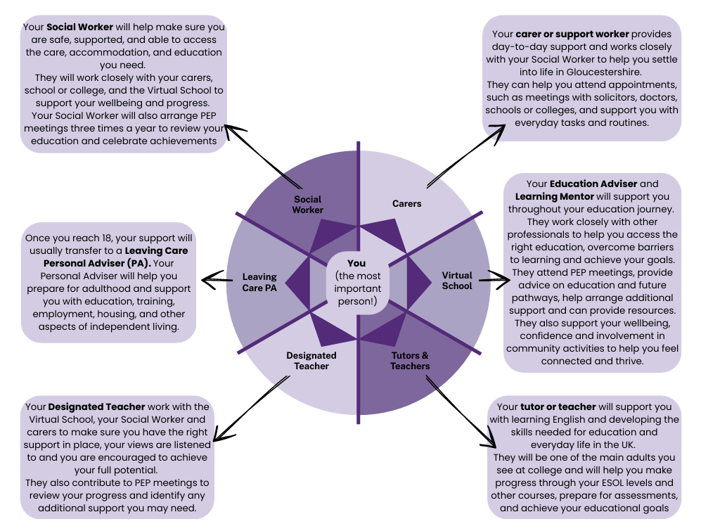
At Gloucestershire Virtual School, we are committed to supporting Unaccompanied Asylum-Seeking Children (UASC) and young people to succeed in education and build positive futures.  

An Unaccompanied Asylum-Seeking Child (UASC) is defined by the Home Office as a child or young person under the age of 18 who has applied for asylum in the UK in their own right and who is not being cared for by a parent or another adult who, by law or custom, has responsibility for them.  

Children and young people who arrive in Gloucestershire as UASC are considered to be in need of support and accommodation under Section 20 of the Children Act 1989, until an assessment determines otherwise. Many young people arrive having experienced significant disruption, uncertainty, and trauma, and our role is to ensure they receive the educational support they need to thrive. 

When a young person arrives in Gloucestershire, the Gloucestershire Virtual School will begin a Personal Education Plan (PEP). Working closely with the young person, their social worker, carer, school or education provider, and the Virtual School team, we will:  

  • Identify and secure appropriate education provision.  

  • Assess educational needs and prior learning experiences.  

  • Set educational goals and aspirations.  

  • Provide tailored support through a multidisciplinary approach.  

  • Offer guidance from a dedicated Virtual School Education Adviser and UASC Learning Mentor.  

Our aim is to help every young person feel welcomed, supported, and able to access opportunities that enable them to reach their full potential.  

When a young person arrives in Gloucestershire, the Gloucestershire Virtual School will begin a Personal Education Plan (PEP). Working closely with the young person, their social worker, carer, school or education provider, and the Virtual School team, we will:  

  • Identify and secure appropriate education provision.  

  • Assess educational needs and prior learning experiences.  

  • Set educational goals and aspirations.  

  • Provide tailored support through a multidisciplinary approach.  

  • Offer guidance from a dedicated Virtual School Education Adviser and UASC Learning Mentor.  

Our aim is to help every young person feel welcomed, supported, and able to access opportunities that enable them to reach their full potential.  

All children and young people of statutory school age are entitled to receive a full-time education appropriate to their Key Stage. This should normally comprise:  

  • 21 hours per week at Key Stage 1  

  • 23.5 hours per week at Key Stage 2  

  • 24 hours per week at Key Stage 3  

  • 24 hours per week at Key Stage 4 (Year 10)  

  • 25 hours per week at Key Stage 4 (Year 11)  

  • For unaccompanied asylum-seeking children (UASC), a time-limited phased integration into school may be appropriate in some circumstances. However, this should not be implemented as a matter of routine. Many UASC will have previously accessed education and may possess strong knowledge and skills across a range of subjects.  

  • Any reduced timetable must be agreed by all relevant parties and should be subject to regular review, with the aim of achieving full-time attendance as soon as possible.  

All children and young people of statutory school age are entitled to receive a full-time education appropriate to their Key Stage. This should normally comprise:  

  • 21 hours per week at Key Stage 1  

  • 23.5 hours per week at Key Stage 2  

  • 24 hours per week at Key Stage 3  

  • 24 hours per week at Key Stage 4 (Year 10)  

  • 25 hours per week at Key Stage 4 (Year 11)  

  • For unaccompanied asylum-seeking children (UASC), a time-limited phased integration into school may be appropriate in some circumstances. However, this should not be implemented as a matter of routine. Many UASC will have previously accessed education and may possess strong knowledge and skills across a range of subjects.  

  • Any reduced timetable must be agreed by all relevant parties and should be subject to regular review, with the aim of achieving full-time attendance as soon as possible.  

  • Turning 18 brings new opportunities and responsibilities, but young people do not have to navigate these changes alone. Although Virtual School’s involvement ends after 18, we will ensure we work alongside partners to help young people plan for the future, including:  

  • Exploring education, training, and employment opportunities.  

  • Developing skills for independent living.  

  • Understanding immigration and asylum processes.  

  • Accessing advice and support to make informed decisions about next steps. At Gloucestershire Virtual School, our goal is to ensure that every unaccompanied young person feels safe, supported, empowered, and ready for the future.  

  • Turning 18 brings new opportunities and responsibilities, but young people do not have to navigate these changes alone. Although Virtual School’s involvement ends after 18, we will ensure we work alongside partners to help young people plan for the future, including:  

  • Exploring education, training, and employment opportunities.  

  • Developing skills for independent living.  

  • Understanding immigration and asylum processes.  

  • Accessing advice and support to make informed decisions about next steps. At Gloucestershire Virtual School, our goal is to ensure that every unaccompanied young person feels safe, supported, empowered, and ready for the future.