
Frequently Asked Questions (FAQs)
1. How long will the bridge be closed and when will it re-open?
We cannot yet confirm the date when the bridge will be re-open.
The start date of the works will be determined by when we have the design, method of working, materials and finish signed off by Historic England and the Secretary of State. Engagement with Historic England is well established on this scheme already. Preparative work ahead of the actual rebuild is well under way, with permits being requested for ecological work and Environment Agency permits for working near the watercourse.
We have specialist salvage divers working for us to reclaim the stone that has fallen in to the Thames. It is a condition of the rebuild to use as much of the original stone as possible. A scaffolding contractor is working with us to design and install the scaffolding on and around the bridge so that the rebuilding work can be carried out safely and efficiently.
We anticipate that the build works will take approximately eight weeks to complete. This programme duration can be affected by inclement weather and unforeseen issues with the bridge structure. We are hopeful that we can start work on site mid-to-late August, which would see us complete the works late October.
2. Can the weight limit be restricted to avoid future damage?
Structural assessment of the bridge has shown that it is capable of taking full highway loading of 40T. It is then appropriate to carry an A-road and the HGV traffic that is permitted to use this route.
From a structural and engineering perspective, there is no requirement to impose a weight restriction on this bridge; we have no plans to introduce a weight limit.
3. Will the River Thames be closed and for how long?
A closure is planned during the installation of the scaffolding around the bridge arch but this is the only planned closure.
If there are any changes to this plan, when the scaffolding contractor has completed their assessment and design, we will let the public know.
4. Who is paying for the repairs and how extensive is the damage?
At present all costs are being met by GCC. We are in contact with the police regarding the driver who caused the damage and establishing a means of claiming all of our costs back. This is an established process and we have a dedicated claims team working on this.
5. Can a temporary free car park be established at the Cotswold Water Park Car Park to the south?
We cannot provide this, as establishing car parks on private land is not within our jurisdiction.
6. Can a one way system be established via Coleshill (south) and Highworth / Buscot Wick (north)?
We cannot sign off a one way system, as it would be extremely long and it is not something we can sign off as Highway Authority.
It is well established that long one way systems create their own road safety issues (and this would be especially true for temporary ones); most notably an increase in traffic speed as drivers are conscious that there will be no opposing traffic and as a result speeds tend to increase.
Secondly long one way systems add to the inconvenience that drivers already have to deal with. This can lead towards them contravening the one way system and endangering other drivers. Temporary restrictions like this are notoriously difficult to sign and enforce, which again compromises their effectiveness. It is for the above reasons that Highway Authorities do not install exceptionally long one way systems.
We have been responding to requests form local communities and businesses to enhance the existing diversion routes, including a road closure and bespoke signing.
7. Who is going to compensate businesses in Lechlade for loss of trade?
We cannot provide compensation to local businesses for any loss of earnings. It is important to remember that this incident and all the resulting disruption is the sole fault of the driver who damaged the bridge. All the measures and restrictions that have been implemented since then we have done as our statutory duties as the Highway Authority.
We have to keep members of the public and the travelling public safe whilst using the highway, where this cannot be done we have to install road closures.
8. Who is going to repair the potholes on Snowswick Lane?
The vast majority of the diversion is not on Gloucestershire’s network and so we cannot carry out maintenance works on networks outside of ours.
We continue to liaise with our neighbouring authorities about this scheme and what the repercussions are. We will continue to review our traffic management and diversion route to see what tweaks can be made to improve things through contact with local communities.
9. Is there a contingency plan if A417 through Buscot floods?
In the event that the A417 is closed at Buscot then we would look to redirect the diversion route along the A4095, via Brampton towards the A40 and then back into Lechlade.
Please note that where an A road is closed, we have to divert traffic onto another A road, we cannot use lower category roads – hence the long diversion routes.
10. How can speeding / dangerous driving be addressed on Snowswick Lane?
Enforcement of the speed limits does sit with the police, so please direct any instances of speeding to Swindon Borough Council and Oxfordshire County Council; they can then have discussions with their police forces.
We will continue to review our traffic management and diversion route to see what tweaks can be made to improve things through contact with local communities.
11. Can you share the traffic management detail?
Project team and specialist advisors have reviewed the current traffic management arrangement on the bridge in line with the traffic signs manual, chapter eight traffic safety measures and signs for roadworks and temporary situations. This confirms the road is not wide enough to accommodate the barriers in the carriageway.
In addition the risk of further damage to the parapet caused by vibration from passing HGV’s/Buses is too great to allow traffic to continue to pass.
Detailed technical analysis completed by specialists and reviewed independently concludes: -
- The existing carriageway width is 3.3m unencumbered
- The absolute minimum carriageway width allowable for normal traffic is 3m which would leave 0.3m to accommodate any traffic management
- There is no standard temporary barrier that could be installed to provide protection for the defective parapet that would fit in the 0.3m space we have available
- The standards for temporary traffic requirements to which GCC must comply are set out in ‘The Traffic Signs Manual, Chapter 8 Traffic Safety Measures and Signs For Roadworks and Temporary Situations’
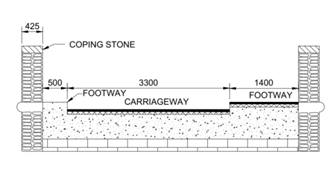
Traffic management arrangements - discussion
Following the response of the county councils out of hours team who attended site after the vehicle incident, the decision was taken to close the bridge to vehicular traffic. This action was taken due to the deficiency of the parapet to provide both vehicular and pedestrian containment.
Due to the weakened state of the parapet, there is also potential for further sections of the parapet to become dislodged in part, or whole due to vehicle vibrations or from driver behaviour relating to distraction and subsequent strikes. Should this occur there is the risk of further material falling from the bridge, which also poses a further serious hazard to waterborne traffic.
In addition, whilst the parapet due to its historic nature is not compliant to current containment standards it does still provide a level of protection to road users. The risk of a subsequent vehicle strike to a damaged parapet has a greater consequence outcome as there is greater potential for a vehicle to leave the carriageway and end up in the river, together with its occupants.
The A361 ordinarily crosses the bridge under traffic control as single running lane due to the narrow nature of the bridge. Consideration was given to the possibility of continuing to run traffic over the bridge under additional traffic management and barriers whilst awaiting commencement of repairs, however due to the road classification it would be necessary to permit all forms of vehicular traffic to continue to use the bridge (for example, buses); with limitations on the installation of barriers due to space on an already narrow route (see above technical detail) together with the risk of causing further damage the road closure had to be maintained. The exception being the provision of a dedicated pedestrian route across the bridge.
1. How long will the bridge be closed and when will it re-open?
We cannot yet confirm the date when the bridge will be re-open.
The start date of the works will be determined by when we have the design, method of working, materials and finish signed off by Historic England and the Secretary of State. Engagement with Historic England is well established on this scheme already. Preparative work ahead of the actual rebuild is well under way, with permits being requested for ecological work and Environment Agency permits for working near the watercourse.
We have specialist salvage divers working for us to reclaim the stone that has fallen in to the Thames. It is a condition of the rebuild to use as much of the original stone as possible. A scaffolding contractor is working with us to design and install the scaffolding on and around the bridge so that the rebuilding work can be carried out safely and efficiently.
We anticipate that the build works will take approximately eight weeks to complete. This programme duration can be affected by inclement weather and unforeseen issues with the bridge structure. We are hopeful that we can start work on site mid-to-late August, which would see us complete the works late October.
2. Can the weight limit be restricted to avoid future damage?
Structural assessment of the bridge has shown that it is capable of taking full highway loading of 40T. It is then appropriate to carry an A-road and the HGV traffic that is permitted to use this route.
From a structural and engineering perspective, there is no requirement to impose a weight restriction on this bridge; we have no plans to introduce a weight limit.
3. Will the River Thames be closed and for how long?
A closure is planned during the installation of the scaffolding around the bridge arch but this is the only planned closure.
If there are any changes to this plan, when the scaffolding contractor has completed their assessment and design, we will let the public know.
4. Who is paying for the repairs and how extensive is the damage?
At present all costs are being met by GCC. We are in contact with the police regarding the driver who caused the damage and establishing a means of claiming all of our costs back. This is an established process and we have a dedicated claims team working on this.
5. Can a temporary free car park be established at the Cotswold Water Park Car Park to the south?
We cannot provide this, as establishing car parks on private land is not within our jurisdiction.
6. Can a one way system be established via Coleshill (south) and Highworth / Buscot Wick (north)?
We cannot sign off a one way system, as it would be extremely long and it is not something we can sign off as Highway Authority.
It is well established that long one way systems create their own road safety issues (and this would be especially true for temporary ones); most notably an increase in traffic speed as drivers are conscious that there will be no opposing traffic and as a result speeds tend to increase.
Secondly long one way systems add to the inconvenience that drivers already have to deal with. This can lead towards them contravening the one way system and endangering other drivers. Temporary restrictions like this are notoriously difficult to sign and enforce, which again compromises their effectiveness. It is for the above reasons that Highway Authorities do not install exceptionally long one way systems.
We have been responding to requests form local communities and businesses to enhance the existing diversion routes, including a road closure and bespoke signing.
7. Who is going to compensate businesses in Lechlade for loss of trade?
We cannot provide compensation to local businesses for any loss of earnings. It is important to remember that this incident and all the resulting disruption is the sole fault of the driver who damaged the bridge. All the measures and restrictions that have been implemented since then we have done as our statutory duties as the Highway Authority.
We have to keep members of the public and the travelling public safe whilst using the highway, where this cannot be done we have to install road closures.
8. Who is going to repair the potholes on Snowswick Lane?
The vast majority of the diversion is not on Gloucestershire’s network and so we cannot carry out maintenance works on networks outside of ours.
We continue to liaise with our neighbouring authorities about this scheme and what the repercussions are. We will continue to review our traffic management and diversion route to see what tweaks can be made to improve things through contact with local communities.
9. Is there a contingency plan if A417 through Buscot floods?
In the event that the A417 is closed at Buscot then we would look to redirect the diversion route along the A4095, via Brampton towards the A40 and then back into Lechlade.
Please note that where an A road is closed, we have to divert traffic onto another A road, we cannot use lower category roads – hence the long diversion routes.
10. How can speeding / dangerous driving be addressed on Snowswick Lane?
Enforcement of the speed limits does sit with the police, so please direct any instances of speeding to Swindon Borough Council and Oxfordshire County Council; they can then have discussions with their police forces.
We will continue to review our traffic management and diversion route to see what tweaks can be made to improve things through contact with local communities.
11. Can you share the traffic management detail?
Project team and specialist advisors have reviewed the current traffic management arrangement on the bridge in line with the traffic signs manual, chapter eight traffic safety measures and signs for roadworks and temporary situations. This confirms the road is not wide enough to accommodate the barriers in the carriageway.
In addition the risk of further damage to the parapet caused by vibration from passing HGV’s/Buses is too great to allow traffic to continue to pass.
Detailed technical analysis completed by specialists and reviewed independently concludes: -
- The existing carriageway width is 3.3m unencumbered
- The absolute minimum carriageway width allowable for normal traffic is 3m which would leave 0.3m to accommodate any traffic management
- There is no standard temporary barrier that could be installed to provide protection for the defective parapet that would fit in the 0.3m space we have available
- The standards for temporary traffic requirements to which GCC must comply are set out in ‘The Traffic Signs Manual, Chapter 8 Traffic Safety Measures and Signs For Roadworks and Temporary Situations’
Traffic management arrangements - discussion
Following the response of the county councils out of hours team who attended site after the vehicle incident, the decision was taken to close the bridge to vehicular traffic. This action was taken due to the deficiency of the parapet to provide both vehicular and pedestrian containment.
Due to the weakened state of the parapet, there is also potential for further sections of the parapet to become dislodged in part, or whole due to vehicle vibrations or from driver behaviour relating to distraction and subsequent strikes. Should this occur there is the risk of further material falling from the bridge, which also poses a further serious hazard to waterborne traffic.
In addition, whilst the parapet due to its historic nature is not compliant to current containment standards it does still provide a level of protection to road users. The risk of a subsequent vehicle strike to a damaged parapet has a greater consequence outcome as there is greater potential for a vehicle to leave the carriageway and end up in the river, together with its occupants.
The A361 ordinarily crosses the bridge under traffic control as single running lane due to the narrow nature of the bridge. Consideration was given to the possibility of continuing to run traffic over the bridge under additional traffic management and barriers whilst awaiting commencement of repairs, however due to the road classification it would be necessary to permit all forms of vehicular traffic to continue to use the bridge (for example, buses); with limitations on the installation of barriers due to space on an already narrow route (see above technical detail) together with the risk of causing further damage the road closure had to be maintained. The exception being the provision of a dedicated pedestrian route across the bridge.
1. Who is undertaking the construction?
We are working with Ringway.
2. Which subcontractors are being used?
- Cotswold Scaffolding
- Commercial and Specialised Diving Ltd
3. How many people will be onsite?
There will be a range in numbers of people on site dependant on the activity being undertaken.
There will be a core structures gang (No. 4) with the addition of more labour when needed (for example, the scaffolders and the divers).
4. What are the working hours of the site crew?
Site operatives working hours are Mon-Fri from 7:45 till 16:30. Some days they will start the day at the depot for briefing/updates and to collect plant/materials.
All site personal are required to have comfort and meal breaks through the working day. The work being undertaken in physical and tiring, breaks are essential to maintain the physical and mental wellbeing of our staff. We have asked site based staff to take breaks in the welfare units provided when they can.
5. Why are the site crew not working longer hours and why are there not more crew members?
The crew would struggle to undertake skilled repair work such as this outside of full daylight hours.
To maintain the heritage asset we are using operatives skilled in masonry repairs, we would like to maintain consistency through the repair and as such will not be rotating gangs.
There is limited space on site and as such we do need to mindful or maintaining space for working.
6. Why do we need a road closure?
The safety of our operatives must be paramount; staff need a safe working space to undertake the repair, as such the road will remain closed for the duration of the works.
The scaffolding will be founded on the road; a road closure will be required for this.
1. Who is undertaking the construction?
We are working with Ringway.
2. Which subcontractors are being used?
- Cotswold Scaffolding
- Commercial and Specialised Diving Ltd
3. How many people will be onsite?
There will be a range in numbers of people on site dependant on the activity being undertaken.
There will be a core structures gang (No. 4) with the addition of more labour when needed (for example, the scaffolders and the divers).
4. What are the working hours of the site crew?
Site operatives working hours are Mon-Fri from 7:45 till 16:30. Some days they will start the day at the depot for briefing/updates and to collect plant/materials.
All site personal are required to have comfort and meal breaks through the working day. The work being undertaken in physical and tiring, breaks are essential to maintain the physical and mental wellbeing of our staff. We have asked site based staff to take breaks in the welfare units provided when they can.
5. Why are the site crew not working longer hours and why are there not more crew members?
The crew would struggle to undertake skilled repair work such as this outside of full daylight hours.
To maintain the heritage asset we are using operatives skilled in masonry repairs, we would like to maintain consistency through the repair and as such will not be rotating gangs.
There is limited space on site and as such we do need to mindful or maintaining space for working.
6. Why do we need a road closure?
The safety of our operatives must be paramount; staff need a safe working space to undertake the repair, as such the road will remain closed for the duration of the works.
The scaffolding will be founded on the road; a road closure will be required for this.
Last reviewed: