
Benefits
The new cycle scheme will be accessible to all by providing high quality access through the city streets, making it shortest and most direct route for both cyclists and pedestrians. It will provide a continuous route for cyclists making cycling and sustainable travel more appealing, encouraging less reliance on car use.
Connecting people and places – the cycleway will create active travel links to Gloucester Docks, Gloucester’s Transport Hub, Railway Station and Gloucestershire Royal Hospital. It will provide link for students to Gloucestershire College (at the docks), and towards the University at Oxstalls and to schools. The proposed route will also connect to the B4063 cycleway currently under construction between Gloucester and Cheltenham and will be a key element or the wider Gloucestershire Cycle Spine between Stroud and Bishop’s Cleeve.
The scheme seeks to address known existing safety concerns for all road users. This includes the accident ‘hot spot’ along Southgate Street which has involved accidents with cyclists and pedestrians.
The scheme will improve facilities for pedestrians, cyclists, and other non-motorised users and will help reduce greenhouse gas emissions and air pollution by replacing short, local car trips, contributing to CO2 reductions, and improving air quality.
The cycleway will improve physical and mental well-being by reducing stress, enhancing mood, promote healthy aging and the prevention of chronic diseases. Cycling is also shown to promote social interaction and community cohesion by creating opportunities for people to meet, talk and participate in local activities.

Source: Cycling and Walking Investment Strategy, Department for Transport (2018)
An improved sense of place and identity. Making the centre of Gloucester a more pleasant and attractive environment for people. Creating enhanced liveable and attractive human-scale urban spaces, reducing noise, stress and improving safety.
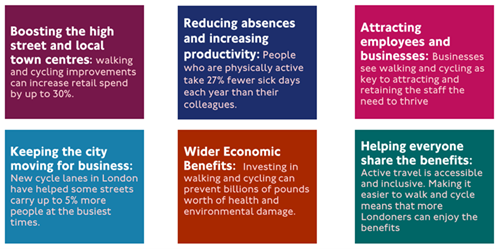
Source: tfl.gov.uk
Reducing the reliance on cars and car ownership. Saving money on maintenance, fuel and parking, as well as avoiding traffic congestion and delays.