
Southgate Street Tall Ships to St Ann Way
Public Information Event: Southgate Street Phase 2
Project Overview
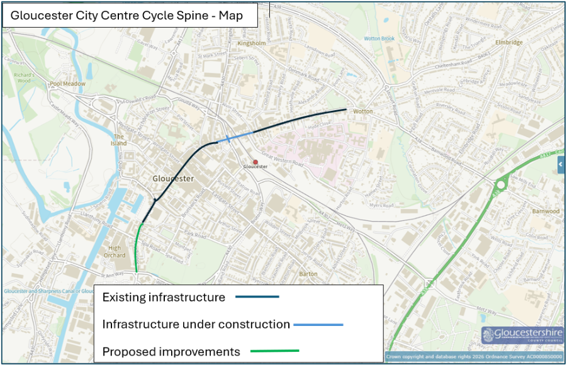
The Southgate Street scheme from the Tall Ship Pub to St Ann Way proposals form a key part of the wider Gloucestershire Cycle Spine, a Gloucestershire County Council project that will create a continuous, high-quality walking, wheeling and cycling route from Stroud in the south to Bishop’s Cleeve in the north.
The scheme also supports the ambitions of the Central Severn Vale Local Cycling and Walking Infrastructure Plan (LCWIP), which serves around 270,000 residents and aims to increase cycling levels across Gloucestershire by 50% between 2015 and 2031.
This section upgrades an important north-south corridor through Gloucester city centre, connecting key destinations including Gloucester Docks, the city centre, employment areas, retail and leisure facilities, public transport hubs and educational destinations. It also links with other major cycling routes, including the future B4063 Gloucester to Cheltenham cycleway, helping to create a safer and more connected active travel network across the county.
Currently, Southgate Street has limited cycling provision, with narrow advisory cycle lanes, often obstructed by parked cars, and no dedicated facilities at the busy St Ann Way junction. The proposals will improve conditions for people walking, wheeling and cycling by providing safer, more accessible infrastructure, making sustainable travel a more attractive choice for everyday journeys.
The project supports Gloucestershire County Council’s ambition for a Greener Gloucestershire and aligns with both the Gloucester City Plan and the Local Transport Plan, helping more people choose active and sustainable travel for trips to work, education, shops and transport connections.
Why Change Is Needed
Southgate Street is a busy route for people travelling into and through Gloucester, but currently:
-
Cycle provision is limited to narrow advisory lanes, offering little protection from the traffic.
-
The junction with St Ann Way has no dedicated cycle facilities, making movements more difficult and less predictable.
-
Footways are uneven, with inconsistent crossfalls and worn surfacing.
-
Footways and cycleway are often obstructed by parked cars
-
Pedestrian crossing opportunities are limited, particularly near side roads.
-
Bus passengers have restricted waiting space and no protection from passing traffic.
The proposed scheme directly addresses these issues through a major upgrade of pedestrian and cyclist infrastructure.
Key Improvements
St Ann Way Junction
The St Ann Way, Southgate Street and Bristol Road junction is being upgraded to improve safety, accessibility and journey reliability for everyone travelling through the area. The scheme will introduce new and upgraded pedestrian crossings, segregated cycling facilities, enhanced accessibility measures and modern traffic signal technology that can respond more effectively to people walking, cycling, using public transport and driving.
The junction layout and signal operation will also be improved to reduce delays and make movements through the crossroads more efficient. Separating key traffic movements will help prevent vehicles from blocking one another, allowing traffic to flow more smoothly and providing greater flexibility to manage congestion. Changes to some low-use turning movements will enable pedestrian crossings to operate more frequently alongside traffic, reducing waiting times and creating more direct, convenient routes. A new crossing on Bristol Road and upgraded crossing facilities throughout the junction will make it easier and safer for people to move around the area, supporting healthier and more sustainable travel choices while helping the junction run at a greater capacity.
Cycling
A new segregated two-way cycle track will be created on the west side of Southgate Street, providing a safer and more attractive route for cyclists. The street layout will be updated to accommodate the new facility and make better use of the available space. Existing on-street parking on Southgate Street will be removed, with a number of parking permit bays relocated to Spa Road. Provision for loading will be maintained through two dedicated loading bays on Church Street.
At the northern end of the route, the cycle track will be raised to footway level. Green surfacing and a raised kerb will help clearly distinguish the cycle track from pedestrian areas. At the St Ann Way, Trier Way and Bristol Road junction, dedicated cycle crossings and improved layouts will provide safer and more direct routes through the junction.
Pedestrians
Pavements along the route will be resurfaced and improved to create a smoother, safer and more accessible environment for people walking. Tactile paving will be installed at crossing points and side-road junctions to help visually impaired users navigate the route safely.
New zebra crossings on Southgate Street will provide additional opportunities to cross the road, while raised crossings at side roads, including St Luke Street and Llanthony Road, will encourage lower vehicle speeds and improve safety for pedestrians.
Traffic Flow
The existing mini-roundabout at the Llanthony Road and Spa Road junction will be replaced with a priority junction, helping to simplify movements, improve safety and reduce vehicle speeds in the area.
Current right-turn restrictions from Southgate Street onto St Ann Way will remain in place, and a new left-turn restriction will be introduced at the St Ann Way junction to support the efficient operation of traffic signals. The right turn from Trier Way into Southgate Street will also be removed to reduce potential conflicts between vehicles, cyclists and pedestrians and help traffic move more smoothly through the junction.
Public Transport
The scheme includes new intelligent traffic signal technology that can detect approaching buses and provide priority through the junction when appropriate. This will help buses travel more smoothly through the area, improving journey reliability and reducing delays. Changes to the junction layout will also allow southbound buses on Southgate Street to move more efficiently by reducing conflicts with opposing traffic, helping to support a faster and more dependable bus network for Gloucester.
A new bus stop bypass on Southgate Street will allow cyclists to pass behind the bus stop while passengers wait on a dedicated island with a shelter and cross the cycle track via a zebra crossing.
Benefits
-
A high-quality cycle route providing a safer and more attractive connection between Gloucester Quays, the city centre and surrounding communities.
-
Improved crossing points upgraded pavements and enhanced accessibility for people walking and wheeling.
-
Safer junctions and road layouts that reduce conflicts between different road users.
-
Improved bus and coach facilities that support reliable public transport and access to Gloucester Quays and the wider city centre.
-
More opportunities for walking, wheeling and cycling, helping to reduce congestion, improve air quality and support healthier lifestyles.
Scheme Illustration
You Said We Did
During the consultation carried out in Summer 2023 (Engagement summary | Highways), residents, businesses and stakeholders raised several questions and queries about the proposals. Common themes included the loss of parking spaces, parking enforcement, access for deliveries, the potential impact on footways, changes to junction layouts and restrictions on certain turning movements.
In response, we carried out parking and traffic surveys, reviewed the design and made sure access for residents, businesses, public transport and emergency services was carefully considered. The scheme includes measures such as additional parking spaces on Spa Road, new loading facilities on Church Street, improved pedestrian routes, dedicated cycling infrastructure and redesigned junctions to improve safety, accessibility and traffic flow.