Application Details - Terms and Guidelines:
Timescales, term and fees, privacy notice
The skip Permit application fees and term may be found on our web site. Additional fees will apply in the event of an extension to operation dates. If the permit is for a part term, the full term fee is payable. Permit renewals must be made within eight calendar days of the current permit expiry and use the same online form as for new applications. A renewal permit can be requested for up to twelve further weeks, anything longer will need a new application form completing. If you need to change the permit dates, an additional fee and on-line form must be completed.
New applications require twelve calendar days to process from receipt of application, payment and supporting documentation. Urgent /Retrospective applications can be requested for an additional fee. You will need to speak to us prior to making an urgent/retrospective application as the name of the person you speak to will be needed for the on-line application. Applications by email or paper are no longer accepted.
Gloucestershire County Council will collect personal information to complete the application process for your permit and will not use the information outside of this. For full information on how we use and store your information please see the Highways Privacy Notice and the section relating to Licences, Permits and Permissions.
General Information
Gloucestershire County Council is the Highway Authority responsible for all publicly maintained roads within Gloucestershire. All trunk roads within Gloucestershire fall under the jurisdiction of the Highways Agency. Under Section 139 of the Highways Act 1980, the County Council has the authority to permit people or companies to place skips on the highway. Anyone placing a skip on the highway without permission from the County Council is committing a criminal offence.
This procedure sets out Gloucestershire County Council’s policy for issuing permits to place skips on the highway and is written in accordance with sections 139/140/140A-C, 171B of the Highways Act 1980, chapter 8 of the Traffic Signs Manual,Section 66 & 67 of the Traffic management Act 2004 and Local Authorities (Transport Charges) Regulations 1998.
On receipt of your application an Area Highways Representative (AHR) from the County Council may visit site to ensure your suggested location is suitable. A site visit may not always be carried out. You will be notified as soon as possible following the site inspection if the AHR declines your application.
It is unusual for applications for extra large or roll on/roll off skips to be accepted. In exceptional circumstances these applications will be considered only after contact has been made with the Area Highways Representative via our contact centre on 08000 514514. This authorisation must be recorded on the application form.
To assist applicants we have produced an on-line form that helps you supply all the information we need to process your application. Failure to supply the required/correct information will result in the application being delayed. Where all therelevant information is not supplied we will contact the applicant and explain what further information is required. The permit will not be processed until all necessary information has been received.
If you require a road closure or temporary traffic signals to facilitate your skip you do need to complete a skip permit application form. You will need to complete an alternative application form to restrict or prohibit traffic (TTR application form), which is available online.
Under Section 140A of the Highways Act 1980 all skips placed on the highway must be registered on the Street works Register as a street work.
How to pay and submit your application
The application will be completed online and before it is submitted you will be directed to our secure payment service to take your payment by card (credit or debit). Applications by email or paper are no longer accepted.
Operational Dates
It is understood that for various reasons works cannot always be carried out between the dates scheduled. For this reason, you need to inform us whether your permit dates are likely to change. You will need to contact us as soon as reasonably possible to seek approval for a date amendment (this must be prior to the commencement of works). The amendment form and fee must be completed and paid.
Please note your operation dates represent the lifespan of your Skip Permit. If your operation is likely to continue beyond your requested end date you will need to apply for an extension/renewal. A renewal permit is issued on consecutive dates.
If you operate outside the lifetime of your licence then remedial action will be taken by Gloucestershire Highways. Under the Highways Act 1980 it is an offence for anyone without lawful authority to obstruct the free passage along the highway.
Your Details
In this section the contact details that will appear on the permit are captured. The contact details given are for emergencies/problems relating to the works. The contact information given will be displayed on the permit and will be in our street works register.
A copy of the permit should be available for inspection at all times for the duration of the licence.
Insurance Details
Supporting documents/references
Valid Public Liability Insurance of a minimum value of £5m per incident, with an unlimited number of incidents must be held for the duration of works.
The County Council will only normally grant permission to a Company that is registered with the Environment Agency as a waste carrier and holds the relevant licence. If someone who is not registered applies for permission to place a skip on the highway the County Council will consider how the applicant intends to dispose of their waste. They must still provide proof of £5m public liability insurance. Both Public Liability Insurance and Waste Licence documentation should cover the lifetime of your skip permit.
It is the Skip Company’s responsibility to ensure whilst undertaking works they hold valid Insurance and Licences. The Council reserves the right to audit the information provided by the skip company at any time.
A site plan must be submitted with the application.
The Application will only be considered when the County Council is satisfied it has received all relevant information and payment.
Operational Details
This section of the form asks the applicant to describe the work being carried out that requires the use of a skip and the address of the premises that this work relates to.
Any skip permit issued will only be for the work and address described in this section of the form.
Skip Positioning
Highways access must comply with the regulations set down in ‘Safety at Street Works and Road Works: A Code of Practice’ which is available online. If access cannot be maintained, a Street Works Licence must be applied for in addition to a Skip Permit. The former may be found on the County’s website under ‘Licences and Permits’.
If it appears to us that a skip could be placed on private property we will question why you wish to place the skip on the highway. You must provide adequate details as to why the skip must be placed on the highway.
Parking Suspensions
You will need to apply and pay separately to suspend parking bays if you wish to occupy a designated parking bay(s).
To purchase a parking waiver call MiPermit: 0333 123 5900 or
Apply online
For more information please refer to the Gloucestershire Parking Terms and Conditions (PDF, 433.4 KB).
Traffic Management
If applicable, you will be responsible for the provision and costs of traffic management and traffic signs on all affected roads. If traffic management is necessary, you will need to submit a traffic management plan with your application. A template can be downloaded from this web site (PDF, 219.5 KB) .
The Licensee shall comply with chapter 8 of the Traffic Signs Manual together with any further conditions the Local Highways Authority require. A requirement when carrying out any work on the highway is that the works are adequately signed,guarded and lit as stipulated in the ‘Safety at Street Works and Roads Works Code of Practice’
Before Skip Placement
Parking suspensions must be in place where necessary and the suspension number provided to the Network Management Team. Traffic management (if necessary) must be in place prior to any works commencing. You will need to inform us whether your operation is likely to take place outside of your scheduled dates. You will need to contact us as soon as possible and before the commencement of work. Additional fees may apply.
During placement
Traffic management (if necessary) must continue to be in place for the duration of your works. If any aspect of the work, e.g. operation dates, parking restrictions etc. need to change at any time you must contact the relevant Council department.Relevant permission must be in place before changes can be implemented. Additional fees may apply. Permits are not transferrable, if the works are going to be taken over by another company they will need to re-apply for a permit. Your permit will be cancelled however no refund will be issued.
Under Section 139 of the Highways Act 1980, the County Council may at any time after issuing the permit inspect the site to check whether the skip company has complied with the conditions in this document.
If any of the conditions in this document are not being complied with the County Council may:
- Instruct the skip company to comply
- Instruct the skip company to remove or alter the position of the skip
- Remove the skip ourselves (the cost will be charged to the skip company)
On Conclusion of Placement
You need to inform us whether your operation took place between the planned dates. You will need to contact us by 10am on the next working day following the operational dates issued to you.
All associated traffic management/equipment must be removed from site in order to return the road to normal use. You will be recharged the costs incurred by the Council if we have to attend site to remove any remaining traffic management/equipment.
When the skip is removed from the highway the site must be left in a safe, clean and tidy condition. The site should be cleaned of any residue, including cleaning of any gullies if needed. All necessary cleaning work will be at owners cost. Youare required to notify the office where the licence was issued when the skip is removed. This could be done via telephone (08000 514514) or e-mail.
Nothing in this procedure affects or limits the County Councils powers under section 140 of the Highways Act 1980 to remove skips from the highway at any time.
Renewal of existing permit
Gloucestershire County Council will issue an extension to the skip permit for an additional fee. A skip renewal will only be accepted if it is applied for within the existing licence period and for the same size skip and location. If a skip renewal is applied for outside this period then it may be classed as a new application. If the renewal is for a different size skip then a new application must be made. The applicant must use the online form, selecting ‘renewal’ and quote the existing skip permit number.
The conditions of the original permit will also apply to the extension.
Conditions of placing a skip within the highway
Each skip will be placed on the carriageway (only in exceptional circumstances, or if instructed by the Highways Authority will skips be permitted to be placed on a footway or verge) and will be positioned:
- So that its longer sides are parallel to the edge of the carriageway and as near to the edge of the carriageway as is reasonably practicable
- On boards when on the highway to prevent any damage caused when dropping and loading the skip. A highways drain must not be obstructed at any point.
- So that it does not impede the surface water drainage of the highway nor obstruct any access to property, fire hydrants, gullies, manholes or any apparatus of any statutory undertaker of the Council.
- Skips will not usually be placed on a highway that has a traffic regulation order restricting the parking of vehicles on that section of highway.
- Where a skip is to be located in an area subject to a residents parking regime, the skip will be positioned outside the property of the resident hiring the skip.
- Not within 10 metres of a road junction.
Wherever possible, skips should be placed on the road. If permission is granted to place skips on the footway or grass verge, then appropriate protection must be used to protect the public highway from damage. If any damage is caused by the skip/vehicle then Gloucestershire County Council may carry out the necessary repair and will charge you for their works. Where a skip, or skips, have been placed on verges or cultivated spaces, it is the responsibility of the skip owner to ensure that the surfaces are restored to their original condition. Only one skip will be allowed on site at any one time.
Where the signing and lighting requirement stipulated for an individual is more onerous than the standard layout (see below sections) the skip company should seek advice on 08000 514514.
No skip will be deposited in, or partly in, the carriageway of the road preventing free passage of vehicles or pedestrians along the carriageway in at least one direction. Nor will it prevent the free passage of pedestrians when deposited in a pedestrianised street. Nor will it prevent free passage of vehicles or pedestrians to any premises unless consent from the occupier of those premises has been obtained.
Each skip should not exceed ten yards in size to be placed on the carriageway. Should you wish to use/position a skip larger than this on the highway, please contact Gloucestershire Highways for advice. Each skip will (whilst on the highway) be marked, guarded and lit in accordance with the following requirements:
The end of each skip (that is to say, the sides of the skip facing traffic in both directions when the skip is positioned as mentioned above, will be painted yellow and must be fitted with vertical markings in accordance with the ‘Builders Skips(Markings) Regulations 1984’, (Statutory Instrument 1984 No. 1933) in having broad red fluorescent and yellow reflecting diagonal stripes (See Section called Signing and Guarding) the painting and stripes will be kept clean at all times. Damaged skips are not acceptable and may result in an instruction for the skip to be removed.
Each skip will be guarded by at least 3 traffic cones complying with BS.873: Part 8 1985, placed on the carriageway at 1.5 metre centres on the approach side of the skip, at 450 to the edge of the carriageway.
At night (that is to say, between half an hour after sunset and half an hour before sunrise) and during periods of bad visibility, a lamp will be attached to each corner of the skip and shall be placed between each cone and the next. Each lamp shall be the nature as prescribed in Paragraph 40 of the Traffic Signs Regulations and General Directions 1981. Each candle must have an illuminative power of not less than 1 candle and must remain lit throughout the night).
It is a condition of the permission that all necessary cones and lamps are provided for the customer by the skip owner and are in good working order. It is suggested that the customer is informed of the signing and lighting requirements in case of any problems while the skip is on hire.
The skip owner must make sure that the necessary cones and lights are placed in position immediately after the skip is deposited on the highway.
Each skip or container must be clearly and legibly marked with the owner’s name, address and telephone number including an out of hours emergency contact name and number.
No skip when standing on the highway will contain any flammable explosive, noxious or dangerous material or any material likely to putrefy or become a nuisance to users of the highway.
No skip will be used in such a way that any of its contents fall on to the highway or there is an escape of dust from the contents of the skip when standing on the highway.
If ownership of the skip cannot be established the skip will be removed under the conditions of Section 140 of the Highways Act.
Signing and Guarding
Department of Transport’s builders Skips (Markings) Regulations 1984 Schedule 1 (Regulation 3) Specifications about design:

- The width of each half of the markings shall be not less than 140 millimetres nor more than 280 millimetres.
- The length of each half of the marking shall be not less than 350 millimetres nor more than 700 millimetres
- The angle of each stripe shall not be less than 40 degrees to the vertical nor more than 50 degrees to the vertical.
- Each half of the markings shall have a minimum area of 980 square centimetres.
- The breadth of each stripe shall be not less than 133 millimetres nor more than 147 millimetres
The markings specified in Schedule 1 shall consist of two plates of equal size and the same shape as one another.
Each such plate shall comply with the requirements specified in the British Standard Specifications for Rear Marking Plates for Vehicles issued by the British Standards institution and published on 1st April 1970 under number BS AU152: 1970 and shall be marked as provided in paragraph 5 of that Standard.
The two plates comprising the marking shall be securely attached to the end of the builder's skip in such a manner that:
(a) each plate is as near to an outer edge of the skip as the construction of the skip allows, so, however, that no part of any plate projects beyond an outer edge of the end of the skip;
(b) the innermost edge of each plate is parallel to and the same distance from the vertical plane passing through the longitudinal axis of the skip:
(c) the upper edge of each plate is parallel to and the same distance from the upper edge of the end of the skip:
(d) no part of either plate is attached to:
(i) any lid, or
(ii) any door except in a case where a door is the only place to which the plate can possibly or conveniently be fixed; and
(e) the upper edge of each plate is:
(i) not more than 1.5 metres from the ground, and
(ii) not lower than the upper edge of the skip.
The stippled areas in the diagram in Schedule 1 shall be of red fluorescent material, and the un-stippled areas in that diagram shall be of yellow reflex reflecting material.
Requirements for Guarding and Lighting Builders Skips
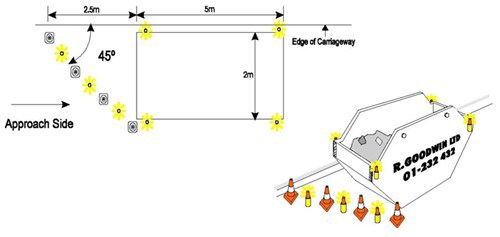
Chapter 8, Section 03.27 of “The Traffic Signs Manual” states that:-
27.1 Roadside containers, also know as ‘builders skips” should comply with the requirements of Appendix 4.1. They may only be deposited on the highway for the temporary storage of builders materials, rubbish etc. with the prior written approvalof the local highway authority (or roads authority in Scotland).
27.2 The Builders’ Skips (Markings) Regulations 1984 require that any builder’s skip which is deposited on the highway (unless it is placed entirely on a footway or verge) must be fitted with vertical red fluorescent and yellow reflectivemarkings on each end. The design and fitting of these markings are prescribed in Schedules 1 and 2 of these regulations.
27.3 Where permission is given for skips to be placed on the footway and verges then provision should be made for pedestrians to pass by.
27.4 During the hours of darkness the skip must be listed by means of road danger lamps at each corner. See Section 04.7 on the use of road danger lamps. The skips may also be guarded by a line of cones at 1.5m centres (Detail B0 on the approachside set at 450 to the edge of the carriageway. During the hours of darkness, a road danger lamp must be placed between each pair of cones in accordance with Section 04.7.
Please note:
(A) Section 139(10) of the Highways Act 1980 provides that nothing in this section shall be taken as authorising the creation of a nuisance or a danger to users of a highway or as imposing on a highway authority by whom a permission has been granted under the section any liability for injury, damage or loss resulting from the presence on the highway of the skip to which the permission relates.
(B) Any expenses incurred by Gloucestershire County Council or the Chief Constable in removing or repositioning the skip may be re-charged from the skip owner. Operators depositing skips on the highway without a permit or leaving skips on the highway after a permit has expired are guilty of an offence and liable to a fine not exceeding level 3 on the standard scale (currently £1000) on conviction. As an alternative to prosecution the Council may, in certain circumstances, accept a retrospective permit application provided the appropriate retrospective fee is paid.
(C) Operators depositing improperly guarded or lit skips – during normal office hours the operator will be informed and given two hours to rectify the matter. Outside normal office times the Council will attempt to contact the operator via the out of hours number provided by the operator and given one hour to rectify the matter. Failure to respond can result in the skip operator being prosecuted. The skip/container may be correctly guarded/lit by the Councils emergency call out contractor and the operator charged with all reasonable costs incurred in doing so.