
Summary

Background
Collating and understanding data are critical public health tools for supporting refugees and asylum seekers in the UK. Data and evidence allow public health teams and others that work with or support refugees and asylum seekers to understand the health needs (LINK to DPH AR Health section) and health inequalities impacting this population, and to understand what works to address these needs. However, there are wide variations in the availability, depth and quality of data for different migrants seeking humanitarian protection between different schemes. Within our Joint Strategic Needs Assessment we present in more depth the available national, regional and local data that we use in Gloucestershire to support our refugee and asylum programmes. A summary of this is below;
Refugee Council estimates that the UK houses approximately 1% of the world’s refugees who have been forcibly displaced. The UNHCR highlight that the majority (as much as 85%) live in low- and middle-income countries, rather than wealthy, developed countries like the UK.
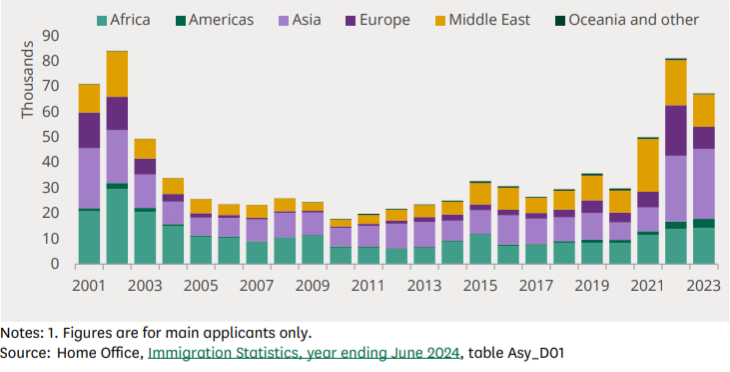
The House of Commons Library use Home Office data to report on the nationalities by regional groupings (see figure 1 below), which shows that for the previous two years, 2022 and 2023, an increased proportion were from Asia and Europe.
Asylum is not the only route for people seeking humanitarian protection to migrate to the UK. The graph below shows the changing nature of international migration over this time, including recent resettlement schemes which are shown on figure 2 as ‘bespoke routes’.
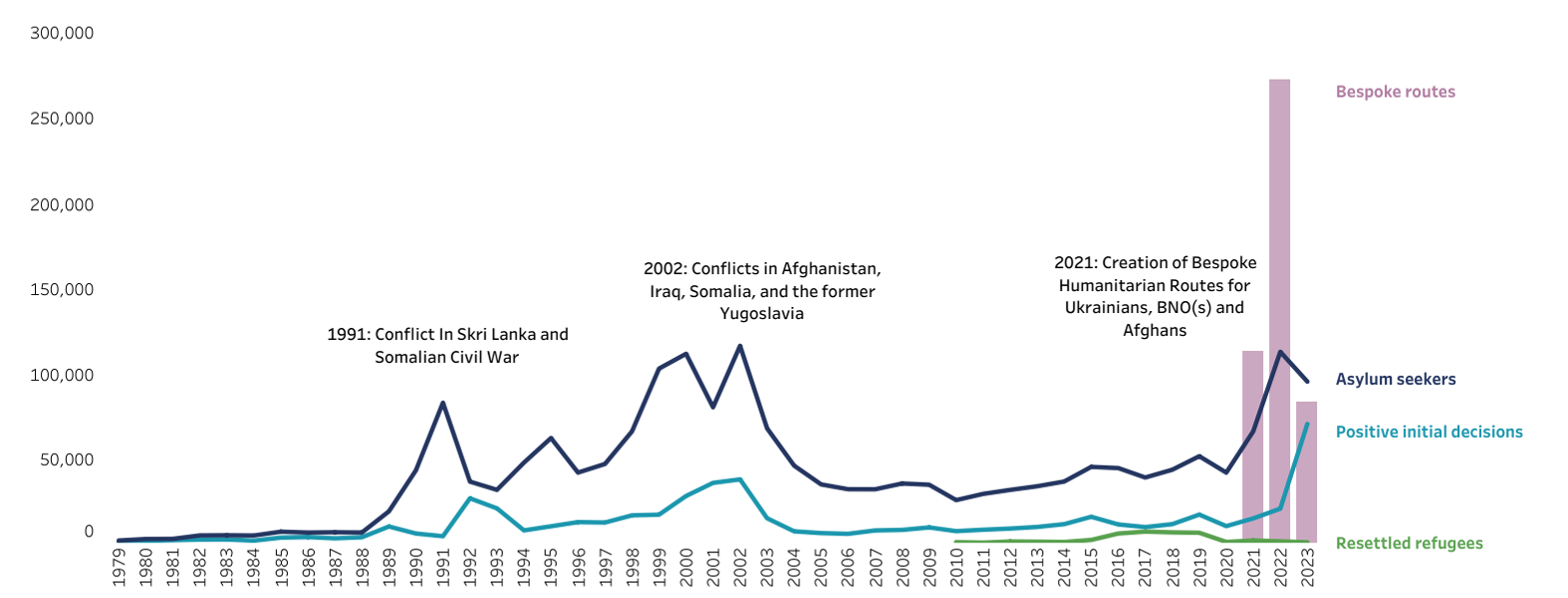
While the right to seek asylum and refugee status are legal rights, the data showing the patterns of those arriving in the UK is only part of the picture. How people feel about migration is very important for helping asylum seekers and refugees fit in and keeping society united. The 2024 British Future report in 2024 found that similar, if not slightly more people in the UK still think immigration (i.e. work, study, family, seeking asylum or humanitarian protection) has a positive impact on Britain (40%) than negative (37%).
The level of public concern around asylum is disproportionate to its share of total immigration numbers. More than five times as many people migrate to the UK each year to study than claim asylum, yet the public estimates that there are twice as many asylum-seekers as international students. On average the public thinks that people seeking asylum make up more than a third of total immigration (37%) while the actual proportion is around 7%. This report also highlights their findings that people often conflate general migration with those seeking humanitarian protection.
Local and regional data
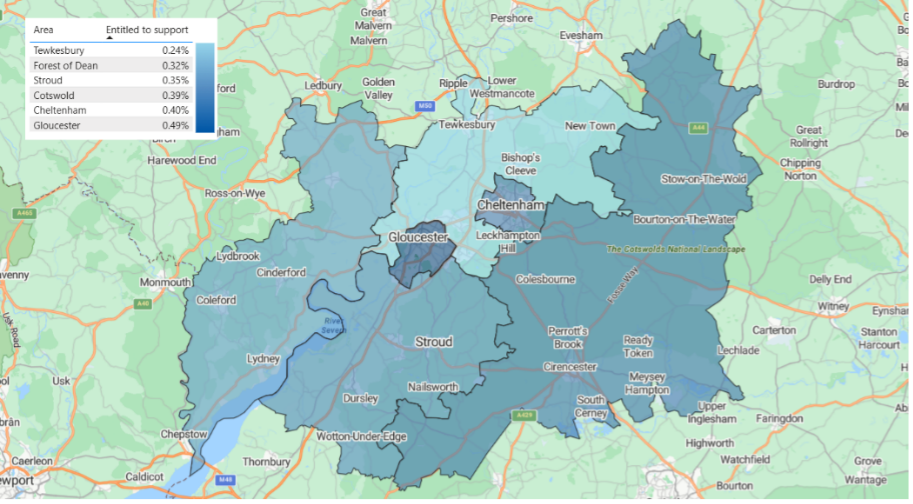
There are 659,276 residents in Gloucestershire. There are 2,395 refugees or asylum seekers entitled to support across the Homes for Ukraine, Afghan Resettlement and Asylum routes. Overall, this equates to less than a half of one percent (0.36%, or 36 people per 10,000 settled Gloucestershire residents). This percentage is broadly in line with rates across the South West at 0.34%, and less than the UK average of 0.43%. These rates vary across the county by district, with the most in urban centers, ranging from 0.24% in Tewkesbury to 0.47% in Gloucester.
There is no consistent breakdown of asylum seekers and refugees by protected characteristics, socio-economic status or other characteristics usually used to understand health inequalities within a subpopulation of the county.
The Home Offices publishes a limited set of information about asylum seekers at the Local Authority level. This data shows that as of the end of September 2024, approximately 445 people and their dependents (excl unaccompanied children seeking asylum) were being supported in Gloucestershire under section 95,98 or 4 regulations. This figure is a snapshot of asylum seekers being supported in-county at the end of September.
Operational data is available on numbers of asylum seekers locally, by broad age and gender, country of origin, and on the status of appeals. This data is used to inform service planning but was not designed to be shared publicly. However, based on 3 months of data from 2024 - the patterns in the data suggest that the demographic representation of asylum seekers in Gloucestershire is similar to national data: the majority are adult males, a significant minority are adult females, and a small minority are children. It also highlights that nationalities of those arriving are diverse with the county supporting people from all continents except Antarctica and Oceania. However, it is important to note that the drivers of migration change and so the proportions coming from different countries also changes over time. Finally, and again similarly to national data above, a large majority of asylum seekers in Gloucestershire had their claim for asylum approved with a small proportion rejected.
Gloucestershire Homes for Ukraine Data
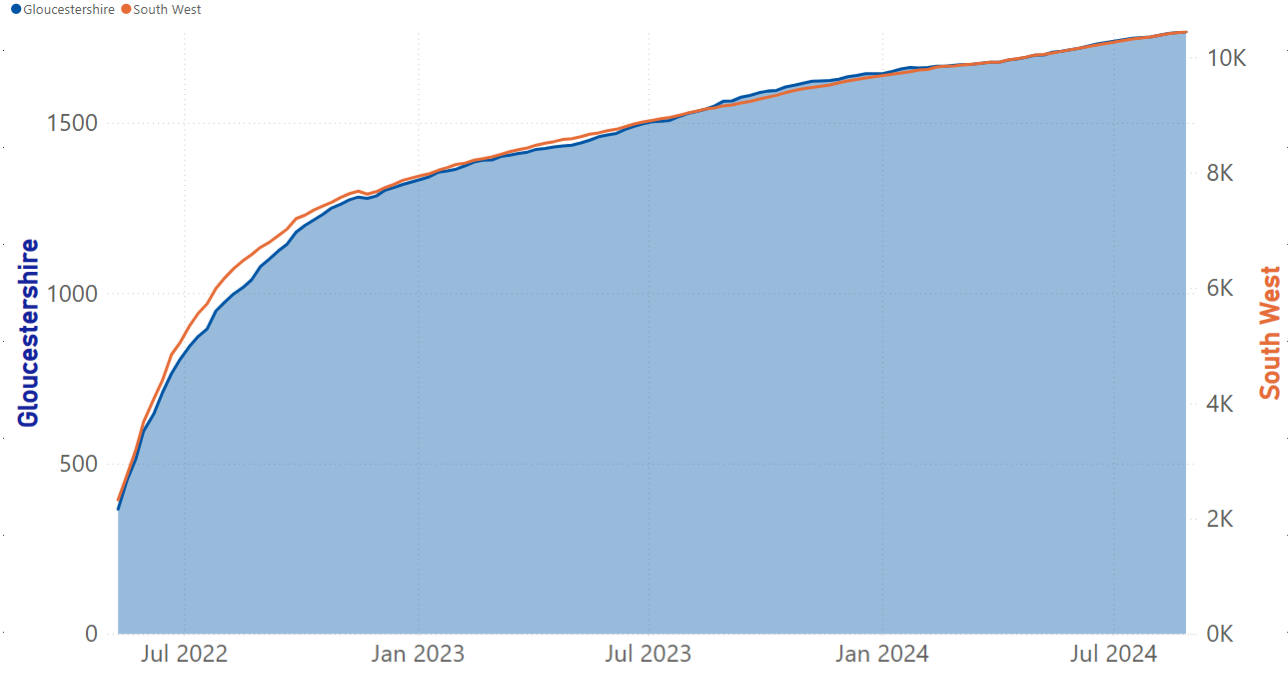
Based on Home Office and Ministry of Housing, Communities, and Local Government data, by September 2024 Gloucestershire had welcomed approximately 1,776 Homes for Ukraine guests (26.9 arrivals per 10,000 usual Gloucestershire residents). This is similar to the comparable rate of 24 arrivals per 10,000 usual residents in the South West region.
Based on operational information, between 1 January and 30 September 2024, Gloucestershire residents welcomed 134 new arrivals on the Homes for Ukraine scheme, and helped 196 move on to secure private accommodation. Arrivals on the Homes for Ukraine scheme are mostly adult females at 52.39%, with 18.63% being adult male, and children making up the remaining 28.98%.
Resettlement through other resettlement schemes
Since 2015, Gloucestershire has welcomed people under the VPRS and UKRS but there have been no new arrivals under these routes since January 2024. As at September 2024, 174 refugees are recorded in as in-county from one of the Afghan resettlement schemes (ACRS and ARAP). This is a snapshot figure published by the Home Office and Ministry of Housing, Communities, and Local Government as in-county at the end of September. As such it is not comparable to the Homes for Ukraine figure above which is the total number welcomed in the course of the scheme.
What information is not available
As shown above, there is data on the numbers entering Gloucestershire through asylum and resettlement schemes in the period from January to September 2024 and some breakdowns by gender. Importantly, for many people arriving through asylum routes there are challenges to collate accurate information that we would consider as standard for the settled population, and which are routinely used to understand and respond to need and plan services. This information might include their needs for medical and social care (like records around medical history and disability), education, skills and qualifications, previous employment histories, and other wider personal assets and needs (for example, their level of fluency in English).
Importantly, in the UK we routinely collect information on what are called ‘protected characteristics’ such as age, gender, disability status, ethnicity. This is to analyse our service delivery and need to ensure that we understand and address inequalities in provision. However, as there is no systematic, accurate and routinely available data on these characteristics for many refugees and asylum seekers when they first arrive it is challenging to assess health and other social inequalities which might vary by these characteristics or other important factors like occupational or educational socio-economic status, religion, or country of origin.
Recommendation: Improve the amount and quality of data currently collected
Summary
This section highlights some of the national and local data about people seeking humanitarian support in Gloucestershire and the UK more widely. These data are critical for those working and providing support for refugees and asylum seekers in Gloucestershire to understand the needs and respond to them. This section also shows that data are also powerful for understanding societal attitudes to refugees.
What is counted, counts. There are significant gaps in the data for refugees and asylum seekers. As a result, unlike the settled population of Gloucestershire, we often do not understand the wider demographics of refugees and asylum seekers. These might be characteristics that we take for granted when we are planning care for the settled population, like whether they have any disabilities, special educational needs, or their medical histories. Similarly, as reflected in the 2024 Director of Public Health Annual Report, we would be able to support people better to settle them into life in Gloucestershire if we consistently knew levels of English language and other skills amongst migrants. Therefore, we should continue to improve the data that we collect about refugees and asylum seekers, so that we can support them better to most easily settle into life in the UK.