
Homes for Refugees

In response to the concerning situation unfolding, Gloucestershire County Council introduced the local Homes for Refugees Scheme at the beginning of 2024, to help address the issue and reduce the risk of rough sleeping.
What?
In Gloucestershire, to give people a bit more time to secure employment and accommodation, the county council established a programme based on the national Homes for Ukraine scheme. The Homes for Refugees (HFR) scheme has been created to offer short-term supported accommodation to refugees who have received a positive decision on their asylum claim and have been granted leave to remain in the UK.
How?
- When the asylum seeker receives confirmation that they have the right to remain in the UK, they are granted refugee status and their Home Office accommodation and support will usually end a few weeks after this.
- If the local housing team assesses the individual as non-priority, emergency accommodation would not normally be offered by the district council.
- The individual is then referred onto the Homes for Refugees scheme where a decision is made about their suitability for the scheme. If offered a place on the scheme, they will be given an initial placement offer of up to three months. In their placement they will be provided with accommodation and support whilst they work towards a longer-term settled arrangement.
The refugee will be placed in one of the following accommodation options:
Community-led Hosted Placement
Similar to the Homes for Ukraine scheme, individuals are placed with host families in private accommodation and hosts receive a £600 monthly ‘thank you’ payment. A spare room and facility to cook meals is provided.
We heard from a Gloucestershire resident who hosted on the scheme…
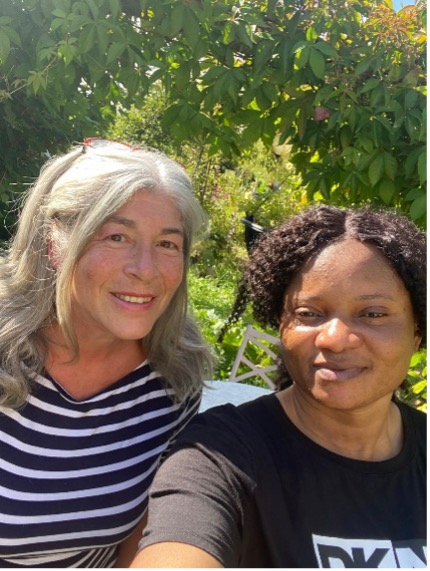 Oritha came from Sierra Leone and, after being accommodated in a Gloucester hotel she was referred to the Homes for Refugees scheme by GARAS in spring 2024. A host was found in Stroud and Oritha moved there soon afterwards.
Oritha’s host says: “I’d been considering renting my spare room out through Air BnB but then saw the information on Facebook about hosting a refugee and thought that would be interesting. The process was very smooth: the DBS check and home check were done within a few days and then Oritha moved in a couple of weeks later.
Staff from HFR came to visit after Oritha had moved in, so we could both meet them and ask any questions, and both HFR and GARAS have kept in touch with me.
I wasn’t sure how I’d get on with having a lodger here full-time but Oritha has been no trouble at all. She works very long hours in a care home but never complains about doing such a challenging job and is quiet, polite and respectful of the shared space.
I’ve enjoyed partaking of the African fish stew she likes to make, which is very tasty and super-spicy!
I think the experience has given me an idea of the challenges that refugees face with things that are everyday to us. Oritha seems to have had a lot of paperwork and bureaucracy to navigate, for example in applying for a provisional driving licence and not having anyone to act as a guarantor for rented accommodation.
She is clearly determined to make the best of her new life in the UK so I wish her well with her move away to study for a Masters degree at university. I would certainly consider hosting another refugee.”
Council-led Supported Placement
Up to 34 beds are available in council owned accommodation, managed by Caring for Communities and People (CCP).
Gloucestershire local authorities have also assigned a housing officer to support the residents in the council-led placements. He said the following…
“Without this programme, asylum seekers would have only four weeks to prepare themselves for independent living, following the granting of their refugee status and the ending of their asylum accommodation. This is in many cases without having language skills or cultural knowledge to navigate UK society and institutions. Most of us would struggle to find somewhere to live and a job with four weeks unexpected notice. Without these placements, Gloucester would undoubtedly being experiencing many more homeless refugees.
Having stable accommodation for three months, while not very long, allows some time for a person to adjust to a new life and to learn about the environment that they find themselves in. It is a very necessary stepping stone between being an asylum seeker and a settled member of society.”
All refugees, whether in council-led or community-led placements, are supported by GARAS, the county and district councils, and CCP in their search for a home and employment, increasing their chances of a successful start to life in the UK.
Support is also commonly provided to help residents access English language lessons, and develop other skills that will enable them to successfully settle and adapt to life in the UK and the local community.