
Supporting Refugee Children : Guidance for Schools
 Gloucestershire Educational Psychology Service
This leaflet is for schools who have children that may have been involved in traumatic and distressing events caused by War and displacement. It includes psychological concepts relating to trauma, ways your student might be helped and a list of useful contacts.
Normal reactions to war and traumatic events
During war, children, like adults, may be repeatedly exposed to many different sorts of horrific, traumatic events. They may witness shelling and shooting, or see their homes or villages being destroyed. They may see injured people or dead bodies; or witness people being tortured or killed, and sometimes see many people being killed at once. Children may experience bereavements, and sometimes see family members or friends being injured or killed. Children themselves may be injured, shot at, or wounded by shrapnel and these experiences can lead to various sorts of psychological problems for children (Smith, Dyregrov and Yule, 2014).
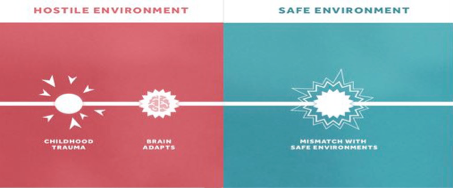
When living in a hostile environment an individual can be exposed to prolonged periods of threat. This can result in altered neural pathways whereby the brain adapts and alters. This can result in hypervigilance and an individual demonstrating a fight, flight or freeze response to ensure their safety. When the individual is in a ‘safe environment’ the brain can react as if it is in a hostile one, as represented in McCrory and Viding’s (2015) Theory of Latent Vulnerability
If a traumatic memory is to be processed sufficiently to alleviate symptoms, it may have to be brought to mind and thought through or “processed” in one way or another. But because this is likely to be accompanied by a great deal of fear, horror, helplessness or other psychological distress, the child may understandably be trying hard not to think about the event. Explaining how thinking through the event might help to reduce symptoms can enable them to make well-informed decisions about whether to consent to, and engage with, the intervention. Active engagement is necessary for processing to take place (Trickey, 2012).
Thinking about how to support your student
For refugee children, it is not as simple as thinking of them having experienced ‘trauma’, and a refugee child’s levels of resilience will depend on an interplay of influences from the micro system, meso system, eco system and the macro system (Bronfenbrenner, 1979).
In addition, Hart (2009) highlights that the three time phases of pre-migration, trans-migration and post-migration are also a factor. According to Rutter (2006) and Hodes (2000) the causes of trauma are varied and individual, however some differences have been identified. One difference identified is whether the trauma was experienced in the home country, en-route or on arrival to the country of destination. What is important is that often traumatic events do not stop when a family or child arrives in the UK.
The challenge for children, who are refugees, is to manage these transitions and establish adaptive ecosystems.
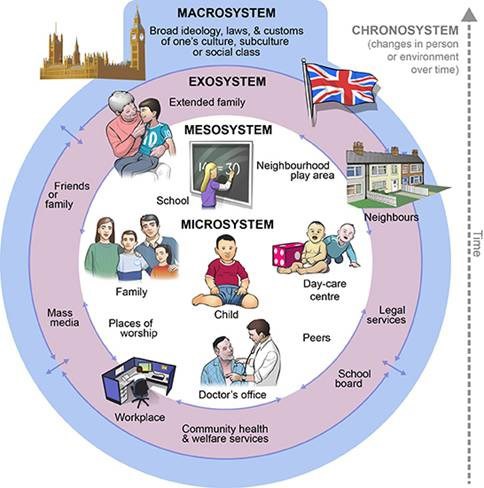
Bronfenbrenner’s Ecological Systems Theory (1979)
Five essential elements of trauma response
(Hobfoll et al., 2007)
- Promote a Sense of Safety – the principle of promotion of safety comes from the understanding that in times of war and mass disruption young children, parents and carers are particularly challenged by a sense of disruption of a ‘protective shield’. Negative post-trauma reactions tend to persist under conditions of ongoing threat or danger. However, when safety is introduced, these reactions show a gradual reduction over time. The extent to which the perception of safety is created will aid people’s coping.
- Promotion of Calming – exposure to mass trauma often results in marked increase in emotionality at the initial stages. A level of anxiety is normal and a healthy response required for vigilance. However, most individuals return to more manageable levels of emotions within days or weeks. Those who do not, experience prolonged periods of hyper arousal. This can have a major effect on risk perception, in that the external environment is perceived as potentially harmful beyond any proportion to the available, objective information. Ultimately, once a situation has been perceived as threatening, neutral or ambiguous stimuli are more likely to be interpreted as dangerous. Effective calming approaches include; therapeutic grounding (to remind individuals they are no longer in the threat-trauma condition), yoga and breathing retraining. Other approaches include guiding individuals to break down the problem into small, manageable units, which increases a sense of self-control and is associated with a positive self-concept.
- Promotion of Sense of Self-efficacy – this is the sense that the individuals believe that their actions are likely to lead to generally positive outcomes. Following trauma exposure, people are at risk of losing their sense of competency to handle events they must face. This starts with events related to the original trauma but quickly generalises to a more fundamental sense of ‘can’t do’. Approaches that promote the individual as an expert and focus on imparting coping skills to the individual, have been found to be effective.
- Promotion of Connectedness – connecting with others is of fundamental importance to children and adolescents, such as facilitating their connection with parents and parental figures. However, negative social support (such as the minimising of problems or needs, unrealistic expectations regarding recovery and invalidating messages) is strongly correlated to long term post-trauma distress. When considering interventions, is it important to identify those who may lack strong social support, who are likely to be socially isolated and keep them connected.
- Promote Hope – instilling hope is critical because mass trauma is often accompanied by catastrophizing, which undermines hope and leads to reaction of a sense that ‘all is lost’. As mass trauma is usually an experience people are not trained for or experienced with, it outstrips their learned coping mechanisms. This means it is important to provide services to individuals that help them get their lives back in place, such as housing, relocation, replacement of household goods and employment. Research suggests that hope can be facilitated by a broad range of interventions, and that whilst catastrophizing is natural it should be identified and countered by more fact-based thinking, which is where the use of Cognitive Behaviour Approaches, such as de-catastrophising, can be effective.
Interventions and practical things to consider for pupils
Reaffirm safety
- Establish a familiar routine for the students and explain to them what is happening using a combination of visual and verbal aids.
- Emphasise that schools are among the safest places they can be.
- Assist students in making connections with trusted adults in school.
- Encourage and find ways to support students in keeping a regular routine that includes healthy nutrition, regular sleep patterns, and exercise to prompt physical and emotional wellbeing.
Make time to talk
- Provide students with opportunity to discuss concerns and help them to separate real from imagined fears because of the abnormal situation they have experienced.
- Encourage social connectedness and a sense of belonging with supportive others.
- Allow opportunities for children to share their knowledge about their culture and customs.
Normalise feelings
- Allow, but do not force, a young person to speak about their feelings and validate their reactions.
- Support and model the appropriate expressions of feelings (i.e. naming feelings in self and others, listening to how others are feeling without judgement, sharing feelings using ‘I’ messages when talking).
- Listen, empathise and affirm that most initial reactions are common and expected (eg. sadness, changes in concentration, distractibility, changes in sleep/appetite).
- Normalise their emotions and explain that they are experiencing normal emotions.
- Understand that knowing what to say is difficult and that simply listening to the student is important. You do not need to provide solutions or try and fix the situation.
Monitor emotional states
- Some children will not express their emotions using language, but through their behaviour. This can include changes in their behaviour, appetite or sleep patterns and can indicate anxiety or stress.
- Children may use play or art to communicate their emotions, which may include play or drawings whereby they re-enact or convey aspects of what they have experienced or seen.
Induction procedures and systems within your setting
- Create a welcome pack for new pupils and their families in their primary language.
- Have a planned induction programme.
- Consider whether a translator would be beneficial when any meetings are held.
- Loan/give a PE kit and uniform or look at options for buying these cheaper second-hand.
- Check how they are getting to school, i.e. is a bus pass needed.
- Check if they have any medical or dietary needs.
- Establish a ‘buddy’ system, have a number of buddies in the school who can help them with practical ‘day-to-day things.
- Have access to a bilingual dictionary in class.
- Have an allocated member of staff, who can be a ‘point of contact’ that the parent/care giver can easily liaise with.
- Make sure you have a system in place to support children who are suffering from trauma or who are struggling to cope.
Potential people to contact for further support
- Your local religious community
- Neighbouring schools
- The school nurse
- Voluntary counselling agencies
- Your school Psychologist or Advisory Teacher
- A member of the Gloucestershire Healthy Living and Learning Team
- For advice and guidance from CAMHS please call the CAMHS Practitioner
Advice Line on 01452 894272, 9am-5pm, Monday to Friday excluding Bank Holidays
The following may also be helpful:
To find the right mental health support for the children and young people you are supporting, please visit https://www.onyourmindglos.nhs.uk/