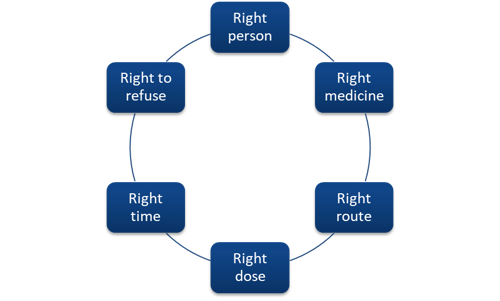
Before administering medication, GSL carers will ensure the 6 R’s of medicine administration have been considered:
11.2
Carers should not provide support with medication unless a medication profile and risk assessment has been completed and determined that support is necessary.
Capacity, consent and refusal
11.3
A person’s My Shared Lives Plan will provide information on someone’s overarching consent to medication administration, and requisite mental capacity assessment when required. Consent is still required before each medication administration (see 11.7).
11.4
Carers will follow the person’s wishes when assisting someone with capacity unless the carer is concerned that the person is no longer able to manage their own medications. Where this is the case, carers will seek advice from the person’s GP before providing assistance then follow GSL incident reporting procedures.
11.5
People have the right to refuse their medication.
11.6
GSL carers will encourage people to maintain prescribed health treatments and to make informed decisions about their health and medication. They will provide information in an accessible format.
11.7
Each time a medication needs to be administered, carers:
will explain to the person what they are about to do in the person’s most confident communication style
will not proceed unless the person gives their verbal or non verbal consent
will re-offer the medication after a short while if the person does not give their consent
will not administer the medication if the person still does not wish to take it and will record on the MAR sheet that the dose was refused
11.8
Carers will encourage people with capacity to consult their GP or pharmacist before they stop taking a prescribed medication.
11.9
If the carer remains concerned that the person is not taking their prescribed medication after discussing it with them, or if the person lacks capacity, the carer will raise their concerns with the person’s GP / pharmacist and GSL.
11.10
Medication must never be used as a form of punishment or control and may only be used as a form of restraint where a best interests decision has been made in accordance with the provisions of the Mental Capacity Act 2005 regarding restraint.
Hygiene and safety
11.11
Before dispensing medications, carers will wash their hands with soap and water, dry them and put on any PPE that is deemed necessary. After this, the carer will then check that:
the medication has not already been given by someone else
they have the right medication for the right person
the medication is as expected, does not appear to have been tampered with, is within its expiry date and has been stored properly. Carers who have concerns about a medication will seek advice from the person’s GP, pharmacist or the NHS 111 helpline before administering it
11.12
Carers will then:
prepare the dose as indicated on the label and the MAR sheet and administer it to the person. Carers will follow any special instructions (like taking it with food) and will offer a drink of water for oral medications.
Immediately record on the MAR sheet:
what medication has been taken
the dosage of medication
the time the medication was taken
if the medication was, refused, missed or spoiled as appropriate
Covert administration
11.13
Covert administration means that a medication is disguised and administered to someone without their knowledge and consent, for example in food or drink.
11.14
If a person has the mental capacity to make decisions about medication, it is unlawful to give them medicines covertly. They have the right to refuse to take their medication, even if this is detrimental to their health and wellbeing.
11.15
GSL will not covertly administer medication except when expressly:
directed in writing by the person’s GP or other relevant health professional to do so because covert administration is in the best interests of a person who lacks capacity, and
agreed by all relevant parties and as recorded in the medication protocol and risk assessment