
What will the workforce requirements be over the coming years?
Nationally the percentage of people working in care roles has been increasing over the last 10 years. We have projected forward Gloucestershire’s care workforce percentage in line with national trends between 2012 and 2023. If the trend continues, over the next 20 years, 5.5% of Gloucestershire’s total workforce will be working in ASC. There is a caveat: this trend cannot continue indefinitely, and we are not able to predict what the upper ceiling would be.
To meet the forecast demand in the way we are currently would require 29.2k people working in care (7.4% of the workforce).
Figure 14: Figure showing the predicted deficit in care home provision based on previous trends and predicted demographic growth

ContrOCC Commitments Report 2019-2023
Capacity Tracker – Estate Report
Nursing staff
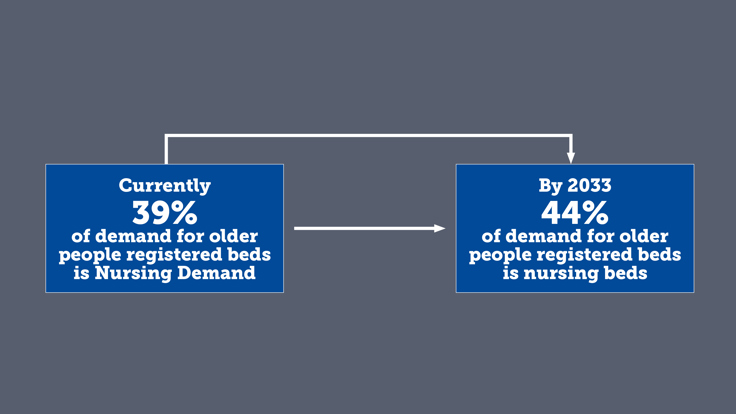
The demand for nursing care is rising quicker than standard residential care. This increase is driven by the higher use of nursing by those aged over 85 – the cohort who are expected to see the greatest population growth in this time.
This means that as well as creating more beds for older people generally, we are going to need to create a disproportionately larger number of nursing beds.
How beds are staffed will determine whether they can support service users who require nursing care. With the demand for nursing care increasing faster than anything else and becoming a larger and larger part of our bedded market, the demand for nurses is also going to be increasing.
Figure 15: Graphic showing how demand will surpass current supply by district
ContrOCC Commitments Report 2019-2023
Capacity Tracker – Estate Report (01 Jul, 01 Aug, 01 Sept 2023)
ONS Sub-national population projections 2018-based principal projection
By extrapolating the national trends across the different roles that make up the care workforce we can see significant deficits are expected in all roles. The most pronounced deficit will be in registered nurses, where 47% of the projected nursing roles required in 2043 are expected to be vacant in Gloucestershire.
Figure 16: Figure showing workforce projections locally and nationally

ONS Sub-national population projections 2018-based principal projection
Skills for care report 2022-23
In general, nursing homes with a capacity of greater than 35 beds require fewer nurses per bed, suggesting that staff in these homes are more efficiently utilised.
Figure 17: Figure showing nursing resource allocation in care homes of differing sizes

ContrOCC Commitments Report 2019-2023
Capacity Tracker – Estate Report (01 Jul, 01 Aug, 01 Sept 2023)
ONS Sub-national population projections 2018-based principal projection
In future, to ensure the most efficient use of the workforce we expect to be available, we should look for ways to utilise all our nurses as best we can. This could be achieved in several ways, such as:
- Pooling nursing resource between homes
- Sharing demand
- Incentivising new homes opening, to open with >35 nursing beds
Any new care home developer will need to be confident that the location chosen will allow for and enable sufficient workforce to staff it.
Last reviewed: