
What influences our health and health inequalities?
 Our health is shaped by a variety of influences.
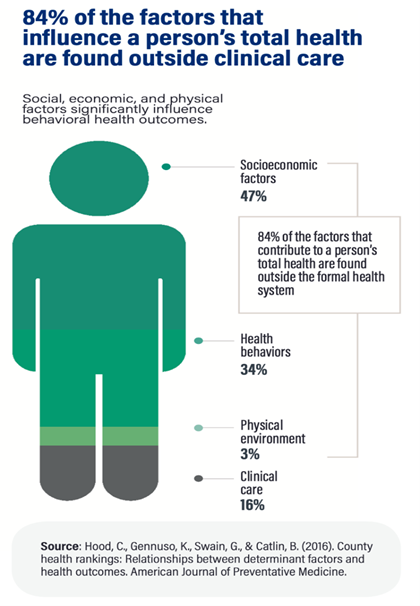
The main drivers of health and health inequalities are the wider social, economic, and environmental circumstances in which people live (for example, where we live, our education, employment status, housing, and income).
These factors influence our individual lifestyles (for example, the availability of affordable food and access to green space can influence what we eat, our physical activity levels and mental wellbeing). Our lifestyles, including our diets, levels of physical activity, consumption of alcohol and smoking can in turn have a significant impact on our health and wellbeing.
Our health is also shaped by our social and community networks (for example, whether we feel isolated or socially connected, the lifestyle behaviours of our immediate peers) and psychological factors such as whether we have a sense of control over our lives, and our overall emotional wellbeing.
We have a choice over some of these influences, but some are beyond our control.
The ‘rainbow model’ developed by Dahlgren and Whitehead in 1991, illustrates the relationship between the individual, their environment and health.
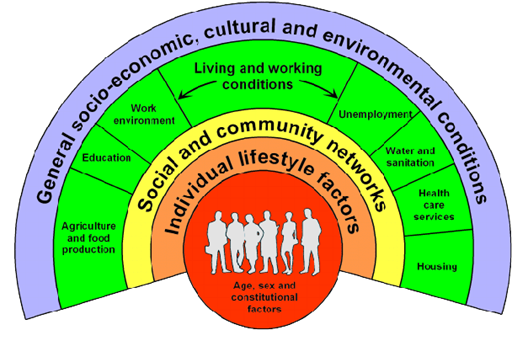
Individuals are placed at the centre and surrounding them are the various layers of influences on health – such as individual lifestyle factors, community influences, living and working conditions, and more general social conditions.
These factors that together influence health throughout the life course are known as the ‘wider determinants of health’. There is a social gradient across many of these determinants with those who are poorer and/or living in more deprived areas experiencing worse health outcomes than people who are better off/living in less deprived areas.
The 2010 Marmot Review ‘Fair Society, Healthy Lives’ states that action on health inequalities requires action across all the wider determinants of health, because inequity in these factors (such as housing, education, employment etc.) are often the cause of behaviours in later life that can lead to ill health. Find out more about wider determinants in this video:
However, recognising that lifestyle factors also play a role, we also need to continue to take action that prevents illness and disease too, such as providing opportunities for people to quit smoking. In designing and delivering services, we also need to bear in mind that the people most likely to experience health inequalities will do so not only in their health outcomes, but also in access, experience, and quality of care.
Last reviewed: