
What is IDM?
Intervention decay’ occurs where at each ‘stage’ of an intervention or pathway cases are either ‘lost’ or do not receive optimal care. This means that there is a reduction in overall population level benefit from the intervention. The IDM tool categorises the stages in the patient pathway in order to identify where these losses are happening. It also helps to highlight where inequalities exist along a pathway i.e. the points where different population groups are more likely to be lost or receive sub-optimal care.

The tool does not help to explain why these losses or disparities occur but highlights practical intervention points where NHS services and wider partners can take action to improve overall outcomes and reduce disparities.
The IDM is designed for use by local programme managers, commissioners, service leads in conjunction with their local community or ‘place-based’ partners. It can be used to inform service improvement activity by any commissioner or provider. However, the tool works best if service leads and place-based partners collaborate to gain a fuller understanding of wider system factors affecting intervention decay and to develop joint action plans.
The ultimate aims of this tool are for partners to work together to take action to enable as many people as possible to gain as much benefit as possible from the pathway or intervention understand any inequalities in the benefits derived by different population groups and then take steps to mitigate. The tool can subsequently be used to help monitor the impact of actions taken.
The IDM tool provides a systematic approach to understanding where ‘losses’ occur along a pathway and therefore provides evidence of the overall effectiveness of a pathway in meeting a predefined need.
By comparing data at each ‘stage’ for different population groups (for example, least vs most deprived quintile; male vs female; BAME vs white British) it highlights where inequalities in uptake and outcomes exist (often described as the ‘inverse care law’, whereby groups with the highest needs have the worst provision) thus helps identify priorities for tackling those inequalities.
There are four key points in a pathway where ‘cases’ and / or impact are lost:
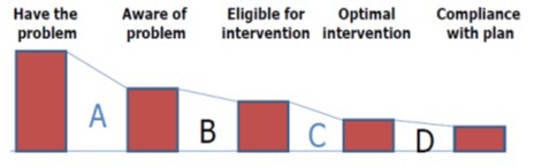
- A = awareness - under recognition of risks / illness and sources of help by individuals.
- B = navigation - the risk or the illness is identified but there are barriers and / or access issues to sources of help or intervention
- C = quality - unwarranted variation in the quality of support or intervention provided
- D = self-management - insufficient assets for ‘recovery’ or support for self-management
Gloucestershire County Council has developed a local IDM template for colleagues across the system to download, save and work on. The template provides a simplified version of the tool and some guidance to get you started.
We have amended the tools locally so that they are easier to use, and whilst we have tested these (as demonstrated in the case studies tab), we need to continue to test these and learn from these experiences to find out how they are working and how they can be improved.
Download the Gloucestershire IDM tool template (DOCX, 75.5 KB)
Last reviewed: