
Enforcement policies
Enforcement policy
This page is about the enforcement policy of Gloucestershire County Council Trading Standards Service. It provides information on:
- the purpose of our enforcement policy
- our principles of inspection and enforcement
- our compliance with the ‘home authority’ and ‘Primary Authority’ principle
- our enforcement actions
- our accessibility and advice details
- what you can expect of us
- our commitment to you
- complaints, compliments and comments about our Service
The service is committed to the principles of good enforcement, as set out in the Legislative and Regulatory Reform Act 2006, the Enforcement Concordat and the Regulators’ Compliance Code.
Within the context of this policy, ‘enforcement' includes any action taken by officers aimed at ensuring that businesses or individuals comply with the law – these actions may range from offering advice, information and issuing public warnings, to cautioning, issuing fixed penalty notices and instituting legal proceedings/prosecutions.
Compliance with this policy will ensure that the Service will strive to be fair, impartial, independent and objective and will not be influenced by issues such as ethnicity or national origin, gender, religious beliefs, political views or the sexual orientation of the suspect, victim, witness or offender. Decisions will not be influenced by improper or undue pressure from any source.
The purpose of this enforcement policy is to provide a framework to make sure that the Service works in an equitable, practical and consistent manner.
The role of Trading Standards is to promote and maintain a fair and safe trading environment and thereby protect the interests of consumers and businesses. The Service enforces a wide range of business and consumer protection legislation relating to quality, quantity, safety, description and price of goods and services.
Officers from the Service carry out duties in various ways including: inspection, sampling, test purchasing, testing, issuing fixed penalty notices, investigation and prosecution, and also by informing, advising and educating businesses and consumers.
The Service recognises that prevention is better than cure and that most businesses want to comply with the law. The Service will endeavour to help these businesses and others to meet their legal obligations without unnecessary expense. When a business does break the law, the Service will consider all the surrounding circumstances before deciding whether formal action is appropriate. A prosecution will only be brought if it is in the public interest to do so.
The purpose of this enforcement policy is to provide a framework to make sure that the Service works in an equitable, practical and consistent manner.
The role of Trading Standards is to promote and maintain a fair and safe trading environment and thereby protect the interests of consumers and businesses. The Service enforces a wide range of business and consumer protection legislation relating to quality, quantity, safety, description and price of goods and services.
Officers from the Service carry out duties in various ways including: inspection, sampling, test purchasing, testing, issuing fixed penalty notices, investigation and prosecution, and also by informing, advising and educating businesses and consumers.
The Service recognises that prevention is better than cure and that most businesses want to comply with the law. The Service will endeavour to help these businesses and others to meet their legal obligations without unnecessary expense. When a business does break the law, the Service will consider all the surrounding circumstances before deciding whether formal action is appropriate. A prosecution will only be brought if it is in the public interest to do so.
Risk based targeting
The Service aims to prioritise and direct regulatory effort effectively using intelligence and relevant risk assessment schemes.
Such risk assessments will have regard to all available, relevant and good-quality data. The Service will give due consideration of the combined effect of the potential impact and likelihood of non-compliance – this approach will enable focus of resources on the areas that need them most and to ensure that persistent offenders are identified quickly.
Proportionality
The Service will ensure that enforcement action is proportionate to the risks involved, and that the sanctions applied are meaningful.
Accountability
The Service will be accountable for the efficiency and effectiveness of our activities as outlined in the Regulators’ Compliance Code.
Fairness and consistency
The Service will treat all consumers and businesses fairly.
The Service aims to give positive feedback to businesses where it is due.
The Service will ensure that enforcement practices are consistent – this means that the Service will adopt a similar approach in similar circumstances to achieve similar ends.
The Service will have regard to national guidelines in decision-making processes.
Openness and transparency
The Service is committed to the open provision of information and advice in a format that is accessible and easily understood.
The Service will ensure that there is always a clear distinction between those actions necessary to comply with the law, and those recommended as best practice but which are not compulsory.
Where businesses have acted against the law the Service may use publicity in order to raise awareness of the issue, to increase general compliance and to improve monitoring of trade practices.
The Service may also publish the results of court proceedings and certain undertakings.
Supporting the local economy
One of the key roles of the Service is to encourage economic progress against a background of protection. Wherever possible, the Service will work in partnership with businesses to assist them in meeting their legal obligations.
Reducing enforcement burdens
If there is a shared enforcement role with other agencies, for example, the Department of Business and Trade, DEFRA, HM Revenue and Customs, the Competition and Markets Authority, the Environmental Health Service or the Police, the Service will consider coordinating with these agencies to minimise unnecessary overlaps or time delays and to maximise overall effectiveness.
Risk based targeting
The Service aims to prioritise and direct regulatory effort effectively using intelligence and relevant risk assessment schemes.
Such risk assessments will have regard to all available, relevant and good-quality data. The Service will give due consideration of the combined effect of the potential impact and likelihood of non-compliance – this approach will enable focus of resources on the areas that need them most and to ensure that persistent offenders are identified quickly.
Proportionality
The Service will ensure that enforcement action is proportionate to the risks involved, and that the sanctions applied are meaningful.
Accountability
The Service will be accountable for the efficiency and effectiveness of our activities as outlined in the Regulators’ Compliance Code.
Fairness and consistency
The Service will treat all consumers and businesses fairly.
The Service aims to give positive feedback to businesses where it is due.
The Service will ensure that enforcement practices are consistent – this means that the Service will adopt a similar approach in similar circumstances to achieve similar ends.
The Service will have regard to national guidelines in decision-making processes.
Openness and transparency
The Service is committed to the open provision of information and advice in a format that is accessible and easily understood.
The Service will ensure that there is always a clear distinction between those actions necessary to comply with the law, and those recommended as best practice but which are not compulsory.
Where businesses have acted against the law the Service may use publicity in order to raise awareness of the issue, to increase general compliance and to improve monitoring of trade practices.
The Service may also publish the results of court proceedings and certain undertakings.
Supporting the local economy
One of the key roles of the Service is to encourage economic progress against a background of protection. Wherever possible, the Service will work in partnership with businesses to assist them in meeting their legal obligations.
Reducing enforcement burdens
If there is a shared enforcement role with other agencies, for example, the Department of Business and Trade, DEFRA, HM Revenue and Customs, the Competition and Markets Authority, the Environmental Health Service or the Police, the Service will consider coordinating with these agencies to minimise unnecessary overlaps or time delays and to maximise overall effectiveness.
The Home Authority Principle means that Gloucestershire based businesses, where they trade or provide services that impact beyond Gloucestershire, can get advice and support from the Service on matters such as legal requirements, changes to the law and so forth. This usually takes the form of a semi-formal relationship
In Gloucestershire, the Service supports the Home Authority Principle, which has been developed to promote good enforcement practice and reduce burdens on business. The primary objective is to create a partnership, which will provide positive benefits to both parties.
The Service will therefore:
- Provide businesses for which the Service is the ‘home authority’ with appropriate guidance and advice, there may be a charge for this service
- Maintain records of contact with ‘home authority’ businesses to reduce duplicate requests for the same information.
- Support efficient liaison between local authorities
- Support the resolution of problems and disputes
The Regulatory and Enforcement Sanctions Act 2008 introduced the Primary Authority Principle – in contrast to the Home Authority Principle, this is a formal relationship.
A Primary Authority is a local authority registered by the Department of Business and Trade with responsibility for giving advice and guidance to a particular business or organisation that is subject to regulation by more than one local authority. The Service will give due consideration to any business, based in Gloucestershire, who wishes to enter into such an arrangement. There may be a charge for this service, see website for more details.
The Home Authority Principle means that Gloucestershire based businesses, where they trade or provide services that impact beyond Gloucestershire, can get advice and support from the Service on matters such as legal requirements, changes to the law and so forth. This usually takes the form of a semi-formal relationship
In Gloucestershire, the Service supports the Home Authority Principle, which has been developed to promote good enforcement practice and reduce burdens on business. The primary objective is to create a partnership, which will provide positive benefits to both parties.
The Service will therefore:
- Provide businesses for which the Service is the ‘home authority’ with appropriate guidance and advice, there may be a charge for this service
- Maintain records of contact with ‘home authority’ businesses to reduce duplicate requests for the same information.
- Support efficient liaison between local authorities
- Support the resolution of problems and disputes
The Regulatory and Enforcement Sanctions Act 2008 introduced the Primary Authority Principle – in contrast to the Home Authority Principle, this is a formal relationship.
A Primary Authority is a local authority registered by the Department of Business and Trade with responsibility for giving advice and guidance to a particular business or organisation that is subject to regulation by more than one local authority. The Service will give due consideration to any business, based in Gloucestershire, who wishes to enter into such an arrangement. There may be a charge for this service, see website for more details.
In deciding what enforcement action to take against an offender the Service will have regard to the following aims:
- To change the behaviour of the offender
- To eliminate any financial gain or benefit from non-compliance
- To be responsive and consider what is the most appropriate sanction for the particular offender and the regulatory issue concerned
- For the action to be proportionate to the nature of the offence and the harm/potential harm caused
- To restore the harm caused by regulatory non compliance, where appropriate
- To deter future non-compliance
The range of enforcement options available to the Service includes the following:
- No action - in certain circumstances, for example where the detrimental impact on the community is small, contravention of the law may not warrant any action.
- Indirect action - including referral to another authority or agency for information or action.
- Verbal/written advice or warning - where an offence has been committed but is not thought appropriate to take any further action, in which case the suggested corrective action and a timescale will be given.
- Penalty Notices - certain offences are subject to Penalty Notices - they are recognised as a low-level enforcement tool. Where legislation permits an offence to be dealt with by way of a Penalty Notices), the Service may choose to administer a Penalty Notices on a first occasion, without issuing a warning. This avoids a criminal record for the defendant.
- Penalty Charge Notices (PCN) - PCN are prescribed by certain legislation as a method of enforcement by which the offender pays an amount of money to the enforcer in recognition of the breach. Failure to pay the PCN will result in the offender being pursued in the County Court for non-payment of the debt. A PCN does not create a criminal record and the Service may choose to issue a PCN without first issuing a warning.
- Financial penalty for breach of the Tenant Fees Act 2019 - this Service may impose a financial penalty of up to £ 5,000 per breach increasing to up to £30,000 for second or subsequent breaches. The process for determining the level of penalty is set out in the Annex below.
- Penalty Notice for Disorder (PND) - a PND is the fixed penalty option for anti-social behaviour such as the sale of alcohol to a minor.
- Statutory notice - these are used as appropriate in accordance with relevant legislation; they usually require offenders to take specific action or to cease certain activities.
- Seizure of goods or documents - some legislation permits officers to seize items and documents that may be required as evidence. This includes mobile phones, computers or other electronic devices which may contain information which may be required as evidence. When the Service seize goods, the Service will give an appropriate receipt to the person from who they are taken. On some occasions, the Service may ask the person to voluntarily surrender the goods.
- Forfeiture - some legislation permits officers to apply to the court to seek forfeiture of goods, either in conjunction with a prosecution, or separately.
- Undertakings and Injunctive action under The Enterprise Act 2002 - The range of actions under this legislation includes the following:
- Informal undertakings
- Formal undertakings
- Interim orders
- Court orders
- Contempt proceedings
Requests for a business to take specific additional measures beyond their basic legal duties, for example, moderating the way they do business or offering compensation to consumers. These are known as ‘enhanced consumer measures’.
- Review of licences - where there is a requirement for a business to be licensed by a local authority (for example, Licensing Act) or other body, a review of the licence or permit may be sought where the activities or fitness of the licence holder is in question.
- Anti-Social Behaviour Orders and Criminal Anti-Social Behaviour Orders - where the non compliance under investigation amounts to anti-social behaviour, then, following liaison with the relevant partners, an appropriate order may be sought to stop the activity.
- Taking animals into possession - under the Animal Welfare Act 2006, if a veterinary surgeon certifies that ‘protected animals’ are suffering or are likely to suffer if their circumstances do not change, the Service will consider taking them into possession and applying for Orders for re-imbursement of expenses incurred and subsequent disposal.
- Caution in accordance with the current Home Office circular - these are considered to deal quickly and simply with less serious offences and to avoid unnecessary appearances in criminal courts. A formal or ‘simple’ caution is an admission of guilt but it is not a form of sentence, nor is it a criminal conviction - it may be cited in court in certain circumstances. A record of the caution will be recorded on the national sanctions database and will be passed to any other bodies that are required to be notified.
- Prosecution - a prosecution will only be undertaken when the evidence passes the ‘Evidential Test’ and when it is in the public interest to do so – the Service will have regard to the Crown Prosecution Service Code of Practice.
Where it is necessary to carry out a full investigation, the case will be progressed without undue delay. All investigations into alleged breaches of legislation will be conducted in compliance with statutory powers and all other relevant legislation (and relevant Codes of Practice), including the requirements of:
- Police and Criminal Evidence Act (PACE)
- Criminal Procedure and Investigations Act (CPIA)
- Consumer Rights Act (CRA)
- Regulation of Investigatory Powers Act (RIPA)
- Investigatory Powers Act (IPA)
- The Protection of Freedoms Act (PFA)
- Human Rights Act (HRA).
As part of the investigation process, persons suspected of breaching legal requirements will, wherever possible,
- be formally interviewed in accordance with PACE
- be given the opportunity to demonstrate whether any statutory defence is available
- have the opportunity to give an explanation or make any additional comments about the alleged breach.
Before a decision to prosecute is taken, the alleged offence(s) will be fully investigated, a report compiled by the Investigating Officer and the file reviewed by a Senior Manager.
The Service will take into account the views of any victim, injured party or relevant person to establish the nature and extent of any harm or loss, including potential harm and loss and its significance in making the decision.
Where the matter is prosecuted, the views of the victim, where appropriate, will be presented alongside the evidence in the form of a Victim Personal Statement.
- Criminal Behaviours Orders - where a prosecution follows from persistent behaviour which has caused, or was likely to cause, harassment, alarm or distress to any person then a post conviction order may be sought to prevent the offender from engaging in such behaviour.
- Proceeds of Crime Actions - designed to recover financial benefit the offender has obtained from his criminal conduct. Applications may be made under the Proceeds of Crime Act for forfeiture of cash or confiscation of assets in serious cases. Proceedings are conducted according to the civil standard of proof. Applications for confiscation are made after a conviction has been secured.
In deciding what enforcement action to take against an offender the Service will have regard to the following aims:
- To change the behaviour of the offender
- To eliminate any financial gain or benefit from non-compliance
- To be responsive and consider what is the most appropriate sanction for the particular offender and the regulatory issue concerned
- For the action to be proportionate to the nature of the offence and the harm/potential harm caused
- To restore the harm caused by regulatory non compliance, where appropriate
- To deter future non-compliance
The range of enforcement options available to the Service includes the following:
- No action - in certain circumstances, for example where the detrimental impact on the community is small, contravention of the law may not warrant any action.
- Indirect action - including referral to another authority or agency for information or action.
- Verbal/written advice or warning - where an offence has been committed but is not thought appropriate to take any further action, in which case the suggested corrective action and a timescale will be given.
- Penalty Notices - certain offences are subject to Penalty Notices - they are recognised as a low-level enforcement tool. Where legislation permits an offence to be dealt with by way of a Penalty Notices), the Service may choose to administer a Penalty Notices on a first occasion, without issuing a warning. This avoids a criminal record for the defendant.
- Penalty Charge Notices (PCN) - PCN are prescribed by certain legislation as a method of enforcement by which the offender pays an amount of money to the enforcer in recognition of the breach. Failure to pay the PCN will result in the offender being pursued in the County Court for non-payment of the debt. A PCN does not create a criminal record and the Service may choose to issue a PCN without first issuing a warning.
- Financial penalty for breach of the Tenant Fees Act 2019 - this Service may impose a financial penalty of up to £ 5,000 per breach increasing to up to £30,000 for second or subsequent breaches. The process for determining the level of penalty is set out in the Annex below.
- Penalty Notice for Disorder (PND) - a PND is the fixed penalty option for anti-social behaviour such as the sale of alcohol to a minor.
- Statutory notice - these are used as appropriate in accordance with relevant legislation; they usually require offenders to take specific action or to cease certain activities.
- Seizure of goods or documents - some legislation permits officers to seize items and documents that may be required as evidence. This includes mobile phones, computers or other electronic devices which may contain information which may be required as evidence. When the Service seize goods, the Service will give an appropriate receipt to the person from who they are taken. On some occasions, the Service may ask the person to voluntarily surrender the goods.
- Forfeiture - some legislation permits officers to apply to the court to seek forfeiture of goods, either in conjunction with a prosecution, or separately.
- Undertakings and Injunctive action under The Enterprise Act 2002 - The range of actions under this legislation includes the following:
- Informal undertakings
- Formal undertakings
- Interim orders
- Court orders
- Contempt proceedings
Requests for a business to take specific additional measures beyond their basic legal duties, for example, moderating the way they do business or offering compensation to consumers. These are known as ‘enhanced consumer measures’.
- Review of licences - where there is a requirement for a business to be licensed by a local authority (for example, Licensing Act) or other body, a review of the licence or permit may be sought where the activities or fitness of the licence holder is in question.
- Anti-Social Behaviour Orders and Criminal Anti-Social Behaviour Orders - where the non compliance under investigation amounts to anti-social behaviour, then, following liaison with the relevant partners, an appropriate order may be sought to stop the activity.
- Taking animals into possession - under the Animal Welfare Act 2006, if a veterinary surgeon certifies that ‘protected animals’ are suffering or are likely to suffer if their circumstances do not change, the Service will consider taking them into possession and applying for Orders for re-imbursement of expenses incurred and subsequent disposal.
- Caution in accordance with the current Home Office circular - these are considered to deal quickly and simply with less serious offences and to avoid unnecessary appearances in criminal courts. A formal or ‘simple’ caution is an admission of guilt but it is not a form of sentence, nor is it a criminal conviction - it may be cited in court in certain circumstances. A record of the caution will be recorded on the national sanctions database and will be passed to any other bodies that are required to be notified.
- Prosecution - a prosecution will only be undertaken when the evidence passes the ‘Evidential Test’ and when it is in the public interest to do so – the Service will have regard to the Crown Prosecution Service Code of Practice.
Where it is necessary to carry out a full investigation, the case will be progressed without undue delay. All investigations into alleged breaches of legislation will be conducted in compliance with statutory powers and all other relevant legislation (and relevant Codes of Practice), including the requirements of:
- Police and Criminal Evidence Act (PACE)
- Criminal Procedure and Investigations Act (CPIA)
- Consumer Rights Act (CRA)
- Regulation of Investigatory Powers Act (RIPA)
- Investigatory Powers Act (IPA)
- The Protection of Freedoms Act (PFA)
- Human Rights Act (HRA).
As part of the investigation process, persons suspected of breaching legal requirements will, wherever possible,
- be formally interviewed in accordance with PACE
- be given the opportunity to demonstrate whether any statutory defence is available
- have the opportunity to give an explanation or make any additional comments about the alleged breach.
Before a decision to prosecute is taken, the alleged offence(s) will be fully investigated, a report compiled by the Investigating Officer and the file reviewed by a Senior Manager.
The Service will take into account the views of any victim, injured party or relevant person to establish the nature and extent of any harm or loss, including potential harm and loss and its significance in making the decision.
Where the matter is prosecuted, the views of the victim, where appropriate, will be presented alongside the evidence in the form of a Victim Personal Statement.
- Criminal Behaviours Orders - where a prosecution follows from persistent behaviour which has caused, or was likely to cause, harassment, alarm or distress to any person then a post conviction order may be sought to prevent the offender from engaging in such behaviour.
- Proceeds of Crime Actions - designed to recover financial benefit the offender has obtained from his criminal conduct. Applications may be made under the Proceeds of Crime Act for forfeiture of cash or confiscation of assets in serious cases. Proceedings are conducted according to the civil standard of proof. Applications for confiscation are made after a conviction has been secured.
Our contact details:
📫 Trading Standards Service, Shire Hall, Westgate Street, Gloucester, GL1 2TG
📞 01452 426161
📧 tradingstandards@gloucestershire.gov.uk
💻 www.gloucestershire.gov.uk/trading-standards
Opening hours: 09.30 – 16.00 (Monday – Friday). The service cannot accept personal callers without an appointment.
For consumer advice contact Citizen’s Advice Consumer helpline:
📞 0808 223 1133
💻 www.citizensadvice.org.uk/consumer
Our contact details:
📫 Trading Standards Service, Shire Hall, Westgate Street, Gloucester, GL1 2TG
📞 01452 426161
📧 tradingstandards@gloucestershire.gov.uk
💻 www.gloucestershire.gov.uk/trading-standards
Opening hours: 09.30 – 16.00 (Monday – Friday). The service cannot accept personal callers without an appointment.
For consumer advice contact Citizen’s Advice Consumer helpline:
📞 0808 223 1133
💻 www.citizensadvice.org.uk/consumer
In the case of calls that could involve a high risk to consumer safety the Service aims to respond to 100% within one working day.
The service aims to acknowledge all complaints and enquiries from the public made directly to this Service within five working days unless contact is by email in which case an auto-response will be sent to you.
Complaints and enquiries received by the service will be recorded for intelligence purposes. A personal response will only be made if more information is needed or an intelligence led assessment of the complaint or enquiry determines that further investigation is required. The Service is unable to investigate all complaints made to our Service. We do use all information received to inform our enforcement actions including inspections and market surveillance activities.
For general enquiries from businesses, the service will acknowledge the enquiry within one working day and respond to enquiries within ten working days.
For enquiries made by businesses who have signed up to a Primary Authority Partnership, the service will acknowledge the enquiry within one working day, and respond to enquiries within five working days.
If the service is not able to deal with the enquiry within these times, you will be contacted to advise you of the date by which you can reasonably expect a response.
You are entitled to expect our staff to:
- Be courteous and helpful
- Identify themselves by name and produce identification if requested
- Provide a contact point for any further dealings
- Give clear and simple advice
- Confirm advice in writing on request, explaining why action is required and over what time-scale
- Clearly distinguish between what you must do to comply with the law and what is recommended as best practice
- Minimise the cost of compliance by requiring proportionate action
- Give you reasonable time to comply (unless immediate action is necessary in the interest of health, safety or to prevent evidence being lost)
- Notify you if the matter is to be reported for legal proceedings
- Advise you of the procedure for making a complaint or representations in cases of dispute
- Maintain confidentiality (subject to exchange of information with our enforcement partners through statutory information gateways)
Officers' powers
Our Officers have a wide variety of powers which include the power to enter premises and inspect goods, to require the production of books, documents or records and, when necessary, the power to seize and detain such goods, books and documents that they believe may be required as evidence.
Officers may also take with them such other persons and equipment as may be necessary when exercising powers of entry.
In certain cases, they may exercise an entry warrant issued by a Magistrate in order to gain access to premises.
If individuals or businesses obstruct Officers, they may be liable to prosecution.
Legal action
Before any legal action is taken there will be an opportunity to discuss the case, although if the service is considering a prosecution this will take the form of a formal interview.
Where a right of appeal against a formal action exists other than through the courts, advice on the appeal mechanism will be clearly set out in writing at the time the action was taken.
In the case of calls that could involve a high risk to consumer safety the Service aims to respond to 100% within one working day.
The service aims to acknowledge all complaints and enquiries from the public made directly to this Service within five working days unless contact is by email in which case an auto-response will be sent to you.
Complaints and enquiries received by the service will be recorded for intelligence purposes. A personal response will only be made if more information is needed or an intelligence led assessment of the complaint or enquiry determines that further investigation is required. The Service is unable to investigate all complaints made to our Service. We do use all information received to inform our enforcement actions including inspections and market surveillance activities.
For general enquiries from businesses, the service will acknowledge the enquiry within one working day and respond to enquiries within ten working days.
For enquiries made by businesses who have signed up to a Primary Authority Partnership, the service will acknowledge the enquiry within one working day, and respond to enquiries within five working days.
If the service is not able to deal with the enquiry within these times, you will be contacted to advise you of the date by which you can reasonably expect a response.
You are entitled to expect our staff to:
- Be courteous and helpful
- Identify themselves by name and produce identification if requested
- Provide a contact point for any further dealings
- Give clear and simple advice
- Confirm advice in writing on request, explaining why action is required and over what time-scale
- Clearly distinguish between what you must do to comply with the law and what is recommended as best practice
- Minimise the cost of compliance by requiring proportionate action
- Give you reasonable time to comply (unless immediate action is necessary in the interest of health, safety or to prevent evidence being lost)
- Notify you if the matter is to be reported for legal proceedings
- Advise you of the procedure for making a complaint or representations in cases of dispute
- Maintain confidentiality (subject to exchange of information with our enforcement partners through statutory information gateways)
Officers' powers
Our Officers have a wide variety of powers which include the power to enter premises and inspect goods, to require the production of books, documents or records and, when necessary, the power to seize and detain such goods, books and documents that they believe may be required as evidence.
Officers may also take with them such other persons and equipment as may be necessary when exercising powers of entry.
In certain cases, they may exercise an entry warrant issued by a Magistrate in order to gain access to premises.
If individuals or businesses obstruct Officers, they may be liable to prosecution.
Legal action
Before any legal action is taken there will be an opportunity to discuss the case, although if the service is considering a prosecution this will take the form of a formal interview.
Where a right of appeal against a formal action exists other than through the courts, advice on the appeal mechanism will be clearly set out in writing at the time the action was taken.
This policy and all associated enforcement decisions take account of the provisions of the Human Rights Act 1998. In particular, due regard is had to the following:
- Right to a fair trial
- Right to respect for private and family life, home and correspondence
The service is committed to providing open, equal and timely access to our services.
As the service is continually seeking to improve our standards, this policy is subject to regular review.
This policy and all associated enforcement decisions take account of the provisions of the Human Rights Act 1998. In particular, due regard is had to the following:
- Right to a fair trial
- Right to respect for private and family life, home and correspondence
The service is committed to providing open, equal and timely access to our services.
As the service is continually seeking to improve our standards, this policy is subject to regular review.
If you are unhappy with the service you have received, or the service have failed to live up to our promises, managers are always willing to discuss with you the cause of your dissatisfaction, and will try to find a solution.
If you wish to make a complaint or send us a compliment or comment about our service:
- Please contact the Head of Service at the address above, or
- You can use Gloucestershire County Council’s online complaints procedure by going to Complaints about corporate issues | Gloucestershire County Council or
- You can talk directly to your Councillor.
If you are still not satisfied, and feel you have been caused injustice, the service will tell you how to complain to the Local Government Ombudsman.
If you are unhappy with the service you have received, or the service have failed to live up to our promises, managers are always willing to discuss with you the cause of your dissatisfaction, and will try to find a solution.
If you wish to make a complaint or send us a compliment or comment about our service:
- Please contact the Head of Service at the address above, or
- You can use Gloucestershire County Council’s online complaints procedure by going to Complaints about corporate issues | Gloucestershire County Council or
- You can talk directly to your Councillor.
If you are still not satisfied, and feel you have been caused injustice, the service will tell you how to complain to the Local Government Ombudsman.
The council’s process for determining the level of penalty to set
STEP ONE – Determining the offence category
The Council will determine the breach category using only the culpability and category of harm factors below. Where an offence does not fall squarely into a category, individual factors may require a degree of weighting to make an overall assessment. The Council may also apply a discretionary factor in order to reflect consistency across England and may consider decisions in other UK jurisdictions where they contain some relevant and persuasive content.
Culpability
| Very high: | High: | Medium: | Low: |
|
Where the Landlord or Agent intentionally breached, or flagrantly disregarded, the law or has/had a high public profile4 and knew their actions were unlawful 4 Which may include any significant role in a trade or business representative organisation 5 A wide definition of vulnerability will be used. See below for a non-exhaustive list. |
Actual foresight of, or wilful blindness to, risk of a breach but risk nevertheless taken | Breach committed through act or omission which a person exercising reasonable care would not commit |
Breach committed with little fault, for example, because: - significant efforts were made to address the risk although they were inadequate on the relevant occasion - there was no warning/circumstance indicating a risk - failings were minor and occurred as an isolated incident |
Harm
The following factors relate to both actual harm and risk of harm. Dealing with a risk of harm involves consideration of both the likelihood of harm occurring and the extent of it if it does. Some offences cause harm to the community at large (instead of or as well as to an individual victim) and may include economic loss, harm to public health, or interference with the administration of justice.
|
Category 1 – High Likelihood of Harm |
Category 2 – Medium Likelihood of Harm |
Category 3- Low Likelihood of Harm |
|
- Serious adverse effect(s) on individual(s) and/or having a widespread impact due to the nature and/or scale of the Landlord’s or Agent’s business - High risk of an adverse effect on individual(s) – including where persons are vulnerable5 |
Adverse effect on individual(s) (not amounting to Category 1) -Medium risk of an adverse effect on individual(s) or low risk of serious adverse effect. - Tenants and/or legitimate landlords or agents substantially undermined by the conduct. -The Council’s work as a regulator is inhibited -Tenant or prospective tenant misled |
Low risk of an adverse effect on actual or prospective tenants. - Public misled but little or no risk of actual adverse effect on individual(s) We will define harm widely and victims may suffer financial loss, damage to health or psychological distress (especially vulnerable cases). There are gradations of harm within all of these categories. The nature of harm will depend on personal characteristics and circumstances of the victim and the assessment of harm will be an effective and important way of taking into consideration the impact of a particular crime on the victim. In some cases no actual harm may have resulted and enforcement authority will be concerned with assessing the relative dangerousness of the offender’s conduct; it will consider the likelihood of harm occurring and the gravity of the harm that could have resulted. |
STEP TWO - Starting point and category range
Having determined the category that the breach falls into, the Council will refer to the following starting points to reach an appropriate level of civil penalty within the category range. The Council will then consider further adjustment within the category range for aggravating and mitigating features.
Obtaining financial information
The statutory guidance advises that local authorities should use their powers under Schedule 5 to the CRA 2015 to, as far as possible, make an assessment of a Landlord’s or Agent’s assets and any income (not just rental or fee income) they receive when determining an appropriate penalty. The Council will use such lawful means as are at its disposal to identify where assets might be found.
In setting a financial penalty, the Council may conclude that the Landlord or Agent is able to pay any financial penalty imposed unless the Council has obtained, or the Landlord or Agent has supplied, any financial information to the contrary. The subject of a Final Notice, or a Notice of Intent where the subject does not challenge it, will be expected to disclose to the Council such data relevant to his/her financial position to facilitate an assessment of what that person can reasonably afford to pay. Where the Council is not satisfied that it has been given sufficient reliable information, the Council will be entitled to draw reasonable inferences as to the person’s means from evidence it has received, or obtained through its own enquiries, and from all the circumstances of the case which may include the inference that the person can pay any financial penalty.
Starting points and ranges
The tables below give the starting points, minimum and maximum financial penalties for each harm category and level of culpability for each type of breach.
Context
Below is a list of some, but not all factual elements that provide the context of the breach and factors relating to the Landlord or Agent. The Council will identify whether any combination of these, or other relevant factors, should result in an upward or downward adjustment from the starting point. In particular, relevant recent convictions6 are likely to result in a substantial upward adjustment. In some cases, having considered these factors, it may be appropriate to move outside the identified category range which will not exceed the statutory maximum permitted in any case.
Factors increasing seriousness
Aggravating factors:
o Previous breaches of the TFA 2019
o Other previous convictions, having regard to the nature of the offence to which the conviction relates and its relevance to the current breach; and the time that has elapsed since the conviction.
o Other aggravating factors may include:
- Motivated by financial gain
- Deliberate concealment of illegal nature of activity
- Established evidence of wider/community impact
- Obstruction of the investigation
- Record of poor compliance
- Refusal of advice or training or to become a member of an Accreditation scheme
Factors reducing seriousness or reflecting personal mitigation
- No previous or no relevant/recent breaches
- No previous convictions or no relevant/recent convictions
- Steps voluntarily taken to remedy problem
- High level of co-operation with the investigation, beyond that which will always be expected
- Good record of relationship with tenants
- Self-reporting, co-operation and acceptance of responsibility
- Good character and/or exemplary conduct
- Mental disorder or learning disability, where linked to the commission of the breach
- Serious medical conditions requiring urgent, intensive or long-term treatment and supported by medical evidence
STEP THREE - General principles to consider in setting a penalty
The Council will finalise the appropriate level of penalty so that it reflects the seriousness of the offence and the Council must take into account the financial circumstances of the Landlord or Agent if representations are made by the Landlord or Agent following the issue of a Notice of Intent.
The level of financial penalty should reflect the extent to which the conduct fell below the required standard. The financial penalty should meet, in a fair and proportionate way, the objectives of punishment, deterrence and the removal of gain derived through the commission of the breach; it should not be cheaper to breach than to take the appropriate precautions and a fundamental principle involved is that there should be no financial gain to the perpetrator from the commission of the breaches.
If issuing a financial penalty for more than one breach, or where the offender has already been issued with a financial penalty, The Council will consider whether the total penalties are just and proportionate to the offending behaviour and will have regard to the factors in STEP EIGHT below.
STEP FOUR- Issue Notice of Intent
The Council will issue a Notice of Intent within 6 months of the enforcement authority having sufficient evidence that the Landlord or Agent has breached the TFA 2019. If the breach is ongoing the 6-month deadline continues until the breach ceases. A Notice of Intent can be served spontaneously.
While there are slight variations in the statutory requirements according to which breach is being addressed a Notice of Intent will typically contain the date of the Notice, the amount of the proposed penalty, the reason for imposing the penalty and how the recipient can make representations concerning the penalty.
STEP FIVE – Consideration of representations and review of financial penalty where appropriate
The Council should review the penalty and, if necessary adjust the initial amount reached at STEP FOUR, and represented in the Notice of Intent, to ensure that it fulfils the general principles set out below.
Any quantifiable economic benefit(s) derived from the breach, including through avoided costs or operating savings, should normally be added to the total financial penalty arrived at in step two. Where this is not readily available, the Council may draw on information available from enforcing authorities and others about the general costs of operating within the law. Whether the penalty will have the effect of putting the offender out of business will be relevant but in some serious cases this might be an acceptable outcome.
STEP SIX – Reductions
The Council will consider any factors which indicate that a reduction in the penalty is appropriate and in so doing will have regard to the following factors relating to the wider impacts of the financial penalty on innocent third parties; such as (but not limited to):
- The impact of the financial penalty on the Landlord or Agent’s ability to comply with the law or make restitution where appropriate
- The impact of the financial penalty on employment of staff, service users, customers and the local economy.
The following factors will be considered in setting the level of reduction. When deciding on any reduction in a financial penalty, consideration will be given to:
- The stage in the investigation or thereafter when the offender accepted liability
- The circumstances in which they admitted liability
- The degree of co-operation with the investigation
The maximum level of reduction in a penalty for an admission of liability will be one-third. In some circumstances there will be a reduced or no level of discount. This may occur for example where the evidence of the breach is overwhelming or there is a pattern of breaching conduct.
Any reduction should not result in a penalty which is less than the amount of gain from the commission of the breach itself.
STEP SEVEN - Additional actions
In all cases the Council must consider whether to take additional action. These may include further enforcement action itself or reference to other organisations where appropriate.
STEP EIGHT – Totality of breaching conduct
Where the offender is issued with more than one financial penalty, the Council should consider the following guidance from the definitive guideline on Offences Taken into Consideration and Totality which appears to the Council to be an appropriate reference and guide.
As the total financial penalty is inevitably cumulative the Council should determine the financial penalty for each individual breach based on the seriousness of the breach and taking into account the circumstances of the case including the financial circumstances of the Landlord or Agent so far as they are known, or appear, to the Council.
The Council should add up the financial penalties for each offence and consider if they are just and proportionate. If the aggregate total is not just and proportionate the Council should consider how to reach a just and proportionate total financial penalty. There are a number of ways in which this can be achieved.
For example:
Where a Landlord or Agent is to be penalised for two or more breaches or where there are multiple breaches of a repetitive kind, especially when committed against the same person, it will often be appropriate to impose for the most serious breach a financial penalty which reflects the totality of the conduct where this can be achieved within the maximum penalty for that breach. No separate penalty should be imposed for the other breaches. Where a Landlord or Agent is to be penalised for two or more breaches that arose out of different incidents, it will often be appropriate to impose separate financial penalties for each breach. The Council should add up the financial penalties for each breach and consider if they are just and proportionate. If the aggregate amount is not just and proportionate the Council should consider whether all of the financial penalties can be proportionately reduced. Separate financial penalties should then be imposed.
Where separate financial penalties are passed, the Council must take care to ensure that there is no double-counting.’
STEP NINE – Recording the decision
The officer making a decision about a financial penalty will record their decision giving reasons for coming to the amount of financial penalty that will be imposed.
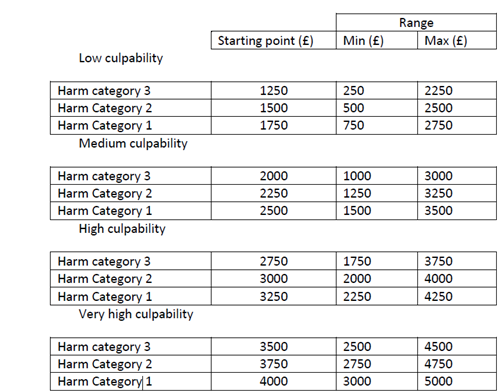
Financial Penalty in the case of a first breach in respect of Prohibited Payments.
The table below gives the starting points, minimum and maximum financial penalties for each harm category and level of culpability. Where exceptional circumstances apply the Council may reduce the minimum penalties further but may not increase them above the maximum permitted of £5000.
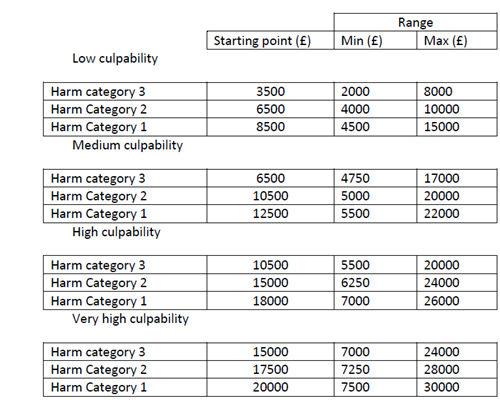
Financial Penalty in the case of a second or subsequent breach in respect of Prohibited Payments within 5 years of a previous breach.
The table below gives the starting points, minimum and maximum financial penalties for each harm category and level of culpability. Where exceptional circumstances apply the Council may reduce the minimum penalties further but may not increase them above the maximum permitted of £5000
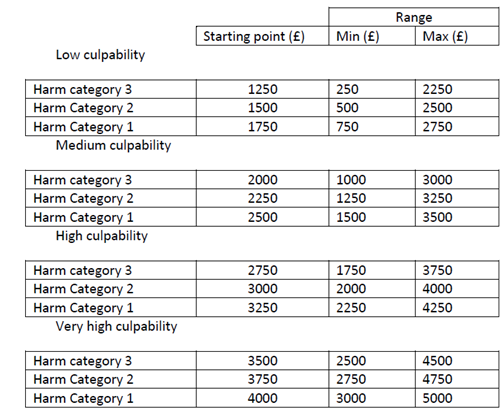
Financial Penalty in the case of a breach in respect of Publication of Fees.
The table below gives the starting points, minimum and maximum financial penalties for each harm category and level of culpability. Where exceptional circumstances apply the Council may reduce the minimum penalties further but may not increase them above the maximum permitted of £5000.
The council’s process for determining the level of penalty to set
STEP ONE – Determining the offence category
The Council will determine the breach category using only the culpability and category of harm factors below. Where an offence does not fall squarely into a category, individual factors may require a degree of weighting to make an overall assessment. The Council may also apply a discretionary factor in order to reflect consistency across England and may consider decisions in other UK jurisdictions where they contain some relevant and persuasive content.
Culpability
| Very high: | High: | Medium: | Low: |
|
Where the Landlord or Agent intentionally breached, or flagrantly disregarded, the law or has/had a high public profile4 and knew their actions were unlawful 4 Which may include any significant role in a trade or business representative organisation 5 A wide definition of vulnerability will be used. See below for a non-exhaustive list. |
Actual foresight of, or wilful blindness to, risk of a breach but risk nevertheless taken | Breach committed through act or omission which a person exercising reasonable care would not commit |
Breach committed with little fault, for example, because: - significant efforts were made to address the risk although they were inadequate on the relevant occasion - there was no warning/circumstance indicating a risk - failings were minor and occurred as an isolated incident |
Harm
The following factors relate to both actual harm and risk of harm. Dealing with a risk of harm involves consideration of both the likelihood of harm occurring and the extent of it if it does. Some offences cause harm to the community at large (instead of or as well as to an individual victim) and may include economic loss, harm to public health, or interference with the administration of justice.
|
Category 1 – High Likelihood of Harm |
Category 2 – Medium Likelihood of Harm |
Category 3- Low Likelihood of Harm |
|
- Serious adverse effect(s) on individual(s) and/or having a widespread impact due to the nature and/or scale of the Landlord’s or Agent’s business - High risk of an adverse effect on individual(s) – including where persons are vulnerable5 |
Adverse effect on individual(s) (not amounting to Category 1) -Medium risk of an adverse effect on individual(s) or low risk of serious adverse effect. - Tenants and/or legitimate landlords or agents substantially undermined by the conduct. -The Council’s work as a regulator is inhibited -Tenant or prospective tenant misled |
Low risk of an adverse effect on actual or prospective tenants. - Public misled but little or no risk of actual adverse effect on individual(s) We will define harm widely and victims may suffer financial loss, damage to health or psychological distress (especially vulnerable cases). There are gradations of harm within all of these categories. The nature of harm will depend on personal characteristics and circumstances of the victim and the assessment of harm will be an effective and important way of taking into consideration the impact of a particular crime on the victim. In some cases no actual harm may have resulted and enforcement authority will be concerned with assessing the relative dangerousness of the offender’s conduct; it will consider the likelihood of harm occurring and the gravity of the harm that could have resulted. |
STEP TWO - Starting point and category range
Having determined the category that the breach falls into, the Council will refer to the following starting points to reach an appropriate level of civil penalty within the category range. The Council will then consider further adjustment within the category range for aggravating and mitigating features.
Obtaining financial information
The statutory guidance advises that local authorities should use their powers under Schedule 5 to the CRA 2015 to, as far as possible, make an assessment of a Landlord’s or Agent’s assets and any income (not just rental or fee income) they receive when determining an appropriate penalty. The Council will use such lawful means as are at its disposal to identify where assets might be found.
In setting a financial penalty, the Council may conclude that the Landlord or Agent is able to pay any financial penalty imposed unless the Council has obtained, or the Landlord or Agent has supplied, any financial information to the contrary. The subject of a Final Notice, or a Notice of Intent where the subject does not challenge it, will be expected to disclose to the Council such data relevant to his/her financial position to facilitate an assessment of what that person can reasonably afford to pay. Where the Council is not satisfied that it has been given sufficient reliable information, the Council will be entitled to draw reasonable inferences as to the person’s means from evidence it has received, or obtained through its own enquiries, and from all the circumstances of the case which may include the inference that the person can pay any financial penalty.
Starting points and ranges
The tables below give the starting points, minimum and maximum financial penalties for each harm category and level of culpability for each type of breach.
Context
Below is a list of some, but not all factual elements that provide the context of the breach and factors relating to the Landlord or Agent. The Council will identify whether any combination of these, or other relevant factors, should result in an upward or downward adjustment from the starting point. In particular, relevant recent convictions6 are likely to result in a substantial upward adjustment. In some cases, having considered these factors, it may be appropriate to move outside the identified category range which will not exceed the statutory maximum permitted in any case.
Factors increasing seriousness
Aggravating factors:
o Previous breaches of the TFA 2019
o Other previous convictions, having regard to the nature of the offence to which the conviction relates and its relevance to the current breach; and the time that has elapsed since the conviction.
o Other aggravating factors may include:
- Motivated by financial gain
- Deliberate concealment of illegal nature of activity
- Established evidence of wider/community impact
- Obstruction of the investigation
- Record of poor compliance
- Refusal of advice or training or to become a member of an Accreditation scheme
Factors reducing seriousness or reflecting personal mitigation
- No previous or no relevant/recent breaches
- No previous convictions or no relevant/recent convictions
- Steps voluntarily taken to remedy problem
- High level of co-operation with the investigation, beyond that which will always be expected
- Good record of relationship with tenants
- Self-reporting, co-operation and acceptance of responsibility
- Good character and/or exemplary conduct
- Mental disorder or learning disability, where linked to the commission of the breach
- Serious medical conditions requiring urgent, intensive or long-term treatment and supported by medical evidence
STEP THREE - General principles to consider in setting a penalty
The Council will finalise the appropriate level of penalty so that it reflects the seriousness of the offence and the Council must take into account the financial circumstances of the Landlord or Agent if representations are made by the Landlord or Agent following the issue of a Notice of Intent.
The level of financial penalty should reflect the extent to which the conduct fell below the required standard. The financial penalty should meet, in a fair and proportionate way, the objectives of punishment, deterrence and the removal of gain derived through the commission of the breach; it should not be cheaper to breach than to take the appropriate precautions and a fundamental principle involved is that there should be no financial gain to the perpetrator from the commission of the breaches.
If issuing a financial penalty for more than one breach, or where the offender has already been issued with a financial penalty, The Council will consider whether the total penalties are just and proportionate to the offending behaviour and will have regard to the factors in STEP EIGHT below.
STEP FOUR- Issue Notice of Intent
The Council will issue a Notice of Intent within 6 months of the enforcement authority having sufficient evidence that the Landlord or Agent has breached the TFA 2019. If the breach is ongoing the 6-month deadline continues until the breach ceases. A Notice of Intent can be served spontaneously.
While there are slight variations in the statutory requirements according to which breach is being addressed a Notice of Intent will typically contain the date of the Notice, the amount of the proposed penalty, the reason for imposing the penalty and how the recipient can make representations concerning the penalty.
STEP FIVE – Consideration of representations and review of financial penalty where appropriate
The Council should review the penalty and, if necessary adjust the initial amount reached at STEP FOUR, and represented in the Notice of Intent, to ensure that it fulfils the general principles set out below.
Any quantifiable economic benefit(s) derived from the breach, including through avoided costs or operating savings, should normally be added to the total financial penalty arrived at in step two. Where this is not readily available, the Council may draw on information available from enforcing authorities and others about the general costs of operating within the law. Whether the penalty will have the effect of putting the offender out of business will be relevant but in some serious cases this might be an acceptable outcome.
STEP SIX – Reductions
The Council will consider any factors which indicate that a reduction in the penalty is appropriate and in so doing will have regard to the following factors relating to the wider impacts of the financial penalty on innocent third parties; such as (but not limited to):
- The impact of the financial penalty on the Landlord or Agent’s ability to comply with the law or make restitution where appropriate
- The impact of the financial penalty on employment of staff, service users, customers and the local economy.
The following factors will be considered in setting the level of reduction. When deciding on any reduction in a financial penalty, consideration will be given to:
- The stage in the investigation or thereafter when the offender accepted liability
- The circumstances in which they admitted liability
- The degree of co-operation with the investigation
The maximum level of reduction in a penalty for an admission of liability will be one-third. In some circumstances there will be a reduced or no level of discount. This may occur for example where the evidence of the breach is overwhelming or there is a pattern of breaching conduct.
Any reduction should not result in a penalty which is less than the amount of gain from the commission of the breach itself.
STEP SEVEN - Additional actions
In all cases the Council must consider whether to take additional action. These may include further enforcement action itself or reference to other organisations where appropriate.
STEP EIGHT – Totality of breaching conduct
Where the offender is issued with more than one financial penalty, the Council should consider the following guidance from the definitive guideline on Offences Taken into Consideration and Totality which appears to the Council to be an appropriate reference and guide.
As the total financial penalty is inevitably cumulative the Council should determine the financial penalty for each individual breach based on the seriousness of the breach and taking into account the circumstances of the case including the financial circumstances of the Landlord or Agent so far as they are known, or appear, to the Council.
The Council should add up the financial penalties for each offence and consider if they are just and proportionate. If the aggregate total is not just and proportionate the Council should consider how to reach a just and proportionate total financial penalty. There are a number of ways in which this can be achieved.
For example:
Where a Landlord or Agent is to be penalised for two or more breaches or where there are multiple breaches of a repetitive kind, especially when committed against the same person, it will often be appropriate to impose for the most serious breach a financial penalty which reflects the totality of the conduct where this can be achieved within the maximum penalty for that breach. No separate penalty should be imposed for the other breaches. Where a Landlord or Agent is to be penalised for two or more breaches that arose out of different incidents, it will often be appropriate to impose separate financial penalties for each breach. The Council should add up the financial penalties for each breach and consider if they are just and proportionate. If the aggregate amount is not just and proportionate the Council should consider whether all of the financial penalties can be proportionately reduced. Separate financial penalties should then be imposed.
Where separate financial penalties are passed, the Council must take care to ensure that there is no double-counting.’
STEP NINE – Recording the decision
The officer making a decision about a financial penalty will record their decision giving reasons for coming to the amount of financial penalty that will be imposed.
Financial Penalty in the case of a first breach in respect of Prohibited Payments.
The table below gives the starting points, minimum and maximum financial penalties for each harm category and level of culpability. Where exceptional circumstances apply the Council may reduce the minimum penalties further but may not increase them above the maximum permitted of £5000.
Financial Penalty in the case of a second or subsequent breach in respect of Prohibited Payments within 5 years of a previous breach.
The table below gives the starting points, minimum and maximum financial penalties for each harm category and level of culpability. Where exceptional circumstances apply the Council may reduce the minimum penalties further but may not increase them above the maximum permitted of £5000
Financial Penalty in the case of a breach in respect of Publication of Fees.
The table below gives the starting points, minimum and maximum financial penalties for each harm category and level of culpability. Where exceptional circumstances apply the Council may reduce the minimum penalties further but may not increase them above the maximum permitted of £5000.
Client Money Protection Scheme
The council’s process for determining the level of penalty to set
Once Gloucestershire County Council is satisfied beyond reasonable doubt that an agent has breached he requirement to belong to an approved client money protection scheme and or has breached the transparency requirement, it can impose a financial penalty.
Gloucestershire County Council has discretion when determining the appropriate level of financial penalty, within the limits prescribed by regulation.
STEP ONE – Determining the offence category
The Council will determine the breach category using only the culpability and category of harm factors below. Where an offence does not fall squarely into a category, individual factors may require a degree of weighting to make an overall assessment. The Council may also apply a discretionary factor in order to reflect consistency across England and may consider decisions in other UK jurisdictions where they contain some relevant and persuasive content.
Culpability
|
Very high: |
High: |
Medium: |
Low: |
|
Where the Agent intentionally breached, or flagrantly disregarded, the law or has/had a high public profile and knew their actions were unlawful. Which may include any significant role in a trade or business representative organisation. A wide definition of vulnerability will be used. See below for a non-exhaustive list. |
Actual foresight of, or wilful blindness to, risk of a breach but risk nevertheless taken. |
Breach committed through act or omission which a person exercising reasonable care would not commit. |
Breach committed with little fault, for example, because: Significant efforts were made to address the risk although they were inadequate on the relevant occasion. There was no warning/circumstance indicating a risk. Failings were minor and occurred as an isolated incident. |
Harm
The following factors relate to both actual harm and risk of harm. Dealing with a risk of harm involves consideration of both the likelihood of harm occurring and the extent of it if it does. Some offences cause harm to the community at large (instead of or as well as to an individual victim) and may include economic loss, harm to public health, or interference with the administration of justice.
|
Category 1 – High Likelihood of Harm |
Category 2 – Medium Likelihood of Harm |
Category 3- Low Likelihood of Harm |
|
Serious adverse effect(s) on individual(s) and/or having a widespread impact due to the nature and/or scale of the Agent’s business. High risk of an adverse effect on individual(s) – including where persons are vulnerable. |
Adverse effect on individual(s) (not amounting to Category 1). Medium risk of an adverse effect on individual(s) or low risk of serious adverse effect. Tenants and/or legitimate Agents substantially undermined by the conduct. The Council’s work as a regulator is inhibited. Tenant or prospective tenant misled |
Low risk of an adverse effect on actual or prospective tenants. Public misled but little or no risk of actual adverse effect on individual(s) We will define harm widely and victims may suffer financial loss, damage to health or psychological distress (especially vulnerable cases). There are gradations of harm within all of these categories. The nature of harm will depend on personal characteristics and circumstances of the victim and the assessment of harm will be an effective and important way of taking into consideration the impact of a particular crime on the victim. In some cases, no actual harm may have resulted, and enforcement authority will be concerned with assessing the relative dangerousness of the offender’s conduct; it will consider the likelihood of harm occurring and the gravity of the harm that could have resulted. |
STEP TWO - Starting point and category range
Having determined the category that the breach falls into, the Council will refer to the following starting points to reach an appropriate level of civil penalty within the category range. The Council will then consider further adjustment within the category range for aggravating and mitigating features.
Obtaining financial information
The statutory guidance advises that local authorities should use their powers under Schedule 5 to the CRA 2015 to, as far as possible, make an assessment of an Agent’s assets and any income they receive when determining an appropriate penalty. The Council will use such lawful means as are at its disposal to identify where assets might be found.
In setting a financial penalty, the Council may conclude that the Agent is able to pay any financial penalty imposed unless the Council has obtained, or the Agent has supplied, any financial information to the contrary. The subject of a Final Notice, or a Notice of Intent where the subject does not challenge it, will be expected to disclose to the Council such data relevant to his/her financial position to facilitate an assessment of what that person can reasonably afford to pay. Where the Council is not satisfied that it has been given sufficient reliable information, the Council will be entitled to draw reasonable inferences as to the person’s means from evidence it has received, or obtained through its own enquiries, and from all the circumstances of the case which may include the inference that the person can pay any financial penalty.
Starting points and ranges
The tables below give the starting points, minimum and maximum financial penalties for each harm category and level of culpability for each type of breach.
Context
Below is a list of some, but not all factual elements that provide the context of the breach and factors relating to the Agent. The Council will identify whether any combination of these, or other relevant factors, should result in an upward or downward adjustment from the starting point. In particular, relevant recent convictions are likely to result in a substantial upward adjustment. In some cases, having considered these factors, it may be appropriate to move outside the identified category range which will not exceed the statutory maximum permitted in any case.
Factors increasing seriousness
Aggravating factors:
· Previous breaches of the client money protection scheme or other property related legislation.
· Other previous convictions, having regard to the nature of the offence to which the conviction relates and its relevance to the current breach; and the time that has elapsed since the conviction.
· Other aggravating factors may include:
- Motivated by financial gain,
- Deliberate concealment of illegal nature of activity,
- Established evidence of wider/community impact,
- Obstruction of the investigation,
- Record of poor compliance,
- Refusal of advice or training or to become a member of an accreditation scheme.
Factors reducing seriousness or reflecting personal mitigation
· No previous or no relevant/recent breaches,
· No previous convictions or no relevant/recent convictions,
· Steps voluntarily taken to remedy problem,
· High level of co-operation with the investigation, beyond that which will always be expected,
· Good record of relationship with tenants,
· Self-reporting, co-operation and acceptance of responsibility,
· Good character and/or exemplary conduct,
· Mental disorder or learning disability, where linked to the commission of the breach,
· Serious medical conditions requiring urgent, intensive or long-term treatment and supported by medical evidence.
STEP THREE - General principles to consider in setting a penalty
The Council will finalise the appropriate level of penalty so that it reflects the seriousness of the offence. The Council must take into account the financial circumstances of the Agent if representations are made by the Agent following the issue of a Notice of Intent.
The level of financial penalty should reflect the extent to which the conduct fell below the required standard. The financial penalty should meet, in a fair and proportionate way, the objectives of punishment, deterrence and the removal of gain derived through the commission of the breach; it should not be cheaper to breach than to take the appropriate precautions and a fundamental principle involved is that there should be no financial gain to the perpetrator from the commission of the breaches.
If issuing a financial penalty for more than one breach, or where the offender has already been issued with a financial penalty, The Council will consider whether the total penalties are just and proportionate to the offending behaviour and will have regard to the factors in STEP EIGHT below.
STEP FOUR- Issue Notice of Intent
The Council will issue a Notice of Intent within 6 months of the enforcement authority having sufficient evidence that the Agent has breached the client money protection scheme requirements. If the breach is ongoing the 6-month deadline continues until the breach ceases. A Notice of Intent can be served spontaneously.
While there are slight variations in the statutory requirements according to which breach is being addressed a Notice of Intent will typically contain the date of the Notice, the amount of the proposed penalty, the reason for imposing the penalty and how the recipient can make representations concerning the penalty.
STEP FIVE – Consideration of representations and review of financial penalty where appropriate
The Council should review the penalty and, if necessary, adjust the initial amount reached at STEP FOUR, and represented in the Notice of Intent, to ensure that it fulfils the general principles set out below.
Any quantifiable economic benefit(s) derived from the breach, including through avoided costs or operating savings, should normally be added to the total financial penalty arrived at in step two. Where this is not readily available, the Council may draw on information available from enforcing authorities and others about the general costs of operating within the law. Whether the penalty will have the effect of putting the offender out of business will be relevant but in some serious cases this might be an acceptable outcome.
STEP SIX – Reductions
The Council will consider any factors which indicate that a reduction in the penalty is appropriate and in so doing will have regard to the following factors relating to the wider impacts of the financial penalty on innocent third parties, such as (but not limited to):
· The impact of the financial penalty on the Agent’s ability to comply with the law or make restitution where appropriate
· The impact of the financial penalty on employment of staff, service users, customers and the local economy.
The following factors will be considered in setting the level of reduction. When deciding on any reduction in a financial penalty, consideration will be given to:
· The stage in the investigation or thereafter when the offender accepted liability
· The circumstances in which they admitted liability
· The degree of co-operation with the investigation
The maximum level of reduction in a penalty for an admission of liability will be one-third. In some circumstances there will be a reduced or no level of discount. This may occur for example where the evidence of the breach is overwhelming or there is a pattern of breaching conduct.
Any reduction should not result in a penalty which is less than the amount of gain from the commission of the breach itself.
STEP SEVEN - Additional actions
In all cases the Council must consider whether to take additional action. These may include further enforcement action itself or reference to other organisations where appropriate.
STEP EIGHT – Totality of breaching conduct
Where the offender is issued with more than one financial penalty, the Council should consider the following guidance from the definitive guideline on Offences Taken into Consideration and Totality which appears to the Council to be an appropriate reference and guide.
As the total financial penalty is inevitably cumulative the Council should determine the financial penalty for each individual breach based on the seriousness of the breach and taking into account the circumstances of the case including the financial circumstances of the Agent so far as they are known, or appear, to the Council.
The Council should add up the financial penalties for each offence and consider if they are just and proportionate. If the aggregate total is not just and proportionate the Council should consider how to reach a just and proportionate total financial penalty. There are a number of ways in which this can be achieved.
For example:
Where an Agent is to be penalised for two or more breaches or where there are multiple breaches of a repetitive kind, especially when committed against the same person, it will often be appropriate to impose for the most serious breach a financial penalty which reflects the totality of the conduct where this can be achieved within the maximum penalty for that breach. No separate penalty should be imposed for the other breaches.
Where an Agent is to be penalised for two or more breaches that arose out of different incidents, it will often be appropriate to impose separate financial penalties for each breach. The Council should add up the financial penalties for each breach and consider if they are just and proportionate. If the aggregate amount is not just and proportionate the Council should consider whether all of the financial penalties can be proportionately reduced. Separate financial penalties should then be imposed.
Where separate financial penalties are passed, the Council must take care to ensure that there is no double-counting.’
STEP NINE – Recording the decision
The officer making a decision about a financial penalty will record their decision giving reasons for coming to the amount of financial penalty that will be imposed.
Client Money Protection Scheme
The council’s process for determining the level of penalty to set
Once Gloucestershire County Council is satisfied beyond reasonable doubt that an agent has breached he requirement to belong to an approved client money protection scheme and or has breached the transparency requirement, it can impose a financial penalty.
Gloucestershire County Council has discretion when determining the appropriate level of financial penalty, within the limits prescribed by regulation.
STEP ONE – Determining the offence category
The Council will determine the breach category using only the culpability and category of harm factors below. Where an offence does not fall squarely into a category, individual factors may require a degree of weighting to make an overall assessment. The Council may also apply a discretionary factor in order to reflect consistency across England and may consider decisions in other UK jurisdictions where they contain some relevant and persuasive content.
Culpability
|
Very high: |
High: |
Medium: |
Low: |
|
Where the Agent intentionally breached, or flagrantly disregarded, the law or has/had a high public profile and knew their actions were unlawful. Which may include any significant role in a trade or business representative organisation. A wide definition of vulnerability will be used. See below for a non-exhaustive list. |
Actual foresight of, or wilful blindness to, risk of a breach but risk nevertheless taken. |
Breach committed through act or omission which a person exercising reasonable care would not commit. |
Breach committed with little fault, for example, because: Significant efforts were made to address the risk although they were inadequate on the relevant occasion. There was no warning/circumstance indicating a risk. Failings were minor and occurred as an isolated incident. |
Harm
The following factors relate to both actual harm and risk of harm. Dealing with a risk of harm involves consideration of both the likelihood of harm occurring and the extent of it if it does. Some offences cause harm to the community at large (instead of or as well as to an individual victim) and may include economic loss, harm to public health, or interference with the administration of justice.
|
Category 1 – High Likelihood of Harm |
Category 2 – Medium Likelihood of Harm |
Category 3- Low Likelihood of Harm |
|
Serious adverse effect(s) on individual(s) and/or having a widespread impact due to the nature and/or scale of the Agent’s business. High risk of an adverse effect on individual(s) – including where persons are vulnerable. |
Adverse effect on individual(s) (not amounting to Category 1). Medium risk of an adverse effect on individual(s) or low risk of serious adverse effect. Tenants and/or legitimate Agents substantially undermined by the conduct. The Council’s work as a regulator is inhibited. Tenant or prospective tenant misled |
Low risk of an adverse effect on actual or prospective tenants. Public misled but little or no risk of actual adverse effect on individual(s) We will define harm widely and victims may suffer financial loss, damage to health or psychological distress (especially vulnerable cases). There are gradations of harm within all of these categories. The nature of harm will depend on personal characteristics and circumstances of the victim and the assessment of harm will be an effective and important way of taking into consideration the impact of a particular crime on the victim. In some cases, no actual harm may have resulted, and enforcement authority will be concerned with assessing the relative dangerousness of the offender’s conduct; it will consider the likelihood of harm occurring and the gravity of the harm that could have resulted. |
STEP TWO - Starting point and category range
Having determined the category that the breach falls into, the Council will refer to the following starting points to reach an appropriate level of civil penalty within the category range. The Council will then consider further adjustment within the category range for aggravating and mitigating features.
Obtaining financial information
The statutory guidance advises that local authorities should use their powers under Schedule 5 to the CRA 2015 to, as far as possible, make an assessment of an Agent’s assets and any income they receive when determining an appropriate penalty. The Council will use such lawful means as are at its disposal to identify where assets might be found.
In setting a financial penalty, the Council may conclude that the Agent is able to pay any financial penalty imposed unless the Council has obtained, or the Agent has supplied, any financial information to the contrary. The subject of a Final Notice, or a Notice of Intent where the subject does not challenge it, will be expected to disclose to the Council such data relevant to his/her financial position to facilitate an assessment of what that person can reasonably afford to pay. Where the Council is not satisfied that it has been given sufficient reliable information, the Council will be entitled to draw reasonable inferences as to the person’s means from evidence it has received, or obtained through its own enquiries, and from all the circumstances of the case which may include the inference that the person can pay any financial penalty.
Starting points and ranges
The tables below give the starting points, minimum and maximum financial penalties for each harm category and level of culpability for each type of breach.
Context
Below is a list of some, but not all factual elements that provide the context of the breach and factors relating to the Agent. The Council will identify whether any combination of these, or other relevant factors, should result in an upward or downward adjustment from the starting point. In particular, relevant recent convictions are likely to result in a substantial upward adjustment. In some cases, having considered these factors, it may be appropriate to move outside the identified category range which will not exceed the statutory maximum permitted in any case.
Factors increasing seriousness
Aggravating factors:
· Previous breaches of the client money protection scheme or other property related legislation.
· Other previous convictions, having regard to the nature of the offence to which the conviction relates and its relevance to the current breach; and the time that has elapsed since the conviction.
· Other aggravating factors may include:
- Motivated by financial gain,
- Deliberate concealment of illegal nature of activity,
- Established evidence of wider/community impact,
- Obstruction of the investigation,
- Record of poor compliance,
- Refusal of advice or training or to become a member of an accreditation scheme.
Factors reducing seriousness or reflecting personal mitigation
· No previous or no relevant/recent breaches,
· No previous convictions or no relevant/recent convictions,
· Steps voluntarily taken to remedy problem,
· High level of co-operation with the investigation, beyond that which will always be expected,
· Good record of relationship with tenants,
· Self-reporting, co-operation and acceptance of responsibility,
· Good character and/or exemplary conduct,
· Mental disorder or learning disability, where linked to the commission of the breach,
· Serious medical conditions requiring urgent, intensive or long-term treatment and supported by medical evidence.
STEP THREE - General principles to consider in setting a penalty
The Council will finalise the appropriate level of penalty so that it reflects the seriousness of the offence. The Council must take into account the financial circumstances of the Agent if representations are made by the Agent following the issue of a Notice of Intent.
The level of financial penalty should reflect the extent to which the conduct fell below the required standard. The financial penalty should meet, in a fair and proportionate way, the objectives of punishment, deterrence and the removal of gain derived through the commission of the breach; it should not be cheaper to breach than to take the appropriate precautions and a fundamental principle involved is that there should be no financial gain to the perpetrator from the commission of the breaches.
If issuing a financial penalty for more than one breach, or where the offender has already been issued with a financial penalty, The Council will consider whether the total penalties are just and proportionate to the offending behaviour and will have regard to the factors in STEP EIGHT below.
STEP FOUR- Issue Notice of Intent
The Council will issue a Notice of Intent within 6 months of the enforcement authority having sufficient evidence that the Agent has breached the client money protection scheme requirements. If the breach is ongoing the 6-month deadline continues until the breach ceases. A Notice of Intent can be served spontaneously.
While there are slight variations in the statutory requirements according to which breach is being addressed a Notice of Intent will typically contain the date of the Notice, the amount of the proposed penalty, the reason for imposing the penalty and how the recipient can make representations concerning the penalty.
STEP FIVE – Consideration of representations and review of financial penalty where appropriate
The Council should review the penalty and, if necessary, adjust the initial amount reached at STEP FOUR, and represented in the Notice of Intent, to ensure that it fulfils the general principles set out below.
Any quantifiable economic benefit(s) derived from the breach, including through avoided costs or operating savings, should normally be added to the total financial penalty arrived at in step two. Where this is not readily available, the Council may draw on information available from enforcing authorities and others about the general costs of operating within the law. Whether the penalty will have the effect of putting the offender out of business will be relevant but in some serious cases this might be an acceptable outcome.
STEP SIX – Reductions
The Council will consider any factors which indicate that a reduction in the penalty is appropriate and in so doing will have regard to the following factors relating to the wider impacts of the financial penalty on innocent third parties, such as (but not limited to):
· The impact of the financial penalty on the Agent’s ability to comply with the law or make restitution where appropriate
· The impact of the financial penalty on employment of staff, service users, customers and the local economy.
The following factors will be considered in setting the level of reduction. When deciding on any reduction in a financial penalty, consideration will be given to:
· The stage in the investigation or thereafter when the offender accepted liability
· The circumstances in which they admitted liability
· The degree of co-operation with the investigation
The maximum level of reduction in a penalty for an admission of liability will be one-third. In some circumstances there will be a reduced or no level of discount. This may occur for example where the evidence of the breach is overwhelming or there is a pattern of breaching conduct.
Any reduction should not result in a penalty which is less than the amount of gain from the commission of the breach itself.
STEP SEVEN - Additional actions
In all cases the Council must consider whether to take additional action. These may include further enforcement action itself or reference to other organisations where appropriate.
STEP EIGHT – Totality of breaching conduct
Where the offender is issued with more than one financial penalty, the Council should consider the following guidance from the definitive guideline on Offences Taken into Consideration and Totality which appears to the Council to be an appropriate reference and guide.
As the total financial penalty is inevitably cumulative the Council should determine the financial penalty for each individual breach based on the seriousness of the breach and taking into account the circumstances of the case including the financial circumstances of the Agent so far as they are known, or appear, to the Council.
The Council should add up the financial penalties for each offence and consider if they are just and proportionate. If the aggregate total is not just and proportionate the Council should consider how to reach a just and proportionate total financial penalty. There are a number of ways in which this can be achieved.
For example:
Where an Agent is to be penalised for two or more breaches or where there are multiple breaches of a repetitive kind, especially when committed against the same person, it will often be appropriate to impose for the most serious breach a financial penalty which reflects the totality of the conduct where this can be achieved within the maximum penalty for that breach. No separate penalty should be imposed for the other breaches.
Where an Agent is to be penalised for two or more breaches that arose out of different incidents, it will often be appropriate to impose separate financial penalties for each breach. The Council should add up the financial penalties for each breach and consider if they are just and proportionate. If the aggregate amount is not just and proportionate the Council should consider whether all of the financial penalties can be proportionately reduced. Separate financial penalties should then be imposed.
Where separate financial penalties are passed, the Council must take care to ensure that there is no double-counting.’
STEP NINE – Recording the decision
The officer making a decision about a financial penalty will record their decision giving reasons for coming to the amount of financial penalty that will be imposed.
Guidance on the Use of Fines, Notices and other Civil Sanctions by GLOUCESTERSHIRE COUNTY COUNCIL When Enforcing the Environmental Protection (Single-use Vapes) (England) Regulations 2024.
Introduction
GLOUCESTERSHIRE COUNTY COUNCIL is a regulator for the purposes of enforcing the Environmental Protection (Single-use Vapes) (England) Regulations 2024 (referred to as the Regulations in this guidance). As a regulator the council is required to publish guidance on our use of the fines, notices and other penalties contained in the Regulations.
This guidance should be read in conjunction with the Regulations and with GLOUCESTERSHIRE COUNTY COUNCIL enforcement policy https://www.gloucestershire.gov.uk/trading-standards/about-us/enforcement-policies/
The Criminal Offence of Supplying a Single-Use Vape.
If a person, as a business, supplies a single-use vape they commit a criminal offence. A single-use vape is a vape which is not intended to be re-used. A legal vape must be refillable and rechargeable and the coil (heating element) must be able to be replaced by the consumer. The government guidance to the Regulations provides more detail on what each of these terms mean -Single-use vapes ban - GOV.UK
Supply includes giving such vapes away. It is also an offence for a person to offer to supply such vapes or for a person to have them in their possession ready to supply.
In line with our enforcement policy GLOUCESTERSHIRE COUNTY COUNCIL may take legal action against a person who supplies, offers to supply or possesses for supply a single-use vape. Legal action may include, but is not limited to, prosecuting someone in the magistrates’ court, applying to review a premises licence under the Licensing Act 2003 or using the penalties explained in this guidance.
The Criminal Offence of Failing to comply with an enforcement requirement
If a person without reasonable excuse, fails to comply with any requirement imposed in the exercise of an enforcement officer’s powers or otherwise obstructs an enforcement officer in the exercise of powers under the Regulations, they are guilty of an offence.
In line with our enforcement policy GLOUCESTERSHIRE COUNTY COUNCIL may take legal action against a person who fails to comply with an enforcement requirement. Legal action may include, but is not limited to, prosecuting someone in the magistrates’ court, applying to review a premises licence under the Licensing Act 2003 or using the penalties explained in this guidance.
Publication of Information About Enforcement Action.
Where we use the penalties under these Regulations, we must from time to time publish details of the cases in which the penalties have been used.
Withdrawing or Amending a Notice
Penalties in the Regulations include the use of various notices. The council may at any time withdraw a notice, reduce the amount of any penalty in a notice or change the steps in a notice required to ensure compliance. Where we do this, we will do so in writing.
FIXED MONETARY PENALTIES AND COMPLIANCE NOTICES
Where a person commits an offence under these regulations GLOUCESTERSHIRE COUNTY COUNCIL may issue a fixed penalty notice. This is a fine issued by the council and is a penalty of £200. Details of how to pay the fine are included in the notices.
When will we issue a fine?
GLOUCESTERSHIRE COUNTY COUNCIL has a zero-tolerance approach to the supply of single-use vapes. Unless there are aggravating circumstances, we will issue a penalty where there is evidence to show that a person has committed an offence under these Regulations, even if it their first offence.
Where there are aggravating circumstances we might take other action, even for a first offence. Examples of aggravating circumstances would include the supply of a single-use vape to a child or if someone commits a second offence or where a person is in possession of a large quantity of single-use vapes.
We will not issue a fine where a business can show it has taken all reasonable steps to avoid committing an offence. We will not issue a fine where we have issued a compliance notice and the business have carried out the tasks detailed in that notice.
When will we issue a Compliance Notice?
This is a notice that we may issue to a person telling them what action they must take to ensure that no further offences are committed. The notice will tell the person how long they have to comply with our instructions. A compliance notice will be used where the authority considers it the most appropriate way to ensure further offences are not committed. Failure to comply with a notice will lead to a person being issued with a fine or the authority may take legal proceedings against them.
Notice of Intent.
If we are considering issuing a fine or a compliance notice on a person we must issue them with a notice of intent. This tells the person what action we propose to take and why we intend to take it. The notice must include either the value of the fine or the details of the action we require the business to take.
A person who is given a notice of intent may offer to put right any damage or compensate another person who has been affected by the offence. This is known as a third-party undertaking. GLOUCESTERSHIRE COUNTY COUNCIL will consider whether to accept any offer of such an undertaking on a case-by-case basis. We must consider any third-party undertakings made before we issue any final notices.
Rights to Make Representations and Objections.
A person who is issued with a notice of intent has 28 days to make any objections or representations. These should be made in writing to Head of Trading Standards, Quayside, Shire Hall, Westgate Street, Gloucester, GL1 2TG. tradingstandards@gloucestershire.gov.uk.
In the case of a fine a person can clear their liability by paying £100 with 28 days of the issue of the notice.
Final Notice.
28 days after we issue the notice of intent, and having considered any objections or representations, we must decide whether or not to issue the fine or compliance notice. The notice will include the grounds for imposing the penalty, the amount to be paid, how payment may be made and the period within which payment must be made. It will also include how to appeal and the consequences of failing to pay the fine or comply with the notice.
Right to Appeal.
The person receiving the final notice may appeal against it if they think we made an error in the facts, we didn’t apply the law properly or that our decision was unreasonable. Anyone wishing to appeal a final decision should do so in writing to The First Tier Tribunal General Regulatory Chamber
Failure to pay the fine or to take the action detailed in the compliance notice will result in consideration of further action. Details of how to pay a fine are detailed in the final notice.
STOP NOTICES
Where GLOUCESTERSHIRE COUNTY COUNCIL considers it appropriate we may serve a stop notice on any person where we reasonably believe is carrying on an activity that is an offence under these Regulations and which is causing, or where there is a significant risk of it causing serious harm to the environment (including the health of animals). We can also issue a Stop Notice if the activity will involve or will be likely to involve the commission of an offence under Regulations.
The notice must explain the steps required to remove or reduce the harm or risk of harm to the environment. It must also include the reasons why we’ve issued the notice, how a person can appeal the notice and the consequences of failing to comply with the notice.
Failure to comply with a Stop Notice is a criminal offence punishable by up to 2 years in prison.
Completion Certificates
Once we are satisfied that the person issued with a Stop Notice has taken the steps specified in the notice, we must issue a certificate confirming this. This is called a “completion certificate”. Once we have issued this the stop notice ends. A person who has been given a stop notice can ask us for a certificate at any time and we must decide as to whether to issue one within 14 days. We must give a written answer to the person if we decide not to issue the certificate.
Appeals Against Stop Notices & Completion Certificates
The person receiving the stop notice may appeal against it if they think we made an error in the facts, we didn’t apply the law properly, that our decision was unreasonable or that they had not committed an offence under the Regulations. Anyone wishing to appeal a final decision should do so in writing to The First Tier Tribunal General Regulatory Chamber
Compensation
If the stop notice is later withdrawn or amended by us because the decision to issue it was unreasonable or any step specified in the notice was unreasonable or the person successfully appeals against the stop notice because the issue of the notice was unreasonable we must compensate that person. If we unreasonably refuse to issue a Completion Certificate we must also compensate that person.
Appeal against compensation decision
A person may appeal against a decision not to award compensation or the amount of compensation awarded on the grounds that our decision was unreasonable or that that the amount we offer is incorrect.
ENFORCEMENT UNDERTAKINGS
Where we think a person has committed an offence under these Regulations they can offer to take some action to ensure offences are not committed in the future. They can also offer to act to put right any damage caused to another person or to compensate them for that damage. They can also offer to correct any damage caused to the environment by their actions. This offer is known as an Enforcement Undertaking. GLOUCESTERSHIRE COUNTY COUNCIL will consider whether to accept any offer of such an undertaking on a case-by-case basis.
If we have accepted an enforcement undertaking, we cannot prosecute for the offence to which it relates nor can we issue a fine for that offence.
Completion Certificates
Once we are satisfied that the person has taken the steps specified in the undertaking, we must issue a certificate confirming this. This is called a “completion certificate”. A person who has given an undertaking can ask us for a certificate at any time and we must decide whether to issue one within 14 days. We must give a written answer to the person if we decide not to issue the certificate.
Appeals Against a Decision to not Issue a Completion Certificate.
A person may appeal against our decision to refuse a completion certificate it if they think we made an error in the facts, we didn’t apply the law properly or that our decision was unreasonable. Anyone wishing to appeal a decision should do so in writing to The First Tier Tribunal General Regulatory Chamber].
Non-compliance with an Enforcement Undertaking.
If a person does not take the action agreed in the undertaking we can either take action to issue any of the other notices in the regulations, we can issue a fine or we can prosecute the person. If a person has complied partly but not fully with an enforcement undertaking we must consider this before we take any further action.
NON-COMPLIANCE PENALTIES
If a person fails to comply with a compliance notice, a third party undertaking or an enforcement undertaking, GLOUCESTERSHIRE COUNTY COUNCIL may recover any costs from that person by issuing them with a penalty.
We will seek 100% of all costs incurred by GLOUCESTERSHIRE COUNTY COUNCIL of fulfilling the remaining requirements including any costs of clean up or disposal costs. Where more than one person has been identified as being responsible for the non-compliance GLOUCESTERSHIRE COUNTY COUNCIL will treat all persons as being jointly and individually liable for all of the costs.
The council must issue the person with a notice which tells them why we are imposing the penalty, the amount to be paid, how payment may be made, the period in which payment must be made and their right to appeal. It must also tell them the consequences of non-payment and the circumstances in which the council might reduce the amount of the penalty.
If the requirements of the compliance notice or the third-party undertaking is complied with before the deadline for payment is reached then the penalty will be cancelled.
Appeals against non-compliance penalties
A person may appeal against our decision to issue a penalty if they think we made an error in the facts, we didn’t apply the law properly, that our decision was unreasonable or that the amount of the penalty was unreasonable. Anyone wishing to appeal a decision should do so in writing to The First Tier Tribunal General Regulatory Chamber.
ENFORCEMENT COST RECOVERY NOTICES
The Council may serve a notice (an “enforcement cost recovery notice”) on a person on
whom a compliance or stop notice has been served which requires that person to re-pay what it has cost the GLOUCESTERSHIRE COUNTY COUNCIL to enforce the law before the notice is issued.
There is no limit on what types of costs apply but they will include investigation costs, administration costs and the costs of obtaining expert advice (including legal advice). We can only recover costs that were necessary for us to enforce the law.
The enforcement cost recovery notice must tell a person how payment may be made, the amount required to be paid, the period in which payment must be made, why the notice has been issued, how a person can appeal and what the consequences of a failure to comply with the notice might be. The person can ask the council to provide a detailed breakdown of the amount.
Appeals Against Enforcement Cost Recovery Notice.
The person required to pay the costs may appeal against the Council’s decision to require them to pay costs or against their decision about the amount of those costs. Anyone wishing to appeal a decision should do so in writing to The First Tier Tribunal General Regulatory Chamber
How we enforce payments.
GLOUCESTERSHIRE COUNTY COUNCIL may choose to recover unpaid penalties as a civil debt (by registering a claim in court) or by applying to a court for an order so we can enforce the payment through:
-
a warrant of control, allowing a county court bailiff to take control of goods or money to the value of the amount being recovered
-
a charging order, placing a charge on property so that the debt due is paid from the proceeds of sale before the debtor receives them
-
a third party debt order, requiring a third party to pay the outstanding debt directly to the creditor from the debtor‘s money. Court fees can also be recovered from the debtor.
Guidance on the Use of Fines, Notices and other Civil Sanctions by GLOUCESTERSHIRE COUNTY COUNCIL When Enforcing the Environmental Protection (Single-use Vapes) (England) Regulations 2024.
Introduction
GLOUCESTERSHIRE COUNTY COUNCIL is a regulator for the purposes of enforcing the Environmental Protection (Single-use Vapes) (England) Regulations 2024 (referred to as the Regulations in this guidance). As a regulator the council is required to publish guidance on our use of the fines, notices and other penalties contained in the Regulations.
This guidance should be read in conjunction with the Regulations and with GLOUCESTERSHIRE COUNTY COUNCIL enforcement policy https://www.gloucestershire.gov.uk/trading-standards/about-us/enforcement-policies/
The Criminal Offence of Supplying a Single-Use Vape.
If a person, as a business, supplies a single-use vape they commit a criminal offence. A single-use vape is a vape which is not intended to be re-used. A legal vape must be refillable and rechargeable and the coil (heating element) must be able to be replaced by the consumer. The government guidance to the Regulations provides more detail on what each of these terms mean -Single-use vapes ban - GOV.UK
Supply includes giving such vapes away. It is also an offence for a person to offer to supply such vapes or for a person to have them in their possession ready to supply.
In line with our enforcement policy GLOUCESTERSHIRE COUNTY COUNCIL may take legal action against a person who supplies, offers to supply or possesses for supply a single-use vape. Legal action may include, but is not limited to, prosecuting someone in the magistrates’ court, applying to review a premises licence under the Licensing Act 2003 or using the penalties explained in this guidance.
The Criminal Offence of Failing to comply with an enforcement requirement
If a person without reasonable excuse, fails to comply with any requirement imposed in the exercise of an enforcement officer’s powers or otherwise obstructs an enforcement officer in the exercise of powers under the Regulations, they are guilty of an offence.
In line with our enforcement policy GLOUCESTERSHIRE COUNTY COUNCIL may take legal action against a person who fails to comply with an enforcement requirement. Legal action may include, but is not limited to, prosecuting someone in the magistrates’ court, applying to review a premises licence under the Licensing Act 2003 or using the penalties explained in this guidance.
Publication of Information About Enforcement Action.
Where we use the penalties under these Regulations, we must from time to time publish details of the cases in which the penalties have been used.
Withdrawing or Amending a Notice
Penalties in the Regulations include the use of various notices. The council may at any time withdraw a notice, reduce the amount of any penalty in a notice or change the steps in a notice required to ensure compliance. Where we do this, we will do so in writing.
FIXED MONETARY PENALTIES AND COMPLIANCE NOTICES
Where a person commits an offence under these regulations GLOUCESTERSHIRE COUNTY COUNCIL may issue a fixed penalty notice. This is a fine issued by the council and is a penalty of £200. Details of how to pay the fine are included in the notices.
When will we issue a fine?
GLOUCESTERSHIRE COUNTY COUNCIL has a zero-tolerance approach to the supply of single-use vapes. Unless there are aggravating circumstances, we will issue a penalty where there is evidence to show that a person has committed an offence under these Regulations, even if it their first offence.
Where there are aggravating circumstances we might take other action, even for a first offence. Examples of aggravating circumstances would include the supply of a single-use vape to a child or if someone commits a second offence or where a person is in possession of a large quantity of single-use vapes.
We will not issue a fine where a business can show it has taken all reasonable steps to avoid committing an offence. We will not issue a fine where we have issued a compliance notice and the business have carried out the tasks detailed in that notice.
When will we issue a Compliance Notice?
This is a notice that we may issue to a person telling them what action they must take to ensure that no further offences are committed. The notice will tell the person how long they have to comply with our instructions. A compliance notice will be used where the authority considers it the most appropriate way to ensure further offences are not committed. Failure to comply with a notice will lead to a person being issued with a fine or the authority may take legal proceedings against them.
Notice of Intent.
If we are considering issuing a fine or a compliance notice on a person we must issue them with a notice of intent. This tells the person what action we propose to take and why we intend to take it. The notice must include either the value of the fine or the details of the action we require the business to take.
A person who is given a notice of intent may offer to put right any damage or compensate another person who has been affected by the offence. This is known as a third-party undertaking. GLOUCESTERSHIRE COUNTY COUNCIL will consider whether to accept any offer of such an undertaking on a case-by-case basis. We must consider any third-party undertakings made before we issue any final notices.
Rights to Make Representations and Objections.
A person who is issued with a notice of intent has 28 days to make any objections or representations. These should be made in writing to Head of Trading Standards, Quayside, Shire Hall, Westgate Street, Gloucester, GL1 2TG. tradingstandards@gloucestershire.gov.uk.
In the case of a fine a person can clear their liability by paying £100 with 28 days of the issue of the notice.
Final Notice.
28 days after we issue the notice of intent, and having considered any objections or representations, we must decide whether or not to issue the fine or compliance notice. The notice will include the grounds for imposing the penalty, the amount to be paid, how payment may be made and the period within which payment must be made. It will also include how to appeal and the consequences of failing to pay the fine or comply with the notice.
Right to Appeal.
The person receiving the final notice may appeal against it if they think we made an error in the facts, we didn’t apply the law properly or that our decision was unreasonable. Anyone wishing to appeal a final decision should do so in writing to The First Tier Tribunal General Regulatory Chamber
Failure to pay the fine or to take the action detailed in the compliance notice will result in consideration of further action. Details of how to pay a fine are detailed in the final notice.
STOP NOTICES
Where GLOUCESTERSHIRE COUNTY COUNCIL considers it appropriate we may serve a stop notice on any person where we reasonably believe is carrying on an activity that is an offence under these Regulations and which is causing, or where there is a significant risk of it causing serious harm to the environment (including the health of animals). We can also issue a Stop Notice if the activity will involve or will be likely to involve the commission of an offence under Regulations.
The notice must explain the steps required to remove or reduce the harm or risk of harm to the environment. It must also include the reasons why we’ve issued the notice, how a person can appeal the notice and the consequences of failing to comply with the notice.
Failure to comply with a Stop Notice is a criminal offence punishable by up to 2 years in prison.
Completion Certificates
Once we are satisfied that the person issued with a Stop Notice has taken the steps specified in the notice, we must issue a certificate confirming this. This is called a “completion certificate”. Once we have issued this the stop notice ends. A person who has been given a stop notice can ask us for a certificate at any time and we must decide as to whether to issue one within 14 days. We must give a written answer to the person if we decide not to issue the certificate.
Appeals Against Stop Notices & Completion Certificates
The person receiving the stop notice may appeal against it if they think we made an error in the facts, we didn’t apply the law properly, that our decision was unreasonable or that they had not committed an offence under the Regulations. Anyone wishing to appeal a final decision should do so in writing to The First Tier Tribunal General Regulatory Chamber
Compensation
If the stop notice is later withdrawn or amended by us because the decision to issue it was unreasonable or any step specified in the notice was unreasonable or the person successfully appeals against the stop notice because the issue of the notice was unreasonable we must compensate that person. If we unreasonably refuse to issue a Completion Certificate we must also compensate that person.
Appeal against compensation decision
A person may appeal against a decision not to award compensation or the amount of compensation awarded on the grounds that our decision was unreasonable or that that the amount we offer is incorrect.
ENFORCEMENT UNDERTAKINGS
Where we think a person has committed an offence under these Regulations they can offer to take some action to ensure offences are not committed in the future. They can also offer to act to put right any damage caused to another person or to compensate them for that damage. They can also offer to correct any damage caused to the environment by their actions. This offer is known as an Enforcement Undertaking. GLOUCESTERSHIRE COUNTY COUNCIL will consider whether to accept any offer of such an undertaking on a case-by-case basis.
If we have accepted an enforcement undertaking, we cannot prosecute for the offence to which it relates nor can we issue a fine for that offence.
Completion Certificates
Once we are satisfied that the person has taken the steps specified in the undertaking, we must issue a certificate confirming this. This is called a “completion certificate”. A person who has given an undertaking can ask us for a certificate at any time and we must decide whether to issue one within 14 days. We must give a written answer to the person if we decide not to issue the certificate.
Appeals Against a Decision to not Issue a Completion Certificate.
A person may appeal against our decision to refuse a completion certificate it if they think we made an error in the facts, we didn’t apply the law properly or that our decision was unreasonable. Anyone wishing to appeal a decision should do so in writing to The First Tier Tribunal General Regulatory Chamber].
Non-compliance with an Enforcement Undertaking.
If a person does not take the action agreed in the undertaking we can either take action to issue any of the other notices in the regulations, we can issue a fine or we can prosecute the person. If a person has complied partly but not fully with an enforcement undertaking we must consider this before we take any further action.
NON-COMPLIANCE PENALTIES
If a person fails to comply with a compliance notice, a third party undertaking or an enforcement undertaking, GLOUCESTERSHIRE COUNTY COUNCIL may recover any costs from that person by issuing them with a penalty.
We will seek 100% of all costs incurred by GLOUCESTERSHIRE COUNTY COUNCIL of fulfilling the remaining requirements including any costs of clean up or disposal costs. Where more than one person has been identified as being responsible for the non-compliance GLOUCESTERSHIRE COUNTY COUNCIL will treat all persons as being jointly and individually liable for all of the costs.
The council must issue the person with a notice which tells them why we are imposing the penalty, the amount to be paid, how payment may be made, the period in which payment must be made and their right to appeal. It must also tell them the consequences of non-payment and the circumstances in which the council might reduce the amount of the penalty.
If the requirements of the compliance notice or the third-party undertaking is complied with before the deadline for payment is reached then the penalty will be cancelled.
Appeals against non-compliance penalties
A person may appeal against our decision to issue a penalty if they think we made an error in the facts, we didn’t apply the law properly, that our decision was unreasonable or that the amount of the penalty was unreasonable. Anyone wishing to appeal a decision should do so in writing to The First Tier Tribunal General Regulatory Chamber.
ENFORCEMENT COST RECOVERY NOTICES
The Council may serve a notice (an “enforcement cost recovery notice”) on a person on
whom a compliance or stop notice has been served which requires that person to re-pay what it has cost the GLOUCESTERSHIRE COUNTY COUNCIL to enforce the law before the notice is issued.
There is no limit on what types of costs apply but they will include investigation costs, administration costs and the costs of obtaining expert advice (including legal advice). We can only recover costs that were necessary for us to enforce the law.
The enforcement cost recovery notice must tell a person how payment may be made, the amount required to be paid, the period in which payment must be made, why the notice has been issued, how a person can appeal and what the consequences of a failure to comply with the notice might be. The person can ask the council to provide a detailed breakdown of the amount.
Appeals Against Enforcement Cost Recovery Notice.
The person required to pay the costs may appeal against the Council’s decision to require them to pay costs or against their decision about the amount of those costs. Anyone wishing to appeal a decision should do so in writing to The First Tier Tribunal General Regulatory Chamber
How we enforce payments.
GLOUCESTERSHIRE COUNTY COUNCIL may choose to recover unpaid penalties as a civil debt (by registering a claim in court) or by applying to a court for an order so we can enforce the payment through:
-
a warrant of control, allowing a county court bailiff to take control of goods or money to the value of the amount being recovered
-
a charging order, placing a charge on property so that the debt due is paid from the proceeds of sale before the debtor receives them
-
a third party debt order, requiring a third party to pay the outstanding debt directly to the creditor from the debtor‘s money. Court fees can also be recovered from the debtor.
Last reviewed: