
How did knights tell each other apart
Heraldry
During the Middle Ages, knights realised that one man in a suit of armour looked a lot like another and it was difficult to tell friend from foe... often with disastrous results!

In an effort to show who they were on battlefields, the knights began to adopt colourful emblems for themselves. These emblems were put onto the knight’s shields and also onto their surcoats – the long flowing coats they wore over their armour (which helped keep the armour clean and the knight cool in the sun or warm in the rain or cold). Because of this, these designs on the surcoats came to be called ‘coats-of-arms’.
Knights also started to use these designs (which were known as ‘devices’) on their flags. Many also put their emblems onto leather jerkins to act as uniform for their own soldiers. This was especially important because in a battle, a soldier could look about and see where he was and where the enemy were.
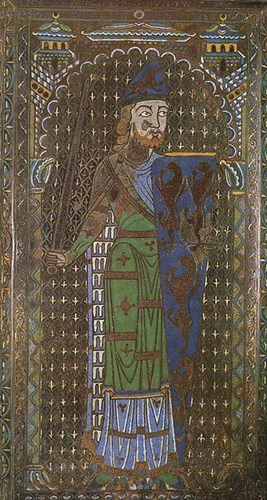
The earliest recorded use of heraldry in Europe is on the tomb of Geoffrey V, Count of Anjou (died 1151). The same shield design is found on the tomb effigy of his grandson, William Longespée, 3rd Earl of Salisbury.
The first English Royal Coat of Arms was created in 1154 under Henry II.
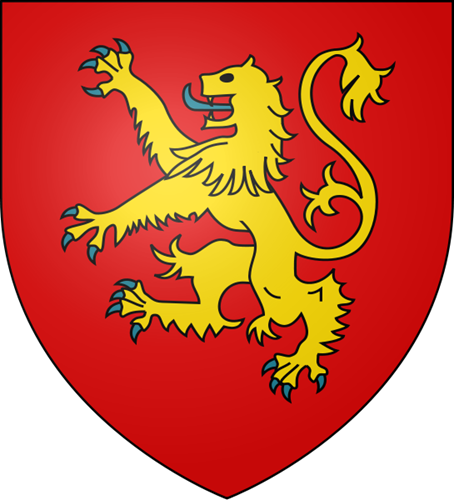
Heraldry became popular among the knights on the crusades - along with the idea of chivalry. Soon every knight had a coat-of-arms and there were so many that some accidentally used the same designs. In order to prevent such mix-ups, the king created people called ‘heralds’ whose job was to write down and record the different coats-of-arms. Because the coats-of-arms were recorded by people called ‘heralds’, the subject came to be called ‘heraldry’.
Heraldic Conventions
Heraldry uses a set of rules to record coats-of-arms in existence. It also has its own language - a mix of Norman-French, English, German and Latin! The rules of heraldry are maintained by the Heralds at the College of Arms.
The Shield
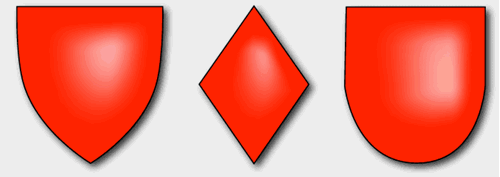
This is the background to a coat-of-arms. It can be different shapes but if the owner is an unmarried lady or widow it is diamond shaped and called a lozenge. The surface of the shield or lozenge is called the field.
Colours

Colours used in coats-of-arms are called tinctures. There are 5 main colours (red, blue, black, green and purple), 2 metals (gold and silver or white) and 2 furs (Vair and Ermine).
Ordinaries
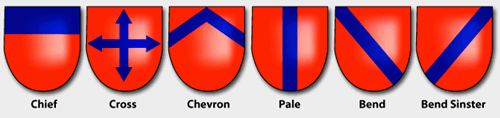
A band or stripe across a shield is called an ordinary. A different name is given to each type of band.
Charges
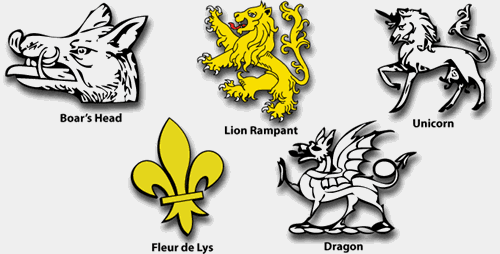
Any decoration on a shield (including the ordinaries above) is called a charge.
Cadency

This is where a different charge is added to a coat-of-arms to show different male family members, i.e. eldest son, second son, etc. The symbols are all fixed (a star, for instance, indicates the third son). Female family members do not have this privilege and have to make do with just the family’s coat-of-arms.
Marshalling

When families with coats-of-arms joined though marriage, the two coats-of-arms were combined on the same shield. This was known as ‘marshalling’ or ‘quartering’. Shields can also be divided into different areas (top, upper centre, centre, base, left and right).
This could go on and on…..
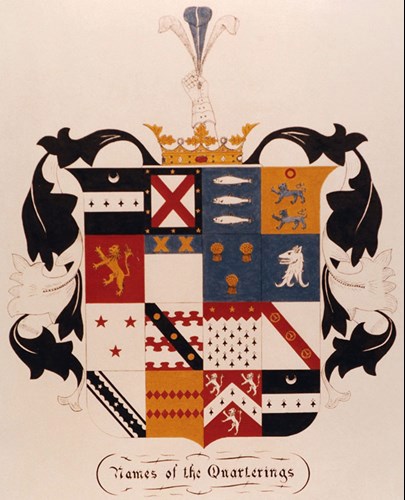
This is a complicated example, with at least 15 different arms involved. It belongs to the family of someone who works at Gloucestershire Archives!
And how about this example?
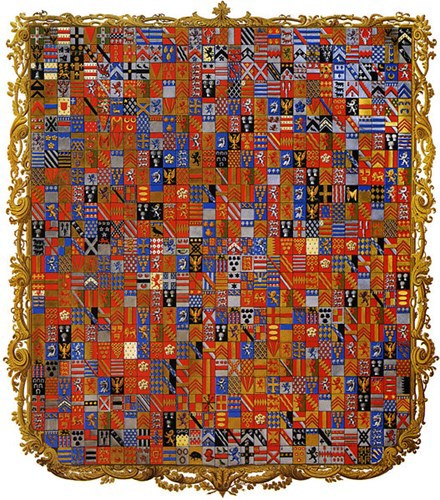
And how about this amazing example? This is a panel of The Grenville Diptych produced for Richard Temple-Grenville, the Marquess of Chandos, which can be seen at Stow House in Buckinghamshire. It shows the combined coats of arms for the Temple-Grenville family and has 719 separate shields in it.
Visitations

The heralds would make ‘Visitations’ so that noblemen could prove their right to bear ‘arms’. Most would produce a family tree called a pedigree. This showed who was the first of their family to receive a coat-of-arms.
This is part of the Kingscote family’s pedigree that is held at Gloucestershire Archives.
If all this sounds complicated think of the poor heralds who have kept track of all those coats-of-arms for over 800 years!
What an achievement!
A coat-of-arms is rarely seen alone and usually has a number of other features, which together are known as an ‘achievement’. An achievement is the ultimate development in heraldry. It combines a coat-of-arms plus other items.
Battlefield Heraldry
As well as wearing their emblems and coats-of-arms on their shields and surcoats knights soon started displaying them on flags. These could then act as rallying points for their men in the confusion of a battle.

Here are some typical examples of the different types of medieval battle flag.
Standard
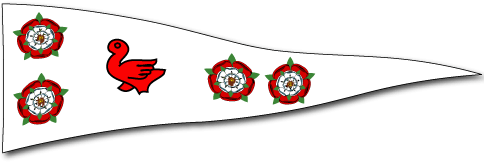
This is a long triangular flag used to mark the rallying point for soldiers during a battle and it usually had badges that the men could recognise quickly and easily.
Pennon

This was a triangular flag with a point or swallowtail and was the symbol of an ordinary knight. It was flown from his lance and usually had his personal emblem or device on it.
Banner

This rectangular flag was flown by kings, princes and those with a coat-of-arms. Royal banners often incorporated national insignia. This was the English Royal Banner flown by the Tudor kings Henry VII and Henry VIII.
To find out about the heraldry of Gloucestershire click here!