
The Dragons of Gloucestershire
There can be little doubt that many gargoyles resemble dragons and, if the French legend about the dragon La Gargouille being the inspiration for gargoyles everywhere is true, then it is little wonder that we have a lot of gargoyles in the county for we also have a lot of dragons!
The Deerhurst Dragon
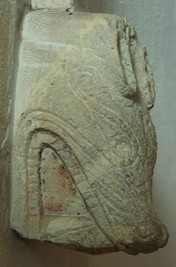
Once upon a time in the parish of Deerhurst (near Tewkesbury), there lived a large dragon that was poisoning the villagers with its fiery breath and eating their cattle. The locals petitioned the king, who issued a proclamation saying that whosoever should kill the dragon would be rewarded with an estate in the parish, which then belonged to the crown. The man who succeeded was John Smith, a local labourer, who put a large quantity of milk at the entrance to the dragon's lair when it was away and then hid nearby. When the dragon came back it drank all of the milk and, feeling full, lay down to sleep in the sun, ruffling up its scales to allow the air to circulate. This was what Smith had been waiting for and he ran up and chopped off the dragon's head by striking the dragon's neck between the scales with a large axe. In the 18th century, the Smiths still possessed this estate and the axe was still being passed from father to son. Today, you can see carvings of the dragon's head at Deerhurst church.
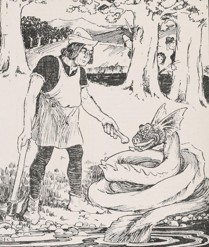
The Coombe Hill Sea Serpent
Not far from Deerhurst is the hamlet of Coombe Hill and many years ago a large sea monster (or possibly a knucker dragon like the picture) came up the River Severn and settled on the riverbank there. At first it only hunted sheep and poultry but it soon began preying on children and milkmaids. Before long, the villagers were all in fear of their lives and many left. The hero of the day was a local lad called Tom Smith (perhaps related to the Deerhurst dragon slayer?), who started leaving food (like roast pig) out for the serpent and by doing so the monster gradually came to trust him, to the point where Smith was able to feed it by hand. One day, whilst feeding the serpent a large marrowbone, he took his axe and smashed it on the head killing it instantly. His reward was limitless free beer in the village pub!
Dragon Place-names and Images in Gloucestershire
The above tales are the only two that have survived about this county’s dragons but there must have been other dragons because there are many places with ’dragon’ elements in their names and also plenty of dragon images. Among these are:
- Stinchcombe – On a hilltop near a hillfort in the parish there was a standing stone called the Dragon’s stone or Drakestone. A house now has the name.
- Cam – In this parish there was a field called Drakelond in 157, though in 1839 the name had changed to Drake Lane in 1839. It may belong to the same legend as the Stinchcombe dragon.
- Dursley – Drakestone Point & Piece
- Newland – A hill in Newland in the Forest of Dean was called Drakehord (the place of the dragon's treasure) in 1337. A later map of 1839 shows it as Dragons Ford.
- Yanworth – A place called Drakenhord is recorded in 1222.
- Sherborne – In the adjacent parish to Yanworth, there was a place called Drakewell. in the 12th century.
- Wormington – this refers to a ‘wyrm’, the name for a non-flying dragon.
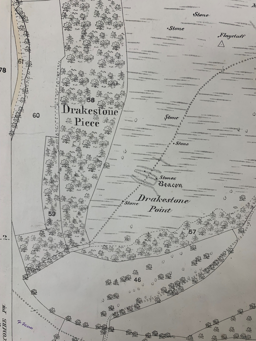 Drakestone Point & Piece, Dursley, 1st Ed OS 1881
Places to see dragons in Gloucestershire
- Moreton Valence Church – This has a winged serpent. In the church doorway there is a 12th century carving showing it being slain by the archangel St Michael.
- Ruardean Church – This is a similar setting, but this time shows St George fighting a dragon.
- Bishops Cleeve Church – Corbels or label end dragonheads.
- Stratton Church – Has a ‘Tree of Life’ carving with a guardian dragon plus some dragon-head window stops
- Fairford Church – has great dragon grotesques
- Toddington Church – a huge dragon gargoyle)
- Elkstone Church - dragonhead window stops
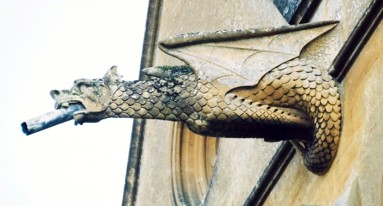 Dragon at Toddington Church