
Who made them and how?
How to make a real gargoyle!
There are several things that you need to make a real gargoyle, such as a suitable building, a good block of stone, a Master Mason and his tools, a lot of money, and a very good imagination!
Below you can see more about these things and why you might need them.
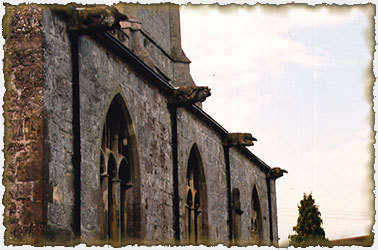
A suitable building
Most gargoyles and grotesques are found on religious buildings such as churches or cathedrals.
Some however can be found on buildings such as palaces, large country houses and stately homes.
Occasionally they are to be found on old medieval hospitals (such as St Bartholomews on Westgate island in Gloucester) and even castles.
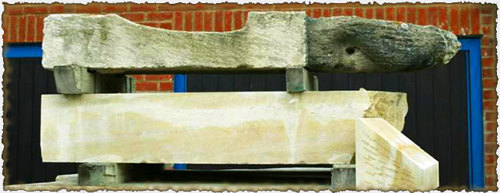
A good block of stone
Most gargoyles are carved from local stone, but not always as sometimes the local stone is simply not suitable for carving.
Some stone is too hard to carve (e.g. dolomite from the Forest of Dean) whilst some is too soft and rots (e.g. the Lias mudstones from the Vale of Gloucester).
If local stone was not suitable then stone would be brought in from elsewhere - the original gargoyles of Gloucester Cathedral are made of stone from Minchinhampton, whereas the rest of the building is made of stone from Painswick.
In Gloucestershire, most gargoyles are made of limestone - the rock that forms the Cotswolds. This is fairly easy to carve and long lasting, though it does corrode slowly when exposed to rainwater (which is actually a weak acid).
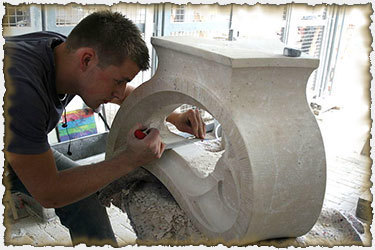
A master mason
Master Masons were professional architects who designed buildings according to their client's wishes and then supervised the construction.
They were real celebrities in the medieval period and earned huge amounts of money, being hired by Kings, Bishops, Priors and the highest members of the nobility.
Stonemasons ranked below Master Masons but they were still important and most had their own 'mark' or signature that they carved into stones - examples at Tewkesbury Abbey are identical to ones in France showing that these men worked throughout Europe.
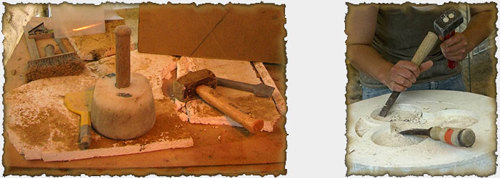
Masons' tools and equipment
Master masons used compasses, dividers, measuring rods, set squares, inks and huge rolls of parchment (to produce architectural drawings on).
Stonemasons used mallets, various chisels, drills, lifting claws and measuring dividers.
A load of cash
Building big buildings was as expensive in the medieval period as it is today.
Master masons liked detail however and so the addition of gargoyles or grotesques to a building was often seen as an extremely high class thing to do!
It also showed to people who looked at the building that no expense had been spared!
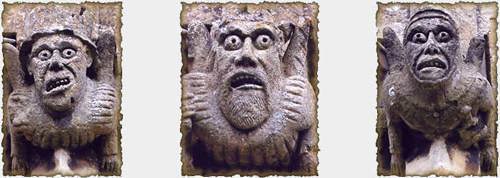
A good imagination
Almost anything can be turned into a gargoyle - animal, human, monster or a mix of all three!
Some gargoyles are modelled on real people who must have been alive when the gargoyles were carved - visit Winchcombe church to see some great examples.
Gargoyles can be scary, friendly or rude... the choice is yours!
Find out about masons' marks here!