
Post-enclosure map of Homestallend, 1592/3
This is the 1592/3 post-enclosure map of Homestallend, which was part of the Manor of Todenham. It was described as land "which laye dispersed by ridges amongst the tenauntes and nowe by consente every mans portion layed togethers". The biggest change in our landscape has arguably been inclosure – it alone created most of what we today call our ‘countryside’. Small scale inclosure had been ongoing since the medieval period – primarily to create rabbit warrens and deer parks. The ‘Inclosure Movement’ however was on a national scale and was instigated by upper class landowners. Their argument was that by enclosing open fields, merging and re-distributing land, it reduced waste, improved efficiency and allowed agricultural improvements that could increase food production.
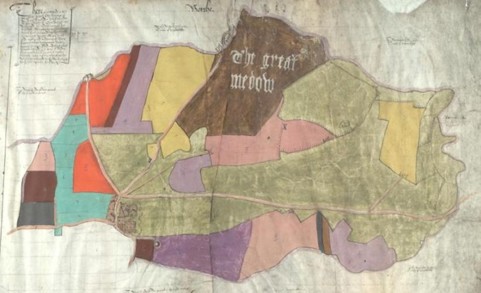
Gloucestershire Archives reference D1099/p1
Pre-inclosure map of Aston Blank, 1752
Prior to the Inclosure Movement, the prevalent agricultural system was the open field system. This owes its origins to the feudal medieval manor where a Lord allowed his tenants to work land, provided that they worked his land as well. Manors typically had two or three large fields, which were divided into many long narrow strips or furlongs for cultivation. Non-arable land was allocated to common pasture, meadow or waste (where the villagers would graze their livestock throughout the year), woodland (for pigs and timber) and private fenced land (paddocks, orchards and gardens), called closes. An individual tenant farmer's holding, or ‘yardland’, typically consisted of about 20 acres of land lying in 70 or so strips, scattered all over a manor with no two strips lying together. On this pre-inclosure map of Aston Blank (aka Cold Aston) the individual strips can just be made out.
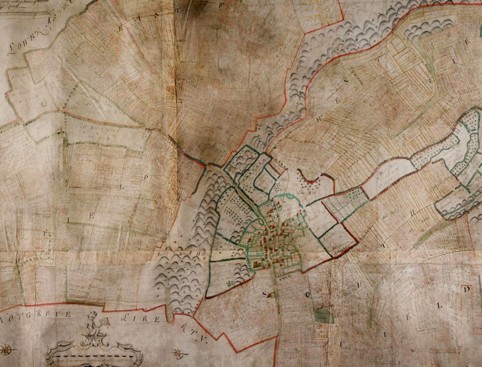
Gloucestershire Archives reference D2231
A Map Plan and Admeasurement of the Parish of Cold Aston, otherwise Aston Blank, in the County of Gloucester made for the purpose of being annexed to that part of the Award which is directed by Act of Parliament to be deposited in the Parish Chest of the Church, 1795
The inclosure movement essentially saw the replacement of the open-field system by privately owned property. It succeeded because it was argued that by inclosing land it made farming more efficient – at a time when county needed more food thanks to an expanding population. The earliest inclosures were undertaken by rich landowners who obtained private Parliamentary Bills but in 1773 an Act of Parliament was passed to legalise inclosure – provided a systematic process and certain conditions were observed (allegedly). The winners were the big landowners who took the best and most land, while the losers were the commoners and the poor who received little or no good land and lost most of their common rights. Public opinion had its own view……
‘They hang the man, and flog the woman,
That steals the goose from off the common;
But let the greater villain loose,
That steals the common from the goose.
The law demands that we atone
When we take things we do not own
But leaves the lords and ladies fine
Who take things that are yours and mine.’
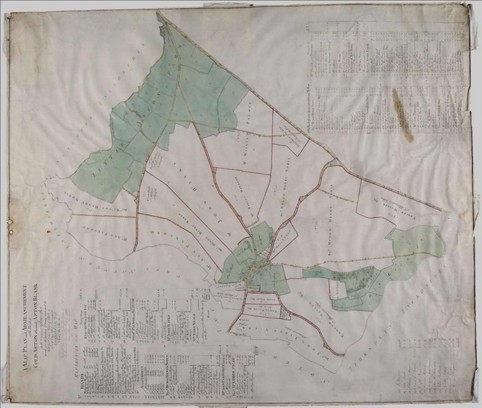
Gloucestershire Archives reference D75/P1 (orientated to match previous map)
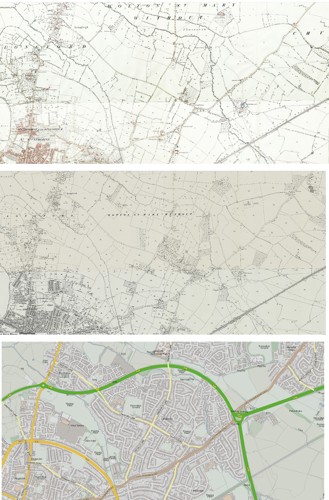
Longlevens through time – 188, 1902 and Modern OS maps
Nothing shows landscape change like the outskirts of towns where – within living memory – the growth of housing has covered once green fields. These maps show the same area of Longlevens in Gloucester from 1881 (top), 1923 (middle) and 2023 (bottom). The urban growth is easily visible.
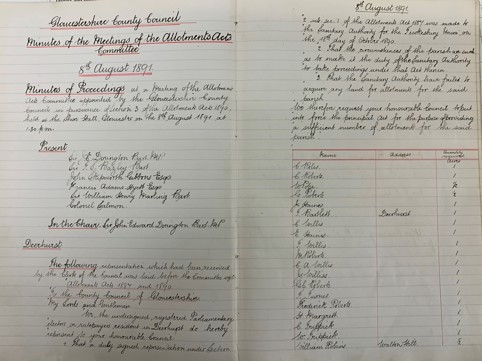
Gloucestershire County Council Allotments Act Committee Minutes, August 1891
Allotments have been in existence since medieval times, but following the Inclosure Acts, the land available for cultivation by the poor was greatly diminished. Followed by rapid industrialisation and the lack of a welfare state it became apparent by the 1850s that the labouring poor needed land to grow food and allotments were proposed as a charitable means by which they could grow their own food and stave off starvation. Despite this it wasn't until 1890 that legislation was enacted with the passing of the Allotments Act which placed a duty on local authorities to provide sufficient allotments, according to demand. After the passing of the act, Gloucestershire County Council created an Allotments Act Committee, whose main role was to ensure that Urban and Rural District Councils provided smallholdings and allotments to their constituents. Allotments were created in most locations and as well as growing food, livestock such as hens, rabbits and bees were permitted on many sites. The committee also ensured that the letting rates of smallholdings and allotments were set at no more than that for local farmland.
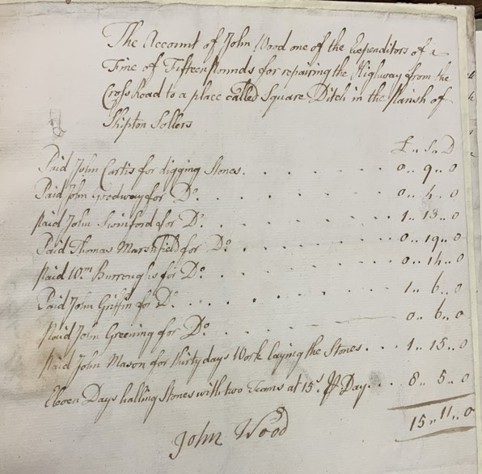
Quarter Sessions account of repairing the highway in Shipton Sollars, 1761
Transport is probably one of the least environmentally friendly things inflicted on the landscape by humans. Prior to the motor vehicle, donkeys and horses were the most common form of tractive effort and were environmentally friendly but as time, even they needed a road network. Roads have been built since the Roman period and have been getting larger and more robust over time. The county Quarter Sessions was the body responsible for the building and repair of roads. This is an account of repairing the highway in Shipton Sollars in 1761. Seven men were paid for digging stones – presumably quarrying them from their land – while another was paid for hauling the stones to the site and one man paid for laying them. The total cost came to £15 11s – around £1,800 today.
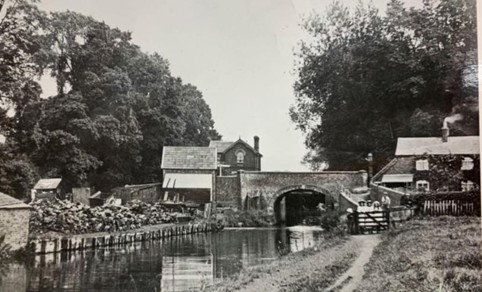
Eastington Bridge, Stroudwater Canal, c1910
Canals had fairly little impact on the landscape. Typically, they had a width of only about 20ft (6m) to allow working. Where required – such as at Eastington here - bridges were built to allow roads to pass over them. The main environmental drawback was their requirement for water – springs, rivers and streams were all utilised to provide a supply. Where locks existed to allow raise the canal level, consumption of water was high, so pumping stations – steam powered – were built used if necessary. Some canals always suffered from lack of water – the Thames & Severn was especially notable in this respect. Today they are important to the local environment and make good wildlife corridors.
Gloucestershire Archives reference D9746/2/301/6
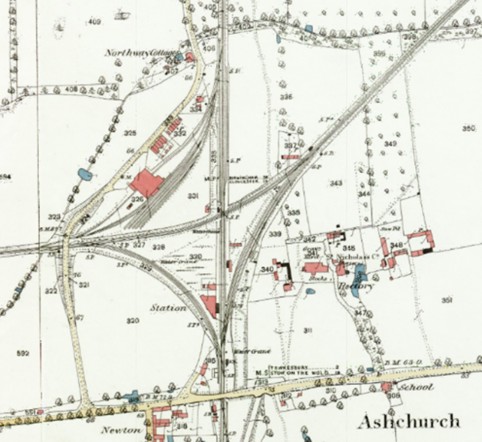
Midland Railway Junction at Ashchurch, c 1881
Unlike canals, railways were land hungry. A double-track railway needed a minimum of 50ft (15.2m) but typically much more! On approaches to stations, marshalling yards and junctions, railways ate land and often the tracks enclosed vast spaces. This is a typical example - the railway at Ashchurch, c 1881, showing the junction between the Midland Railway’s Bristol & Birmingham Branch (N-S), the Ashchurch, Tewkesbury & Malvern Branch (W) and the Barnt Green, Evesham & Ashchurch Branch (NE). The track layout here shows how much land was required. The main reason was that trains required gentle curves and gradients, so the radii of any curves was greater. One positive aspect of this was that the space enclosed by railway tracks subsequently became ‘waste’ land populated primarily by plants (typically buddleia, bramble, sorrel, etc) which in turn encourage insects and pollinators, plus mammals such as rodents, rabbits and foxes.
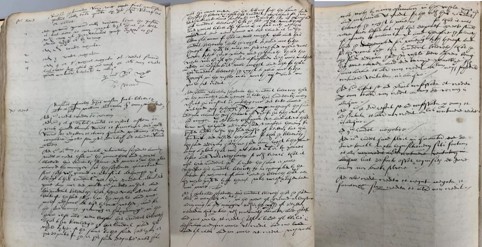
Gloucester Diocesan Records Act Books – Depositions, 1586-1592
The earliest reference to the weather in the archives is from the Diocesan Court books – sadly written in Church Latin in an awful hand! It relates to a 1588 tithe dispute where John Weston, a farmer, argued he should pay less tithe because hay he’d mown in a field called The Coniger was ‘lost through evil weather’. Presumably, he had mown the field, and the hay was drying when the weather turned and ruined the crop - even today, the success of haymaking depends on the weather. One common quote sums this up: ‘What is the difference between a good farmer and a bad one? Timing.’
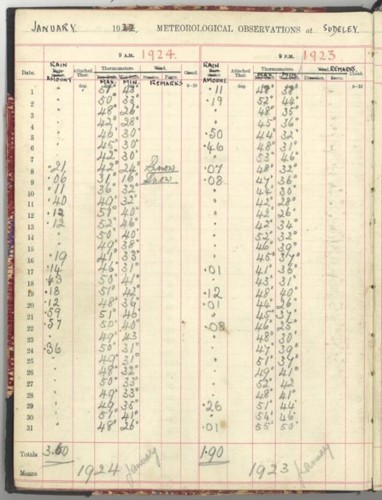
Meteorological Observations at Sudeley, January 1923 & 1924
The archives hold a number of weather reports, mostly collected from in 1900s onwards. The bulk of these were recorded by amateurs, but Staverton aerodrome and Cheltenham Borough Council both compiled returns from official observers as well as voluntary ones. This is typical set of ‘Meteorological Observations’ recorded in a dedicated meteorological notebook by a member of the Dent-Brocklehurst Family of Sudeley in Winchcombe. The volume covers the years 1922-1936 and this is the page for January 1924 and 1923. Although the volume has pro-forma headings for Barometer, Thermometer, Wind and Cloud readings, sadly the recorder has altered these and has only recorded rainfall, temperature and remarks.
Gloucestershire Archives reference D2579/E7
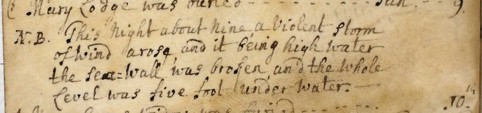
Awre parish register, 1737
The Severnside parishes were always on guard against weather-related flooding and storm-surges. This example comes from the parish of Awre in 1737, when a ‘violent storm of wind’ overtopped and broke the sea-wall, flooding the immediate area to a depth of five feet. This was probably Woodend – a small hamlet south of the village which was lost to the river around this time.
N.B. This night about nine, a Violent storm
of wind arose, and it being high water
the sea=wall was broken and the whole
level was five foot under water.
Gloucestershire Archives reference P30/IN/1/1
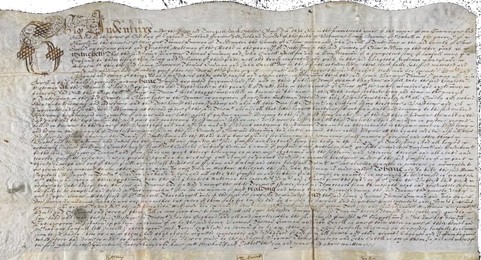
Lordship or manor of Mythe, 1638
With the River Severn running through the county, Gloucestershire and the Vale of Gloucester has always experienced flooding, usually – but not always – on a seasonal basis. The earliest document in the archives that relates to seasonal flooding is a 1638 deed of the sale of the Manor of Mythe in Tewkesbury. As well as the site of the manor, a capital messuage called Mythe House, one messuage, two cottages, a parcel of land, the rights to tithe payments and fishing rights in the Severn and Old Avon, this deed included the rights to the ferry that was used ‘between the Town of Tewkesbury and the Mythe Hill in time of the ffloode for drawing and carrying all manner of persons and other things through the water’.
Gloucestershire Court of Sewers: General minutes, 1583-1607
The earliest body tasked with managing flooding was the Court of Sewers which held jurisdiction over the sea walls and watercourses (then called sewers) on low-lying coastal land along the Severn. The burden of sea defence and land drainage fell on landowners and tenants, and the job of the court was to assess compliance, specify remedial work and apportion costs pertaining to the sea walls and drainage systems – known locally as reens, gouts and pills. The records name those responsible for repairs, the extent for which they are responsible and the date by which it should be completed, on pain of paying a fine or having it done at their expense. This is the first page of the first minute book and is typical: noting broken sea walls in Berkeley, a request from inhabitants of Ham to raise the sea wall and at the bottom, a list of men responsible for repairing the sea wall at Oldbury. An excellent account of the work of the Court of Sewers can be found in the latest edition of the Bristol & Gloucestershire Archaeological Society’s Gloucestershire Record Series; 'The Gloucestershire Court of Sewers' which can be obtained here: https://www.bgas.org.uk/volumes/about-vol-35-the-gloucestershire-court-of-sewers
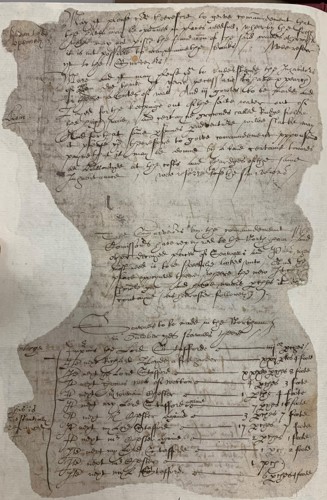
Gloucestershire Archives reference D272/1
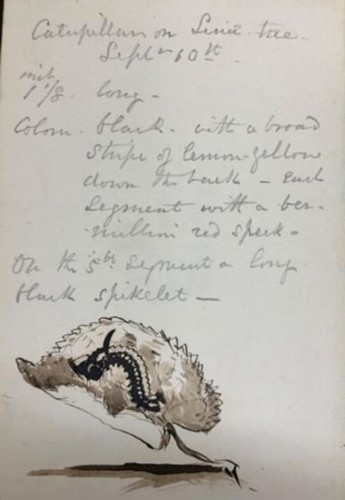
Guise Family notebooks containing notes on natural history, 1870
The natural history collections contained within the archives comprise many different forms, from written notes, published volumes and drawings and paintings. This is a page from a nature notebook belonging to the Guise Family of Elmore drawn around 1870 that depicts a caterpillar found on a Lime tree. The author has also written down notes about the insect – which we think identify it as a Lime Hawk-moth (Mimas tiliae).
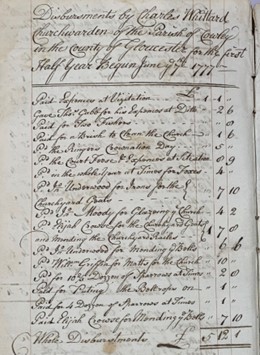
Cowley Churchwardens Accounts, 1777
Today – thankfully – our wildlife is protected by law. However, in the past, wildlife wasn’t protected and - for a time, it was the opposite – the destruction of certain species was actively encouraged. By the 1500s the nation was recovering from the Black death of 1349, but food production wasn’t keeping up and the population was more or less always one failed harvest away from starvation. As a result, Henry VIII and Elizabeth I introduced laws to control vermin in order to conserve food. Henry’s act was vague but Elizabeth’s ‘An Acte for the preservation of Grayne, 1566’ included a list of the species classed as vermin and the bounty people would receive for killing them. To claim their bounty for killing these animals, parishioners would take the head to the parish Churchwardens, who’d pay the bounty. Many of these bounties are recorded in the Churchwarden’s accounts of the county’s parishes. This page from the parish of Cowley in 1777 records bounties paid for ‘two fishers’ (kingfishers) 2s 6d (£11 today), ‘for foxes’ 4s (£17), ‘for 10 dozen sparrows’ 2s (£8) and ‘for 4 dozen of sparrows’ 1s (£4). Sparrows were heavily targeted as they were deemed to be a pest on crops and damaged buildings (especially thatched ones). Between 1700 and 1930 an estimated 100 million sparrows were killed - it was still legal to catch and kill them up until 2005!
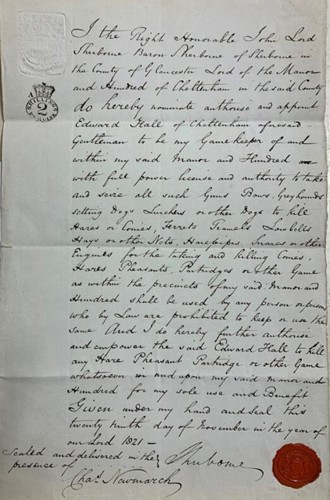
Appointment of Edward Hall of Cheltenham, as gamekeeper for the manor of Cheltenham, 29 November 1821
Gamekeepers are no doubt responsible for the loss of much of our wildlife and in many respects, also the alteration of the environment to suit certain species at the detriment of others. They were hired (usually) by upper class country landowners to control ‘vermin’, to raise and look after game for hunting and keep out any poachers. Gamekeepers had to be licensed by local JPs – although in many instances, these were the people who employed them! Applications had to include certain set statements and written by the employer of the prospective gamekeeper – such as this example, written by Lord Sherborne, appointing Edward Hall to be his gamekeeper on the Manor and Hundred of Cheltenham.
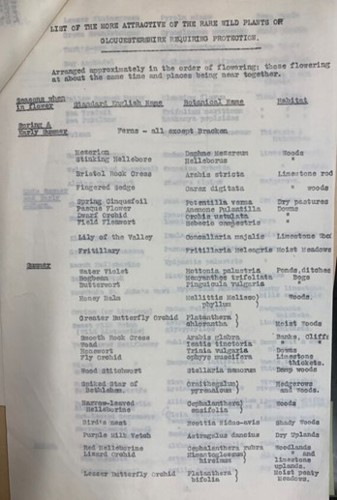
List of the More Attractive of the Rare Wild Plants of Gloucestershire Requiring Protection, 1937
By the 1930s the Council for the Protection of Rural England were concerned about the decline of wild flowers and plants and their Wild Plant Conservation Board sent out pamphlets about protection of wild flowers, after which Gloucester Borough Council generated this non-aesthetically correct list of "the more attractive of the rare wild plants of Gloucestershire requiring protection" Although there have been Acts protecting certain game species in the past (typical upper classes!), the first piece of real conservation legislation in the UK was the Protection of Wild Birds Act 1954, which was revised in 1967. Over time, it became apparent that other species required protection and that such conservation was probably best considered alongside other elements of natural history and so the Conservation of Wild Creatures and Wild Plants Act 1975 came into being. These two acts were consolidated into one new piece of legislation, the Wildlife and Countryside Act 1981 which is still in force today and is reviewed every 5 years.
Gloucestershire Archives reference GBR/L6/23/B2576
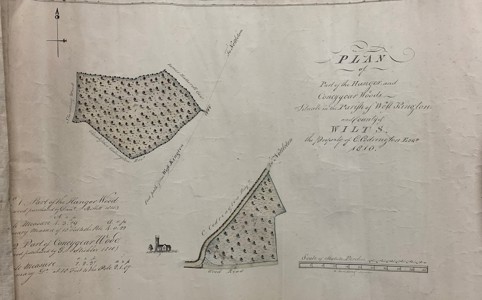
Parts of the Hanger and Coneygar woods, 1810
There are many records relating to woodlands in Gloucestershire Archives including such things as maps and plans and wood accounts. The latter generally comprise sales of wood and other things such as faggots, poles, timber, ‘fine wood’, lops, old trees, etc. The former are more general and mostly show outlines of woods, sometimes with notes on the trees in them. This plan of Hangar Wood and Conygear Woods in West Kington in Wiltshire comes from the Codrington of Doddington archive and is typical. It shows the plans of the woods together with their acreages as well as hedges, gates and roads. Like many of these plans, it includes a drawing of some local features – in this instance a perspective sketch of West Kington Church.
Gloucestershire Archives reference D1610/P47
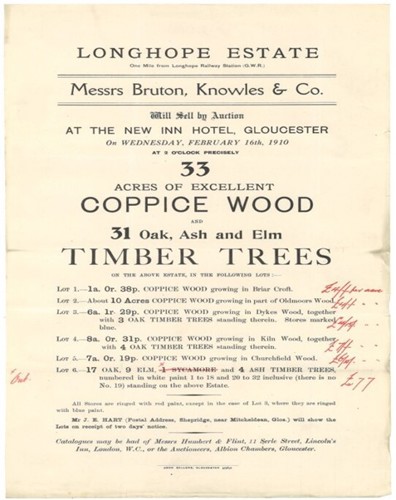
Sale particulars of coppice wood, Longhope Estate, 1904
Coppicing is an ancient form of woodland management. It involves repetitive felling on the same stump (‘stool’) near to ground level, allowing the shoots to regrow from the stump. Every 7-20 years, depending on the species of tree being coppiced - a new crop is available. Coppicing ensured a regular source of firewood (for domestic use and for making into charcoal for iron production) and timber (for fencing, house building, and cart-making). It also improved the health and biodiversity of woodlands by opening them up to the sunlight, allowing a wider range of plants to flourish. Today it is making a widespread comeback and is used by ‘bodgers’ to make fences, benches, stiles and stakes and charcoal for BBQs. This auction sale form the Longhope estate was for several lots of trees to be coppiced and individual ‘standards’ (the larger trees that were left to mature into adults) to be felled.
Gloucestershire Archives reference D2299/1/1/414
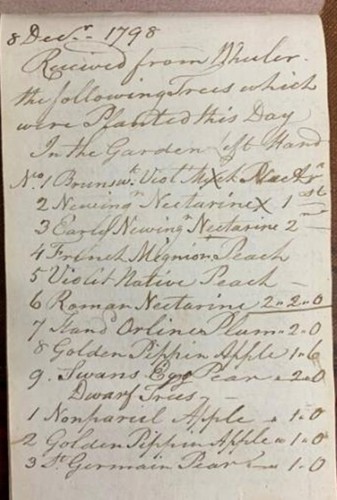
Estate memoranda of James Agg, relating to orchard on Prestbury property, 1798
Gloucestershire is blessed with orchards – the bulk being in the Vale and along both banks of the Severn. Nearly all were planted deliberately and they are one of the most biodiverse habitats in the county. As a whole they have been in existence for almost a thousand years with some individual orchards being incredibly old. ‘Modern’ orchards used trees obtained from specialist fruit nurseries – such as this example, a receipt from a 1798 memo book of James Agg’s Prestbury Estate in Cheltenham which used trees from Wheeler’s Nursery in Gloucester. It lists nectarine, peach, plum, pear, and apple trees.
Gloucestershire Archives reference D855/E8
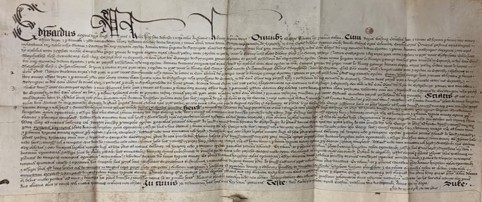
Deed to Bridgesburye Farm, Cirencester, late belonging to the monastery, 1552
Farms are everywhere in Gloucestershire – but the first named farm in the archives does not appear until the mid-1500s. It is named in this deed as ‘Bridgesburye farm’ and was granted by letters patent of Edward VI to Sir Anthony Kyngston, Provost Marshal and High sheriff of Gloucestershire, in September 1552. The farm was originally a possession of Cirencester Abbey and had passed into the Crown’s hands at the Dissolution.
Gloucestershire Archives reference D674b/T18
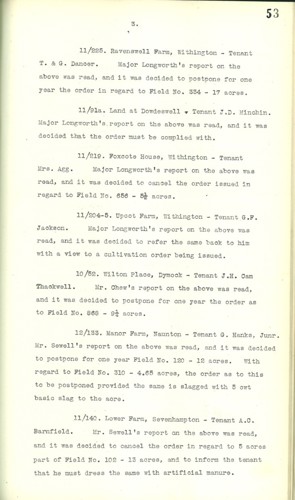
Gloucestershire War Agricultural Cultivations Committee minutes, 8 November 1918 - 24 May 1919
Among the most interesting agricultural records are those from the WW1 ‘WarAG’. The War Agricultural Executive Committees were government-backed organisations tasked with increasing agricultural production in each county, during both WW1 and WW2. They were established in Autumn 1915 by the 2nd Earl of Selborne in a collaboration between the Board of Agriculture and County Councils, with the aim of better managing the country's limited wartime agricultural resources. This page from the minutes for November 1918 details reports on farms served with official cultivation orders – often for individual fields. The WarAg records cover all manner of agricultural items from distribution and use of horses, hire of tractors, land use, crops, pests and dairy.
Gloucestershire Archives reference CWA/M4/2
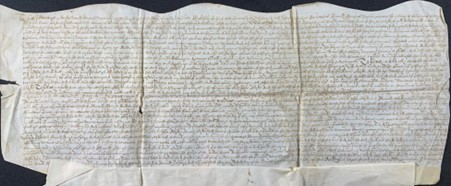
Messuage in Long Newnton with ‘flyghte of pygeons’, 1593
In the past pigeons and doves were important and environmentally friendly food sources. They have been farmed for food since neolithic times and throughout the medieval and early modern period were highly regarded as an easily available source of protein. As well as being a sustainable source of food, these birds provided feathers for the aristocratic household and manure for the estate. This 1562 deed from Long Newton in Wiltshire for a messuage and three closes also includes a culver-house or dove-house. The word ‘culver’ comes from the Old English culufre, culfre, which was derived from the Latin columbula, meaning “little pigeon” and the Latin columba for “pigeon”. Today this now specifically means the Wood Pigeon (Columba palumbus), although in the past most of the birds raised for food were Domestic pigeons (Columba livia domestica) which are the domesticated form of the Rock Dove (Columba livia) or wild pigeon. Although many larger houses and estates boasted dovecotes in some shape of form – and we have numerous examples of deeds showing this here in the archives – what is significant about this deed is that it specifically included a "flyghte of pygeons“ as part of the deal, which was rare. A final thought regarding domesticated pigeons is that as well as food, they were also valued for their religious significance due to their associations with the Holy Spirit in Christian thought.
Gloucestershire Archives reference D1571/E88
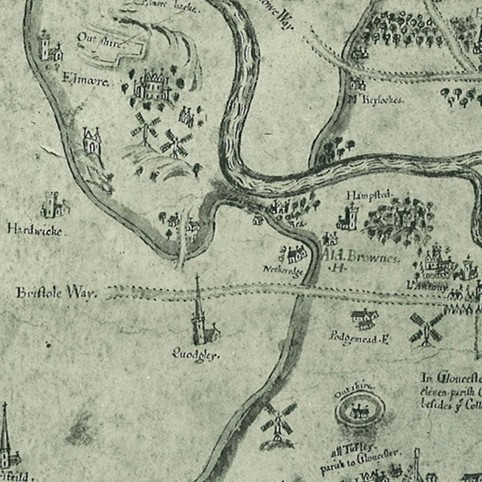
Windmills on the southern side of Gloucester, c1624
The most common energy generating mechanisms in Gloucestershire prior to the 1800s were water mills and windmills. For centuries, these totally green sources of power have been driving mechanisms for fulling wool cloth, for paper production, for sawmilling, for electricity generation, to grind flour and animal feed. Watermills were more common, and most rivers and streams had one or more of them along their length – sadly, although many mill buildings survive today few of them are still working as mills, the Stanway Mill (https://www.stanwayfountain.co.uk/the-watermill.html) being an notable exception). Windmills were used where the gradients of rivers and streams – even with judicious fluvial engineering – were too slight to power a water wheel. As can be seen in the image above, several windmills existed outside Gloucester, where the low-lying aspect of the landscape made wind power far more suitable than waterpower. Like watermills, windmills were expensive to build – one built for the Duke of Beaufort at Stapelton by Mr Carther, a Bristol based millwright, which had a tower 30-feet high and 14 feet in diameter cost over £230 (around £24,000 today).
Gloucestershire Archives reference GBR/acc7380
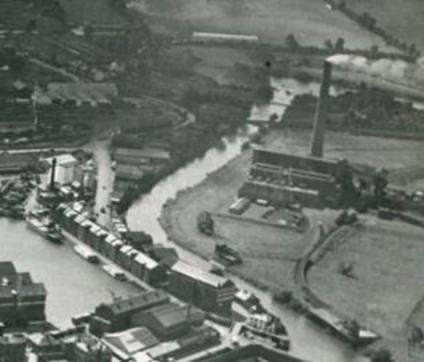
Castle Meads Power Station, Gloucester, 1958
Prior to the advent of nuclear power, the only economic means of generating electricity was by burning coal in coal-fired boilers that supplied high-pressure steam which powered turbo-alternator sets that generated electricity. This is the Castle Meads Power Station in Gloucester, which generated 40MW – a typical output for the period. It was Gloucester’s very own electricity generating plant, built on the banks of the Severn, opposite the docks and the Old Quay. It owed its existence primarily to the advent of the Second World War, as it had been built with government involvement as one of two war emergency stations (the other being at Earley near Reading), essentially acting as a national backup generating station, located in a safer area, away from major cities and their more vulnerable power plants. Electricity was generated by burning coal, which was brought in via the GWR's Docks branch from Over, and by barge on the Severn. It was originally owned by the Corporation of Gloucester, but between 1948 to 1958, it was operated by the British Electricity Authority, followed by the Central Electricity Authority. From 1958 until it closed in 1972, it was operated by the Central Electricity Generating Board, being demolished in 1978.
Gloucestershire Archives reference D10638/6/09/1958