
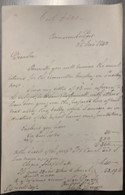
Letter from John Denyer, Thames & Severn Canal Company Agent, to John Stephenson Salt, Thames & Severn Canal Company Treasurer, London, 1842
The letter was written on 25 November 1842 by John Denyer, the Thames & Severn Canal Company’s agent (manager) at Brimscombe Port. Every week Denyer sent John Stephenson Salt, the Company Treasurer in London, details of traffic and water levels over the summit etc, together with a covering letter about matters of interest. This letter was one such and contains one prophetic sentence, ‘Mr Brunell, with others have been going over the proposed line of rail road along this valley, which I consider as indicative of the report having some foundation…” The ‘line of rail road’ was the Cheltenham & Great Western Union Railway and Brunel was its chief engineer. Parts of it had already been built and when it opened fully in May 1845, it took much of the canal traffic and within 70 years the canal would be abandoned….
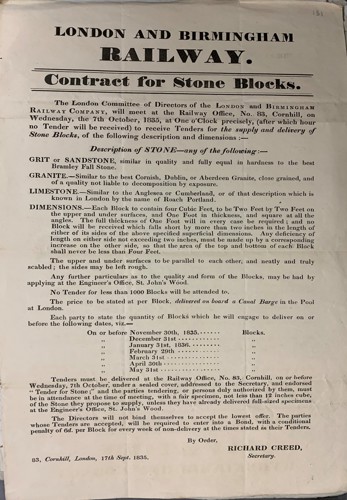
Contract for stone blocks for London & Birmingham Railway, 1835
Whenever railways were built construction materials – stone, timber and metal – were required, usually in vast quantities. This document is a contract outlining the London & Birmingham Railway’s requirements for stone blocks and was sent to David Mushet, Forest of Dean Ironmaster, on 17 September 1835 presumably to see if he would tender for the contract. The blocks were probably to be used in the construction of embankment walls but whether the Forest of Dean stone was suitable isn’t known. The railway itself was in operation from 1833 to 1846, when it became part of the London & North Western Railway (L&NWR) and then ultimately, after the 1924 railway grouping, the London Midland & Scottish Railway (LMS). Today it is the southern portion of the West Coast Main Line.
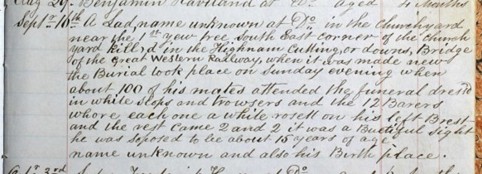
Churcham rough burial register, 16 September 1849
Building railways was the realm of the ‘Navvies’ – vast gangs of itinerant labourers (around 30% of whom were Irish) who went from job to job around the country. Navvies and their families lived and worked in appalling conditions, living in rough timber and turf huts alongside the bridges, tunnels and cuttings that they built. They had a reputation for fighting, hard living and hard drinking – most Victorian society viewed them as degenerates and a threat to social order, but most of the criticism was unjustified. Despite exploitation and extreme deprivation, they achieved amazing feats of engineering—equipped with little more than gunpowder, picks, shovels and wheelbarrows – but at a terrible cost. Deaths were common – typically 3% of the workforce. This entry in Churcham parish’s rough burial register records the burial of a young navvie, aged about 15, who had died whilst working in the railway cutting at Highnam.
A Lad, name unknown at [Churcham] in the churchyard
near the 1st yew tree south east corner of the church
yard kill’d in the Highnam Cutting, or downs, Bridge
of the Great Western Railway, when it was made new
the Burial took place on Sunday evening when
about 100 of his mates attended the funeral dress’d
in white slops and trousers and the 12 Barers
whore each one a white rose on his left Brest
and the rest came 2 and 2 it was a Buetiful sight
he was soposed to be about 15 years of age,
name unknown and also his Birth place.
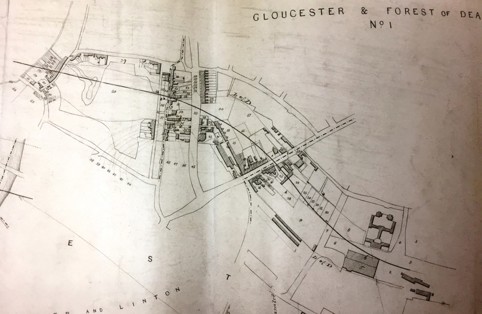
Quarter Session deposited plan for the Gloucester & Forest of Dean Railway, 1845
By law, plans of public undertakings were required to be deposited with the Clerk of the Peace of the appropriate counties. These included canals, horse or tram-railroads, docks, rivers, turnpike roads, water supply, ferries and bridges, gas schemes and tramways but the great majority from 1830 to 1875 are of railways – such as this one for the Gloucester & Forest of Dean Railway of 1845, with I K Brunel as it’s appointed engineer. These Q/Rum plans are typically very large manuscripts with books of reference, giving details of the ownership, occupation, use and area of land affected by the schemes. They vary greatly in detail but, almost always only property immediately adjoining the railway is shown. Some are based on the relevant Ordnance Survey 1 inch to 1 mile sheet with the route of the proposed line superimposed, such as this example, which shows the proposed line passing through the Kingsholm area of Gloucester. Interestingly, many of the railway schemes were never carried out, so the plans cover parts of Gloucestershire where no railway was subsequently built.
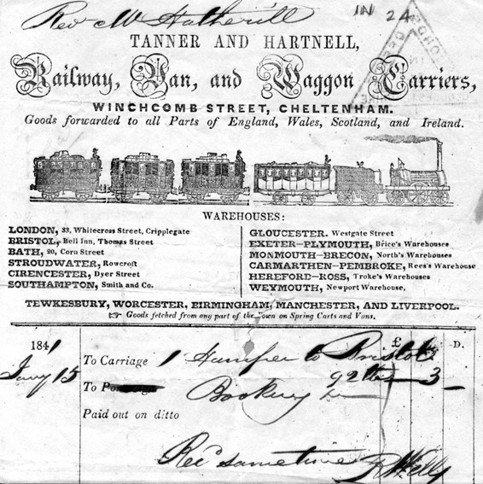
Receipt from Tanner And Hartnell - Railway, Van and Waggon Carriers, July 1841
This is a receipt from Tanner and Hartnell, Railway, Van and Waggon Carriers, of Winchcombe Street in Cheltenham, dated July 1841. It has a stylised header showing a stylised 2-2-2 steam locomotive, tender and carriages and records the carriage of a single hamper belonging to Rev. W Hatherwell to Bristol, for 3s (around £9 today). Like canals before them, railways offered an excellent way to move goods around the country – especially goods with a high weight to value ratio, such as coal – but railways were much faster and relegated the canals to history.
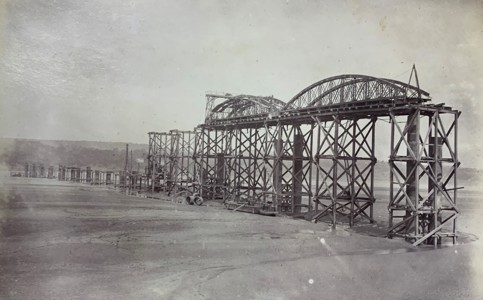
Construction of Severn Railway Bridge, around 1876
Where a railway had to cross a waterway, road or other gap, the solution was to build a bridge. This is the Severn Railway Bridge – it was the largest rail bridge in the county. It was built for the Severn Bridge Railway Company, primarily to carry Forest of Dean coal to the docks at Sharpness; it was the furthest-downstream bridge over the Severn until the opening of the Severn Bridge motorway bridge in 1966. Construction of the Severn Rail Bridge started in 1875, and it was opened to traffic in 1879. This image, taken at low water, is looking roughly north-eastwards and shows two of the eastern bridge spans under construction. It comes from a contemporary photograph album that is dated to 1876 and although its providence is unknown, the quality of the photography is good.
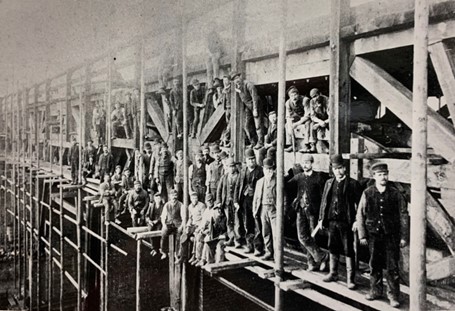
Watts Viaduct, Stroud, around 1889-92
Viaducts are essentially long bridges that cross wider valleys and low-lying areas where there may or may not be a river. The yare common in towns and cities, where the railway must be carried above buildings and roads. Typical examples of the former is St. Catherine’s Viaduct where the South Wales Mainline crosses Alney Island west out of Gloucester, while a typical example of the latter is the viaduct in Kingsholm, which runs from St. Oswald’s to Gloucester Station. However, with steep valleys, rivers and a canal, Stroud is a town of viaducts, having five in close proximity. These viaducts were timber structures, built around 1845 but all were subsequently rebuilt in brick. This image shows the 12-span Watts Viaduct (132yrds) on the line leading into the town from the west was being bricked up around 1889-1892. The large timber baulks are part of the old viaduct, while the scaffolding is the smaller timbers and metal poles. At the bottom left, some of the new brick-built columns can be made out.
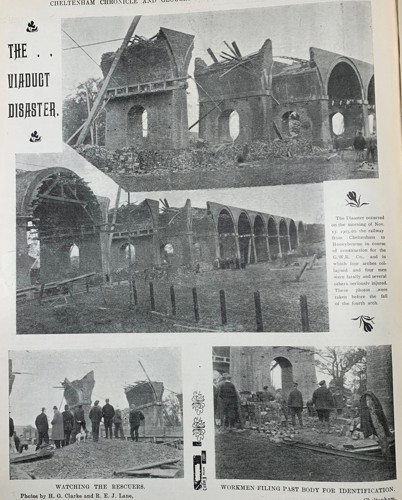
Stanway Viaduct disaster, Friday 13 November 1902
By Autumn 1902, work on the GWR’s Cheltenham to Honeybourne line was progressing well and the largest engineering structure, the gently curving 218 yard (200m) long, double track, 15-arch Staffordshire blue brick Stanway viaduct, was nearing completion. Suddenly, at 8.15am on Friday 13 November, the viaduct suffered a partial collapse when the newly completed No. 10 arch fell soon after its timber supports had been removed, taking a crane which was on top with it. The crane driver survived, and he was rescued and moved under No.9 arch….. just as this too collapsed. While he was being dug out a second time, the No.8 arch also collapsed followed by the No.7 arch and huge cracks appeared in the No.6 arch. The cause was never fully determined but was probably a combination of the weather, ground conditions, early removal of the timber supports, the weight of the crane and the type of mortar used. It was also suggested that some of the labourers were unskilled workers (bakers and farm hands, etc.), drawn by the good wages. After the collapse, the viaduct was rebuilt and opened to traffic the following year and carried trains until the line closed 1976. It reopened to heritage rail services in May 2010 as an extension of the Gloucestershire Warwickshire Railway – it is currently closed while repairs are undertaken to prevent water penetration into the structure.
Ledbury railway tunnel accident, April 1915
Ledbury tunnel lies just over the border in Herefordshire, but this photograph is part of the Gloucestershire Railway Carriage & Wagon Company Ltd. In April 1915, there was a serious accident when a goods train being directed into a higher-level siding to allow a following express to pass, missed a warning signal. The driver was unable to stop, and the train went through protective trap-points at the end of the siding and derailed. The locomotive came close to falling from the siding onto the main track but several of the wagons (carrying loads of brick, stone and cutlery). The driver was pinned under the engine for three hours until lifting equipment – some of which is seen here – arrived from Swindon but, unbelievably, he suffered only minor injuries. Trap points are railway safety devices that are used to protect main railway lines from unauthorised trains exiting sidings onto the main line by derailing them before they egress the siding.

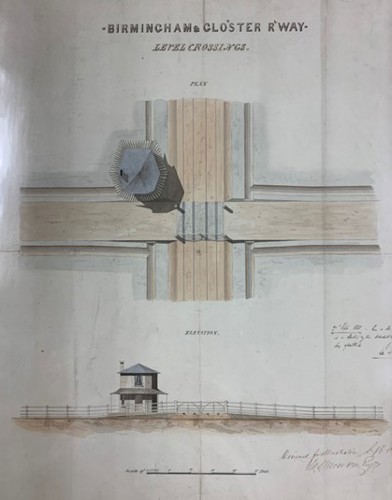
Level crossing, Birmingham & Gloucester Railway, 1838
When railways met roads on even ground, gated level crossings were used to allow passage of trains, road traffic and pedestrians. Taken from the parish records of St. Mary’s in Cheltenham, this plan and elevation shows the original Alstone level crossing that was built by the Birmingham & Gloucester Railway. The crossing is still in use today, although the gate keeper’s cottage is now gone.
Barton Gates crossing, Gloucester, 22 February 1959 and 10 December 1960
These two photographs taken from the archive of the Gloucester Citizen, both show the Barton Gates level crossing in Gloucester, linking Eastgate Street and Barton Street. The crossing was one of the busiest in the county, sat across the Tuffley Loop just to the south of Gloucester Central Station. The top photograph shows the keeper in the process of closing the four large gates, while the bottom photograph shows the automatic barrier gates, which were newly installed around the time of the photograph in 1960. Quite possibly this is the first time that they were in action!

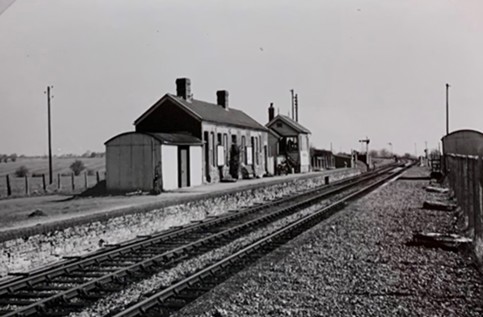
Foss Cross station, circa 1930
Country stations typically had the bare minimum required to function: a platform (two if the line was double-track), a ticket office/waiting room, a platform shelter and a lamp hut (typically made of corrugated iron) – used to store lamps and lamp oil, plus the tools and spare-parts needed for lamp maintenance and repair. Located midway between Cirencester and Withington on the Midland & South Western Junction Railway, Foss Cross Station was typical of many small rural railway stations. It opened in August 1891 with the opening of the Cirencester to Andoversford Junction section of the MSWJR and closed in September 1961. Passenger numbers were never huge and came mainly from the village of Calmsden about 2 miles to the south-west, plus the villages along the Coln valley between Coln Rogers and Bibury. Unlike some small stations Foss Cross had its own signals box, which controlled train movements not only on the through lines but also on the sidings of the station, which served local quarries. In 1895 a goods shed was built south of the station on the down line and in 1911 cattle pens were opened on the up line. However, like so many rural stations, commercial and passenger traffic fell rapidly after WW2 and prior to Foss Cross’ closure, there was just one regular passenger, a lady travelling from Cirencester to her job at a farmhouse near to the station.
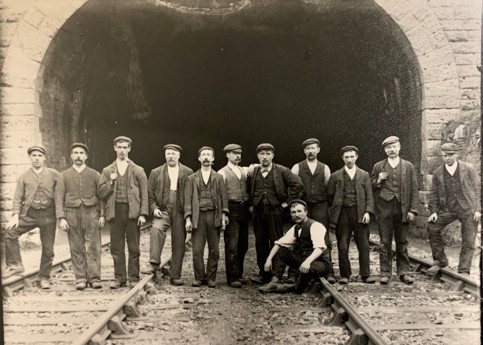
'Permanent Way' gang, Sapperton, around 1900
Railways needed almost constant attention – not only in checking wear and tear to the line, but undertaken any repairs needed to the track, buildings and the lineside paraphernalia. This was the realm of the ‘PW Gang’ – the Permanent Way Gang – as seen here at the entrance to Sapperton Tunnel. The photograph was taken around 1908 by Albert George Gardiner, of Oakridge near Bisley, but it isn’t known how or why he took it.
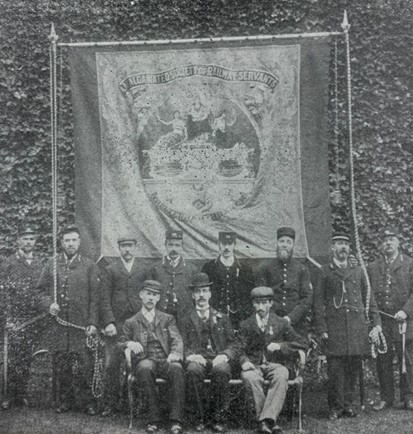
Amalgamated Society of Railway Servants Cheltenham Branch, 1902
This photo shows the committee of the Amalgamated Society of Railway Servants (ASRS) Cheltenham Branch in 1902 at the presentation of their new branch banner. The men here comprise signalmen, shunters, firemen, a porter and a guard, from the GWR, MR and M&SWJR. The ASRS was a trade union of railway workers from 1872 until 1913 when it merged with other unions to form the National Union of Railwaymen. In 1899, the ASRS introduced a resolution at the Trades Union Congress that led to the formation of the Labour Party.
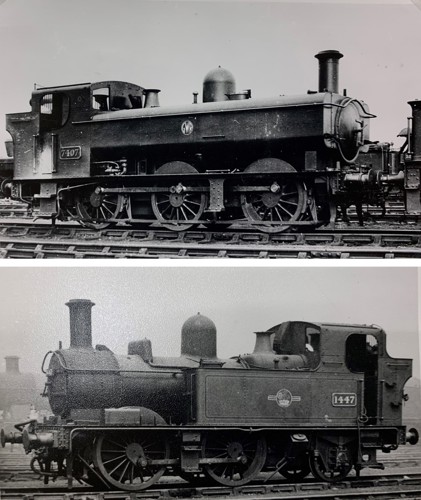
GWR locomotives class 74XX 0-6-0 PT No.7407 and class 1400 0-4-2T No. 1447
Branch lines generally had tighter curves, less capacity and lower volume of traffic so they required smaller, less-powerful locomotives. The top image is No. 7404, a GWR (Great Western railway) 74XX Class 0-6-0 PT pannier tanks, which was one of 307 locomotives, built by GWR’s Swindon Works from 1936-1950. They were used for local, suburban and branch line passenger and goods traffic, shunting duties, and as banker engines on inclines, so were common sights in Gloucestershire. The bottom image is British Rail’s No. 1447, an ex-GWR Class 1400 0-4-2T locomotive introduced in 1932 for light branch work. Theses engines were described as nippy little engines and were fitted with push-pull control apparatus for Auto-Train working, so became a familiar sight locally.
Sharpness shunter (GWR class 1362 0-6-0 ST)
The shunters were the unfashionable workhorses of the railway world, used to move carriages and wagons into position or assemble trains in marshalling yards. This GWR Class 1362 0-6-0 ST saddle tank – whose number isn’t known – is at Sharpness where it was used for shunting work. The class was built for use in docks and other sidings where track curvature was too tight for larger locomotives. Trains will soon return to Sharpness thanks to the Vale of Berkeley Railway, a heritage railway that is working to re-open the existing Sharpness Branch line to passengers. It aims to rebuild many of the key structures that once adorned this section of the historic joint GWR and LMS railway, which was formerly part of the Severn & Wye Railway. The result will be a new heritage railway attraction and educational facility, enhancing the local community.

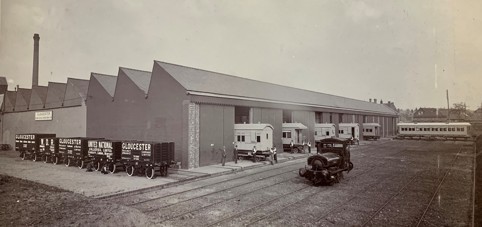
Gloucester Railway Carriage & Wagon Company Ltd, around 1901
The Gloucester Railway Carriage & Wagon Company Ltd (GRCWC) was a railway rolling stock manufacturer based in Gloucester’s Bristol Road, from 1860 until 1986. The company made goods wagons, passenger coaches, diesel multiple units, electric multiple units and various special-purpose vehicles. It had a local, national and international market and produced equipment for WW1 and WW2 - such as munitions, vehicles, tanks and sections for D-Day’s Mulberry Harbour. In addition, the company made trains for the London Underground and Toronto Subway. This image shows the workshops, the photograph wall (where the company took photographs of some of the products they made), the company’s shunter ‘Siam’ and the traverser. The traverser (also known as a transfer table), consists of a single length of track that can be moved from side to side, in a direction perpendicular to the track. There are often multiple tracks on one side of the table and a single or multiple track(s) on the other. It allows the transfer of manufactured rolling stock between the roads of the workshops. In this view, a carriage is seen on the traverser and some carriages are partly rolled out from the sheds. A preserved traverser can be seen at Didcot Railway Museum.
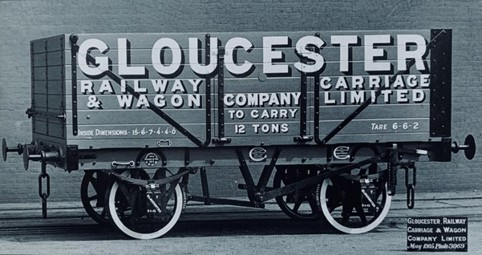
GRCWC sales demonstration model of 12-ton, 7-plank wagon, May 1905
Private Owner (PO) wagons were common on the railways – when British Railways was formed, they inherited over half a million of them! As every industrial process required coal or coke, the most common were 5- & 7-plank coal wagons and whereas collieries wagon fleets could be numbered in hundreds, even small local merchants or manufacturers had their own coal wagon or two. Building these private owner goods wagons was the stock-in-trade of the GRCWC. This photograph shows a sales demonstration model of a 12-ton, 7-plank, that was probably used briefly for advertising purposes in the company’s showroom on London Road, before being repainted for a new owner. The company took numerous photographs of its products – leaving an archive of 120 photograph albums, that are still heavily used today by researchers, model rail enthusiasts and heritage railways.
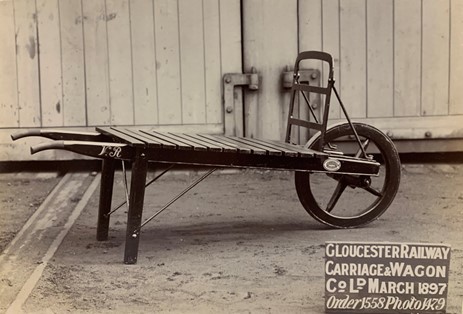
GRCWC porters' station sack truck, 1897
Every railway station needed trolleys and sack trucks to move passenger luggage around. They came in a myriad of designs, from single wheel ack trucks – such as the example shown here – to four-wheel trolleys. They may not have been the most glamourous side of the railways but they were vital and the Gloucester Railway Carriage & Wagon Company made them as well.
Dowty test-track, test wagon and retarders
Although more famous for manufacturing aircraft undercarriage, Dowty also made railway equipment. Among their railway equipment were hydraulic retarders – the yellow objects seen here in the middle of the photograph) which were used to control the speed of wagons on inclines in hump-shunting marshalling yards. When a wagon rolled over these, the retarders slowly compressed which had the effect of slowing down the speed of the wagon. They could be pre-set to account for different weights/loads of wagons. Although none are used on the British railway network (as our hump shunting marshalling yards have all been closed), they are still in use on the Continent and in North America. To test these units, Dowty built a sloping ramp test rig at their Ashchurch site. This used a test wagon which was hauled up the incline and then released. The cream brick building visible on the right is the old water tower for Ashchurch railway station.

Demolition of Churchdown Railway Station, 1964
This photo shows Churchdown station in the process of demolition – it was closed on 2 November 1964 as part of the infamous “Beeching Axe” cuts. The station was opened on 2 February 1874 – although there had a temporary earlier station that had opened on 9 August 1842 before being closed again on 27 September 1842. The permanent station was the joint property of the Midland Railway (the successor to the Birmingham & Gloucester Railway) and the Great Western Railway, who had shared the line since 1847. Unlike many smaller stations, Churchdown never a goods shed or any sidings for the delivery of bricks, slate, coal and other commodities – presumably the railway companies didn’t see a demand because of the proximity of Gloucester and Cheltenham. The Beeching cuts were a major series of route closures and service changes that were made as part of the restructuring of the nationalised railway system in the 1960s. They are named after Dr Richard Beeching, then-chair of the British Railways Board and the author of two reports – The Reshaping of British Railways (1963) and The Development of the Major Railway Trunk Routes (1965) – that outlined the necessity of improving the efficiency of the railways and the plan for achieving this through restructuring. Beeching’s reports ultimately closed approximately 55% of stations, 30% of route miles, and cut 67,700 railway jobs.

GWR Lost Luggage form (part), 1909
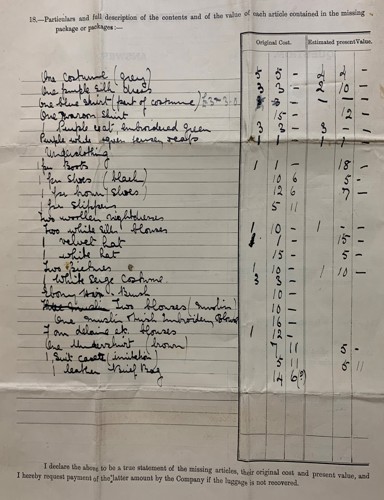
In October 1909, after a stay in London, Miss Margaret Hewitt took a 3rd Class train from Paddington back to her home at Weymouth. However, the GWR managed to mislay her baggage – a large black leather trunk – after collecting it from her London address. The company sent her a letter of regret and a lost luggage form to complete. This is page three of the form, which required her to list the items she had lost and give their original value and an estimate of the current value. She valued the items at around £31 – approximately £2,400 today! – but we do not know whether she ever got her trunk back or if GWR compensated her!
Gloucester, All Saints Parish: Church Council records, 1925
Gloucester’s All Saint’s Church was next to the Barton Street Junction on the Tuffley Loop right by Eastgate Street Station. Locomotives would often wait in a siding by the church to clear the mainline, waiting for signals after running around their trains in the station or when they were shunting in the large marshalling yard. As the locomotives stood idle, steam pressure built up in their boilers and at irregular intervals, the excess would ‘blow off’. In May 1925 this was causing annoyance during church services at All Saints, to the extent that they recorded it in the Church Council’s vestry minutes, with a note for the chairman to take the matter up with the authorities! Later in the minute book, it notes that the ‘nuisance caused by the locomotives has been remedied’.