
Introduction
If you enter the word ‘Christmas’ into the Gloucestershire Archives online catalogue, you will get a total of 2,206 results. This exhibition can only feature a fraction of these documents, but hopes to show a flavour of what kind of archival records this covers. It contains land grants, thefts of holly, civic decorations from the 1600s, school treats, turkeys, lists of presents, Christmas food, Christmas cards and even some official ‘bah humbug!’ involving a caretaker and the fire service. The only things that are missing are festive menus from various eating places and recordings of Christmas day radio broadcasts from the BBC. So, sit back with a glass of sherry, a mince pie and listen out for sleigh bells as we head down the Archive chimney into our world of Christmas!
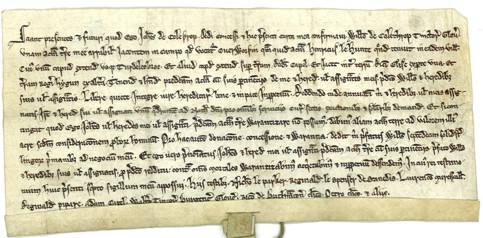
First mention of Christmas - Grant of Land made between John de Colethrop and William de Colethrop, dyer of Gloucester
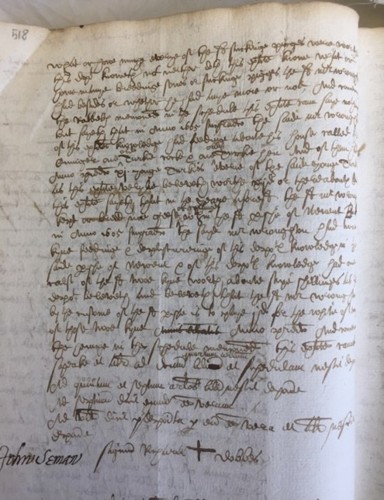
This document contains the earliest actual mention of ‘Christmas’ in Gloucestershire! It is from the family and professional correspondence of John Parsons, attorney of Kemerton and Tewkesbury (1760-1805). Parsons dealt with many families including the Twysell family of Kings Stanley. Among the records of the Twysells there are several documents that date from the 1200s dealing with grants of land in Colthrop, which was part of the Manor of Standish but is now in the parish of Haresfield. The document shown here is a grant of land made between John de Colethrop of Standish and William de Colethrop, a dyer of Gloucester. Written in Latin, the grant is not dated precisely but is thought to have been written around 1270 and it concerns one acre of arable land lying in a field called ’Overworthin’. We do not know precisely where this acre of land was because in a typically complicated way, it is only identified by using the names of adjacent pieces of land or their owner/occupiers. In this case, one end of Overworthin extended to ‘Turdelesbroc’ and the other end to the land of Robert Capel and it lay between the land of Richard Glise on the one side and the land of Roger Hygun on the other. We also know that the grant cost William de Colethrop 17 shillings (about £600 today) and was witnessed by a total of eight people: Nicholas le Parker, Reginald le Spenser of Stanedis (Standish), Laurence Maresscoll, Reginald Pipare, Adam Capel, Walter Dyer, burgess of Gloucester and two clerks; Richard de Brithamton clerk and Peter the clerk. The annual rent for the land is given as one farthing (a quarter of a penny, about 80p today) and this amount was payable at Christmas. This is written as 'ad Natalem Domini’ (literally ‘for Christmas’ or ‘at the birth of the Lord’) and is visible midway on line 6. The wording is heavily abbreviated – appearing roughly as ‘ad Nath dmi’ – and is on a fold so is difficult to read but is a reminder that even back then some people were working over Christmas!
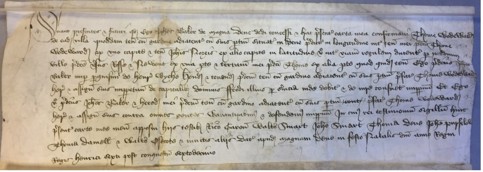
First mention of Christmas Day - Gift of a House & Garden from John Baker of Mitcheldean to Thomas Wodeward
Whereas the first document in this exhibition is undated, this document is clearly dated - the 16th year of the reign of Henry VI (aka 1437). It also happens to record the earliest mention of Christmas Day in Gloucestershire Archives. It records the gift of a house and adjacent garden in Dene that John Baker of Mitcheldean granted to Thomas Wodeward of Mitcheldean. The plot was described as being ‘in length between the tenement of Thomas Wodeward and the tenement of John Nozers’ and ‘in width between the king's highway towards Ross and Newent and the land of the said Thomas, which tenement John Baker bought from Henry Wyche’. The deal was signed and sealed at Mitcheldean on Christmas Day (written as ‘in festo Natalis Domini’ – literally ‘on the feast of the birth of the Lord’) and there were seven witnesses: Richard Garon, Walter Smart, John Smart, Thomas Dene, John Purselow, Thomas Damell and Walter Osecote. You’d have hoped that they all got a mince pie and a slap up dinner!
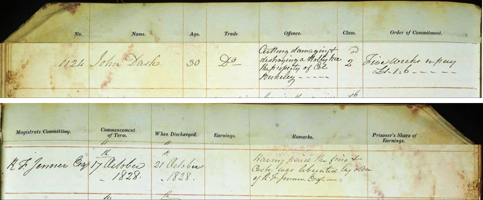
Theft of holly – Horsely Gaol Register
Holly appears in many archive documents. This is an entry in the Horsley Gaol Register for John Dash, a labourer (possibly from Wiltshire) who lived in Horton. The entries in these registers span two pages so this is an edited image to show the relevant lines on both pages. John Dash was brought up before the magistrates on 17th October 1828 having been charged with ‘cutting, damaging & destroying a holly tree, the property of Colonel Berkeley’. He was found guilty and sentenced to 5 weeks hard labour or a fine of £1-1s-6d (about £53 today!). It appears that John didn’t fancy being a jailbird for he was released on 21 Oct 1828 - in the ‘Remarks’ column it states ‘Having paid the fine and costs was liberated by order of R H Jenner Esq.’.
Theft of Holly – Quarter Session’s Court of Summary Jurisdiction
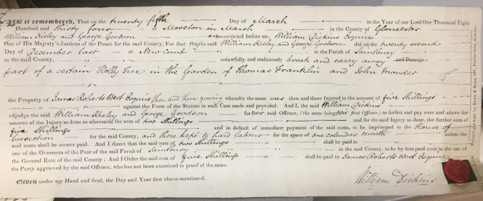
Stealing holly was a common offence – this is a typical entry in the Quarter Session’s court of summary jurisdiction for William Keeley and George Goodson, who were both charged that they did ‘break and carry away part of a certain Holly tree’ at Saintbury on 22 December 1833. The men were found guilty and were fined 2 shillings each plus 5 shillings damages (approx £6 and £17 today) or, if they couldn’t pay, a sentence of hard labour for one calendar month in Northleach gaol.
Holly & Ivy decorations – Gloucester Borough Stewards' Accounts book, 1636-1654
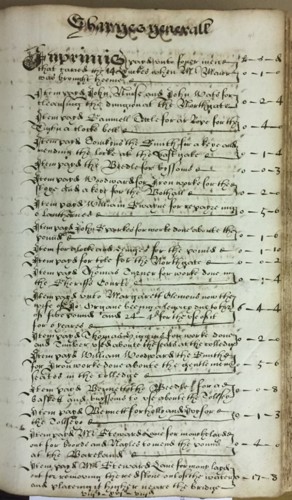
In the 1600s – and despite the city’s Puritan leanings - Gloucester Borough Council liked to celebrate Christmas with decorations. The sixteenth entry on this page of the Stewards' Accounts book for 1636-1654 has an entry for holly and ivy for the Tolsey, the building where the council held meetings.
‘Item: paid Mr Bennett for holly and ivy for the Tolsey…….1s 3d’

Holly decorations - Littledean Church Churchwardens' Register
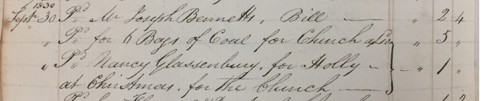
Like today, lots of churches were also decorated. This entry is in the Churchwardens' register for Littledean Church in 1830 and records paying a parishioner for holy to decorate the church.
‘Paid Nancy Glassenbury for Holly at Christmas, for the Church. 1s’
Christmas Tree & school treats – Edgeworth Vestry minutes
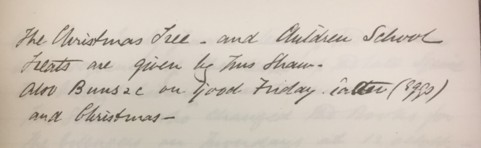
In the same way that some parishioners supplied holly for churches, some provided trees as the 1898 Vestry minutes for Edgeworth show. In this instance Mrs Shaw did the honours.
‘The Christmas Tree – and Chidden school
treats are given by Mrs Shaw.
Also Buns & c on Good Friday Easter (eggs)
and Christmas –‘
Turkeys – Tithe Dispute in Bishop’s Court Act Book 1606-1609
The earliest reference to turkeys in Gloucestershire Archives comes from the 1607 Bishop’s Court Act Book. This series of records (424 volumes in total) begin in 1541 and include general act books, consistory court books, records of visitations, subscription books, registers of orders, licences, faculties and dissenters' meeting houses and diocesan surveys. Among them are witness 'depositions' (statements) in respect of cases concerning offences under ecclesiastical jurisdiction. These are fascinating documents giving insights into many aspects of life in the 1600s including disputes over tithes and taxes, accusations of immorality and insults, the making of wills and unseemly behaviour in church – not always from the congregation! The witnesses come from almost every strata of society from knights, clerics and yeomen to weavers, miners and labourers. People's ages, their place of birth and occupations are often given as well as the names of streets, fields, inns and roads in addition to parishes and churches. Sadly however, the handwriting, the partial use of Latin and the time it takes to look through even one year's depositions means that the records are relatively inaccessible, although indexes and abstracts are being created to address these difficulties. This turkey reference comes in a witness deposition in a tithes dispute between the Vicar of Newent, Nathaniel Dall, and James Wroughton, gentleman. The deposition was made by a local farmer Richard Dobbes, who stated that Wroughton ‘had an old turkey cock and hen and eleven young turkeys worth about twelve pence each.’ He later states that he thought that ‘the turkeys were worth eight pence each’ – about £3.30p today!

Turkey theft – Quarter Sessions Deposition 1793
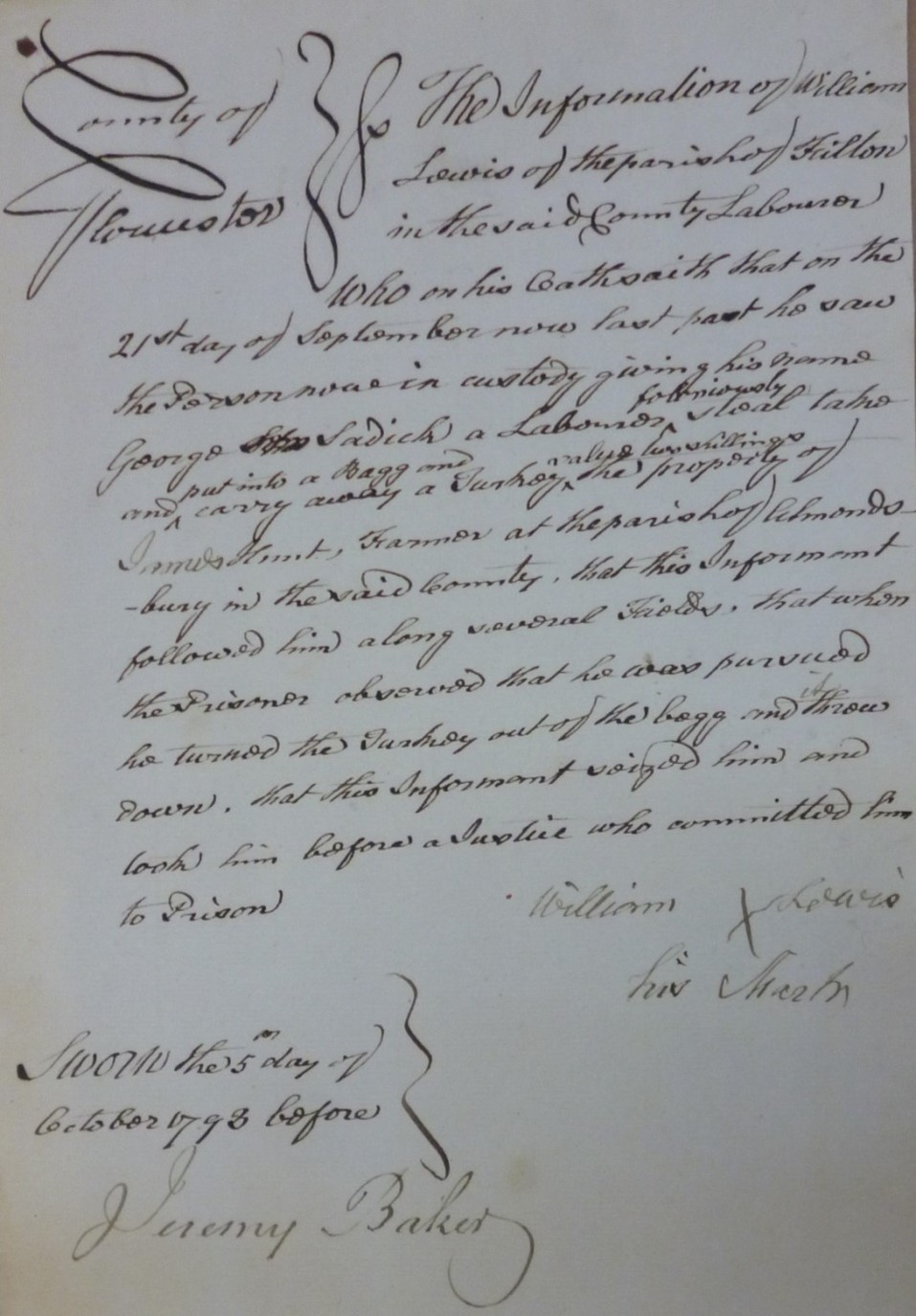
This Quarter Session record is a witness deposition made by William Lewis on 5th October 1793 before Jeremy Baker. It provides evidence against George Sadick, a labourer of Filton, who stole a turkey belonging to James Hunt, a farmer of Almondsbury.
County of Gloucester: The information of William Lewis of the parish of Filton in the said County labourer who on his oath saith that on the 21st day of September now past he saw the person now in custody giving his name George Saddick a labourer feloniously steal take and put into a bag and putt into a bagg and carry away a turkey valued at two shillings, the property of James Hunt, farmer at the parish of Almondsbury in the said county, that this informant followed him along several fields, that when the prisoner observed that he was pursued he turned the turkey out of the bagg and threw it down, that this informant seized him and took him before a justice who committed him to prison.
Rental of Christmas capons and pullets due, 1716
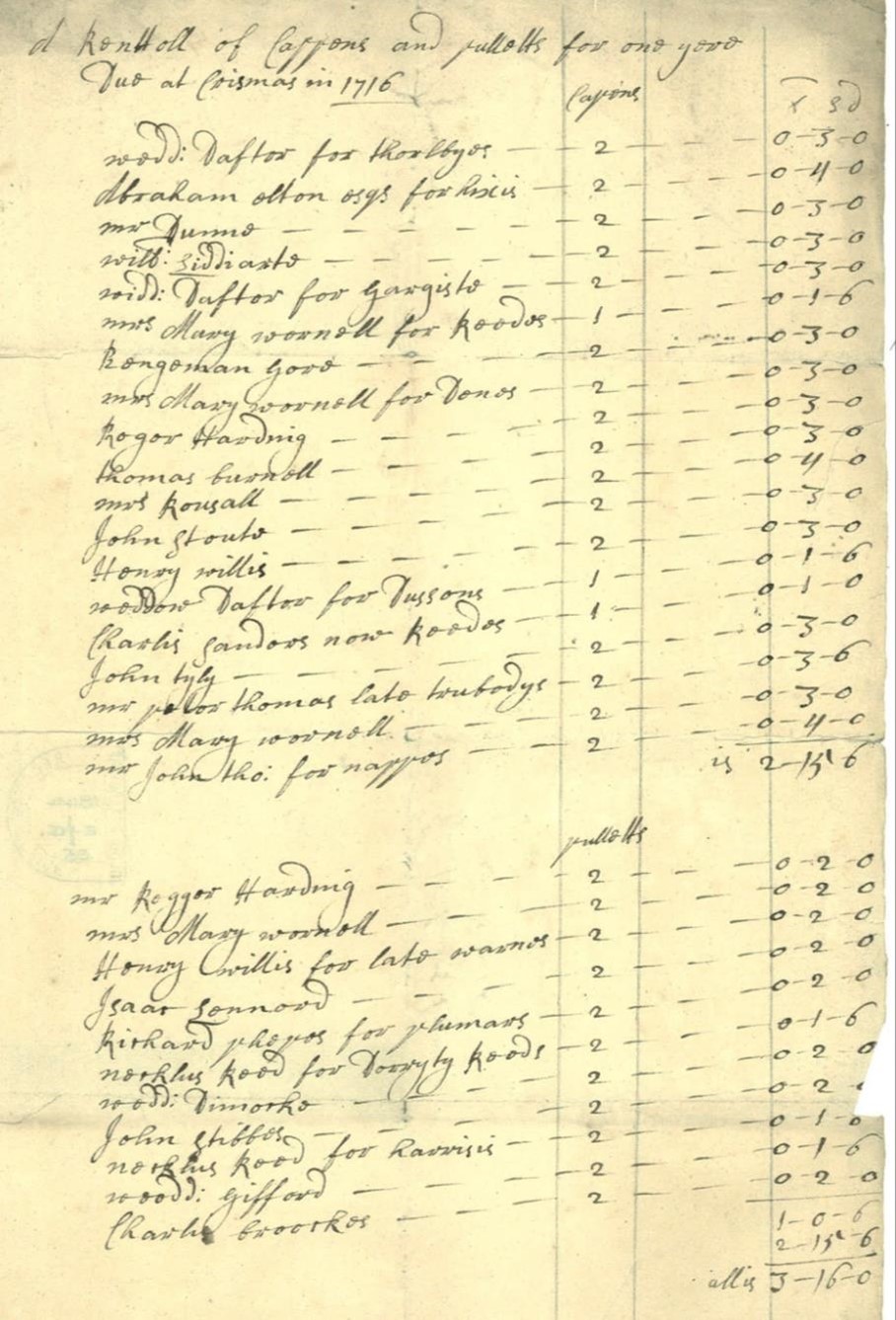
Receiving animal produce and/or animals was a common feature of rental agreements with payments that had to be made at Christmas. A typical example comes from the manor of Hanham as this 1716 account shows. In this instance, the manor received a total of 35 capons and 22 pullets in addition to the monetary rents, which were worth £3 16s (about £300 today).
A fat goose – Lease for a messuage & appurtences
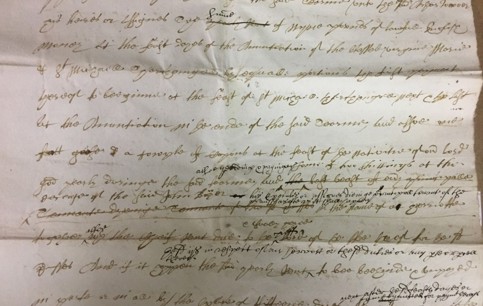
Geese feature frequently in our archives primarily as place names – Goose Lane, Gander Lane and Millbrook Street in Gloucester (which was once known as Goose Lane or Goosewhyte Lane). More commonly however, geese appear in indentures and agreements as annual payments, such as this rather scruffy, scribbly example; a copy lease for a ‘messuage and appurtences’ (i.e. property) called Ty Rees ap Howell ap Moris in Montgomeryshire. It lists a rent of £9 per annum plus a ‘a fat goose and a couple of capons at the feast of the Nativity’
Turkeys by mail – Cotterell Papers Volume 4
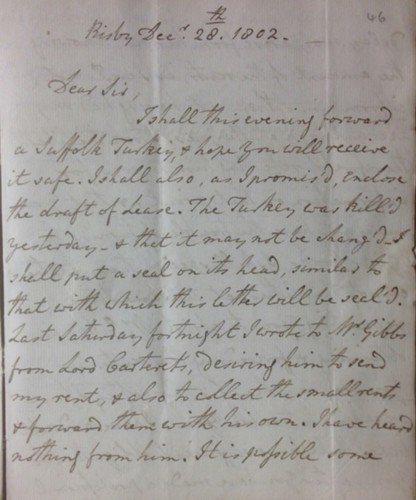
The Cotterells were a family of yeoman farmers from the Saintbury and Campden areas, but one branch were solicitors and practitioners of law in Chipping Campden. Amongst the Cotterell archive are papers belonging to George Cotterell, solicitor of Campden. These include a series of letters sent to him by Thomas Scotman of Great Barton near Bury St. Edmunds. The letters are fairly detailed and refer to a tradition whereby Scotman seems to have always sent Cotterell a turkey at Christmas. This doesn’t seem to have been in lieu of any payment although Scotman was rather wary of these being stolen or substituted by unscrupulous persons and so attached his seal to the bird’s neck. However at the same time, Scotman typically only paid the carriage part-way, so Cotterell had to pay the rest. The relevant section of this letter is as follows:
“Dear Sir,
I shall this evening forward a Suffolk Turkey, I hope you will receive it safe. I shall also, as I promised, enclose the draft of lease. The Turkey was killed yesterday – & that it may not be changed, I shall put a seal on its head, similar to that with which this letter will be seal’d.”
Death of a beggar in winter weather, Naunton parish register
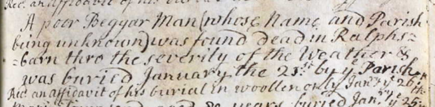
Christmas was also a time for charity, for winter was a time of hardship and even fit young adults workers needed a feast to bulk up if only to see them through the rest of the winter. The poorest, oldest and feeblest members of a community were all physically vulnerable to hunger & cold – many died as a result of a cold winter. This is a sad example of just such an occurrence in the parish of Naunton in 1786; a beggar dying in a barn due to severe weather.
‘A poor Beggar Man (whose Name and Parish
being unknown) was found dead in Ralph’s
barn thro the severity of the Wether &
was buried January the 21st by ye Parish.
And an affidavit of his burial in woollen on the January 26th’
Charity – List of Cottagers to whom Beef and Plum Puddings are given, Christmas 1872-3
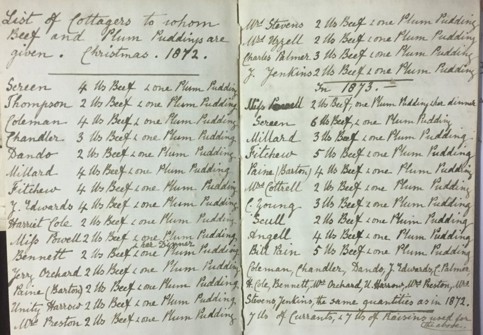
Landed gentry often distributed gifts of food to their workers. This image comes from an account book of the Codrington Family of Doddington and covers the years 1872 and 1873. In 1872, 98lbs (44kg) of beef was distributed to 19 families, while the following year this fell to 66lbs (30kg), although there were 22 families in total. Each family received one plum pudding – the name ‘plum pudding’ comes from the fact that raisins were often referred to as ‘plums’. The author of the document noted that that a total of 7lbs (3kg) each of currants and raisins were used to make the puddings.
Charity - List of children's presents given at Christmas party at Dyrham Park and their cost
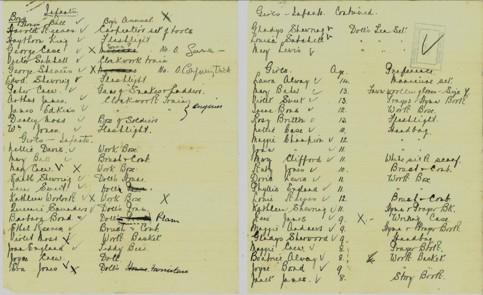
As well as giving food to their tenants, the large estates might also hold a party for the children of their tenants or villagers. This list is from the archive of the Blathwayt family of Dyrham Park and shows the presents that were purchased by Robert Wynter Blathwayt (1850-1936) in 1926/27, presumably after discussion with his wife, who was no doubt in charge of this event. The presents here are quite substantial and include: flashlights, dolls, doll’s house, a boy’s annual, story books, a ball, a box of soldiers, work boxes, brush & comb sets, doll’s prams, teddy bear, gloves, prayer books, snakes & ladders, conjuring sets, hand bags and clockwork trains. There is also a set of carpenters tools which are presumably toy ones as well as some hymn and prayer books. Of interest in a subsequent page is an air-rifle – which was crossed out and replaced by a knive.
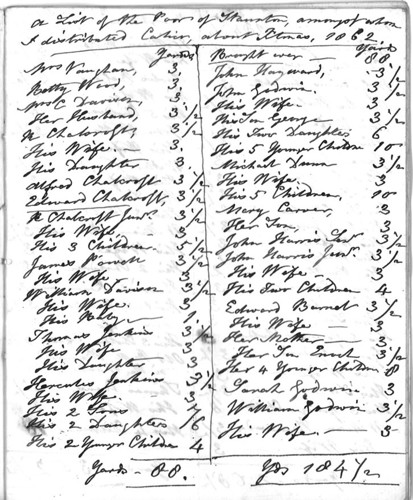
Charity – ‘A List of the Poor of Staunton amongst whom I distributed Calico about Xmas 1862’
Others preferred to give money or goods rather than food. This particular list is for yards of calico cloth given by the Gibbon Family of Staunton in the Forest of Dean to the poor of the parish. It is interesting to note that amounts are listed for individuals rather than to families, although presumably each family received a length equal to the total sum. Most adults received between 3 to 3½ yards (2.7 to 3.2m) of calico while children received an average of 1.92 yards or 5ft 9” (1.7m). Whether this was standard practice for the Gibbon family we do not know – although this was at the time of the Cotton Famine (caused by the blockade of Confederate Southern ports during the American Civil War which stopped the flow of cotton into mills in Britain and Europe). Although this primarily impacted on the livelihood of thousands of textile workers in the north west of England (through their connections with the supply of slave-grown cotton) it presumably had knock on effects throughout the county.
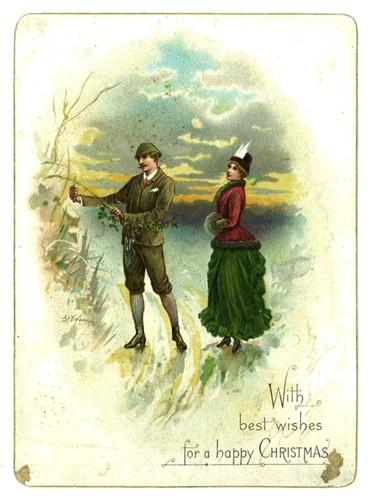
Christmas cards
The first recorded Christmas card was given to James I of England in 1611 and was more of a folded manuscript than a card (it was only discovered in 1979 in the Scottish Record Office). It wasn’t until the 1840s that Henry Cole, a prominent civil-servant, really invented the Christmas card as we know it. Cole had been key in reforming the British postal system, notably in setting up the Uniform Penny Post – which set a charge of one penny for the carriage and delivery of any letter under ½ ounce in weight between any two places in the United Kingdom of Great Britain and Ireland, irrespective of distance. Although this was primarily to assist trade and mercantile communications, it also encouraged the sending of seasonal greetings on decorated letterheads and visiting cards. Cole was wondering how the new postal system could be used more by ordinary people and simply came up with an extension of the visiting card, but a specific pre-printed Christmas theme which could be quickly personalised so saving the time in writing a letter. Cole’s first attempt proved a failure as it was too expensive, but the Victorian commercialisation of Christmas was growing and, when cheaper colour printing became possible, Christmas cards began to become more popular. Early British cards rarely had religious themes, but instead favoured flowers and sentimental images of children and animals often using elaborate shapes and materials. Many were based on the already established ‘Valentine’ card – and this is an example from the Hicks Beach family of Coln St Aldwyn, showing a well-dressed country gent cutting a sprig of holly for the lady.
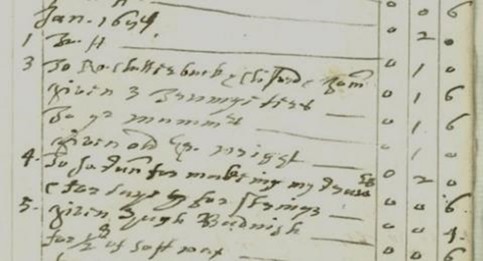
‘In comes I’ - Personal account book of John Clifford, 1673/4-1679
This is an extract from the personal account book of John Clifford of Frampton-on-Severn. This is a simply wonderful assemblage containing all manner of things including: clothes, visits and travel within Gloucestershire, gifts to the poor, taxes and rates, purchase of saddlery, wine and food items (including oranges, lampreys, "gillin" [salmon]), repairs to watches and clocks, purchases and repairs to weapons (including a sword and guns, one described as a "birding peece") and gambling losses at tables (backgammon). It also has house repairs and building as well as purchases of tools (such as rakes and cherry baskets). When it comes to Christmas, the accounts list money given away (including gratuities to servants bringing gifts of venison, partridges, pigeons, etc) and payments to a trumpeter at New Year, 1678. However the prime interest in this particular section for New Year, 1677 is this line entry on January 3rd;
‘To ye mummers ………1s’
Mummer’s plays are traditional folk plays performed around Christmas time and feature a number of odd characters, dressed in outlandish garb. They first appear in the 1300s as courtly entertainment but quickly spread and this entry is one of the earliest references to mumming in England outside of the capital. The plays are short, comic and in rhyme. The central theme is the battle between light (personified by St George) and dark (personified by a dragon or a Turkish Knight). Other characters vary but typically include Old Father Christmas, the Doctor, his servant, a hobby-hoss and Beelzebub/Devil. The plot is simple – after introductions and some sword play, St George ends up dead – whereupon the doctor performs a miraculous, albeit comedic, cure on the body who promptly comes back to life (possibly symbolic of reawakening the earth from the death of winter). Once, there were over 60 locations in Gloucestershire where mumming was recorded but most ceased after WW1 – primarily due to loss of performers. A revival is currently underway and nowadays several local sides can now be seen.
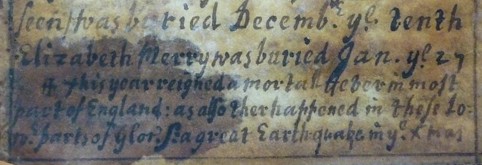
Christmas 1675 - Haresfield Parish Register
Although parish registers typically record the mundane day-to-day ceremonies of baptisms, marriages and burials, on occasion, the incumbent might add a little more information about something that happened or affected the parish. The parish register of Haresfield records one of the most unusual Christmases in Gloucestershire and one that was probably not forgotten for a long time!
"+ this year reigned a mortal ffever in most part of England: as also ther happened in these lower parts of Gloucestershire: a great earthquake in the Xmas."
‘Mr Bricker dressed as Father Christmas, Clanna House, Alvington’
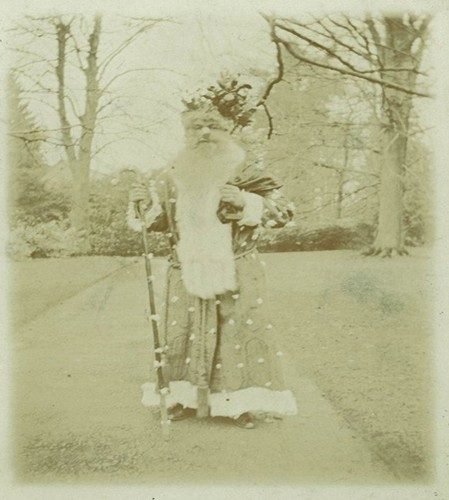
Lastly in our Christmas themed archive offering we have this sadly faded photograph of “Mr. Bricker" dressed as Father Christmas. All that is known about it is that it was taken in the grounds of Clanna Falls house, Alvington near Lydney in the early 1900s. At around this time, Clanna Falls was a large house with an extensive estate that was owned by Walter B Marling, whose brother, Sir William Marling, owned the adjoining Sedbury Park estate. Marling sold the entire estate in 1919 and it was purchased by Richard Pryce-Jenkin of Raglan. When he died in 1951, the estate was split up and the house demolished, being replaced by a caravan park. Returning to “Mr Bricker”, it seems likely that he was probably one of the servants and had presumably been volunteered to play Father Christmas at a children’s Christmas party, given that it is clearly daylight and a sack (full of presents?) can be seen over his left shoulder. The outfit – which was probably red in colour – is fur-trimmed and has white dots (representing snowflakes?) over it. The hat can’t really be seen but appears to have greenery and flowers on it and his staff also has the same white dots. Mr Bricker is clearly wearing a huge false beard and – as a seasoned Father Christmas – the author can well imagine how much it tickled!