
Introduction
Over the years there have been many different types of transport used in the county of Gloucestershire. This exhibition of material from Gloucestershire Archives will show examples of all the main transportation categories used, including road, rail, water and air, together with their respective different power systems, so animals, humans, steam, electricity and internal combustion. While many of these are what you might call ‘standard’ types, there are several oddities. Each image is accompanied by a brief accompanying text highlighting aspects that we hope you’ll find interesting and intriguing.
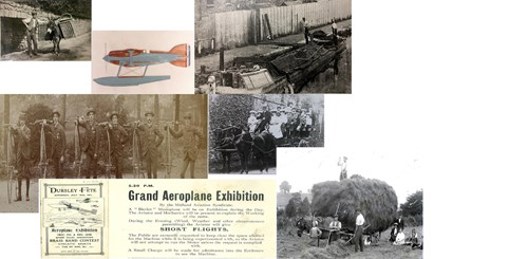
Donkey Power
Donkeys have been used for transporting people and goods for thousands of years.
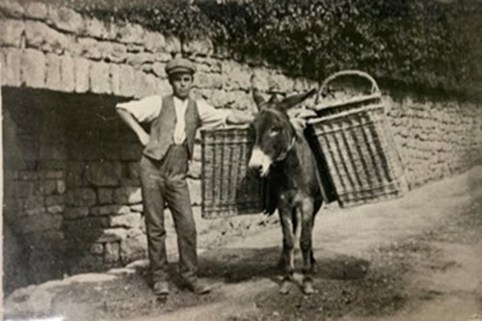
If there is one place in Gloucestershire where they are a good idea – it’s Chalford, where the narrow lanes that run along the hillsides have steep gradients and numerous twists and turns! This photograph shows a donkey delivering bread in the village, taken around 1900. Two large panniers were attached across the animal's back and a basket was provided for the delivery boy to take loaves to the doorstep. Other household goods were also carried, as was coal. The bread baskets were no doubt made locally as was the leather tack required to keep them on the donkey. The donkey transport had no doubt been going on in the village for at least a hundred years prior to this and continued until well into the 1930s. In 2008, a weekly donkey delivery service was restarted by Chalford Community Stores, but sadly this ceased in 2011.
D9746/1/17/312
Farm Wagons
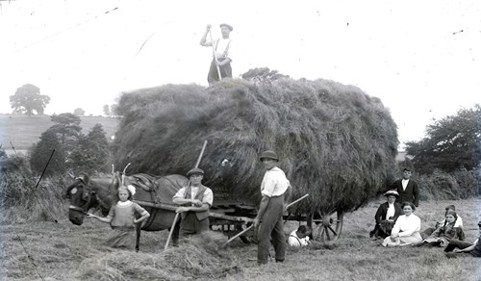
Wagons were four-wheeled vehicles hauled by single or multiple animals – building them required craftmanship and multiple skills. They were essential for farm work and were used for all purposes with different styles evolving. This is a wagon at haymaking time taken at Charingworth, near Ebrington. It is impossible to tell whether this is a Gloucestershire bow wagon or a simpler box wagon, but it does have a small front wheel and so is a ‘three-quarter lock wagon’. This small front wheel could fit under the wagon body and so gave the wagon a tighter turning circle – useful in Gloucestershire’s narrow lanes. Many wagons carried the name and location of their owner on the headboard and this one was owned by Captain Blackwell of The Chase Farm, Charingworth and the letters ‘..KWELL’ and ‘..WORTH’ can just be made out by the farmhand’s right-shoulder. An amazing collection of farm wagons known as the Lloyd Baker Collection, can be seen today at The Old Prison at Northleach. The wagons are of regional importance being mostly gathered from the Cotswolds and Vale of Gloucester during the 1960s. The collection has seen some preservation work done by professional wheelwrights/carpenters when funding allows, and the wagons are currently under the care of volunteers at the Corinium Museum.
D11554/769
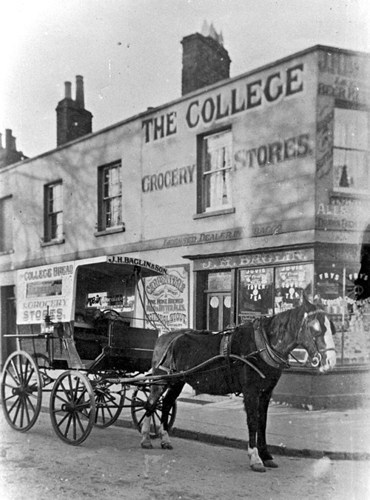
Urban Horse Wagons
This wonderful photo shows the horse-drawn delivery wagon of J. H. Baglin & Son’s College Grocery Stores in St Paul's Road, Cheltenham. Wagons built for urban purposes tended to be smaller and less robust than rural ones, as they hauled smaller loads over busier, paved roads. The exceptions were the larger flat-bed drays used to carry coal and beer, etc. Most were simple box wagons and there were fewer specialist types (although milk delivery carts tended to be purpose-built tall box wagons). Most urban wagons had advertising for their owners as can be seen on the wagon sides here. Grocery stores delivered bread and cakes, tinned goods, cupboard items such as tea, coffee, flour and sugar as well as perishable foods such as meat and dairy items, most notably butter and our wonderful Gloucestershire cheeses!
GPS/78/236
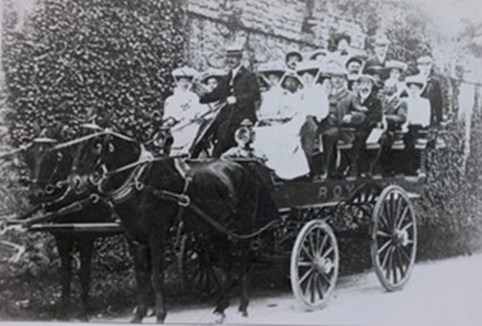
Horse-drawn Omnibus, London Road, Stroud, c1910
Before the railways, coaches were the main way for people to travel long-distances. By the 1870’s however they were mainly operating urban and suburban areas, horse buses were popular such as this one in London Road, Stroud. These could carry more passengers with better seating – although covered buses were not yet common. Getting on and off them was also quite difficult, especially for ladies in their skirts. They were called ‘omnibuses’ as they called at all stops and continued in use until the 1920’s.
D9746/1/7/50
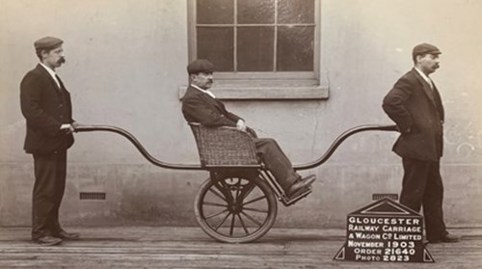
Gloucester Railway Carriage & Wagon Company Carette, 1903
A velocipede is a human-powered land vehicle with one or more wheels. This very odd contraption was made by the Gloucester Railway Carriage & Wagon Company in November 1903 and was a one-wheeled carette for the use of a Crown Agent in the Colonies. The carette was like an open topped sedan chair, although the single wheel made it easier for the men pushing/pulling it as most of the weight was taken by the wheel. As the main spar ran under the seat, the person sitting in it had to have a leg on either side and so it probably wasn’t the easiest thing to get on or off from.
D4791/16/30/2823
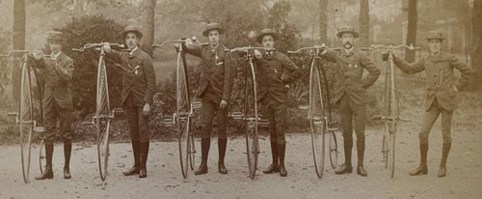
Gloucester Cycling Club, c1880
Named after the penny and farthing coins, penny-farthings were fast (the front wheel travelled a large distance for every rotation of the legs) and offered some comfort as they had solid rubber tyres. These are members of the Gloucester Cycling Club, pictured in Gloucester Park sometime around 1880. Penny-farthings were popular in the 1870s but were becoming obsolete by the late 1880s with the development of modern bicycles, which were marketed as "safety bicycles" – because of the reduced height and reduced risk of falling off when compared to penny-farthings.
SR44/36297/42
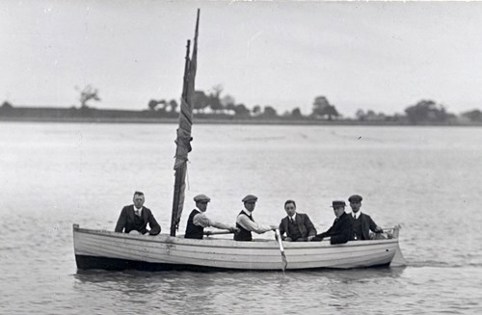
Boating on the Severn, undated
Boating was a popular pastime for both fishing and pleasure. This is a group of men (possibly recuperating soldiers) rowing a rather nice clinker boat on the Severn near Newnham. The sail, probably a gaff sail, is furled and so the men are pulling on the oars. Judging by the fact that they have removed their jackets it might be hard going - although it looks to be high water as there does not appear to be much tide or river flow.
D4764-4-31
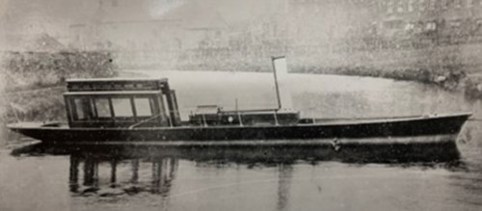
Edwin Clark & Co Steam launch
In the last quarter of the 19th century, there was a high demand for steam launches, locally, nationally and internationally, both for pleasure and work purposes. This was possible because the size of steam engines had reduced, and new compound 2-cylinder steam engines and the screw propeller had been introduced. This elegant unnamed example is seen at Brimscombe Port and was built by local boatbuilders Edwin Clark & Co. It is a steel river launch that was 35ft (10.6m) long, 6ft (1.8m) in beam and had a top speed of 8½ knots (10 mph/16kmph). The wheel can just be made out at the front of the cabin and behind the boiler/engine housing. The white circle is a gauge, most probably a boiler-pressure gauge. The bulk of their steam launch business originated from customers around London and Thames, so most of their completed craft were dispatched eastwards to their destinations via the Thames & Severn Canal. The company was taken over by Abdela & Mitchell shipbuilders in 1901 and they continued the trade but most of their craft were destined for service in foreign climes, notably South America and Africa. Some of the latter were sent abroad as kits to be assembled at their destination.
D9746/2/312/19
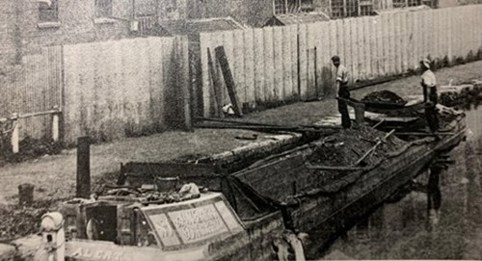
Narrowboat ‘Alert’, Brimscombe
From the 1700s to the 1950s canals were a nationwide transport network covering over 4,700 miles but with the advent of the railways, commercial canal traffic gradually died away. Bulk cargoes were the raison d'etre of canals and the most common cargo was coal. This photograph shows a cargo of coal being unloaded from the canal narrowboat ‘Alert’ at Brimscombe Mills. The two men unloading are doing so using a double-hod and are walking over two planks – a tricky operation. There is an open gate in the fence, which is presumably where the coal is being taken through – possibly into Brimscombe Mill itself. Alert looks to be a ‘standard’ narrowboat, 72-foot (22 m) long, with a beam of 7-foot (2.1 m) and capable of carrying around 40 tons of cargo.
D9746/2/312/13
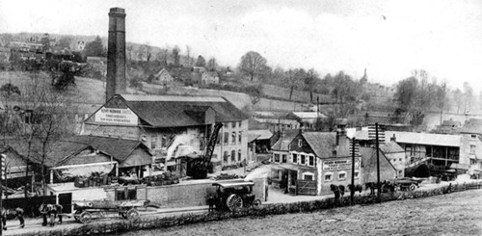
Henry Workman’s sawmills, Woodchester, c1930/31.
So much can be seen in this fantastic view of Henry Workman’s sawmills at Woodchester in 1930/31. On the left and right are horse-drawn timber forwarders - these were specialist wagons were used to transport felled trees and they could be adjusted for different trunk lengths. Teams of three horses were used to pull them. In the centre is a steam traction engine – with steam raised. On the extreme right can be seen two motor cars. In the yard there is a large steam-crane, which was moved on a set of rails. The sawmills had their own rail layout with three rail sidings (out of view to the right) for storage and shunting and two that led into the main works building. This connected to a passing loop the Golden Valley Stroud-Swindon line, allowing timber to be taken out of the site.
GPS/375/110
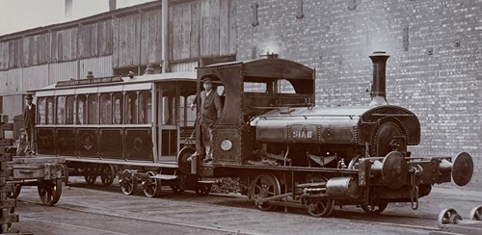
Gloucester Railway Carriage & Wagon Company’s 0-4-0 saddle tank locomotive Siam
Steam locomotives came in all shapes and sizes! This is ‘Siam’ a 0-4-0 outside cylinder saddle tank steam shunter used by the Gloucester Railway Carriage & Wagon Co. Siam had been built in 1875 by Sharp Stewart of Glasgow (possibly with the works number 2472). She may have been acquired by the GRCWC second-hand from the Ebbw Vale Steel Iron and Coal Company Ltd in 1902 and was to work at Bristol Road for eight years. She was one of several small steam shunters that were used by the GRCWC for moving carriages and wagons along the High Orchard Branch of the Midland Railway in Gloucester and for moving raw materials, fuel, and vehicles for repair around its factory site on the Bristol Road. The ‘0-4-0’ is the ‘Whyte notation’ for this shunter, which is a classification method for steam locomotives that counts the number of leading wheels, then the number of driving wheels, and finally the number of trailing wheels, with the numbers being separated by dashes. Siam has no leading wheels, four driving wheels and no trailing wheels, hence the ‘0-4-0’. Because it is also a saddle tank – where the water tank sits over the top of the boiler like a saddle sits atop a horse – it could also be referred to as an 0-4-0ST where the ‘ST’ stands for ‘saddle tank’.
D4791/17/2
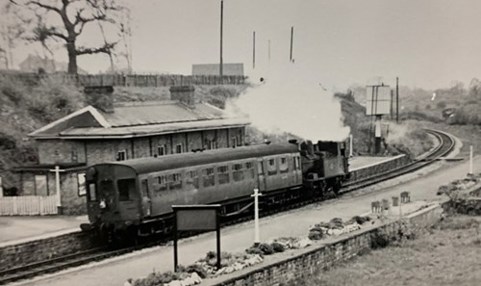
Great Western Railway Autocoach, Sharpness Station, 1964
Seen here at Sharpness station, the Autocoach was a type of passenger coach used by the GWR for push-pull trains powered by a steam locomotive. At one end of the coach there was a driving cab (seen here on the left), allowing the driver to control the train without needing to be in the cab of the steam locomotive. Because this meant that the autocoach/locomotive combination could be driven from either end, it removed the need for the locomotive to uncouple and run-around a train to take it on a return trip. The locomotive is No.1448 0-4-2T, a GWR 1400 Class. These were designed by the GWR for branch line passenger work and specifically to work with the autocoaches. On rural routes – such as the Stroud, Sharpness and the Forest of Dean branch lines – they enabled a more frequent service to be operated at lower cost. The white lamp at the rear of the carriage here indicates that this train has arrived at the station locomotive first and has come from Lydney over the Severn Railway Bridge. From here it will continue its journey locomotive first to Berkeley Road station. At Berkeley Road, the lamp will be moved to the locomotive at the rear and the autocoach will leave coach first to head back to Lydney. This Lydney-Berkeley service had around six services a day and had been running since the opening of the Severn Railway Bridge in 1879, although the autocoaches were only introduced in 1936. It lasted until October 1960, when an accident involving petroleum barges on the Severn brought down part of the railway bridge. The bridge was judged to be beyond economic repair, and the Sharpness line resumed its earlier status as a branch. Passenger services between Berkeley and Sharpness only lasted for four more years, being withdrawn in November 1964, and the Sharpness and Berkeley stations were closed. The Sharpness line remains open for freight traffic to and from Sharpness Docks (though these services are not frequent) and nuclear waste material from the decommissioned Magnox Berkeley nuclear power station.
D9746-1-1-47
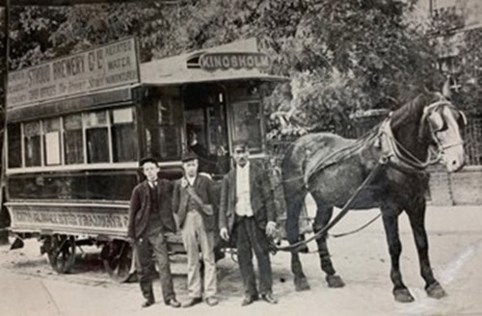
City of Gloucester Tramways Co. Ltd horse-drawn tram
The City of Gloucester Tramways Co. Ltd had been running horse-drawn trams in the city since 1879 but it was never very profitable and in 1902 the company was bought by the Gloucester Corporation for £26,000 (just over £2 million today). Included in the sale were the India Road and Bristol Road tram depots, the entire track, 14 tram cars, 8 omnibuses, 6 charabancs and 100 horses (valued at £2500). The council rebuilt the system to a 3’ 6” (1.1m) gauge and electrified it – and the last horse-tram ran on 17 March 1904.
D10638-1-1965-18-64
Black Mariah Tram
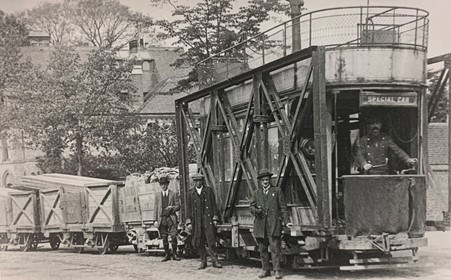
In 1917, an extension of the Gloucester tramway system saw a line laid out from the eastern terminus at Barnwood to Brockworth, where the new Brockworth Aerodrome was then under construction. In addition, more track was laid from the GWR sidings at Gloucester Docks?, where much of the construction material was unloaded. Some trams – known as Black Mariah's – were altered so that they could act as locomotives and haul railway trucks to take building materials to the aerodrome.
GPS/611/49
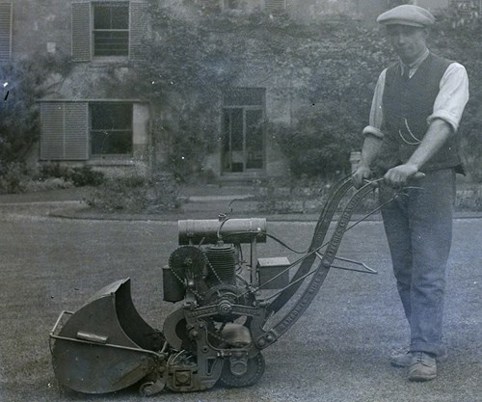
Ransomes self-propelled Motor Mower, Old Rectory, Weston-Sub-Edge around 1920
The lawn mower was invented in 1830 by Edwin Beard Budding of Stroud, while working for John Ferrabee at his Phoenix Foundry, Thrupp. Budding and Ferrabee licenced the design to other companies, notably Ransomes of Ipswich, who began making Budding mowers as early as 1832. In 1902 Ransomes made the first powered lawn mower, driven by an horizontal-axis internal combustion gasoline engine. This photo shows a Ransomes self-propelled 20” Mk.2 or 18” Mk.3 Motor Mower (powered by a Villiers Mk.V 269cc two-stroke engine) on the lawn of the Old Rectory, Weston-Sub-Edge around 1920 (mower info courtesy of the Old Lawnmower Club).
D11554/554
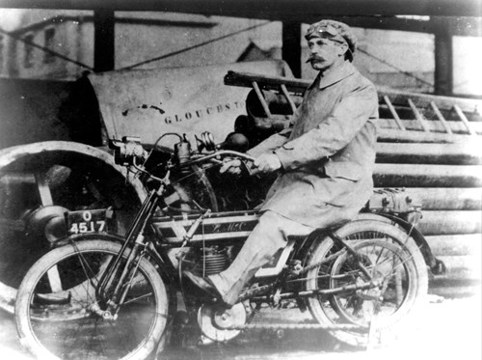
LMC motorcycle
This fantastic photograph shows Mr James Wood, road roller inspector in Gloucestershire County Council's surveyor's department, on an LMC motorbike in the Gloucester council depot sometime around 1914. The registration number, 0 4517, is not a Gloucestershire registration but a Birmingham one, which makes sense because the Lloyd Motor Engineering Company was based in Ladywood, Birmingham. They produced motorbikes from 1903 to 1922 and, depending on the model, they cost from around £50 up to £80, being produced in solo, touring, low-frame and sidecar versions. This version which is either the solo or touring version boasts two speed chain and belt drive for low and high-speed running respectively. The company’s 1910 advertising makes reference to a special ‘novelty’ on one of its models: ‘a pillion seat with footboard, rail and guard for a lady passenger’! Note also what appears to be a segment of a front roller or a traction engine wheel behind the motorbike on the left.
GPS601/68
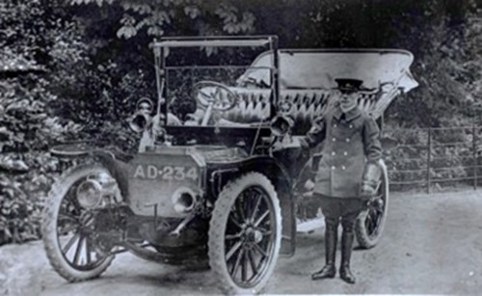
AD 234, Coventry Climax, owned by Charles Apperley, 1906
This is AD 234, a 20 hp Coventry Climax, 4-seater side-entrance tonneau owned by Charles Alfred Apperley, the wealthy woollen manufacturer of Rodborough Court in 1906. From its registration documents we know that it was Royal Blue in colour with primrose lines and wheels – although they do not appear to be in the image, so possibly they were just lined in primrose. The chauffeur is in full uniform – note the classic driving gauntlets that he is wearing (which were also used by early aviators). Registration numbers were often re-used: AD 234 had been reused on two earlier cars owned by Apperley and would be re-used on a further two newer cars before the registration was cancelled.
D9746-1-7-88
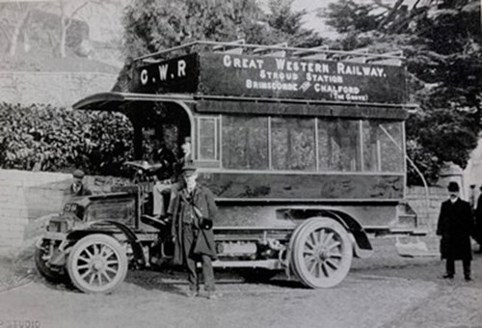
Great Western Railway Bus No.16, The Grove, Chalford
This is Great Western Railway bus No.16, a 20hp Milnes-Daimler Standard Double-Deck 018/16RO bus at The Grove, Chalford. The GWR ran an extensive system of road-vehicles in conjunction with its rail services, including buses and delivery vehicles (both carts and flat-beds). Not all were motor vehicles and many of the delivery vehicles were horse-drawn wagons. Bus services from Stroud station started in January 1905 to link with steam rail motor services in the area – which is interesting as both the places seen on the side of the bus – Brimscombe and Chalford – had railway halts. The CO 84 number plate of this bus indicates it was actually registered at Exeter.
D9746/1/7/424
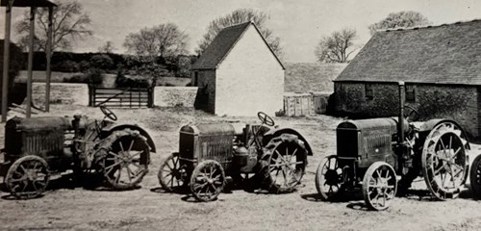
International Titan Tractors, W G Bridges, Cirencester
The first internal combustion tractors were invented in the late 1890s in America, and while unpopular at first, petrol and paraffin powered tractors began to catch on when they became smaller and more affordable, and by the 1920s, gasoline-powered tractors had become the norm (diesel tractors didn’t become common until the 1960s). This picture shows three International Titan tractors after being delivered to W.G. Bridges, one of the first motor vehicle garages and dealerships in Cirencester. Judging by the condition of their wheels, the two on the left may be second-hand models and/or have been tested in a muddy field!
D9746/1/7/432
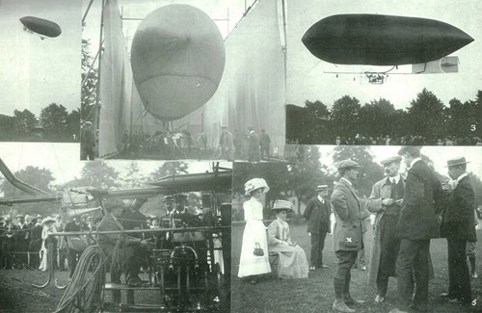
Willows No. 2 Airship, Cheltenham
These photographs show the Willows No.2 airship at Cheltenham on 11 July 1910 just before it took off to return to Cardiff. Built by Mr Ernest Willows (1886–1926), a pioneer Welsh aviator and the first person to hold a private airship pilot’s licence. He can be seen sitting in the ‘car’ bottom left and standing in the centre of the bottom right image. Willows No.2 had flown to Cheltenham from Cardiff on 9th July in just 4 hours, on the new airship’s second proving flight. The airship was 26.2 m (86 ft) long and 6.7 m (22 ft) in diameter with an 820 m³ (29,000 cubic feet) gas bag made from silk. It was powered by a J.A.P. 30-hp air-cooled motorcycle engine and the pilot sat in a bamboo and steel control car suspended below the hydrogen filled gasbag. Steering was done via a rudder and two swivelling propellers on either side of the car. The following month Willows flew to London, a 122-mile (196 km) flight that took 10 hours – a record for a cross-country flight in Britain at the time that also entailed flying across the Bristol Channel, the first time this had been done!
Cheltenham Chronicle & Gloucestershire Graphic, 11 July 1910
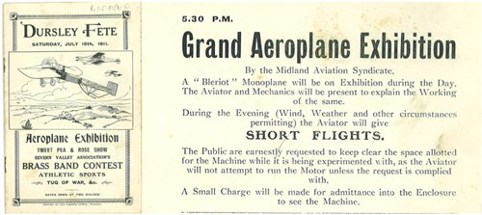
Dursley Fete programme cover and inside advert, July 1911
From the early 1900s onwards, flying machines and aviation became all the rage and before long ‘around-Britain’ air-races, static displays and even air-displays were becoming commonplace. This is part of the programme for the Dursley Fete in July 1911, which featured a static and aerial display by a Bleriot XI monoplane owned by the Midland Aviation Syndicate. Such was the attraction of aviation that a drawing of the aeroplane got pride of place on the programme’s front cover and a half-page segment on the inside. Typical of the time is that apart from its demonstration flight, the monoplane was hidden from general view as the programme states that ‘A Small Charge will be made for admittance into the Enclosure to see the machine.’
R115.113GS
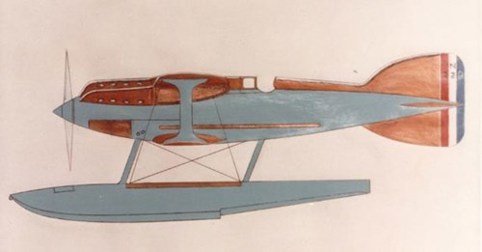
Gloster IVB N223 sea plane
The Coupe d'Aviation Maritime Jacques Schneider, also known as the Schneider Trophy, is a trophy that was awarded annually (later, biennially) to the winner of a race for seaplanes and flying boats. Named after its instigator, the race was held twelve times between 1913 and 1931. It was intended to inspire technical advances in civil aviation but in reality became a contest for pure speed. It generated huge nationalistic overtones as nations competed the trophy and produced significant advancements in aeronautics, notably in aerodynamics and engine design, ultimately lending its developments to World War II fighter aircraft. The Gloster Aircraft Company entered sea planes in the 1924, 1925 and 1927 races, the best result being in the 1925 race when the Gloster III finished second. For the 1927 Trophy, the Air Ministry was determined to improve Britain's performance and placed orders for designs of high speed floatplanes from Gloster, Supermarine (the S.5) and Shorts (the Crusader). Gloster's 1927 design, the Gloster IV, was a development of the Gloster III. Henry Folland, Gloster’s Chief designer redesigned the aircraft to reduce drag. Like its precursors, the Gloster IV was a wood biplane, with a monocoque fuselage that was powered by a 900 hp (671 kW) direct-drive Napier Lion VIIA engine. Both the upper and lower wings were gulled (angled) to allow the drag of the wing/fuselage junction to be minimised, while radiators were built into the surfaces of the wings and floats. Three examples were built – the IV, IVA and the IVB – each differing in the tail arrangement. The 1927 race was held in Venice and the Gloster IVB was finally chosen to compete. On the day of the race, 26th September 1927, the Gloster IVB, piloted by Flight Lieutenant Samuel Kinkead was the first aircraft to take off and it completed five laps before retiring (the race was won by Flight Lieutenant Sidney Webster in the Supermarine S.5….which eventually evolved into the Supermarine Spitfire). On inspection, it was found that the Gloster's propeller shaft was seriously cracked and would probably have failed and crashed if Kinkead had not retired. After the race, the aircraft returned to the UK, where they were modified to improve the pilot's view and used as high speed trainers.
D5922/3/6/1
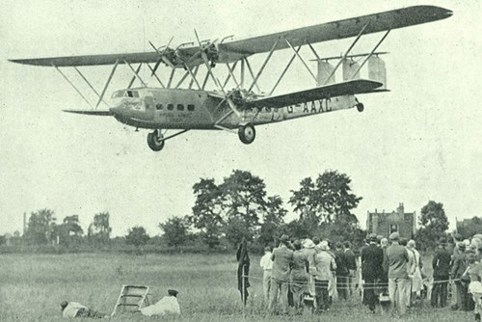
Handley Page HP45 G-AAXC Heracles, Brockworth Aerodrome, 1932
On Saturday 6th August 1932, British Imperial Airways Handley Page HP45 G-AAXC Heracles visited Brockworth Aerodrome. The largest airliner in the world, these elegant but ungainly looking aircraft were the last word in luxury and could carry 38 passengers over 500 miles in high comfort at 100mph! Heracles was flying drama critics from Croydon to the premier of George Bernard Shaw’s play ‘Too good to be true’ at the Malvern Festival. While the critics went on by road, the airline gave a joy-ride flight for local civic dignitaries and to members of the public. The latter had to have pre-booked the joy-rides and tickets had been available in Thomas Cook’s Gloucester branch for 10s/6d (around £25 today!). At the start of WW2 Heracles was taken into RAF service but in March 1940 her sister HP45 Hanno was blown into her in a severe gale at Whitchurch Airport, Bristol. The damage caused was so extensive that both aircraft were written off.
Cheltenham Chronicle & Gloucestershire Graphic, August 1932
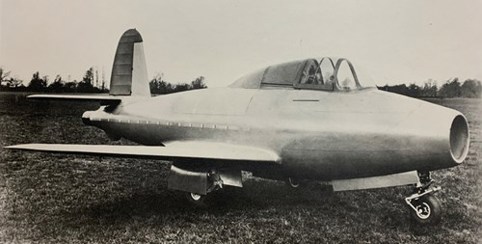
Gloster E.28/39
This was the first British jet-aircraft and it was built to test the jet engines that Frank Whittle’s Power Jets Ltd had been developing during the 1930s. The Gloster Aircraft Company won the contract and work began at Brockworth but moved to Regent Motors in Regent Street, Cheltenham (now the Regent Arcade) as a precaution. In April 1941, the prototype was completed but a flight-worthy engine was not available so a non-flight capable one was installed instead – the aircraft then moved to Brockworth for ground tests and it was during these (probably on 8 April) that a series of short ‘bunny hops’ of about 6ft in height were made – the first flight of a jet aircraft in Britain. Subsequently, the aircraft received a flight-rated engine and went to RAF Cranwell where on 15 May 1941, Gloster's Chief Test Pilot, Flt-Lt Gerry Sayer flew it in a 17 minute flight, making it the 4th jet aircraft to fly (the first being the German Heinkel He 178 in 1939).
D12580/5
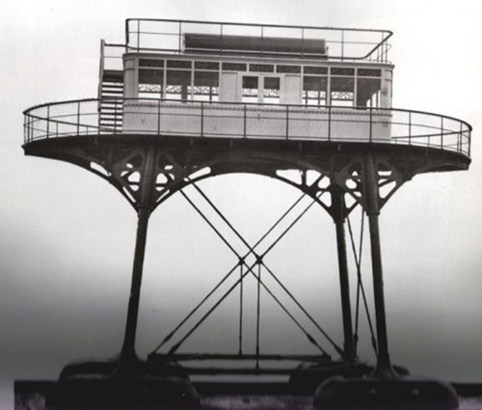
Gloucester Railway Carriage and Wagon Company Gantry Car
In 1894 The Gloucester Railway Carriage and Wagon Company built a ‘Gantry Car’ for Magnus Volks’ Brighton and Rottingdean Seashore Railway Company. Volk’s had already built a successful Brighton electric railway, and he was eager to find ways to extend his line eastwards to nearby Rottingdean. He soon realised that to advance his existing railway would involve very costly works to construct a steep climb to the top of the cliff or build a viaduct running along the (unstable) undercliff, so he hatched a somewhat crazy alternative plan to create a railway which ran through the sea! The GRCWC won the contract to build a sea-going tram for the line, which was to be powered by electricity supplied by trolley-style suspended cables running along the landward side of the track (Gloucester’s Sissons & Co made the power station that supplied electricity to the railway). The tram, which was officially known as 'Pioneer', but nicknamed the ‘Daddy long-legs’ was a curious invention with an elliptical deck 45ft long by 22ft wide that could hold 160 passengers. The car was supported on four braced tubular legs each 23ft long. It weighed 45 tons and each leg hosted a bogie housing four large wheels encased in steel plates, with one bogie on each side being driven by a shaft and worm gear arrangement leading from two General Electric 25hp electric motors. The other two legs carried the brakes to the remaining two bogies and all the bogies were fitted with scrapers to push aside seaweed, marine life shingle from the track. The coach body also featured a ships bell and lifeboat and required a qualified sea captain to drive it!
D4791/16/10 No.867