
St. John Ambulance Association Gloucester
D7935/8/6
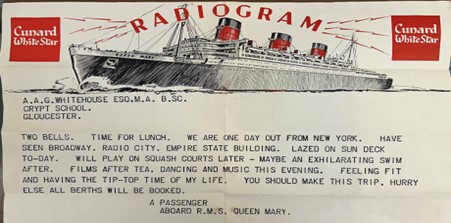
Because long-distance air travel was not an option prior to the 1930s, all long-distance international travel was undertaken by ship and train, or usually a combination of both. Sadly because, even after the advent of air-travel, it seems that even the wealthier citizens of Gloucestershire were conservative and preferred surface travel (with one exception) most of this presentation by default looks at travel by sea. Of course, if you had to go by sea, then why not travel in style! The RMS Queen Mary crossed the Atlantic in 4 days in total luxury at an average speed of 29kts (33mph/53 km/h) and she held the Blue Riband from 1938 to 1952. This was sent by a pupil or ex-pupil to a teacher, Arnold Whitehouse, at The Crypt School. The Queen Mary typically carried 2,000 passengers but on one voyage in 1943, she carried 16,600 people – still the record for the most people on one vessel!
British & Irish Steam Packet Company Timetable
D6035/8/6
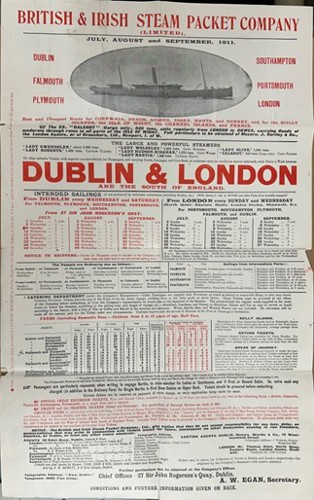
Trips to Ireland were offered from numerous companies - such as this one from the British & Irish Steam Packet Company in 1911. Sailings to Dublin ran twice a week from London, Portsmouth, Southampton, Plymouth and Falmouth. Oddly, the ship shown on the brochure was the SS Calshot – the only company vessel that didn’t carry passengers just cargo!
Steamers to Denmark, 1832
D3549/25/8/2
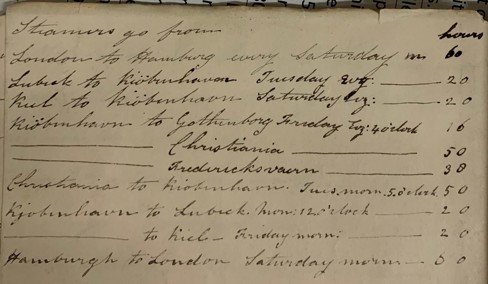
European trips have always been popular and in 1832 Thomas Lloyd-Baker – on a trip reminiscent of C4’s Travel Man – travelled to Denmark to visit Kiöbenhaven (Copenhagen) and Christiania. His plan was to sail from London to Hamburg on a Saturday and then had options to catch various steamers from the following cities: Lubeck, Kiel, Gothenburg, and Frederikshavn. You can't help but wonder how long this took to work out without the internet!
Booth Line Amazon Cruise Brochure
D6035/8/6
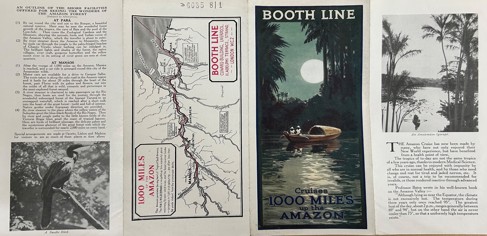
The Booth Line was a shipping company founded in 1866 in Liverpool with interests in the United States and South America. This Amazon cruise offered by the company was promoted as it could be taken with ‘impunity by all who are in normal health’ thanks ‘to modern Medical Science’. This brochure came from the Whitehouse family of Churchdown – we don’t know if they ever went; most of their holidaying interests seem to lie with bicycle holidays!
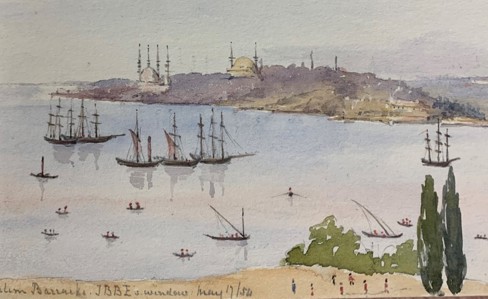
Istanbul from across the Bosphorus, 1854
D1571/F559
One good way to travel abroad was to join the military – this was especially true in the Victorian period when, the expansion of the British Empire saw numerous colonial wars and troops were frequently sent abroad. We have many military diaries featuring foreign travel, but apart from some maps and plans few have any illustrations. One exception is this volume of watercolour sketches of Crimea around Sebastopol, 1854-5 from the archive of James Estcourt of the Sotheron-Estcourt family of Shipton Moyne. This is a watercolour painting of Istanbul painted by Captain Clifford, a colleague of Major-General James Bucknall Bucknall Estcourt, a member of the Sotheron-Estcourt family of Shipton Moyne. The view shows Istanbul across the Bosphorus and was painted from Estcourt’s room in the ‘Selim Barracks’ – better known as the Selimiye or Scutari Barracks. During the Crimean War (1854–56), the barracks were allocated to the British Army and used as a military hospital, becoming famous because of Florence Nightingale. Although celebrated as a heroine, James’ wife, Caroline (who travelled with her husband to the Crimea) described Nightingale as being "very overbearing and presumptuous". James was a career soldier who had an interesting and varied service that included visiting Canada and Mesopotamia. In February 1854, as a brigadier-general, he saw his first active service when he was appointed adjutant-general to the British Crimean expeditionary force, where he performed his duties efficiently at Gallipoli, Varna, and at the Battles of Alma and Inkerman. Promoted to Major-General, he died of cholera in the Crimea on 24 June 1855 and was buried in The British Head-Quarters Burial-Ground, situated halfway between Sebastopol and Balaclava.
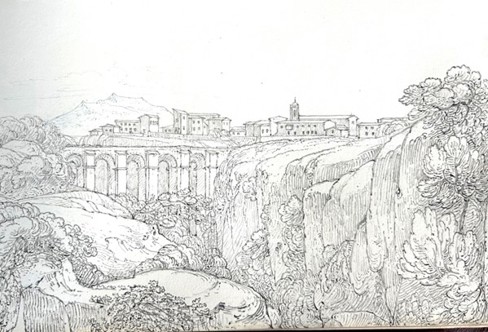
Civita Castellana, Italy, c1813-36
D45/F57
Whilst travelling on military service in Europe, General George Whitmore from Lower Slaughter frequently made sketches and drawings of the places he travelled through – like this example of Civita Castellana in Italy.
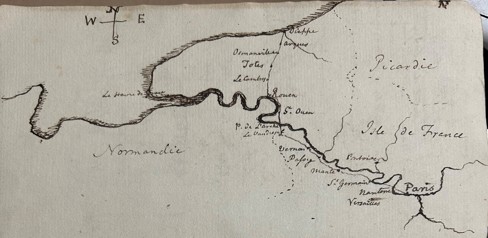
Journey to Paris, 1776
D2002/3/4/1
In 1776, John Freeman-Mitford, 1st Baron Redesdale, undertook a cross-channel trip to Paris. This entailed a sea-crossing to Dieppe and then an overland stagecoach to Rouen, then a stagecoach following the Seine to Paris. On the way he made drawings of some of the people and places he encountered.
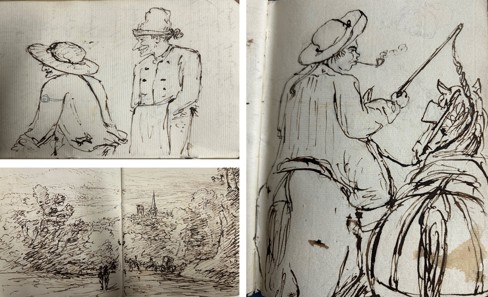
Sketches of people and places in France, 1776
D2002/3/4/1
These are some of the drawings that John Freeman-Mitford, 1st Baron Redesdale, drew while travelling to Paris by stagecoach.
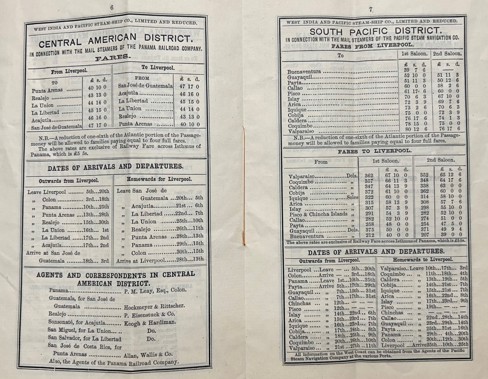
West India & Pacific Steamship Company Passenger Tariff, 1869
D2455/F3/6/4/1
All the main shipping lines published brochures giving detailed information about sailing dates, routes and prices. This is the West India & Pacific Steam-ship Company’s brochure for 1869 and is typical of the time. Comprising an 8-page booklet, these timetables include every destination and arrival port as well as fares, rules and regulations and shipping agents.
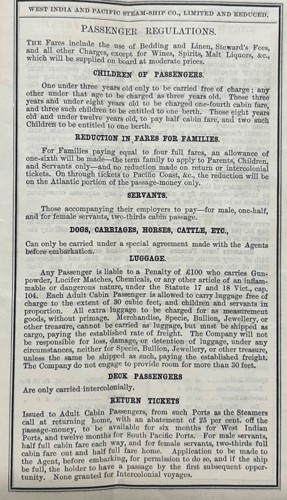
West India & Pacific Steamship Company Passenger Regulations, 1869
D2455/F3/6/4/1
Although much more laid back than today’s airline regulations, the shipping companies did have their own rules! Most were concerned with charging for extra luggage – including servants, who were charged at half-fare for males and two-thirds for females. Regarding valuables, ‘Merchandise, Specie, Bullion, jewellery or other treasure’ could only be shipped under freight shipping rules and charges. Fines of £100 would also be imposed on any passengers found carrying ‘Gunpowder, Lucifer matches, Chemicals of any other article of an inflammable or dangerous nature’.
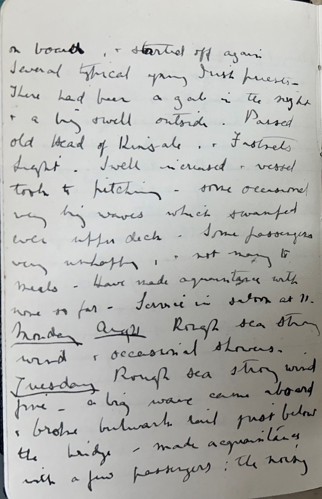
Susan Hicks-Beach Diary, Atlantic Crossing, 1905
D2455/F3/11/2/2
This is from the diary of Susan Hicks Beach when she left on an around-the-world trip to Singapore via America, Japan, Shanghai and Hong Kong (returning via Ceylon and India) in 1905. She sailed from Liverpool on the 19 August on the RMS Umbria – which she described as ‘an old ship’ and having ‘less space than a P&O and a long way from the bath’. Susan Hicks-Beach was right about the ship’s age – the Umbria (and her sister ship Etruria) were launched in 1884 and were the last two Cunard express ocean liners that were fitted with auxiliary sails and the last express steamships built for a North Atlantic route with two-cylinder compound steam engines rather than the more modern and more efficient 3-cylinder triple-expansion designs. Like most Atlantic voyages, after leaving England, the Umbria called at Queenstown in Ireland before starting her Atlantic crossing. This part of Susan H-B’s diary records the passing the Old Head of Kinsale off the south-west of Ireland shortly after leaving Queenstown. There was a gale blowing creating a rough sea, that frequently broke over the decks of the ship. Susan records that many passengers were ‘very unhappy’ and that there were ‘not many to meals’! Two days later the gale was still blowing, when a wave caused structural damage to the Umbria, smashing the ship’s bulwark rail below the open bridge.
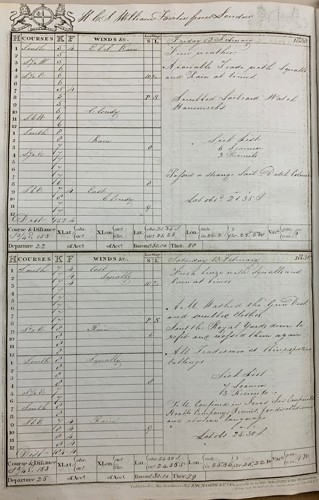
Log of the William Fairlie, Indian Ocean, 12th & 13th February 1830
D1292/2/43
A ship’s log records the day-to-day activity onboard a ship. This is a page from the log of the William Fairlie, for Friday 12th and Saturday 13th February 1830 while sailing from London to Bengal and China. The William Fairlie was a full-rigged ship built at Calcutta in 1810 for the East India Company (EIC). She made four voyages for the EIC but from 1821 became a Free Trader, continuing to trade with India under an EIC license. She also made voyages transporting convicts to New South Wales (1834), and Tasmania (1852) and immigrants. This log gives the prevailing weather on the days, described as fair weather with ‘squalls and rain at times’ on both days allowing the ship to make around 5-8 knots (6-9mph). On the 12th, a ‘strange sail - Dutch colours’ was sighted and there were 6 seamen and 3 recruits on the sick list. On the 13th the ‘gundeck was washed and clothes scrubbed’, the sick list comprised 7 seamen and 3 recruits and one recruit was ‘confined in irons’ for ‘disobedience and abusive language’. The Fairlie sailed until 1865 when she was lost in a cyclone off Ceylon, although most of her crew survived and were subsequently rescued by another Indiaman a month later.
Painting of the coast of Malacca by ‘M.A.C.’, undated
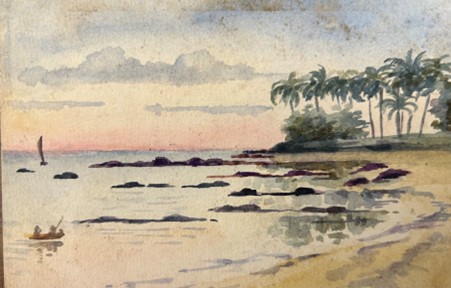
D10423/Box47/14
Straight off BBC’s Desert Island Discs, this watercolour painting of a palm-fringed beach was done by ‘M.A.C.’ (unknown) in a letter describing travel to Malacca. The painting is contained within the archive of Charles Wade of Snowshill in a box of miscellaneous letters belonging to Mary Graham – who later married Charles Wade. The only clues are that it is with a card from ‘M.A.C.’ to Mrs Graham, who at the time lived at The Parsonage, Kuala Lumpur, F.M.S.(Federated Malay States). It is presumed that ‘M.A.C.’ was a friend of Mrs Graham.
Indian elephant with ladies on a howdah
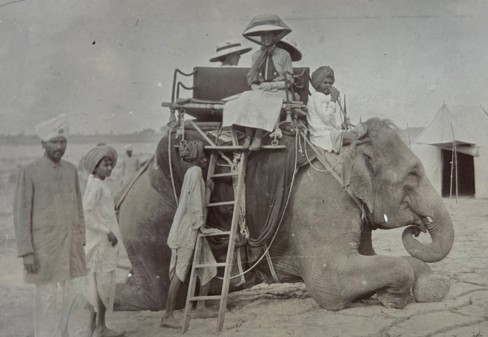
D8841/1/2
This photograph of an Indian elephant, it’s handlers and two ladies on a howdah was taken by Ton Whittingham-Brown. Tom was born in Hull in 1915 but his father worked in India, which was where Tom subsequently spent part of his childhood, before the family returned to the UK and London. While in India he took numerous photographs, of which this is one. He later became a teacher and after service in WW2, was appointed as head of Gloucester’s King's School. At the time the school was under threat of closure, but he transformed it into a thriving modern school, after which he took a headmaster’s post in Kenya. In 1982 he returned to the UK, living at Clifton in Bristol. He died in February 1983 while visiting Nairobi on a world tour.
Towers of Silence, 15 February 1903
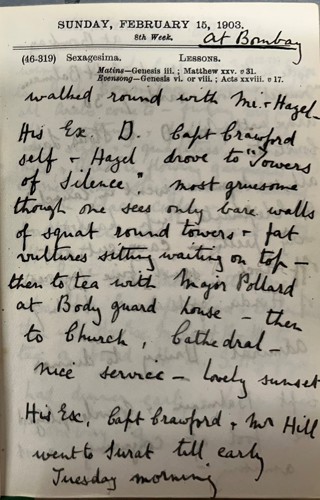
D2455/F3/11/2/2
While at Bombay, on her world tour, Susan Hicks-Beach visited the ‘Towers of Silence’ or ‘dakhmas’. These are circular, raised structures built by Zoroastrians for the excarnation of the dead. Vultures and other carrion birds, who gathered around the towers, would consume the flesh from the dead bodies, after which the skeletal remains would be gathered up and placed into a central pit where further breakdown could occur. She described these towers as ‘most gruesome’ but noted that there were ‘fat vultures sitting, waiting on top’! It was known that vultures could strip the flesh from a newly offered body in minutes!
Susan Hicks-Beach diary – Alexandria & SS Rowmelia, 24-25 March 1903
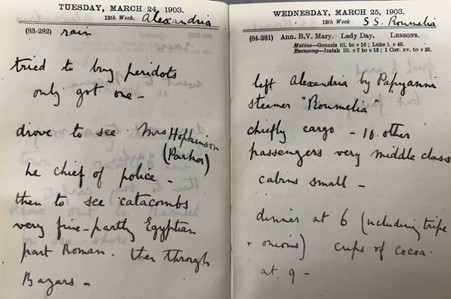
D2455/F3/11/2/1
Whilst returning to the UK, Susan Hicks-Beach travelled from Suez to Alexandria by train. At Alexandria, she tried to buy peridots (a yellow-green transparent variety of the mineral olivine) and toured the catacombs bazars. The following day she left Alexandria onboard the steamer SS Roumelia of the Papayanni Line bound for Malta. This vessel was primarily a cargo ship but carried small numbers of passengers. With the casual snobbery of her class, Susan often made notes in her diary about the ships she sailed on, usually accompanied by observations on her fellow passengers. This voyage was no different, for she noted that the passengers were ‘very middle class’ and that the ship had small cabins. Oddly she rarely mentioned the food onboard ships but on this voyage she did because at dinner there was ‘tripe & onions’!
Memo of Tour of Sir Micheal Hicks Beach
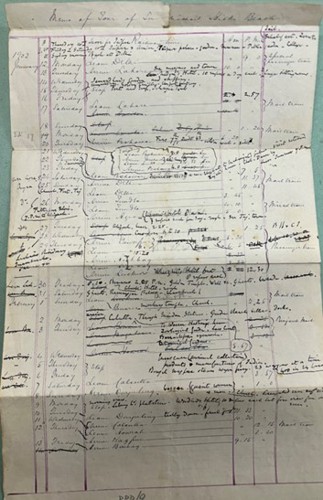
D2455/F3/6/4
The second half of Michael and Lucy Hicks-Beach world tour saw them travelling through India. This is their itinerary, starting at Jaipur on 8 January 1902 and reaching Bombay on 14 February. There are lots of alterations – presumably due to a combinations of changes in destinations and none appearance or delays of trains or other transport!
Official invitation to the opening of the Aswan Low Dam, 10 December 1902
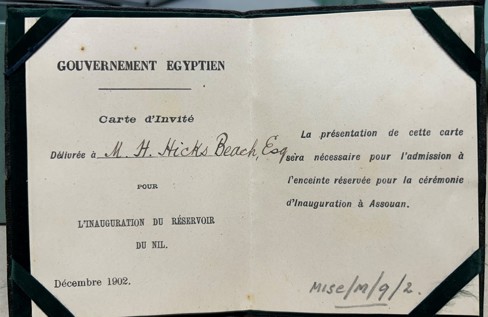
D2455/F3/10/4/4
During his world tour, Sir Michael Edward Hicks Beach travelled in North Arica – visiting Egypt and the Sudan. In Egypt he toured Cairo, Luxor and Karnak and while there received an official invitation from the Egyptian Government to the opening of the Aswan Low Dam on 10 December 1902. This was the first dam across the Nile and it was a gravity masonry buttress dam that was the largest dam of its type in the world. It had been designed by Sir William Willcocks and the main contractor was John Aird & Co.
Handley-Page HP.45 G-AAXC Heracles at Brockworth, August 1932
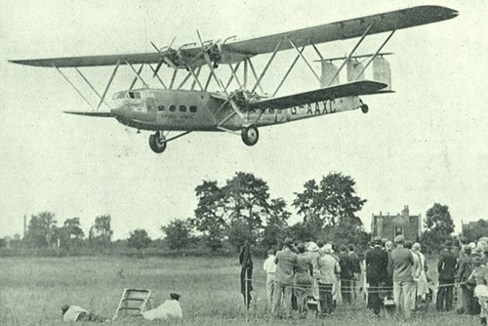
Cheltenham Chronicle & Gloucestershire Graphic, August 1932
By the 1930’s air travel had advanced sufficiently to allow international air travel. A taste of the future was offered by the visit of Imperial Airways Handley Page HP.45 G-AAXC Heracles in August 1932 which came to Brockworth on a charter flight to deliver newspaper critics who were going to Malvern to see the premiere of a new play by George Bernard Shaw. While at Brockworth, the aircraft gave experience flights to local councillors and to paying passengers (tickets had been on sale at Thomas Cook in Gloucester). First flown in 1931, they were the world’s biggest airliner with the HP.45’s operating on Imperial Airways European route, while their sisters, the HP.42’s, operated on the intercontinental routes to the Africa, India and South Africa. In WW2, all were impressed into RAF service with No. 271 Squadron. On 3 March 1940 G-AAXC Heracles was damaged beyond repair when HP.42 G-AAUD Hanno was blown into her during gale at Whitchurch Airport, Bristol.
Derby Airways Advance Timetable and Fares, 1961
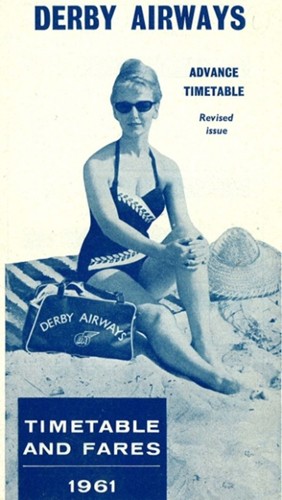
RR286.1
In April 1959, Derby Aviation, a charter and freight airline formed a subsidiary, Derby Airways, after it was awarded a licence to operate scheduled flights to Jersey. As part of its new business, it began scheduled air services from Staverton (now Gloucestershire Airport) to Paris, the Channel Islands and Ostend. The first customers from Staverton were the Gloucester Labour Club who booked onto the first Paris flight for £6 return. The flight was booked for the 18th April with the group taking advantage of the ‘Facilitation’ – a new Anglo-French agreement allowing passport-free flights in the holiday season. Unfortunately, someone got the dates mixed up and it was realised that the new agreement was not starting until Friday 25th April! No-one in the group had passports and when they called the Foreign Office to ask if they could get them, they were told that new passports couldn’t be processed in time for the flight. As a result, the whole holiday was cancelled. Derby Airways continued operations from Staverton on a semi-regular schedule basis until October 1964, when after an expansion it changed its name to British Midland Airways. Since then, numerous operators, including Cambrian Airways, InterCity Airlines and Manx2, have tried to establish regular scheduled flights from the airport, but none have really succeeded. The last was the Isle of Man airline, Citywing, which operated scheduled flights from the airport from 2013, marketing it as an alternative to Birmingham Airport, Bristol Airport and Oxford Airport, but it ceased trading in 2017. However international charter flights by private operators still fly from Gloucestershire Airport on a regular basis.
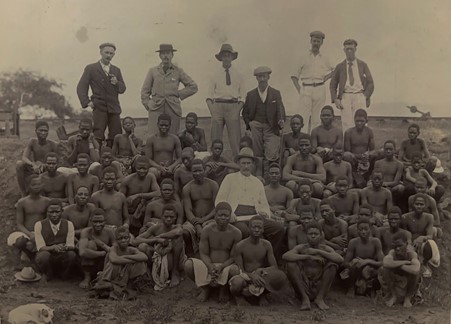
Gloucester Railway Carriage & Wagon Company employees and native worker, c1900
D4791/17/2
Several of the larger Gloucestershire industrial companies sent their employees on overseas trips, especially if their work or products required it. The Gloucester Railway Carriage & Wagon Company supplied goods around the world and so it frequently sent its employees abroad to oversee delivery and assembly of its products. This photograph is from the company archive and shows some of the company's representatives with native railway workers in Africa. Unfortunately the details of this intriguing shot are missing although it is most likely to have been taken on or around the opening of the Beira-Salisbury Railway between Beira in Mozambique and Salisbury (now Harare)in Zimbabwe.
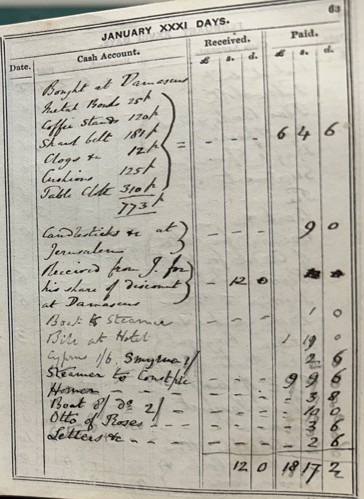
Expenses of Micheal Hicks-Beach, 1902/3
D2455/F3/6/4/6
This is a page recording expenses from Micheal Hicks-Beach’s round the world trip. It lists various items bought at various places:
– A coffee stand, shark belt, clogs, cushions and a tablecloth at Damascus for £6 4s 6d (£490 today).
– Candlesticks at Jerusalem for 9s (£35 today)
– A hotel bill (probably Damascus) for £1 19s (about £154 today)
– Posting of letters (2s 6d – roughly £10)
– A steamship passage to Constantinople (Istanbul) – this was the most expensive item at £9 9s 6d which is around £745 today.
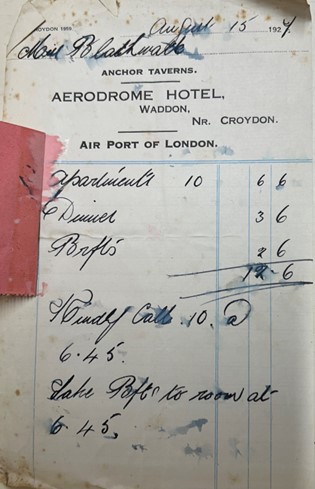
Bill from Aerodrome Hotel, Waddon, near Croydon, 15 August 1927
D2659/27/53/18
In the early days of international civil aviation, you flew from Croydon Airport – Britain’s first international airport and predecessor to London Heathrow. Like today, hotels sprang up by the airfield to accommodate travellers, and this is a bill from the Blathwayt archive for the Aerodrome Hotel, located next to Croydon airport. It comes from Mary Blathwayt’s collection in the Blathwayt archive and records an overnight stay with dinner on the 15th August with an alarm call at 6.45am and breakfast on the 16th, it suggests she was going to fly from Croydon later in the morning, but sadly if she was and what her destination was isn't recorded!
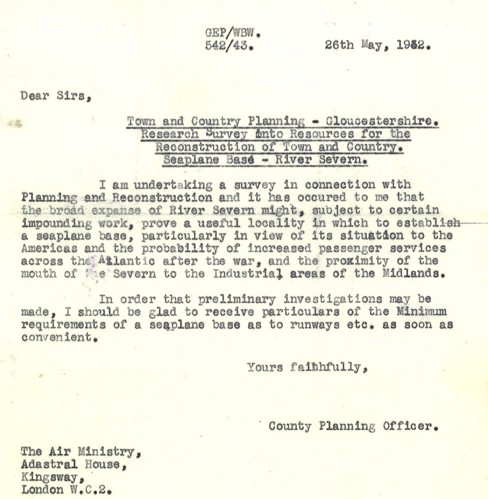
Letter to Air Ministry – seaplane base on Severn Estuary, 26 May 1942
C/AP/R1/SE/4/2
In 1942, the Gloucestershire County Council’s County Planning Officer wrote to the Air Ministry, suggesting that, post-war, the Gloucestershire section of the Severn Estuary might make a good seaplane base, from where trans-Atlantic seaplane air services might operate from. The Air Ministry replied that the estuary was too restricted, and its main length was too exposed to the prevailing weather. It also noted that if the estuary had been suitable, then the military would have already developed it as a base. Another factor was that aviation advanced so much in WW2, that the age of the seaplanes was already coming to an end and post-war modern aircraft had the range to cross the Atlantic in one flight, rather than having to make it in shorter legs.