Belonging Exhibition: Display 1
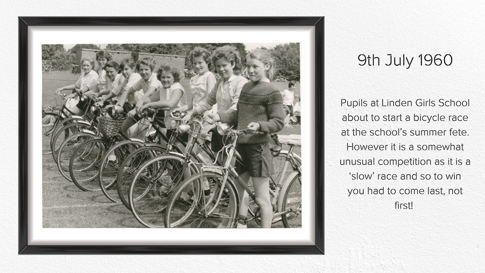
9th July 1960
The first image in the Belonging Exhibition takes us back to the start of a bicycle race at Linden Girls School in Gloucester. The race is about to begin at the school's summer fete in July. However it is a somewhat unusual competition as it is a ‘slow’ race and so to win you had to come last, not first! Sadly we don’t know who won it but it fair to say that a few probably fell off, especially if they had to stay within the lanes marked out on the grass!
Image Reference: D10638/1/1960/28
Belonging Exhibition: Display 2
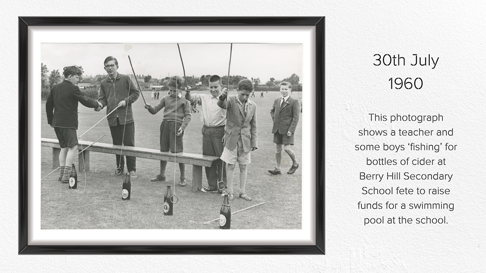
Bottle fishing at the school fete, 30th July 1960
This photograph shows a male teacher and some boys ‘fishing’ for bottles of cider at Berry Hill Secondary School fete in July 1960. This took place at the school’s summer fete to raise money for a swimming pool at the school. The idea was to use the fishing rod and line to drop the ring over the top of the bottle and then catch it – hoping that the ring would trap the bottle neck so the fisherman could retrieve the bottle. Without knowing the precise rules it’s a guess as to how many goes you had!
Interestingly, the tops of the bottles are intact – but it’s not known for sure whether these were full of cider or something else! Some of the labels can be made out and reveal the brands; Bulmers and (on the far left) Cidona - an Irish apple based soft drink on sale since 1955 that for a time was made by the Bulmer company of Hereford. Two of the bottles (first on the right and second from the right) appear to have a ‘W’ on them and might be from the local Much Marcle based cider makers firm Weston’s.
Image Reference: D10638/1/1960/31
Belonging Exhibition: Display 3
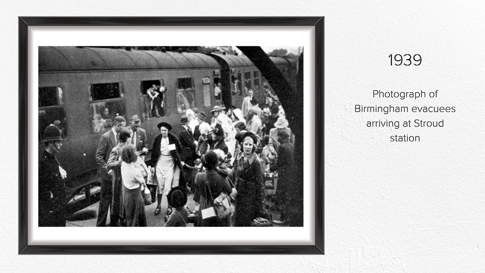
World War 2 Evacuees disembarking from train at Stroud railway station, 1939
This photograph shows evacuees from Birmingham arriving at Stroud Railway Station. Amidst the general confusion you can see members of the local reception committee on the left hand side waiting to receive them, along with a local Policeman.
You can simply imagine the noise and chaos that will fill the station for the next 30 minutes or so!
Interestingly, all of those leaving the train appear to have gas masks – while those waiting for them (including the police officer) don’t. This demonstrates that it took a little while for the government machine to distribute its wartime preparations out into the countryside as opposed to supplying the major towns and cities.
This photograph shows that it was not just children who could be evacuated but other specific social groups deemed non-essential to war work including the infirm, pregnant women and mothers with babies or pre-school children (who would be evacuated together). Several of the ladies on the right of this picture appear to fall into that last category.
Image credit: Museum in the Park, Stroud
Belonging Exhibition: Display 4
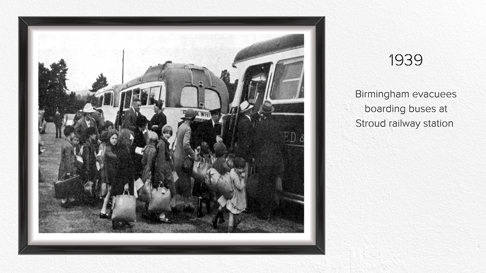
World War 2 Evacuees boarding buses at Stroud railway station, 1939
This photograph shows evacuee children from Birmingham boarding buses at Stroud railway station. Evacuation was a massive logistical operation that involved teachers, local authority officials, Police, railway staff and the Women's Voluntary Service (WVS).
Being an evacuee must have been scary and exciting at the same time. The children had to leave their families and homes behind and then try to fit in with host families in the country, who of course were total strangers. To ensure they reached the right hosts, children had labels attached to them, giving details and you can see these in the photograph.
The government advised that evacuee children should take their gas mask in its case, a change of underclothes, night clothes, plimsolls (or slippers), spare stockings or socks, toothbrush, comb, towel, soap, face cloth, handkerchiefs and a warm coat. Many families struggled to provide their children with all of the items listed and of interest in this photograph is that many of the children are carrying shopping bags rather than suitcases.
The buses are from the famous Red & White Service Ltd, which was formed by John & Arthur Watts of Lydney in 1929 but expanded to provide services in the Forest of Dean, Gloucestershire (moving into the Stroud area in 1933 after acquiring the business of Red Bus Services of Stroud), Monmouthshire and the Glamorgan valleys as well as the long-distance market.
Image credit: Museum in the Park, Stroud
Belonging Exhibition: Display 5
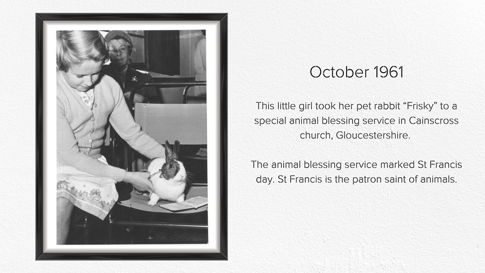
St Francis Day, 1961
This display shows a little girl with her pet rabbit “Frisky”. She took the rabbit to a special animal blessing service in Cainscross church, Gloucestershire. The animal blessing service marked St Francis day, as St Francis is the patron saint of animals.
This photo is shared with the kind permission of the Citizen.
Image Reference: D10638/1/1961/40
Belonging Exhibition: Display 6
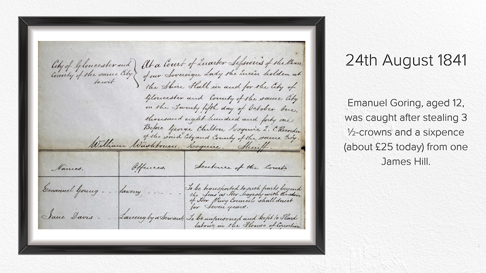
Sentenced to 'transportation beyond the seas', 1841
Emanuel Goring, aged 12, was caught after stealing 3 ½-crowns and a sixpence (about £25 today) from one James Hill on 24th August 1841. After a period of incarceration in Gloucester Gaol, he was sentenced at the Michaelmas Assizes in October 1841 to ‘transportation beyond the seas’ to Van Diemen’s Land (now Tasmania) for 7 years. Initially however he was sent to a juvenile reformatory at Parkhurst Gaol on the Isle of White. He was later transported on the ship Elphinstone on 10th April 1842, but when transported he was officially pardoned on the proviso that when the ship reached Tasmania he became an apprentice to a local employer.
Between 1842 and 1852, it is thought that about 1,500 boys between the ages of 12 and 18 years were sent to various colonies in Australia and New Zealand in this way, being known as ‘Parkhurst Boys’.
Image Reference: GBR/G3/SG/1
Belonging Exhibition: Display 7
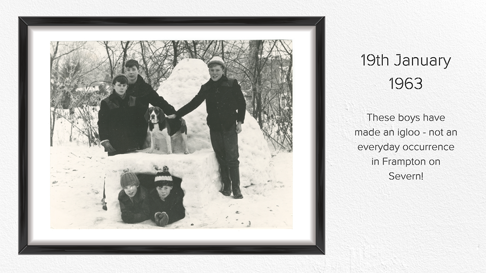
A snow day in Frampton on Severn, 1963
This display shows boys and a dog, in hats and gloves on a January snow day. They've been busy making an impressive igloo - a rare sight in Gloucestershire.
This photo is shared with the kind permission of the Citizen.
Image Reference: D10638/1/1963/3
Belonging Exhibition: Display 8
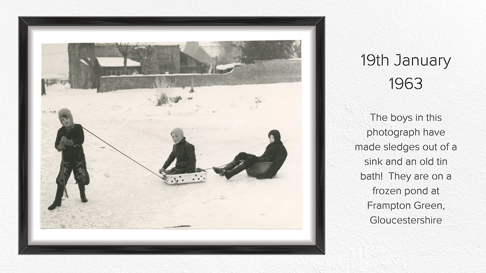
Sledging on a frozen pond, 1963
Snowy weather can be fun, especially for children. Do you remember making a snowman or having a snow ball fight? The boys in this photograph have made sledges out of a sink and an old tin bath! They are on a frozen pond at Frampton Green, Gloucestershire.
This photo is shared with the kind permission of the Citizen.
Image Reference: D10638/1/1963/3
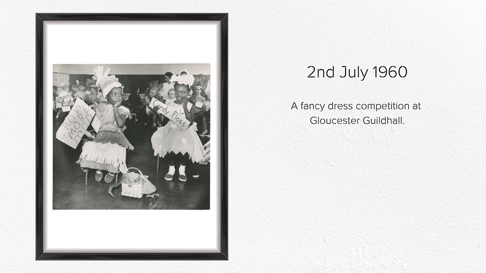
Belonging Exhibition: Display 9
A Fancy Dress Competition, 1960
This display shows children taking part in a fancy dress competition at Gloucester Guildhall. Two girls were holding up signs, their costumes were called “Grow more food” and “Candy Floss”.
This photo is shared with the kind permission of the Citizen.
Image Reference: D10638/1/1960/27
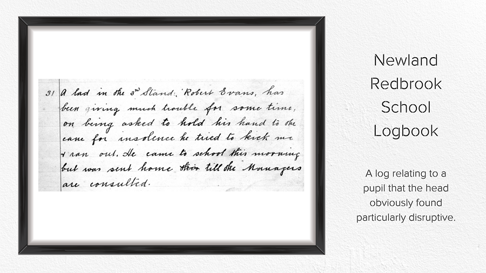
Belonging Exhibition: Display 10
This image comes from the log book of Newland school and relates to a pupil that the head obviously found particularly disruptive and over a long period of time.
Corporal punishment was permitted at the time although it did have to be recorded in a special Punishment Book. This instance is recorded in the log book because the head didn’t get a chance to administer it!
Schools did not like excluding pupils as it affected their income and so it was a decision that was not taken lightly and so would be discussed and decided upon at a meeting with School managers and the teaching staff.
Image Reference: S227/1
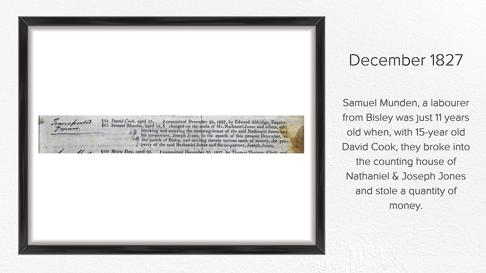
Belonging Exhibition: Display 11
Sentenced to 7 years transportation to New South Wales, 1827
In December 1827, Samuel Munden, a labourer from Bisley was just 11 years old when, with 15-year old David Cook, they broke into the counting house of Nathaniel & Joseph Jones and stole a quantity of money. They were subsequently caught and committed to Gloucester Gaol, appearing before the magistrates at the Christmas Assizes.
The pair were sentenced to 7 years transportation to New South Wales, sailing on 17th October 1830 on the ship Lady Harewood. For the 2 years prior to their transportation it is likely that the boys were held onboard the prison hulk HMS Euryalus (a veteran of the Battle of Trafalgar) at Chatham on the Medway.
When it was decommissioned this ship had become a prison hulk reserved for young males and just such a vessel is described in the opening scenes of Dickens' Great Expectations: "The black Hulk lying out a little way from the mud of the shore, like a wicked Noah's ark, cribbed and barred and moored by massive rusty chains, the prison ship seemed to Pip's young eyes to be ironed like the prisoners."
Image Reference: Q/SG2/1815-1840
Belonging Exhibition: Display 12
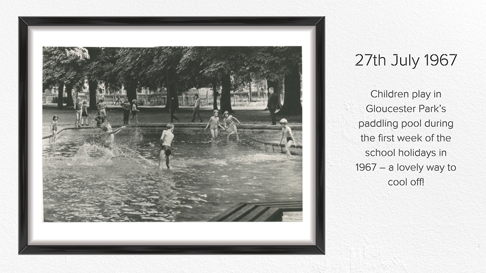
School's out, July 1967
Children play in Gloucester Park’s paddling pool during the first week of the school holidays in 1967 – a lovely way to cool off!
This photo is shared with the kind permission of the Citizen.
Image Reference: D10638/1/1967/30
Belonging Exhibition: Display 13
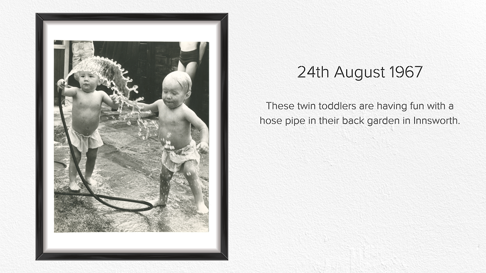
A back garden in Innsworth, August 1967
This display takes us back to the summer of 1967, in a back garden in Innsworth where two twin toddlers were having a good time.
This photo is shared with the kind permission of the Citizen.
Image Reference: D10638/1/1967/33
Belonging Exhibition: Display 14
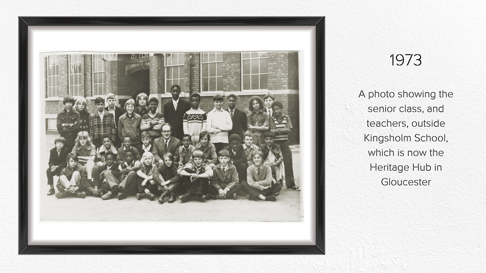
Kingsholm School, 1973
Here we present a photo showing the senior class, and teachers, outside Kingsholm School in 1973. The building is now the Heritage Hub in Gloucester.
Image Reference: D10638/1/1973/30
Belonging Exhibition: Display 15
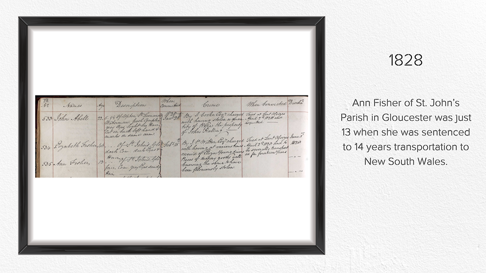
Sentenced to 14 years transportation to New South Wales, 1828
Ann Fisher of St. John’s Parish in Gloucester was just 13 when she was sentenced to 14 years transportation to New South Wales.
Ann was tried at Gloucester’s Lent Assizes 1828 alongside her mother, Elizabeth Fisher, on the charge of ‘having at various times, received of Eliza Young, diverse pieces of drapery, well knowing the same to have been feloniously stolen.’
The gaol register also records Ann and her mother’s appearance; Ann was of ‘fair complexion, grey eyes and sandy hair’ while her mother had a ‘dark complexion, dark eyes and hair’. The harsh sentence was probably because the judges decided they’d received 2 loads of stolen goods and so were sentenced to 7 years for each offence. Eliza Young was also tried at the same assizes and received the same 14 year transportation sentence. It appears that Ann was incarcerated together with her mother and both were transported on the convict ship Competitor on 13th June 1828 – it is debatable whether this was luck or a case of conscience from the authorities. Whether they were permitted to remain together in Australia is not known.
Image Reference: GBR/G3/G/3/2
Belonging Exhibition: Display 16
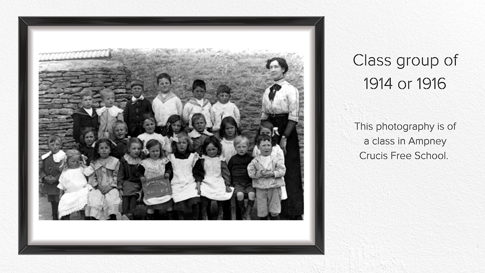
Class Group from Ampney Crucis Free School
This display is of a class from either 1914 or 1916.
The school was founded as Ampney Crucis Charity School by Sir Robert Pleydell, Lord of the Manor of Ampney Crucis in 1719, the school was funded from rents of land at Ranbury Farm in the adjacent parish of Ampney St. Peter. From the profits of this land the tenant of the farm had to pay £65 towards the maintenance of the master and mistress, and the clothing and instruction of poor boys and girls in reading, writing and the principles of Christian religion.
Initially children were selected by the trustees and attended the school for a period of four years beginning at the age of 8 or 9, but by 1862 the school was open to all parish children. Today the school has moved to new buildings but the old school survives as a private dwelling.
Image Reference: S15/9/1
Belonging Exhibition: Display 17
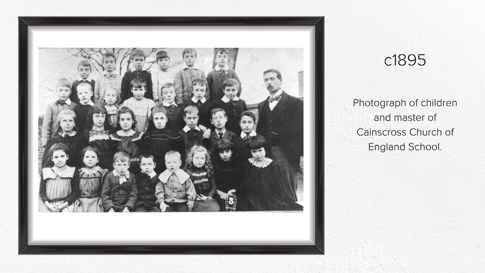
Children and master of Cainscross Church of England School, c1895
Cainscross school can trace its roots back to the eighteenth century when it was established as one of two charity schools at Stonehouse and Ebley. By 1833 the schools were affiliated to the National Society (the National Society for Promoting Religious Education) whose aim was to provide elementary education, in accordance with the teaching of the Church of England, to the children of the poor.
The Ebley National School was put under a separate management committee in 1845 as by that time it was mainly supported by contributions from Cainscross parish and most of its 159 children were from the parish. In 1877 a new school building was built on a site given by the Vicar of Cainscross, opposite the church, St. Matthews, and it is here that this photograph was taken around.
Image Reference: GPS/68/12