
Death in the Archives
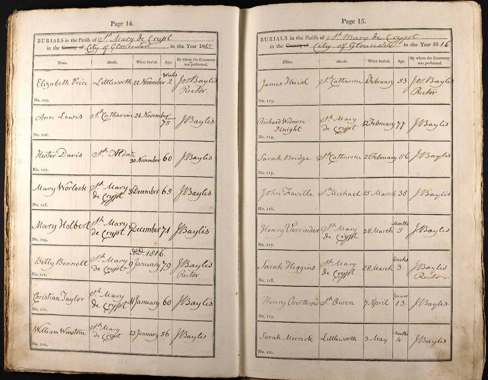
1. Coberley parish register, 1695 - 1778
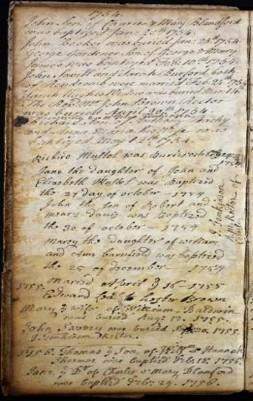
P105/IN/1/6
These are the accounts that contain most records of deaths via the details of burials. The origins of parish registers go back to 1538 when, as part of the Reformation changes, parish churches were required to keep registers of all persons baptised, married and buried in their parish. Pre-1754 registers usually contain baptisms, marriages and burials in one volume – as with this example form Coberley. They generally record the name of the deceased and the date of burial – which typically happened a few days after the death occurred.
2. Burial register St. Mary de Crypt parish, Gloucester, 1845-46
P154/11/IN/1/13
In 1812, parish registers came under legislation with Sir George Rose’s ‘Act for better regulating and preserving Parish and other Registers of Births, Baptisms, Marriages, and Burials in England’. This was enacted on 28th June 1812, and it required baptisms and burials to be kept in separate pre-printed volumes with specific information recorded. For burials, this was the date of burial, the name of deceased, their place of abode (village or address), their age and the name of the officiating minister.
3. Brimpsfield parish register, February 1624
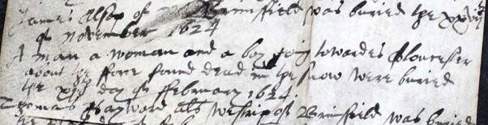
P58/IN/1/1
Occasionally multiple burials took place on one day – this is an entry from Brimpsfield parish for February 1624. It records the deaths of an entire family who froze to death in the snow while heading towards Gloucester.
A man a woman and a boy going towards Gloucester
about the Fowr found dead in the snow were buried
the XIth day of February 1624.
4. ‘Smooten to death’, Duntisbourne Rous parish register, 18 April 1636
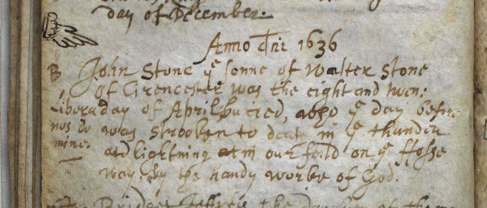
P123/IN/1/1
On occasion, other information was given such as the cause of death, especially if it was unusual and the minister thought it noteworthy. This entry in the Duntisbourne Rouse parish register records the burial of John Stone, son of Walter Stone of Cirencester, on the 18 April 1636. John died after being stuck by lightening, the vicar writing that he was ‘smooten to death in the thunder & lightning’ and that this was ‘the handy worke of God’. To emphasise it, the vicar has drawn a manicule (a ‘hand of God’) in the left-hand side of the register!
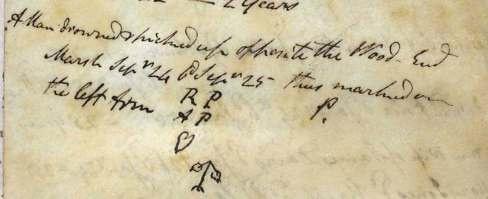
5. ‘A Man drowned’, Awre parish register, September 1794
P30/IN/1/1
Drownings were terribly common – men, women and children drowned in ponds, ditches, rivers, wells and even a barrel of beer. A sad feature of the Severnside parishes was that bodies of drowned people would often wash up on the river or estuary shorelines. Prior to the 1808 Burial of Drowned Persons Act it was usual to bury unclaimed bodies of those drowned at sea in unconsecrated ground where they came ashore, above the tide line without shrouds, coffins or markers but the new act required that such bodies should be laid to rest in the nearest consecrated ground and paid for by the parish. However, identification was rare, and here the vicar of Awre recorded the tattoos on the arm of a drowned man, just in case an inquiry was ever made about the body and it was possible to identify him from his tattoos:
‘A Man drowned & pitched up opposite the Wood-End
Marsh Sept 24th or Sept 25th thus marked on
the left arm’
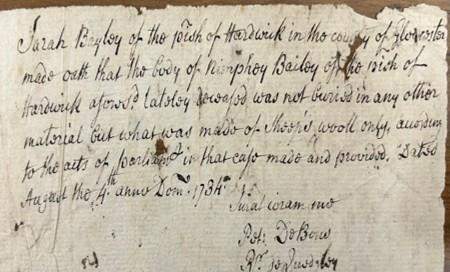
6. Certificate of Burial in Woollen for Nimphey Bailey, Hardwicke parish, 1734
P161/IN/4/5
In 1666, an Act was introduced that required the dead (except plague victims and the destitute) to be buried in a woollen shroud. One of the features of the act was that relatives had to a swear an affidavit to confirm the burial had been in woollen or otherwise face a fine of £5 – these 1733 & 1734 examples come from Hardwicke parish. The reason was to maintain the supply of domestically produced rather than continental wool. The law was generally ignored from the 1770s and repealed in 1814.
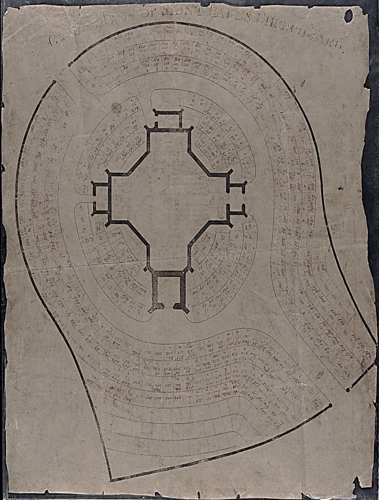
7. Graveyard, St. Paul’s Church, Parkend
P245/CW/3/18
Graves were dug and tombstones erected by permission of the vicar and diocese. Surprisingly, few churches have churchyard burial plans – this is the burial plan for St Paul’s Church, Parkend. Most graveyard plans were in the head of the church’s Sexton - the official responsible for maintaining and caring for the church and its grounds, ringing bells, and sometimes digging graves! The GFHS have an excellent online memorial inscriptions index with over 600,000 names!
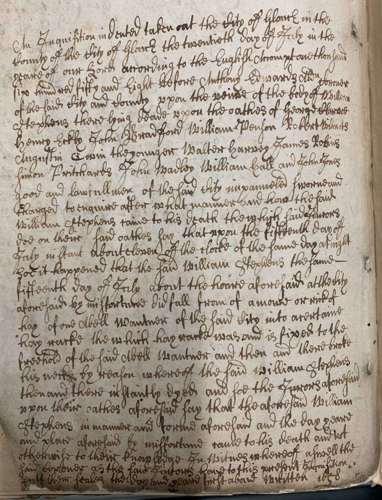
8. City of Gloucester Coroner’s inquest for William Stephens, 15th July 1658
GBR/G2/1
The office of Coroner began in 1194, and it was the Coroner’s task – with the help of a jury of 12-23 people – to investigate any unexpected death, be it unknown cause, accident, suicide or murder. However, the main reason wasn't to establish what had happened – it was to see if the incident had the potential benefit of revenue for the Crown! This was because the goods and chattels of those found guilty of the crime of murder or suicide ('self-murder’) would then be forfeit to the crown, as were wrecks of the sea, fires (both fatal and non-fatal) and any discovery of buried treasure. Before the 1844 Coroner’s Act, there were four Coroners in the county who travelled around the county to hear inquests except Gloucester and Tewkesbury, who had their own Coroners. This is a typical inquest entry for the City of Gloucester coroner, recording the death of William Stephens – who on 15th July about 11 o’clock at night fell from a hay rick onto a hay rack and broke his neck, dying instantly.
9. County Coroner’s inquest into the death of Eliza Paish, Fairford, 1880
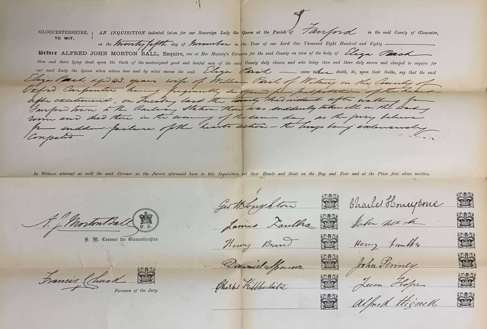
CO3/I/14/71
After 1844, coroners were grouped into four districts plus Gloucester and Tewkesbury, with individual coroners appointed for each one. Potentially these later records can include Inquest Papers, Minutes of Inquests, Registers of Deaths and Correspondence. Generally, they are much easier to use, although the handwriting can still be an issue – this is typical. County Coroner’s inquest into the death of Eliza Paish, who died of a heart attack in the waiting room of Fairford railway station, 1880.
10. County Coroner’s inquest into the death of William Iles, Fairford, 1873
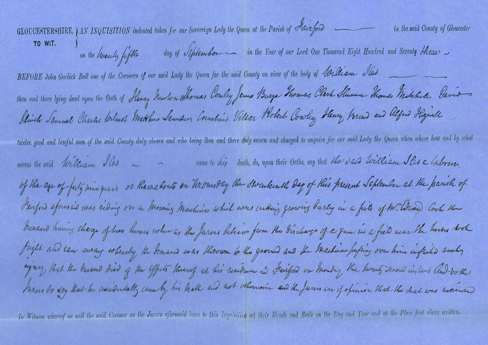
CO3/I/7/41
Sadly, the survival rate of these coroners’ records is varied – mostly because many were sent for salvage during the war years. They are generally written on part proforma forms – with enough space given for the coroner to write in the circumstances of the death and the inquest result. Sadly – as in this example – many are written on blue paper which can hinder reading the text. Looking at the Coroners’ records for the deaths of farmers – many fall straight into the Horrible Histories ‘Stupid Deaths’ category. We have farmers or farm labourers who died after falling from hay ricks, being stabbed in the head with pitchforks, killed by horses, being run over by farm wagons, falling into threshing machines (surprisingly common) and cutting themselves with billhooks. This is typical – the inquest into the death of William Iles, who died after being ‘run over by his own mowing machine’, at Fairford in September 1873.
11. Coroner’s Order for Burial, November 1912
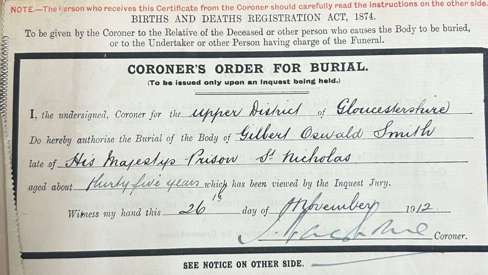
Q/GC/46/1
A coroner's burial order is a legal document issued by a coroner that gives permission for a burial to go ahead when a death has been reported to the coroner – this example is the release for burial for Gilbert Oswald Smith, who was executed at Gloucester Gaol on 26th November 1912. The coroner and jury used to have to physically view the body before burial and if a body was buried before this happened, the coroner could order it to be exhumed. Orders were not issued unless the coroner had held an inquest touching the death. Today, the order (or cremation form) is typically collected from the coroner's service directly by funeral directors.
12. Will of Anne Vaizey, Bisley, April 1779
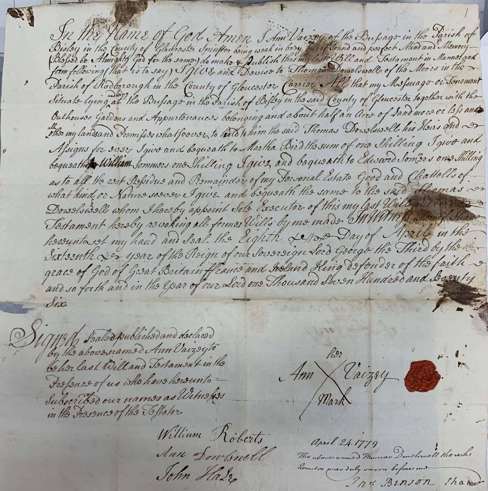
GDR/R8/1779/61 Anne Vaizey, Bisley
Although wills do not deal directly with death per say they do deal with its aftermath. The early history of wills is complex but from the mid-1500s, a will enabled a person (the testator if a man or testatrix if a woman) to specify how they wanted their property and possessions to be divided up after their death. Gloucestershire wills were proved by the Diocese of Gloucester and they’re all on Ancestry but – unfortunately – they imaged the microfiche copies of wills, not the originals, making them tricky to read even if the handwriting is good and the language English. Wills were often written on the testator’s death bed, they can include information about close family – spouse, children and grandchildren as well as their wider family and even friends, neighbours and servants. They normally start with the preamble ‘In the name of God Amen…’ then typically have something along the lines of ‘I, (testator’s name), being of sound mind but weak in body…’ There’s little punctuation and so reading wills can be tricky, especially as some can be highly complicated and lengthy.
13. Will of Petronilla of Lydney, 1368
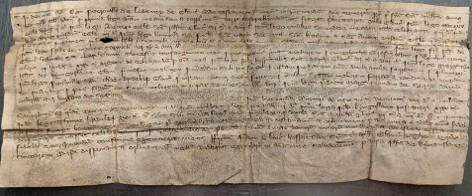
GBR/J1/986
Some have a wealth of detail - this fascinating early will belongs to Petronilla of Lydney, who lived in Gloucester and died in 1368. The will lists (in Latin) gifts of money to priests, clerks, the Gloucester friaries, St Bartholomew’s Hospital and to friends, to whom she also left personal effects, such as furred gowns, a maser (an ornate drinking bowl often decorated with silver and gold), chests, cloaks and amber beads. Petronilla was a wealthy woman as the amounts bequeathed varied from 2d (£4) to 20s (approx. £515) with the total being around £7 (approximately £3,400)!
14. Letters of Administration for William Northen, 1779
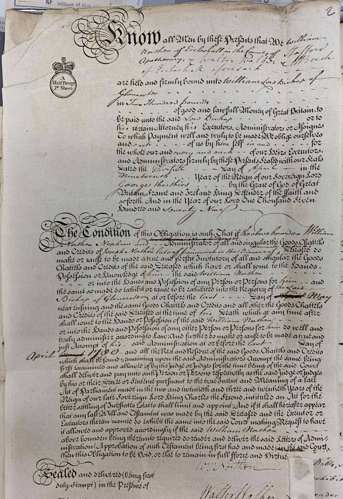
GDR/R8/1779/62
If a person died intestate – without leaving a will – then their estate went to probate, where the Diocese of Gloucester court decided who was entitled to any inheritance. This process used a pro-forma form but contain relatively little useful information.
15. Inventory of Robert Alsopp of Littleton, 1663
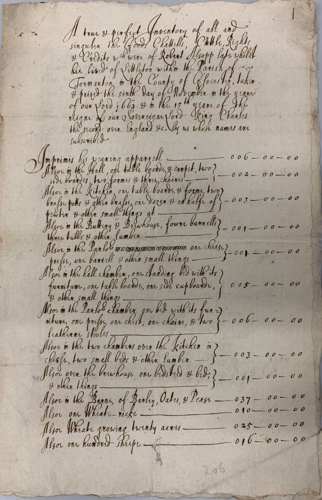
GDR/R9/1663/265
From 1530 to 1782 every executor had to appoint three or four local men to appraise or value the deceased’s personal estate and provide the probate court with a full inventory or list of goods and their value – less any real estate (land and property). They list items starting with the word ‘Imprimis’ or ‘Item’ and typically start with ‘Wearing apparel and money in purse…’ then go onto to list household items both large and small. After 1782 they were not legal requirements (though an interested party could request one) which means that fewer inventories survive for the later period.
16. Part inventory of Thomas Dance, yeoman farmer of Twyning, 1877
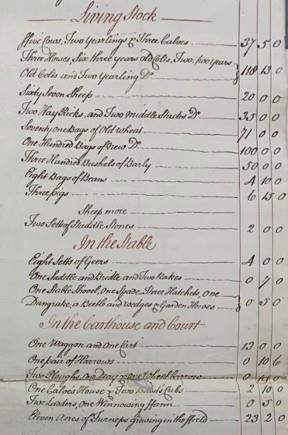
GDR/INV/1771/44a
Inventories are often arranged room-by-room or, on farms, as in this case – the 1877 inventory of Thomas Dance, a farmer yeoman of Twyning – building by building, ‘In the Stable’ and ‘In the Carthouse and Court’ here. As well as the farm buildings these inventories often list animals – the ‘Living Stock’ or aka ‘livestock’ – and agricultural equipment. In the inventory of Thomas Dance these included:
-
Five cows, two yearlings and three calves.
-
Three horses, six three-year-old colts, two two-year-old colts and two yearling colts.
-
Sixty-seven sheep.
-
Two Hay ricks and two middle stacks.
-
Seventy-one bags of old wheat.
-
One hundred bags of new wheat.
-
Eight bags of beans
-
Three pigs
-
More sheep (!)
-
Two setts of Staddle stones.
17. Execution Register entry for Ralph Smith, Gloucester Gaol, 7 June 1939
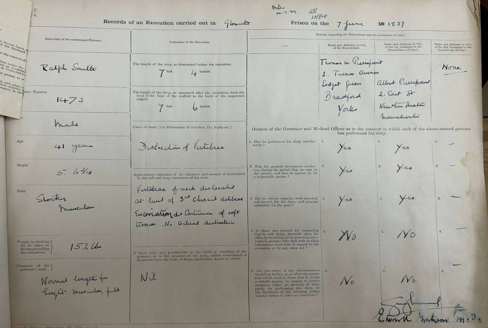
Q/GC/46/1
A total of 123 people were executed by hanging at Gloucester Gaol between its opening in 1791 and the final execution in 1939 – records do not survive for earlier executions in the earlier gaol or the castle. Prior to 1792, county executions took place at Alney Island (known as ‘The Tree’) at Over while afterwards hangings moved to the prison – onto the roof of the gatehouse. Following the 1868 Capital Punishment Amendment Act, executions became ‘private’ and took place inside the prison walls – initially in the quadrangle but later in a special execution cell on the end of A-wing. All the executions that took place at the gaol were entered into the official execution register. This recorded the prisoner’s details – plus things such as weight and build which were deemed necessary for the execution. Also included was the length of the drop (before and after), cause of death and any destruction to the soft tissues of the neck. The name of the executioner and his performance were also recorded – the execution of Ralph Smith on 7 June 1939 was undertaken by the famous hangmen Thomas Pierrepoint and his nephew, Albert Pierrepoint.
18. Burials of John Allen and John Penny, Thornbury parish burial register, April 1816
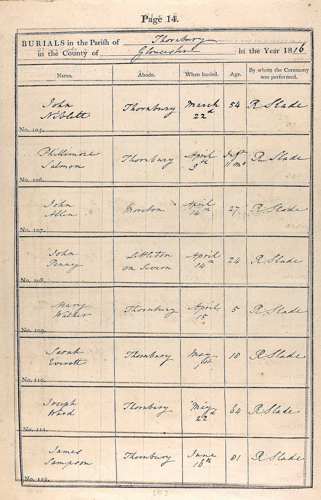
P330/IN/1/30
Executed prisoners were typically buried in unmarked graves within the prison grounds, with an estimated 121 to 123 individuals interred on-site over the prison's history. However not all prisoners were so buried, and some were collected by family to be buried in their home parishes. Examples of this were the notorious ‘Berkeley Poachers’ – John Penny and John Allen – who after execution (and dissection) were taken by their families and buried at Thornbury, being duly entered as burials in the parish burial register. Such entries are rarely marked as having been executed in the parish registers.
19. “to keep the Little Bitch bissy”,will of Sarah Overbury, 1803
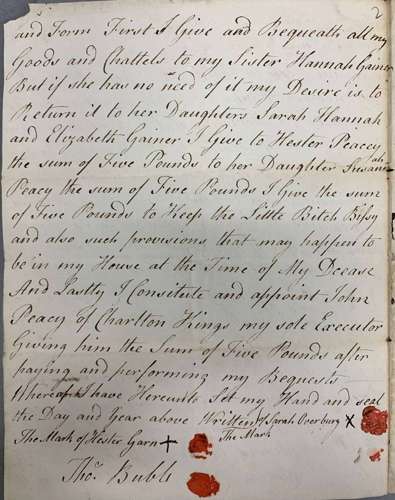
GDR/Wills/1803/48
With some wills you can get a real feeling for the love and warmth that some folks had for their family and friends. This will of Sarah Overbury who died in 1803 records just such a relationship….
“I give to Hester Peacey the sum of Five Pounds, to her Daughter Susannah Peacy, the sum of Five Pounds to keep the Little Bitch bissy…..”
20. Insect damaged document
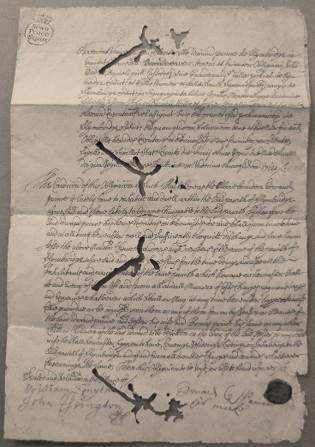
As far as archives are concerned insects are ‘Public Enemy No.1’! The reason for this is simple:
-
many insects eat cellulose - the main ingredient of paper or
-
animal protein - which is in animal glue, leather and parchment.
So, to an insect, an archive which generally contains documents of paper or parchment, is like a free, slap-up, all-you-can eat feast! This is an example of a document that was attacked by an insect larva while folded – the damage was done before it came to the archives. Generally, insect larvae are more of a threat the adults, as the larvae tend to be eating machines. Provided our strongrooms are kept within the BS standard (BS5454)
22. Insect sticky trap and dead insects
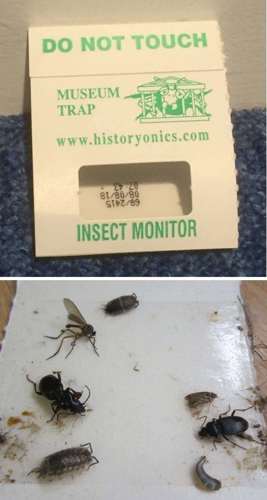
Conservation Department, Gloucestershire Archives
We actively monitor for insects using sticky traps – these are made of cardboard and have strong glue on them - so any insects wandering into them get trapped. They can be made species and sex specific. Once a month, we inspect these traps to see what species we have caught. We can photograph any unknown insects and send the images to the Natural History Museum in London who identify them to us and inform us if they are a threat or not. How many we trap also gives us an idea of how many insects there might be. If we need to kill the insects, we do not use pesticides or insecticides – as these might damage the documents. Instead, we put the documents into special dry freezers or put them in a vacuum chamber, where the air is then removed.