
Discovering Music in the Archives
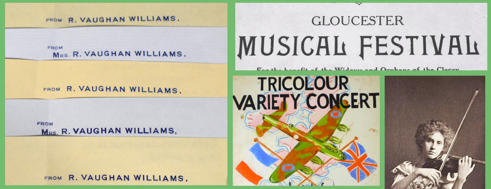
Many Archives contain amazing musical archives, and Gloucestershire is no exception. The county has a rich musical history, growing from early monastic chant, through strong folk traditions, via internationally significant composers and classical festivals, to vibrant modern popular music. This exhibition traces that story chronologically, exploring how music in Gloucestershire has been shaped by religion, landscape, industry and community. It will, of necessity, be a whistlestop tour!
Although Gloucestershire Archives is a record office, we don’t collect vinyl records. The ‘record’ here refers more to maintaining the official record, or archives, of Gloucestershire and South Gloucestershire. So our ‘records’ are generally paper, parchment, photos and documents created on computers rather than LPs. But music definitely belongs in the Archives and leaves behind a remarkable paper trail, and occasionally sound recordings and films too. Within the Archives we can discover how people in Gloucestershire have made, performed, listened to, paid for, argued about, cherished, forgotten and rediscovered music across centuries.
Swipe through the exhibition to learn more about Gloucestershire's musical heritage.
Liturgical music and medieval survivals
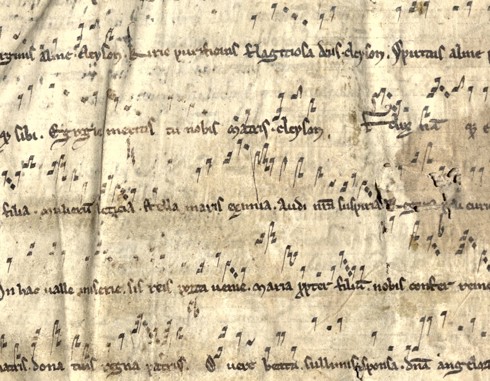
D678/1/M4/1
The roots of Gloucestershire’s musical history lie in the Anglo-Saxon and medieval church. Plainsong is a form of unaccompanied church music that was monophonic (in other words, a single line of melody). It was introduced to England by Roman missionaries in the 7th century. It gradually superseded earlier regional forms such as Celtic chant. A specifically English variation of the Gregorian plainsong known as ‘Sarum Use’ developed in the 11th century at Salisbury Cathedral which became the dominant form of worship in England for centuries. Local variations can be detected, particularly in Benedictine communities.
Medieval cartularies: D678/1/M4/1
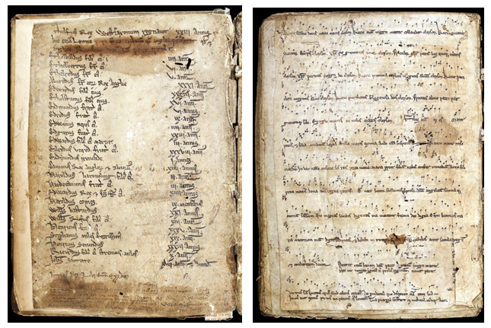
D678/1/M4/1
Two remarkable survivals in Gloucestershire Archives are found in the two volumes of medieval cartularies (registers of charters and documents) from Winchcombe Abbey. The Abbey was founded in 798 on the site of a nunnery which itself was founded in 787. The first cartulary (D678/1/M4/1) contains documents from 811 to 1328 and was mostly written up during the reign of Henry III, 1216-1272. On the left-hand side you can see a list of Anglo-Saxon rulers in Wessex. On the right-hand side is an example of monophonic plainchant from the period 1150 to 1300 which would have been passed down orally before being written down as notes on a 4-line stave. This music survives because the Dutton family of Sherborn and Standish, later the Sherborne family, inherited their lands following the dissolution of the monasteries. The monastic books have survived as part of the Sherborne family archives.
Medieval Cartularies: D678/1/M4/2
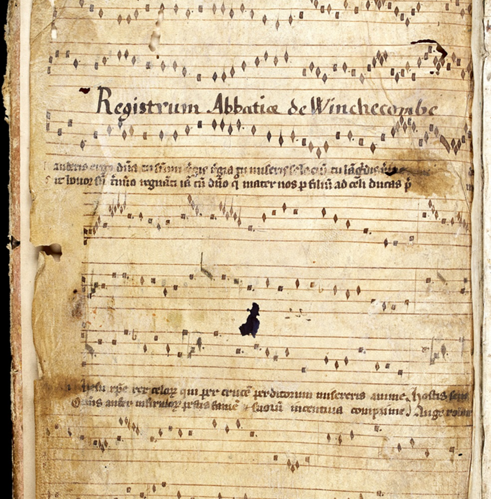
D678/1/M4/2
The second volume includes documents from 1280 to 1440. It also contains medieval music. The music is used to protect the volume, and is valued for its good quality parchment, not because of the music, which would not have been seen as it was pasted down on the cover. In this case the cover is skin over oak boards with parchment music on the inside to protect it further. Again, the music is highly likely to have been sung at Winchcombe Abbey, then re-used for their most important book, their cartulary. This music is polyphonic (multi-part), using ‘Ars Nova’ notation. There are two sequences in a 3-part score, written on five-line staves.
Between 1536 and 1549 when Henry VIII ordered all monasteries, nunneries and friaries to be dissolved and their assets seized most musical manuscripts were destroyed as they were deemed too Catholic. Some music manuscripts were repurposed, not for their content, but because the vellum and parchment were too valuable. Thus, music was cut up and reused as book bindings, flyleaves and paste-downs for new books being created in the 16th and 17th centuries.
Stonehouse Manor Court Book
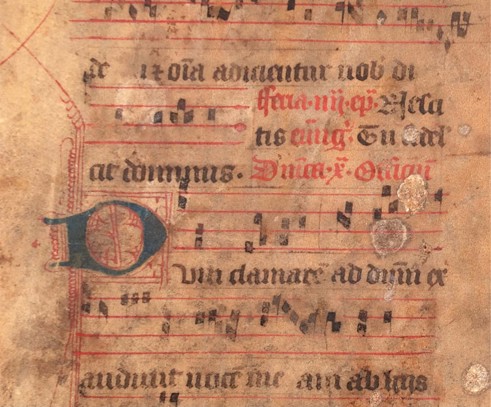
D4289/M1
Does the survival of this early 15th century liturgical music (D4289/M1) illustrate a similar process? It is the cover of the Stonehouse Manor Court Book for 1533-1589 and includes stewards’ extracts from court rolls and a survey of the manor. The music dates from 100 years earlier and is part of two continuous parchment leaves from a gradual (the book providing music for the Mass), written in square notation. The music is for the introit for the 10th Sunday after Pentecost. The presence of an illuminated initial suggests that it may have been a relatively important manuscript. How did these two parchment leaves find their way into use as a book cover in Stonehouse several decades later? Have any other fragments from this gradual survived? The Earls of Arundel were lords of the manor of Stonehouse from 1375 to 1558 and had connections with various religious houses so further research shall be conducted into this in due course.
Gloucester Cathedral Archives
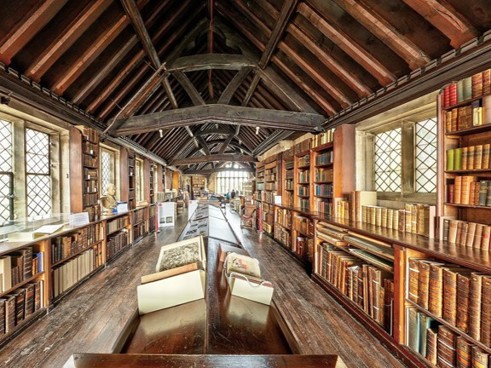
Gloucester Cathedral’s 15th century library, image copyright: Kevin Lewis
Plainsong would have been sung in St Peter’s Abbey, Gloucester. The choral tradition in this medieval building survived the Reformation as the Abbey was re-founded as Gloucester Cathedral in 1541 and continues to this day. Gloucester Cathedral Archives holds some medieval music fragments but so far it looks as though these tend to survive in books donated to the cathedral after its foundation in 1541 rather than being produced or sung in the medieval abbey itself.
Music in the Cathedral
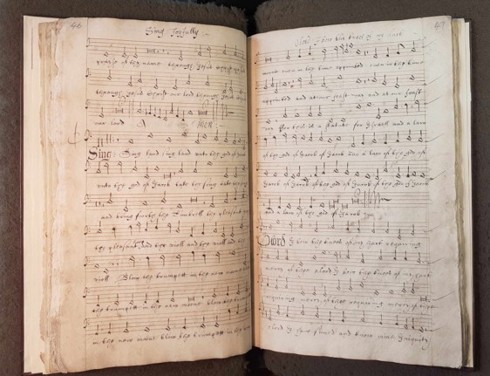
MS101
The magnificent acoustics of the cathedral’s Gothic architecture particularly suited polyphonic music (in other words many sounds, not just the single line of monophonic plainsong). The Cathedral Archives holds many records relating to music performed in the cathedral. Particularly important are early surviving part books used by the Cathedral Choir. This bass part book (MS101) dates from around 1640-41 and was copied out by John Okeover, who was the cathedral organist from 1638 to 1663. It contains 70 compositions, 68 from 26 different composers with 2 anonymous contributions. This indicates the extent of different music learnt and performed by the choir. Today, the cathedral choir is often accompanied by the cathedral organ, the case of which dates back to 1666 just after Okeover’s time. We will return to organs later.
West Gallery Music
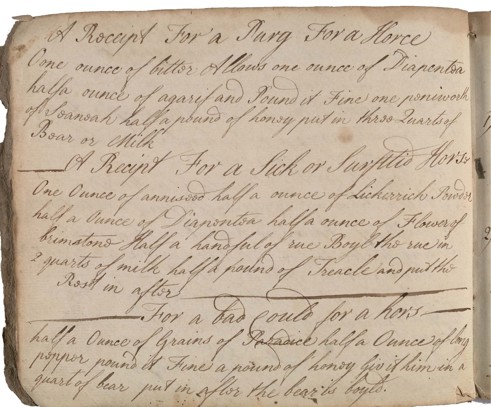
D3596/1
Before the widespread installation of organs, many Gloucestershire churches relied on what is often called west gallery music. This refers to hymns, metrical psalms and anthems—often sung in parts—supported by a small band of local players, frequently positioned in a gallery at the west end of the church. It flourished from the late seventeenth century into the early nineteenth, and then gradually declined as organs arrived and musical practice became more standardised.
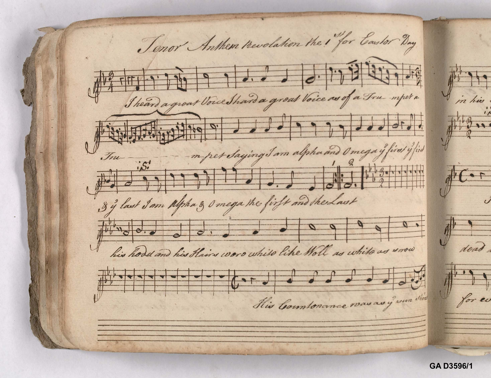
No, we haven’t included the recipe for purging a horse in the wrong exhibition! Evidence for west gallery music survives in unexpected places. Here is William Butts’ farm rent and account book from Brickhampton Farm in Churchdown, dated 1777 to 1784. As well as recipes for purging horses, it includes entries for fields, buildings, inventories of hay and straw, directions for killing rats — and then, quite suddenly…….
West Gallery Music 2
D3596/1
…… four pages of music and words for anthems to be sung by tenors. It’s a reminder that singers often copied their own parts into whatever notebook was handy. (D3596/1)
Churchwardens’ accounts
P297/CW/2/1
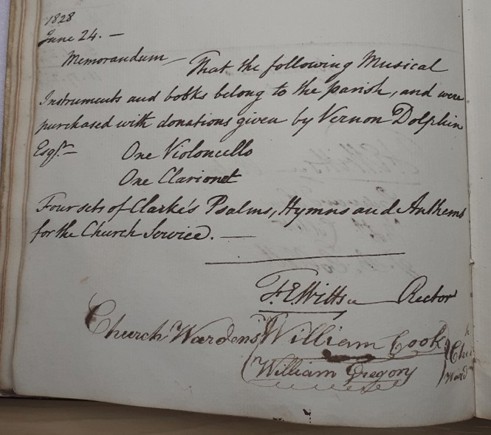
Churchwardens’ accounts are another invaluable source. These financial records often list payments for instruments, strings, repairs, and music books. In Upper Slaughter parish, an 1828 memorandum in the churchwardens’ account book records a donation from Vernon Dolphin esquire enabling them to buy a cello, a clarinet and four sets of Clarke’s psalms hymns and anthems for the church service. (P297/CW/2/1). It is thought that the composer of this church music is likely to be Thomas Clark of Canterbury who sold similar music across the UK, focusing initially on West Gallery and methodist traditions before moving into the core Anglican repertoire for choirs and organs. Elsewhere, accounts for strings for viols suggest that bands were active long before organs became common. Some parishes also used serpents, the snake-shaped bass instrument notoriously difficult to play. You can occasionally find serpents hanging on the walls in parish vestries.
The Archives sometimes preserve evidence of rules and disagreements over local music-making. At Rodborough, an unusually detailed agreement about the musicians’ “singing seat” lists who may sit there and sets standards: you had to understand the rules of music and sing psalm tunes ‘with a tolerable voice’. It even fixes the price—five shillings - for a seat and specifies you should live in Rodborough. There was one exception: “Peter Plane of Stroud parish shall have the liberty to sit in the said pew and make use of his bassoon but that no instrument of music but a bassoon shall be used there.” (P272 In 1/1)
Tewkesbury Baptist Chapel
D4944/11/3
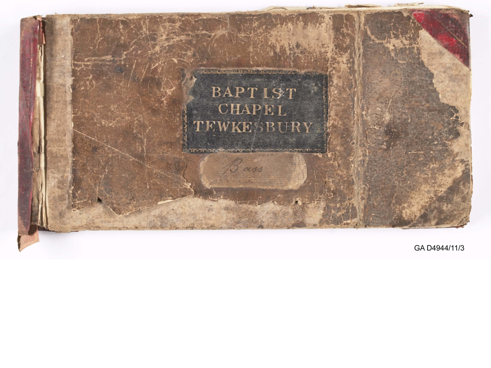
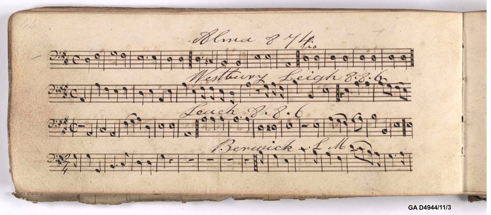
Part-singing wasn’t confined to Anglican parish churches. A set of four part-books from Tewkesbury Baptist Chapel, probably from the 1840s (Gloucestershire Archives ref: D4944/11/3), preserves metrical settings for nonconformist worship.
Tewkesbury Baptist Chapel 2
D4944/11/3
The surviving books are soprano, alto and two bass books—the tenor is missing, which matters because the tune often sits in that line so it is difficult to recreate what the music would have sounded like. Even so, it shows how widely the habit of copying and singing in parts had spread in religious life across Gloucestershire.
Quire Books associated with Samuel Isaacs
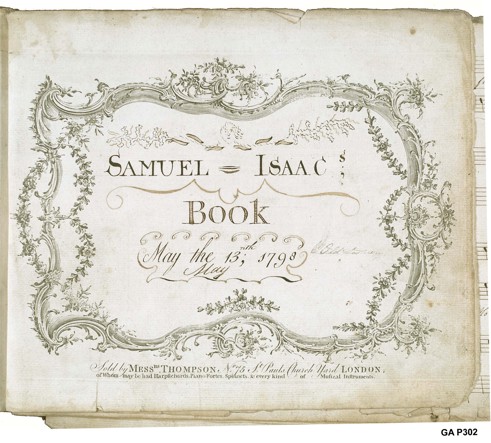
GA P302
A particularly rich source of information comes in the manuscript ‘quire books’ associated with Samuel Isaacs, parish clerk and choir master at Old Sodbury. The earliest book dates from 1790.
Quire Books
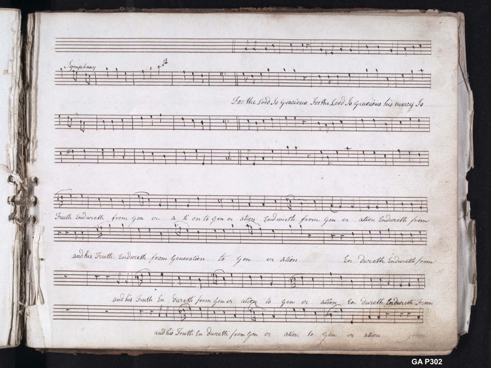
GA P302
You can see that these ‘quire books’ belonged to the west gallery tradition due to the instrumental ‘symphony’ between the sung sections. Their choir must have been pretty good as the anthems and hymns are quite complex. A related Horton volume runs from 1798 into the 1860s and even contains a personal note: an “evening hymn” for Miss Cecilia Codrington, to be sung at Doddington in 1845. Samuel Isaacs’ choir manuscripts have been transcribed and sung by the Gloster Gallery Quire led by John Thorn - bringing alive the music in Gloucestershire more than 200 years later. And for those who want a deeper dive, Gillian Sheldrick’s MA dissertation, Strange Noises and Curious Tunes: Rural Psalmody In Early Nineteenth Century Gloucestershire, 2024, is based on these manuscripts and also available at Gloucestershire Archives.
The arrival of church organs
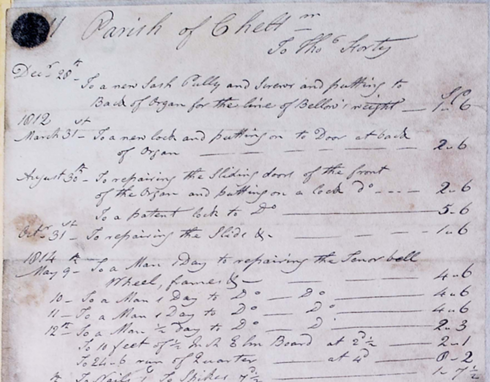
P78/1/CW/2/18/1
For many parishes, the solution to musical disputes lay in installing an organ. In some parishes, west gallery bands resisted their introduction or continued alongside organs for a time. In others, installation of an organ was embraced as a way of imposing musical discipline and removing disputes over pews, payments, and privileges.
There are 2351 references to organs in our online catalogue. You need to reduce this figure slightly to account for people with the surname Organ (particularly prevalent in Berkeley and North Nibley). But fundraising, repairs, tuning and recital programmes are all well documented. For keen organ scholars, organ specifications, listing all the stops etc, sometimes survive amongst the parish papers. Organs are often mentioned in the church documents and accounts because they are not cheap to buy or maintain. And where there is expenditure there are records. In this early example you can also see the expenditure on the organ and the bells in Cheltenham St Mary’s parish church in 1812 (P78/1/CW/2/18/1).
New organ at Bourton on the Water, 1949
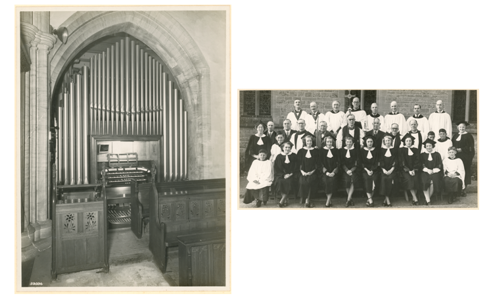
Bourton on the Water – new organ Easter 1949. Photo: The Butt Studio, Bourton on the Water (GA: P55/MI/4/2)
At Bourton on the Water, at Easter 1949, an official photographer based in the town was commissioned to take photographs. This was to celebrate the installation of their new 3-manual organ ‘with electric action’ built by JW Walker and Sons. This replaced their previous organ which had been condemned due to dry rot a decade before. A major fundraising campaign ensued and included a concert at the local manor house attended by Ralph Vaughan-Williams and members of the London Symphony Orchestra. Also included is the photo of the church choir taken at the same time.
Gloucester’s cathedral organ has a much longer history – The organ case and façade pipes date from 1666 and are a rare 17th century complete survival. It was built by Thomas Harris and has been rebuilt multiple times since, notably Henry Willis and Harrison & Harrison. As of 2026 it is currently being revamped again. In July 2026 we will be able to hear the organ—which began its life 350 years ago—in its full glory at the Three Choirs Festival, which is held in Gloucester in 2026.
The earliest surviving significant organ in Gloucestershire is the Milton Organ in Tewkesbury Abbey, which dates back to the 1630s. However, it came to Tewkesbury in 1737 via Magdalen College Oxford and Hampton Court Palace. It too underwent significant refurbishment in 1997 by Kenneth Jones and Associates.
[Note: Oldest surviving church organ is in Switzerland and dates from the 1430s.]
The Three Choirs Festival
SR20/40549.3GS
The Three Choirs Festival is widely recognised as the oldest continuously running classical music festival in Europe. Its first recorded gathering was in Gloucester in 1715 and originated in informal meetings of the cathedral choirs of Gloucester, Hereford and Worcester. It was formally named the Three Choirs Festival in Gloucester in 1838.
Concerts initially focused on sacred choral works, but by the 19th century the Festival was attracting large audiences, some coming to the city via the railway network. Perhaps less well-known is the fact that Gloucester’s Shire Hall (built in 1816 and the headquarters of Gloucestershire County Council since 1889) was used for secular concerts from 1817 onwards. This was because it was considered improper for non-liturgical music to take place inside the cathedral at that time. The Shire Hall concert hall was extended in 1910 to hold 1000 people and featured a gallery and a new organ. The Festival commissioned new works from English composers such as Edward Elgar, Ralph Vaughan Williams, Herbert Howells, and Ivor Gurney.
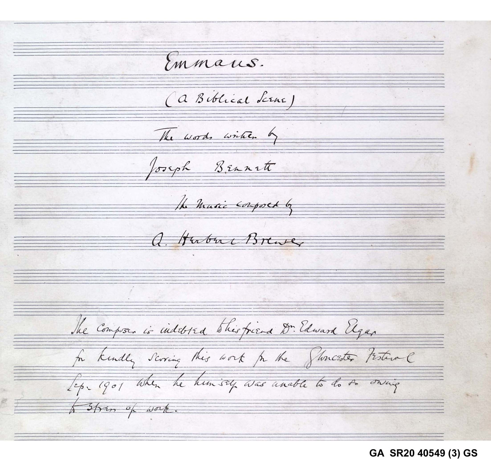
Just as the Three Choirs Festival is peripatetic, the archives of the Festival have also been collected by the record offices in the three counties and Gloucester Cathedral Archives too. In Gloucestershire Archives, we have the score for Herbert Brewer’s oratorio, Emmaus, first performed in 1901, seen here. Herbert Brewer was Gloucester Cathedral’s organist and a distinguished Three Choirs Festival composer. His autobiography shows that he ran into numerous problems whilst composing Emmaus. His gratitude to a helpful friend is recorded here: “The composer is indebted to his friend Dr Edward Elgar for kindly scoring this work for the Gloucester Festival Sept[ember] 1901 when he himself was unable to do so owing to stress of work.”
In Gloucestershire Archives we also have a particularly rich set of papers relating to Herbert Sumsion, cathedral organist and composer, who lived an incredibly long life from 1899 to 1995 (D7944). His collection includes a diary of the 1937 Festival and copies of letters he wrote to Zoltan Kodaly, the Hungarian composer and conductor. Sumsion wrote about conducting works at the Three Choirs Festivals between 1928 and 1936. He was a Gloucester lad who sang in the cathedral choir, then became organ scholar and later organist at Gloucester, following Herbert Brewer in 1928. He conducted 11 x 3 choirs festivals until his retirement in 1967. His papers also include correspondence with Sir Arthur Bliss, Sir Adrian Boult, Sir Edward Elgar, Kathleen Ferrier, Gerald Finzi, Herbert Howells, Ralph Vaughan Williams and Dame Ethel Smythe.
Gloucestershire composers
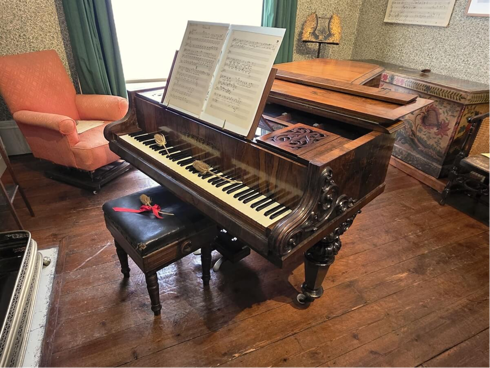
Gustav Holst’s piano at The Holst Victorian House museum in Cheltenham
Closely linked to the Three Choirs Festival is a remarkable concentration of early 20th century composers and poets often referred to as the “Gloucestershire Group”: Sir Hubert Parry, Ralph Vaughan Williams, Herbert Howells, and Ivor Gurney. Ivor Gurney was born in Gloucester, and his music and poetry draw deeply on the Gloucestershire landscape. Herbert Howells was born in Lydney and his sacred music – much of it composed for or inspired by cathedral acoustics – became foundational to Anglican choral repertoire worldwide. Hubert Parry grew up at Highnam Court near Gloucester, whilst Ralph Vaughan Williams was born near Down Ampney near Cirencester (the name given to a hymn tune he later composed) but he left for Surrey at the age of three.
Before focusing on Ivor Gurney and his magnificent archival collection, we must stop off in Cheltenham to visit Gustav Holst’s birthplace where a whole museum is devoted to him. It is well worth a visit if you haven’t been already. He was born there in 1874. Here you can see the piano on which he composed ‘The Planets’ orchestral suite between 1914 and 1917. The museum also has musical manuscripts including ‘The Perfect Fool Ballet Music’. As Curator Laura Kinnear explains, it is a rare handwritten score by Holst himself. It is rare because he had a problem with his hands and asked others to copy his scores.
Ivor Gurney at Gloucestershire Archives
D10500/1/M/1
Undoubtedly one of the star collections held at Gloucestershire Archives relates to Ivor Gurney, the gifted Gloucestershire composer and First World War poet (1890-1937). He studied under Herbert Brewer in Gloucester and Sir Charles Villiers Stanford at the Royal College of Music. According to Herbert Howells, Stanford regarded Gurney as ‘potentially the biggest’ of all his pupils (which included Vaughan Williams and Holst) but ‘the least teachable’. Ivor Gurney was wounded in WW1 and spent time in Barnwood House Asylum in Gloucester. Sadly he spent his final years in a Dartford hospital with continued poor mental health.
His archive collection is very comprehensive, including manuscript songs, instrumental music, poems, letters, photographs and related papers. Both his poetry and music were very much inspired by the Gloucestershire countryside.
We have Ivor Gurney’s music college friend, Marion Scott, to thank for the comprehensive archive collection, as she looked after his affairs. She asked hospitals to pass all manuscript material to her. And towards the end of his life, she wrote to his many friends asking them to forward any manuscript material they might have. When Marion Scott died in 1953, the material passed first to Gerald Finzi, and then to Gurney's brother, Ronald. In 1959 Ronald deposited the collection with Gloucester City Library on permanent loan. It came to the Archives in 2005, and additional material has since been added by others, including the executors of Michael Hurd, the biographer of Ivor Gurney.
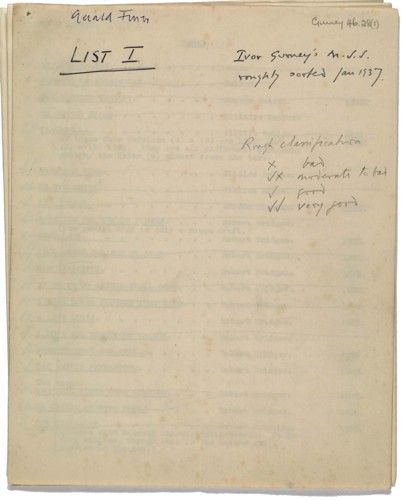
Here is the first page of a catalogue compiled by fellow composer, Gerald Finzi, of Gurney’s songs which he classified by perceived quality. It includes a page of instrumental music from the asylum years, over which he had written ‘Everything on this page is worthless.’
Ivor Gurney 2
D10500/1/M/2/63/5
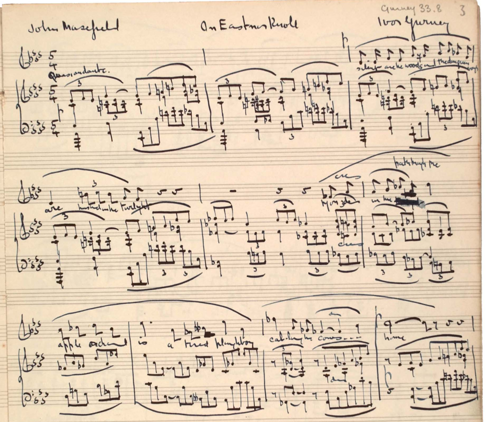
Gurney set several John Masefield poems to music including this one, On Eastnor Knoll (D10500/1/M/2/63/5) in 1925. Another, ‘By a Bierside’, was clearly written in the WW1 trenches as you can still see the mud splatters on it. D10500/1/M/2/63/1. The first version was written in 1916, and later versions were produced up to 1924. The survival of drafts and altered scores allows musicologists to study the creative process, not just finished works.
Prior permission is required from the Gurney Trustees before consulting the collection at Gloucestershire Archives.
Less well-known Gloucestershire composers
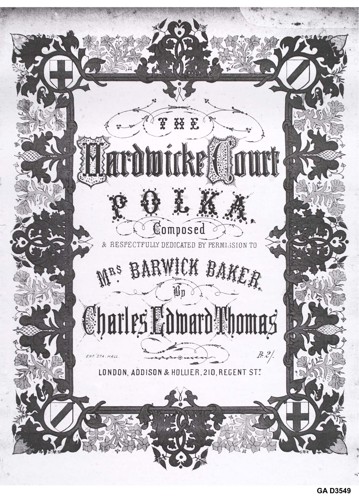
D3549/26/2/20
We also hold material relating to less well-known Gloucestershire composers. Here we have Charles Edward Thomas who composed this Hardwicke Court Polka as a commission for Mrs Barwick Baker. (D3549/26/2/20). Other composers include Basil Harwood, Alfred Melville Cook whose collection includes correspondence with Benjamin Britten, and Robert Lucas de Pearsall. Robert was a noted composer of madrigals and Anglican church music, but our records mainly relate to the house he lived in! We don’t tend to collect printed music or recordings but there are examples where local people have written their own music and we do hold examples of this. For example, HA Edwards, born in 1881 was the son of Basil Edwards the rector of Ashleworth from 1890 to 1911 and he wrote sheet music for funerals!
Cheltenham and the rise of music festivals
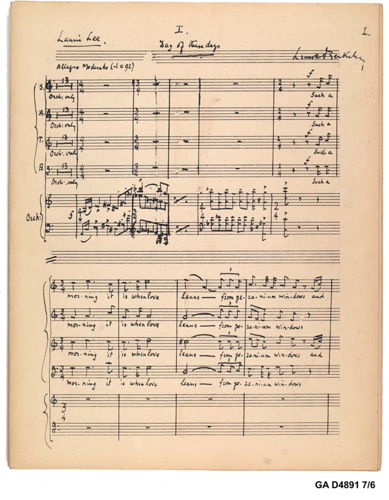
D4891/7/6
While Gloucester dominated sacred and choral music, Cheltenham emerged after the Second World War as a centre for classical music. Founded in 1945 by the Borough of Cheltenham (now known as Cheltenham Borough Council), the Cheltenham Music Festival was created specifically to promote new British composition. It has since commissioned and premiered hundreds of works, including symphonies, concertos, and chamber music by leading modern composers such as Benjamin Britten, William Walton, and Arthur Bliss. The Halle Orchestra under Sir John Barbirolli was resident from 1948m to 1963, which supported the festival's growth. The Jazz Festival was founded in 1996 and also attracts emerging and international performers. The Cheltenham Festival Charity has recently deposited their extensive archive with us (D14708). They celebrated their 80th year in 2025.
Just a year behind and celebrating its 80th season in 2026 is the Painswick Music Society. Their brilliant archive (D11400) with a printed programme for every concert since 1946, will form the basis of a talk on 2nd May 2026 here at Gloucestershire Archives by Professor Martin Woodhead, Chair of the Painswick Music Society. The Society is run by volunteers but continues to attract high profile performers such as Voces8 and the pianist Sir Stephen Hough.
2027 will be the 80th anniversary of the Stroud Festival. In their (D4891) archive, we hold 12 commissioned scripts and scores from 1960s to 1980s, including this poem by Laurie Lee set to music by Sir Lennox Berkeley – Day of these Days, one of Lee’s 4 poems, Signs in the Dark (D4891/7/6).
A special call-out also to two Gloucestershire Choral Societies founded in the 19th century who have both deposited their archives with us: Tewkesbury & District Choral Society (D8948) and Gloucester Choral Society (D8057). The Gloucester collection also includes scores of music they commissioned.
Folk music, wassailing and community collecting
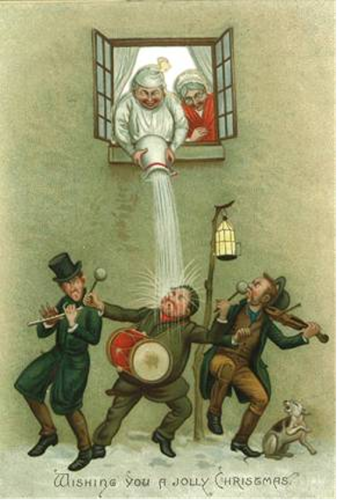
Hand-painted Christmas card from Hicks Beach family, Earls St Aldwyn, GA D2455/F4/5/1/4
We shall now move onto community musicians and folk music.
We don’t normally collect Christmas cards, but this hand painted one has a certain charm. It is reminiscent of an extract from Laurie Lee’s Cider with Rosie where he affectionately describes the Christmas carolling tradition in Slad. The term ‘carol barking’ suggests rough, loud and enthusiastic singing rather than a polished performance, very much along the lines of some of the West Gallery Quires we encountered earlier.
‘Come carol-barking then?’ We were the Church Choir, so no answer was necessary. For a year we had praised the Lord out of key, and as a reward for this service - on top of the Outing - we now had the right to visit all the big houses, to sing our carols and collect our tribute.’
Wassail from Woodchester
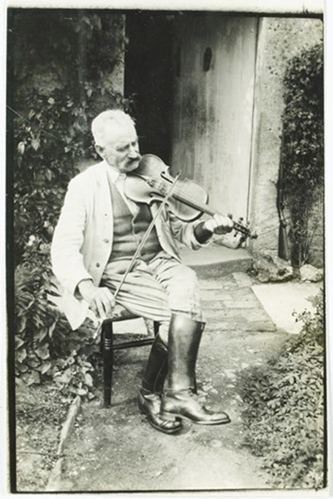
Johnny Hopkins of Salperton, 1930s.
GA: D2600/1/96
And keeping the December/January theme going, here is a wassail from Woodchester sung by Billy Buckingham of nearby Stonehouse, collected by Gwilym Davies in the 1970s.
Note the Gloucestershire accent that has been captured too. Wassailing remains alive and well in Gloucestershire and usually takes place in January to awaken cider apple trees and scare away evil spirits to ensure a good fruit harvest. Many villages maintain their own wassail song variants, such as Uley, Avening, Nailsworth and Badminton. Gwilym and his wife Carol have documented these (and many other instances of Gloucestershire folk song) on the ‘Single Gloucester’ and ‘Glostrad’ websites and also in their collection held in Gloucestershire Archives (D13660).
The fiddler shown above is Johnny Hopkins of Salperton near Cheltenham photographed by Harry Hurlbutt Albino (D2600/1/96). It is part of a collection of the photographs and glass plate negatives Harry took of places, personalities, rural crafts and industries in the Cotswolds. Many photos were originally taken to accompany articles in the ‘Gloucestershire Countryside’ magazine between 1939 and 1956. Harry had an interest in folk music and traditions and also took photographs of Morris dancers.
Other folk records held at the Archives include the Gloucestershire District of the English Folk Dance and Song Society (D5445), and recently the Cheltenham Folk Song Club deposited their recordings with Gloucestershire Archives, 1965-1975 (D17069). We also have several documents relating to Johnny Coppin (to whom we will return later).
Gwilym Davies’ folk song collecting from 1974 onwards followed in the tradition of significant collectors such as Cecil Sharp. Sharp visited Gloucestershire extensively between 1908 and 1921 and collected over 200 songs whilst also studying Morris dances. Ralph Vaughan Williams, Percy Grainger, and Alfred Williams all found rich pickings in Gloucestershire. This work ensured Gloucestershire’s musical heritage and oral tradition at the community level was not lost. Many of these records are now held in Cecil Sharp House in London, the headquarters of the English Folk Dance and Song Society, or the British Library’s sound archive. Alfred Williams’ manuscript collection is held in the Wiltshire and Swindon History Centre but nearly 200 of the working-class song lyrics were collected in Gloucestershire. Many of them were published in the Wilts and Gloucestershire Standard.
Music in schools
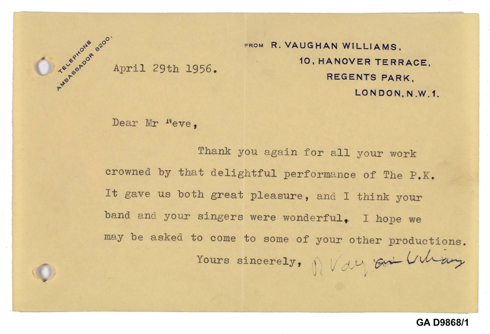
D9868/1
School music is how most of us have participated in music-making. 19th and 20th century school logbooks often list the songs learnt by infants and primary school children, and some include school inspectors’ reports pertaining to music.
There is surprising evidence from Mitcheldean parish records where the charity girls’ school derived considerable annual income from a regular music festival to celebrate the foundation of the boys’ and girls’ schools. This started in 1795 until well into the 19th century. We are grateful to the late Dr John Jurica, from the Victoria County History for this reference.
Being Gloucestershire, there are also appearances by major composers in schools. Here we have a letter from Ralph Vaughan Williams. Mr Neve was the music master at Cheltenham Grammar School in the 1950s who performed Vaughan Williams’ opera, PK, which refers to The Poisoned Kiss. It seems to have been a very successful occasion, attended by the composer and his wife, and received many favourable reviews. There was one dissenting voice who felt the opera best forgotten. But the opera was recorded in 2003 by Chandos with conductor Richard Hickox, the National Orchestra of Wales and the Adrian Partington singers. As well as this letter, Mr Neve’s collection of papers includes set designs, programmes and newspaper cuttings.
School song from the Crypt Grammar School in Gloucester
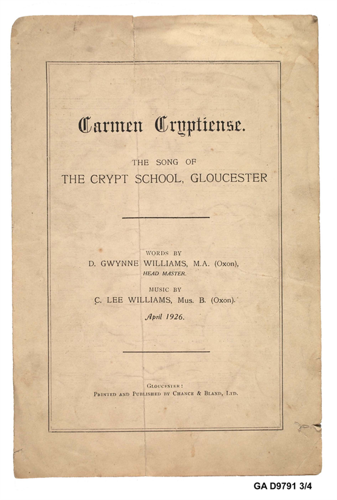
D9791/3/4
Here is the school song from the Crypt Grammar School in Gloucester. Inside are both the words and the music dating from 1926 (D9791/3/4).
These collections remind us that music history is not only about composers and festivals, but about participation — people singing, playing, organising, and caring enough to keep records.
Brass band traditions
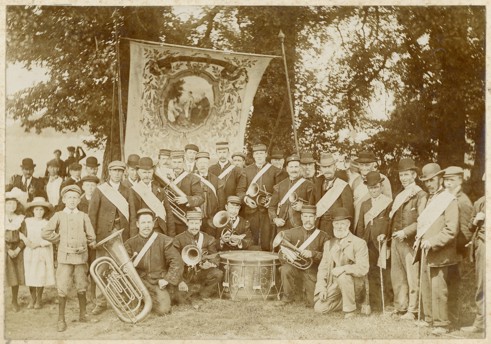
Newent? brass band, c. 1890. GA: GPS/601/43
In Gloucestershire, brass bands became especially strong in industrial communities, particularly in the Forest of Dean. Mining villages such as Cinderford, Coleford, Lydbrook, and Ruardean formed their own bands, often supported by subscriptions from workers and local societies. These bands performed at fêtes, parades, chapel services, and political meetings, and rehearsals were important social events as well as musical ones. Evidence of this tradition survives in Gloucestershire Archives in the form of photographs, concert programmes and newspaper reports. The South Gloucestershire coalfield, including communities such as Kingswood, Coalpit Heath and Mangotsfield also supported brass bands, helping forge community identity in places shaped by rapid industrial change. Affordable brass instruments and printed music allowed working people to take part in organised music-making on an unprecedented scale.
Here we have a brass band image from 1890. It was given to the Archives by a firm of solicitors in Newent following a house clearance, so we assume it is a local band, but if anyone knows differently, please get in touch with the Archives.
Forest of Dean Brass Band, 2004
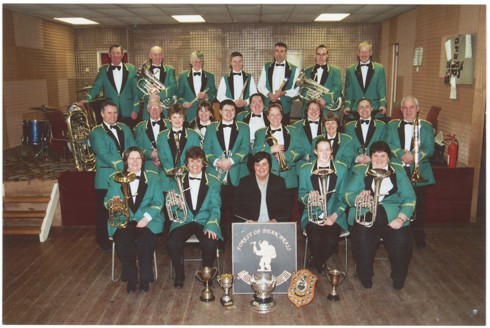
D10638/2/6/22
We know this image shows the Forest of Dean Brass Band with conductor Jackie Gwynne featured in the Citizen newspaper in 2004.
We have the archives of Gloucester Brass Band, 1992-2002 (D14608). It is believed this is the community band, rather than the premier Flowers Brass Band also based in Gloucester. The Flowers Brass Band formed in 1968 following the disbandment of the Royal Gloucestershire Hussars Brass Band. They are a very successful competitive band who were National Champions of Great Britain in 2024 and 15-time West of England Champions.
Popular music and producers
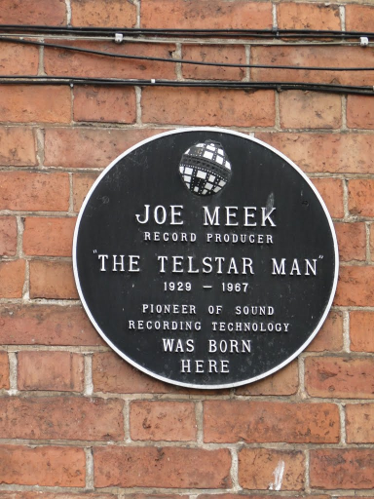
Photo by Robert Thursfield, via WikiCommons
There are, of course, a remarkable range of pop musicians and producers associated with Gloucestershire. We don’t hold the personal papers of any of them, but they do appear in our newspaper and local studies collections. There is marginally more about the iconic 1960s music producer, Joe Meek, born and buried in Newent. You can find out more about Joe Meek on Saturday 2nd May 2026 when Peter Rochford, chairman of the Joe Meek Society will be speaking at Gloucestershire Archives about his 30 years’ research journey. He is writing a book on Joe Meek and his innovative audio techniques, which will, in due course, help fill a gap in our collections.
The Wilts and Glos Standard contains the obituary and inquest report into the death of Cozy Powell, 1947-1998, drummer in rock bands including Black Sabbath. We have photos of the grave of Brian Jones, founding member of the Rolling Stones, born and raised in Cheltenham. The Singer Songwriters, FKA Twigs from Cheltenham and Lily Allen who lived near Cranham have not yet made their way into the Archives. Our BBC radio Gloucestershire collection includes Andy Vivian’s interview with Bill Reid, a nightclub owner and jazz music promoter in Cheltenham from the 1930s to 1999 (D8497), providing a glimpse into this world. Anyone wishing to research the folk singer Johnny Coppin is in luck with 48 items in our online catalogue relating to him. Hopefully we can capture more in his 50th anniversary year.
International surprises
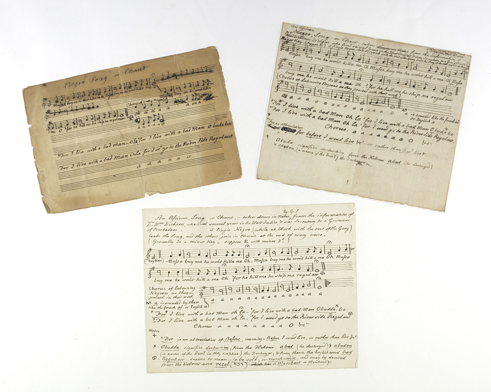
D3549/13/3/27
We shall end with a document that at first glance has nothing to do with Gloucestershire and may not have been heard in Gloucestershire until very recently. It is an undated late 18th century Song of enslaved people in Barbados (D3549/13/3/27). The song was written down by the leading anti-slavery campaigner Granville Sharp. The manuscript includes explanations of the words, notes on performance, and the melody itself is a haunting tune in E minor with verse and chorus. This music manuscript is designated on UNESCO’s Memory of the World Register, recognising its outstanding documentary value and global significance as rare musical evidence of the lived experience of enslavement.
So what is it doing in Gloucestershire? Granville Sharp who lived from 1735 to 1813 was one of the leading anti-slavery campaigners of the late 18th century and early 19th century but also a keen musician. He notated the music heard by William Dickson when he was living in Barbados as Secretary to the Governor General. Until this point, the music would have been passed from one generation to another orally. You can see that Granville Sharp wrote out two drafts before arriving at his final neat version.
Here is a version of what the song sounds like performed by Roger Gibbs, a Bajan musicologist, singer and guitarist specialising in Calpyso and soca music, who nominated the song for UNESCO recognition.
International surprises 2
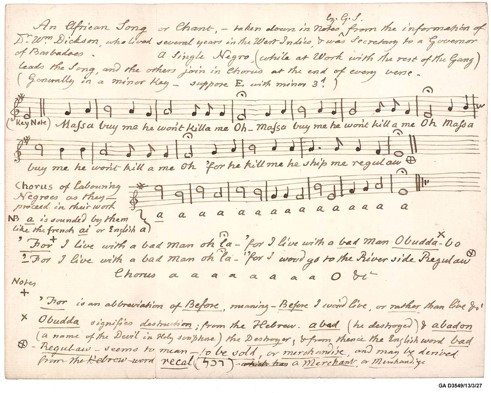
D3549/13/3/27
This manuscript was shown to Vanley Burke (often referred to as the godfather of Black British Photography) and Rider Shafique, a Gloucester-born musician of Bajan descent who attracts 85,000 monthly listeners on Spotify. Collaborating with the Archives and Voices Gloucester, Rider and Vanley created a musical and artistic response to the song, which was heard and shown, together with the original manuscript, in Gloucester Cathedral in September 2024.
Extract of Rider Shafique's musical work
By kind permission of Rider Shafique
So we shall bring this gallop through Gloucestershire’s musical heritage to an end by featuring the work of Rider Shafique from Gloucester. He is a vocalist, MC and spoken-word artist rooted in the sound system culture. He bridges the genres of dub, reggae, drum & bass and dubstep. His work focuses on activism, anti-racism and black identity. He has donated some of his films and creative work to Gloucestershire Archives. We will shortly be accessioning his sound-piece created in response to the UNESCO song.
Here you can listen to a short snippet of Rider’s response to our UNESCO song. It starts with the sound of the waves in Barbados, then introduces Gloucester Cathedral organ playing the song, then Rider’s spoken word approach to the song. The whole piece is 11 minutes and 47 seconds long. It proved a powerful way of thinking about the impact of enslavement.