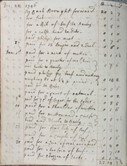
Domestic account book of Ann Beach, December-January 1746
Much of our material regarding household lists are from upper class families, as these households usually kept accounts, so details of typical food purchases have survived. Whereas some households bought on a calendar basis – only buying certain items at their cheapest (i.e., starch after harvest), others made regular purchases and paid on account. This page from the domestic account book of Ann Beach the younger of the Hicks-Beach family of Coln St Aldwyn is a typical upper class set of purchases. It includes fish (species not given), beef (rib & sirloin), calves head, mutton (neck & shoulder) and veal (loin). Also listed are bread, oatmeal, roles (possibly bread rolls?) and sugar for cyder. The birds purchased include snipe, teal and larks (2 dozen!) – the latter a sad insight into one of the reasons why our nation’s wildlife is so species poor: if they weren’t thought of as vermin, they were often regarded as food for the upper classes. Vegetables were rarely bought as most of these were obtained from the kitchen gardens and milk (for butter and cream) came from local farms.
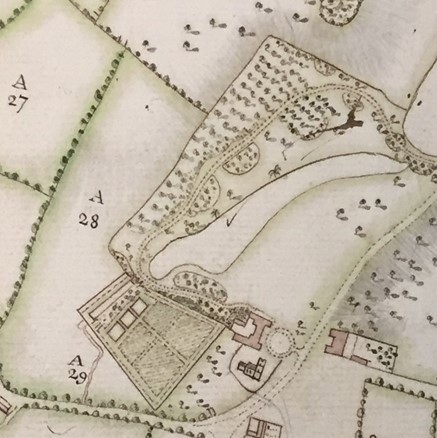
Dodington House kitchen garden and orchard
“No man need ever have an ill-provisioned house if there be but attached to it a dovecote, a warren and a fishpond.” Olivier de Serres, Théâtre d'Agricult (1600)
Almost every house had a garden of some sort, where vegetables could be grown, and poorer families would often keep a few hens and a pig or two as well. Larger houses typically had extensive large kitchen gardens and orchards which were designed to provide a continual supply of fruit, flowers and vegetables. This plan of Dodington House shows off the size of its walled garden (to the left of the house) and orchard (above it). Walled gardens were especially good for fruit and tender vegetables, and most larger houses also had glass houses for exotic fruits as well (notably pineapples – which became a sought-after delicacy in Europe and were associated with power, wealth, and hospitality – especially if you had the facilities and staff skilled enough to grow them at home). By the 1700s, fish ponds had grown out of fashion for food production (although remained for landscape, angling and boating), so for fish and meat (other than game), larger houses typically obtained it from suppliers or from ‘home farms’ on the estate. Items such as flour would also be purchased externally.
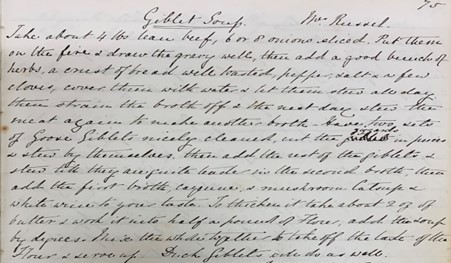
Giblet soup
This probably wasn’t as bad as it sounds but it did have to stew all day! It comes from the papers of the Le Marchant Family, who settled in Little Rissington in the 1860s, where Robert Le Marchant was Rector for over 50 years. His wife, Eliza Catherine, began recording recipes in a volume around 1856 and it was added to by various authors, possibly her daughters, over the years. It contains recipes such as Toad in the Hole, Gloucester Jelly, Planche Cake, Buttercup Ointment, Conger Soup and how to dress a suckling pig. This recipe used beef, onions, a toasted crust of bread, herbs, cloves and salt and pepper to make a broth, which was strained off. The meat was then stewed again, and two sets of chopped goose giblets were added. The first broth was then added to the second along with cayenne, mushroom ketchup and white wine - the whole thing was then thickened with the gradual addition of a stiff roux (2oz of butter to ½ lb flour) and served. The recipe writer notes that duck giblets could replace the goose giblets.
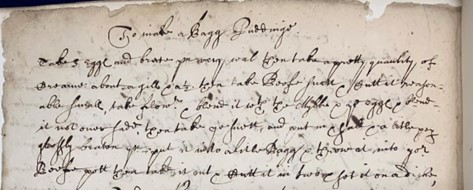
To make a bagg pudding
The word ‘pudding’ comes from the Middle English word ‘poding’, which meant a ‘meat filled animal stomach’. Traditionally, puddings were boiled in linen cloth or bags and were cooked in the ‘copper’ – the wash house boiler, which was used to heat water and consisted of a copper bowl sat on top of a furnace. Boiled puddings were popular primarily because it was far easier to bring water to the boil and maintain the boil on top of a fire rather than use an oven. Early puddings were savoury meat-filled concoctions but by the 1600s puddings could be savoury or sweet (flour, nuts and sugar) and by the end of the 1700s most had lost the meat content – with the exception of foods such as umble pie (umbles are the meaty parts of a beast's pluck - the heart, liver, kidneys and lungs - usually of a deer, but also of other animals)which later gave rise to steak & kidney pudding. From the Smyth Family of North Nibley and dated to around 1609-1639, this is the oldest recipe we have. It is a recipe for a beef suet cooked in a cloth bag (hence the name) in beef broth.
Take 3 eggs and beate [the]m very wal (well) then take a pretty quantity of Creame about a gill [and] a 1/2 then take Beefe suet Cutt it reasonable small take flow[er] [and] blend it w[i]th the Mylke [and] [th]e eggs [and] blend it not over sadd then take [th]e suett and put in [and] salt [and] a litle pep[per] loossly beaten [the]n put into a litle Bagg [and] throw it into yo[ur] Beefe pott then take it out [and] Cutt it in two and set it on a dishe
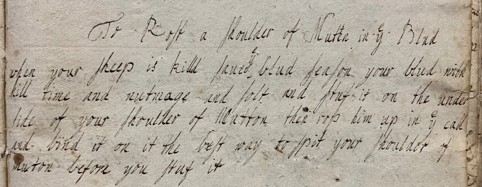
'To roast a shoulder of muten in ye blod'
This is taken from the ‘Recipe and herbal book’ of Anne Beech the elder of Netheravon, a member of a branch of the Hicks-Beech Family and it dates to around 1731. Like most recipe books of this period, it includes culinary and medicinal recipes. So far, this recipe is the only one we’ve found in the archives that specifically mentions spit roasting. Roasting in front of a fire – rather than baking it in an oven (as the term ‘roasting’ has come to mean today), gave meat a much better flavour and didn’t dry it out. Roasting was undertaken either by suspending the meat over or in front of the fire (being turned by hand, by dogs in a wheel or, later, by a clockwork bottle-jack) or by skewering it horizontally on a spit, which was the traditional method. Roasting in an oven in a tray only became the norm when closed ranges were introduced. The recipe stuffs the shoulder with sheep’s blood – probably congealed – and seasoned with thyme, nutmeg and salt. Some similar recipes called for the shoulder to be soaked in blood before spitting.
‘when your sheep is killd save ye blud season your blud with
hill time and nutmage and salt and stuf it on the under
side of your shoulder of mutton then [w]rap him up in ye call
and bind it on it the best way to spit your shoulder of
muton before you stuf it.’
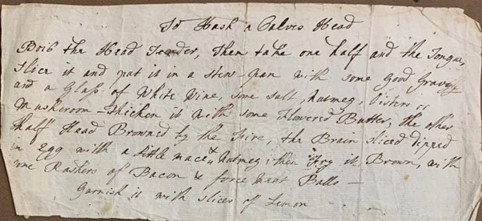
To hash a calve's head
Calves' heads were much prized and were often served whole, boiled, roasted and trimmed, as a centrepiece to be carved at table. However, an equally popular recipe was to ‘hash’ them and it is pretty much as vile as it sounds! Hashing was the general term for a stew or fricassee (itself a stew made with pieces of meat browned in butter then served in a sauce flavoured with the cooking stock) that used re-heated small meat pieces with vegetables or other ingredients. This recipe comes from the Danvers Family of Thornbury. It calls for the calf’s head to be boiled until tender, then split it in two. One half (with the tongue) is then stewed with gravy, white wine, salt, nutmeg, and the resulting mix thickened with a roux (‘floured butter’). The other half is browned by the fire, then the brain is sliced, dipped in egg with mace and nutmeg before being fried with bacon and forcemeat balls (a mixture of ground meat, combined with fats, seasoning, and other flavouring ingredients). I’m not sure the serving instruction ‘garnish it with slices of lemon’ would help….
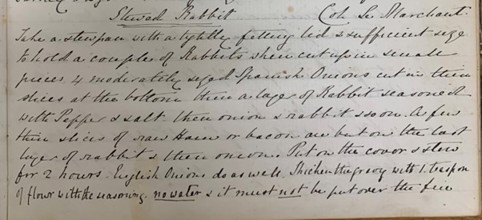
Stewed rabbit
Rabbit was far more popular in the past as it was easily available to upper classes and – thanks to poaching – to the lower classes as well. This recipe from the Le Marchant Family used two rabbits that were jointed into small pieces and it required a large stewpan with a tightly fitting lid. It is a layered stew with a base of chopped Spanish onions (larger but milder than English brown onions), then a layer of jointed rabbit pieces, seasoned with salt and pepper. These layers were then repeated until there was no rabbit left. A layer of ham or bacon was then laid over the top layer of rabbit and the pot was then covered and baked in the oven for 2 hours – the recipe specifically states that it ‘must not be put over the fire’, presumably implying that a lower temperature cooking was required. No water was used and when ready, the pot liquid was thickened with flour and herbs to make a gravy.
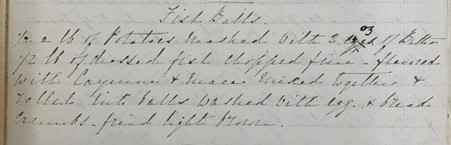
For curry
By the late 1600s, Britain was acquiring a taste for spicy curry dishes, due to its growing links with India. Written around 1817-1826, this recipe is from the recipe book of Charlotte Guise of the Guise family of Elmore, Highnam and Rendcomb, which chiefly contains household recipes, but also some medical cures, and garden notes on the cultivation of potatoes and strawberries. This curry could be made with chicken or rabbit and – like most curries today – used fried onions in butter as its base. The recipe is long and quite complicated, but essentially makes a cooking mix of finely ground cloves, mace, nutmeg, fine black pepper, curry powder, turmeric and salt. This was then added to a mutton or veal stock, to which was added an onion, blanched ground almonds, cayenne pepper and salt. This mix was then added to the meat, which was prepped as a fricassee with a weak mutton broth and marinated for half an hour before being strained. The meat then went into a stew pot with the strained liquor and cooked until the meat was tender. It was thickened with butter and cream and the recipe states the curry should be ‘light & bright yellow’ – so resembling a modern korma. The recipe says that its taste is improved by the addition of mango pickle and the liquor from Indian pickle to give it an acid taste. ‘Indian pickle’ is an old name for piccalilli, a mixture of chopped vegetables and hot spices (one of which is turmeric, hence its yellowy colour). The first known record of the name ‘piccalilli’ is in 1772 by a Mrs Raffald in her cookbook, who gave a recipe for making ‘Indian Pickle or Piccalillo’ that is very similar to modern ones.
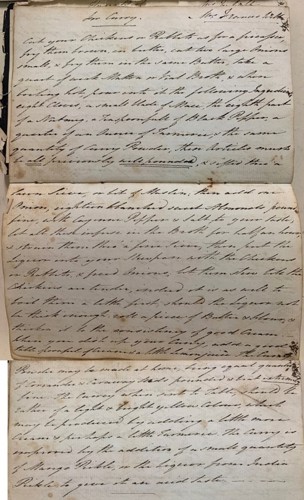
To make a squab pye
This traditional dish from the Southwest comes from the Bathurst family of Lydney. Though the name suggests it contains squabs (young pigeons), in fact it is a two-crust (i.e., it had a pastry bottom, sides and top) mutton pie with alternating layers of onions, sliced apples and thin steaks cut from a neck of mutton. It also requires ‘raisins of the sun’ – dried raisins – and was baked in the oven for about 2 hours. Originally it may have used pigeon or dove, but mutton was used as a substitute from the early 1700s and the misnaming of the pie was seemingly for ‘surprise’ effect. Charles Dickens disliked it intensely, writing in his journal ‘All the Year Round’ that it produced “nausea, unsociability, and, in course of time, hatred of the whole human race.” Today, it is listed amongst the ‘at risk’ British food dishes.
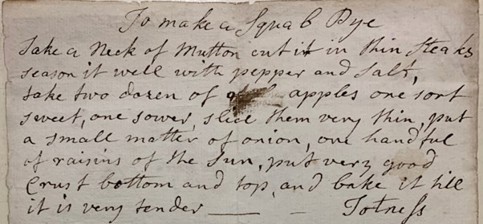
To stew lampernes or lampreys
Taken from the recipe book of Charlotte Guise of the Guise family of Elmore, this recipe for lamprey (aka lamperne) is a classic Gloucestershire dish. Although they resemble eels, lamprey are not fish, but Agnatha, jawless aquatic invertebrates that evolved in the late Devonian period around 380mya. They are parasites on other fish, attaching themselves with their sucker-like mouths and feeding on their blood. Although they were very common in the past, today lamprey are critically endangered in Britain, thanks largely to pollution. This recipe calls for well cleaned lamprey to be added to beaten cloves, mace, salt, pepper, flour, ‘old cyder’, ketchup, port wine and horseradish, then stewed for around 45 minutes. I suspect the result still wouldn't be edible! Lampreys were considered a delicacy for the wealthy in medieval England and were often given as gifts to royalty. It was a tradition for Gloucester to give the monarch a lamprey pie each Christmas. In 1200, the city was fined 40 marks (around £40,000 today) by King John for failing to provide a pie. This custom ended in 1836 but a pie is still presented on special occasions such as coronations and jubilees. For Queen Elizabth’s Golden Jubilee and King Charles III coronation however, Canadian lampreys had to be used!
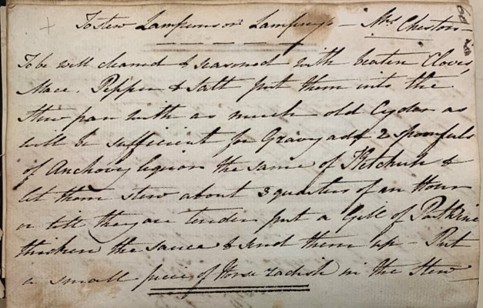
Fish balls
Perhaps not the most appetising of names, this dish is essentially a modern fish cake and comes from the recipes of the Le Marchant Family. It uses ½ lb of potatoes that are cooked and mashed with butter. To this is added ½ lb of dressed fish that had been finely chopped. Cayenne pepper and mace were added for flavouring. The mix was then formed into balls that were washed with beaten egg and then dipped or rolled in breadcrumbs, then fried until golden. The type of fish used isn’t given, so presumably it could have been freshwater or sea fish, although with the latter, it was only probably white fish rather than oily fish.
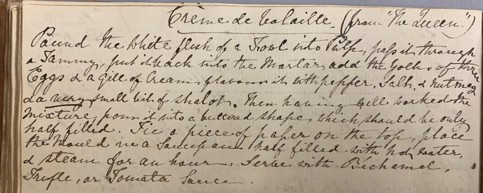
Creme de volaille
A ‘Volaille’ is simply a French term for the flesh of a chicken used for food. The most common birds eaten were hens, pheasants, partridges, ducks and geese. Nobles and wealthy landowners hunted wildfowl using falcons and many had their own dovecote and poultry yard in which to breed their own birds. Poorer people generally kept hens because they were easy to look after and to feed. However, they were primarily kept for their eggs – so people refrained from eating their own chickens if possible. This recipe from the Sharpe Family uses ground chicken put through a ‘tammy’ (or ‘tamis’ - a fine sieve) then mixed with cream, three egg yolks, pepper, salt, nutmeg and a small amount of shallot (this is emphasised). This mix is put into a butter mould, covered with paper and steamed for an hour. It was served with a béchamel sauce and either a ‘sharp sauce’ (a floured sauce made from wine vinegar boiled with sugar) or tomato sauce.
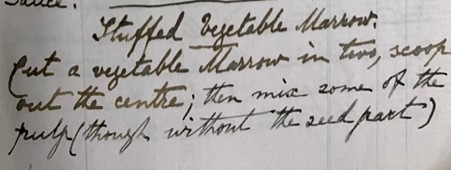
Stuffed vegetable marrow
Most of the vegetables of the medieval European era between 600 and 900 years ago are still popular today – the main difference being that some common vegetables of today were not known, i.e., potatoes, peppers, etc. There are relatively few recipes mentioning vegetables in the archives, presumably because cooking them was quite standard – boiling (on their own or in stews) or frying. From the Codrington family of Dodington, and written between 1872 and 1887 this recipe is for a stuffed marrow. Marrows have to be one of the most dull and bland vegetables ever and if that wasn’t enough, they do not provide much nourishment either – in fact their only real attraction is that they can produce a good yield from a small area. This recipe tells what the cook should do, i.e., cut it in two and scoop out the centre…but fails to say what the pulp should be mixed with!
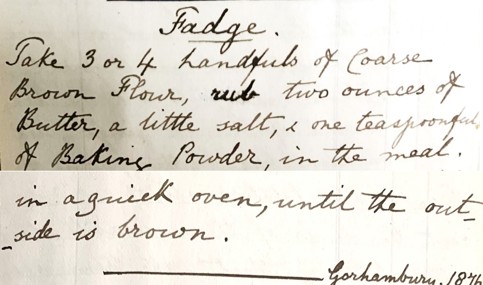
Fadge (not fudge!)
Fadge is a traditional Ulster-Scottish word for potato bread or a potato cake. This version from the Codrington household however omits potatoes and uses flour, although it is possible that potato flour was used. Some recipes use a mix of wheat and potato flour. The recipe calls for a ‘quick’ oven and the fadge should be cooked until the outside is brown. The word ‘quick’ mean a high temperature – around 218°C/ Gas 7 (425 °F).
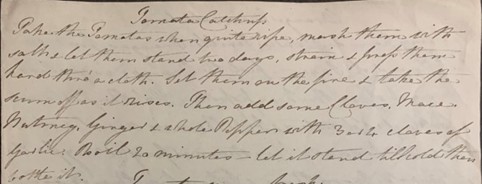
Tomato catchup
Ketchup or catsup or catchup (as here) is a table condiment with a sweet and sour flavour that we are all accustomed to. The term ketchup first appeared in 1682 and it was historically prepared with mushrooms as the main ingredient, but other early recipes used egg whites, oysters, cockles, grapes, mussels, or walnuts. This family version takes ripe tomatoes and mashes them with salt, then lets them stand for two days. Afterwards, the mix is strained through a fine cloth – removing pips and skins – then it is put into a pot or cauldron on the fire. Cloves, mace, nutmeg, ginger a whole pepper[corn] and 3 or 4 cloves of garlic are added, and the mixture boiled for 20 minutes. As it heats up, any scum is skimmed off. It is then left to cool, and when cold, bottled.
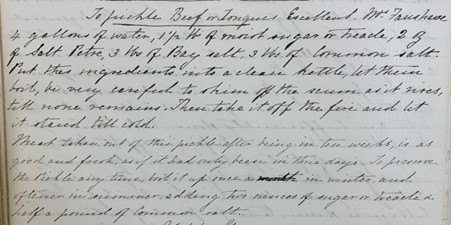
Audley End pudding
Audley End is a huge 17th century country house at Saffron Walden, Essex. It is a classic ‘prodigy’ house, one of several large and showy country houses built by courtiers or other wealthy families, that have been described as either "noble palaces of an awesome scale" or "proud, ambitious heaps”. Whichever view is taken, Audley End is one of the finest Jacobean houses in England. It was originally built by Thomas Howard, 1st Earl of Suffolk, primarily for entertaining James I but by the 1800s it had come into the hands of the Barons Braybrooke.
At the time of this recipe, Audley End was owned by Charles Neville, 5th Baron Braybrooke, and the cook of the house was either a male French chef, Monsieur Merer, or Avis Crocombe. Crowcombe became the cook sometime between 1871 and 1881. Little is known about her early life, but in 1871 she was working as a cook in the household of Thomas Proctor Beauchamp at Langley Hall, Norfolk. It seems likely that she replaced Monsieur Merer as part of a cost-cutting exercise by Baron Braybrooke as female cooks cost less than male chefs! In the event it is known that she left Audley End in 1884 when she married, but her handwritten cookery book was passed down through her family for generations and rediscovered by a distant relative in 2009.
Subsequently she has been made famous by English Heritage who created a very popular YouTube series, The Victorian Way, starring historical interpreter Kathy Hipperson. One of the new wave of ‘slow’ videos, this offers viewers a gentle glimpse into a simpler time without mod cons or plastic and where nothing was wasted.
Although our recipe comes from the Codrington archive, given the name of this pudding it seems highly likely that one of the Codrington family members ate it at Audley End and asked for the recipe. Using flour, milk, cream, butter, sugar, this was simmered gently and produced a sweet like a crème caramel, especially as the top was burnt with a salamander. This was a flat iron that was heated in the fire and placed on top of the food, essentially toasting the upper layer to a tasty caramelised crisp.
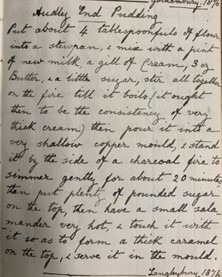
To make fritters
Coming from the archive of the Bathurst Family of Lydney, these apple fritters are made with a batter of eggs, flour, cream and sugar, nutmeg, mace and cinnamon, which is beaten and then rested for 3 hours. Before cooking 5 spoons of scalded sack, brandy and ale or beer are added to the batter! Sack is an archaic term referring to a dry white fortified wine imported from mainland Spain or the Canary Islands (one type, Sherris sack, is today better known as sherry). The apples used are described as ’small pippins’. These vary in size, shape, and appearance, ranging from small to large and round, ovate, to conical in shape. They vary in taste from sweet to sweet-tart and are suited for fresh and cooked preparations. There were several Gloucestershire apples that the Bathurst could have used, the Princess Pippin (from Dymock), Port Wine Pippin (Chaxhill), Sugar Pippin (Walmore) or the Gloucester Pippin (aka the Blenheim Orange Pippin). There were also several varieties in existence over the Severn from Lydney, such as the Berkeley Pippin and the Elmore Pippin. Whatever the variety of apple used, they were to be sliced ‘wafer thin’, before being dipped into the batter and fried in either beef dripping of hog’s lard!
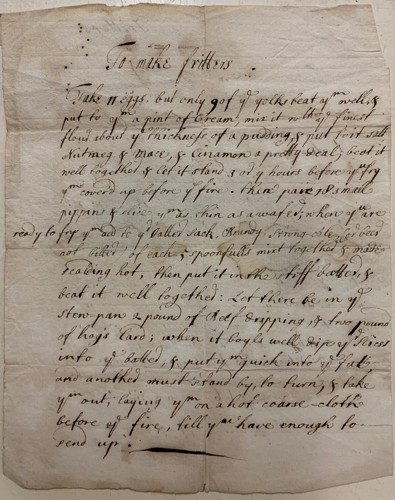
Colonel Wylde's pickle
Preserving food was critical to get through the winter months – especially for the lower classes – and there were four main methods by which to achieve it, pickling, drying, smoking and salting, with refrigeration coming later. Each one had its advantages and disadvantages, and each was used for specific food types. One of the most common methods and which could be used for almost any foodstuff was pickling, the process of preserving or extending the shelf life of food by either anaerobic fermentation in brine or immersion in vinegar. Pickling uses an edible antimicrobial liquid that inhibits the growth of and/or kills bacteria and microorganisms. Although pickling affects the food's texture and flavour, it was used for vegetables, fruits, fish, meats, mushrooms, dairy and eggs. This recipe from the Le Marchant Family of Little Rissington is technically a chutney, as pickles are made using whole fruits and vegetables, while chutneys are made using small, chopped pieces of fruits or vegetables. It is a standard ‘chutney’ recipe, albeit for making a large amount as it uses 6lbs of Spanish onions, 6lbs of apples and white vinegar. However, it then ups the game by using ¼lb of red chillies!
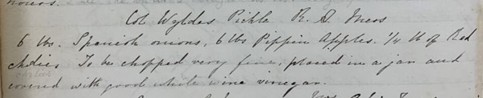
To pickle beef or tongues
This recipe for pickle doesn't use vinegar but instead uses a brine solution made up of 4 gallons of water, 1½lb of moist sugar (brown sugar) or treacle, 2 oz of Salt Petre, 3lbs of Bay salt (sea salt) and 3lbs of common salt. The mix is boiled and when all the scum has floated up and removed, it is left to cool. The recipe states that meat taken out of the pickle after 10 weeks ‘is as good and fresh as if it’s only been in three days’. Its shelf life could be extended by boiling once a month and adding sugar, treacle and salt. This recipe uses another common pickling ingredient, Salt Petre, aka Potassium nitrate, which was more commonly used in fertilizers, rocket propellants, fireworks and was also a major constituent of gunpowder (black powder)! In this type of recipe, it acts as a curing agent and this it results in something resembling a modern corned beef or salt-beef.
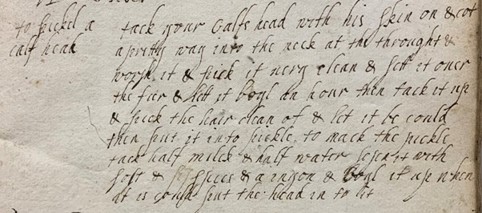
To pickle a calf head
An alternative picking technique was to use milk. This recipe required milk, onions, salt and spices (typically a bay leaf and peppercorns) as was fairly common. It calls for the calf head to still have its skin on and then you make a deep cut in the neck at the throat and nose, then boil it for an hour after which the hair is picked off and it is placed into a suitable pickling container. It has a lot of mangled English, but reads:
Tack your calfs head with his skin on & cot
a pretty way into the neck at the throught &
nose it & pick it very clean & sett it over
the fier & lett it boyl an hour then tack it up
& pick the hair clean of & let it be could
then put it into pickle to mack the pickle
tack half milch and half water sesen it with
salt & ps spics & a inyon & boyl it up when
it is could put the head in to it
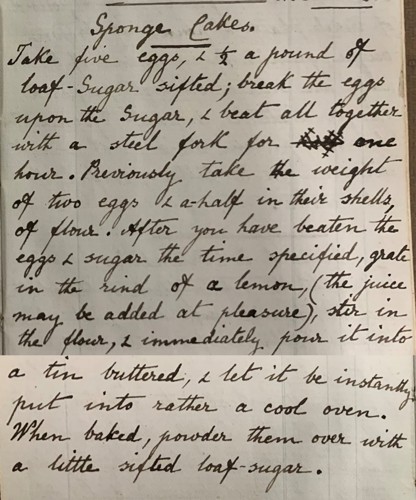
Sponge cakes
The term ‘cake’ has a long history and the word itself is of Viking origin, from the Old Norse word "kaka". In ancient Rome, the basic bread dough was sometimes enriched with butter, eggs, and honey, which produced a sweet and cake-like baked good. Early cakes in England were also essentially bread and the most obvious differences between a ‘cake’ and ‘bread’ were the round, flat shape of the cakes and the cooking method, which turned cakes over once while cooking, while bread was left upright throughout the baking process. Sponge cakes, leavened with beaten eggs, originated during the Renaissance, possibly in Spain. When ovens began to become more common, cakes were typically the second or third item to be baked, after bread. From the Codrington Family, this is a standard recipe for a sponge cake using flour, sugar and eggs – into which the rind and juice of a lemon is added. The drawback is that you are supposed to beat the mixture together for an hour! It doesn't require very much flour – just ‘the weight of two & a half eggs in their shells of flour’ – about 4½-5oz (130-150g). It is one of the few recipes that provides some baking instructions – as it is put into a ‘rather cool oven’.
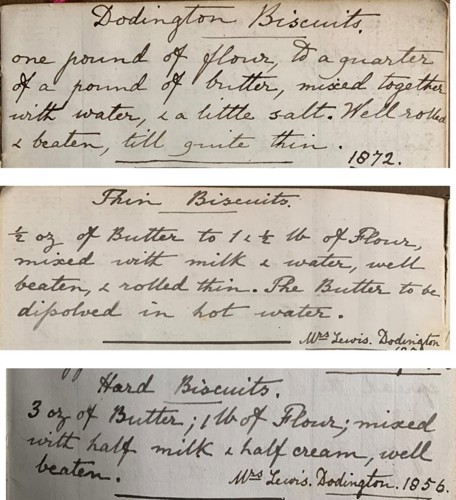
Biscuits: Dodington biscuits, thin biscuits & hard biscuits
Biscuits, in most English-speaking countries, are a flour-based baked, typically hard, flat, and unleavened. They are usually sweet and may be made with sugar, chocolate, icing, jam, ginger, or cinnamon. By medieval times, biscuits were made from a sweetened, spiced paste of breadcrumbs and then baked (e.g., gingerbread), or from cooked bread enriched with sugar and spices and then baked again. Modern biscuits appeared when the supply of sugar, and the refinement and supply of flour coincided with the Industrial Revolution, allowing mass-production. These three biscuit recipes all come from the Codrington Family of Dodington - hopefully, what they lacked in naming imagination they made up for in taste, even though there are no sweeteners in these recipes.
Dodington Biscuits – The salt in this recipe may have made this more of a cracker.
Thin Biscuits – this recipe calls for the butter to be dissolved in hot water, creating an emulsion, before mixing with the other ingredients. This step would help the biscuits texture.
Hard Biscuits – the cream used here would have added richness to these biscuits.
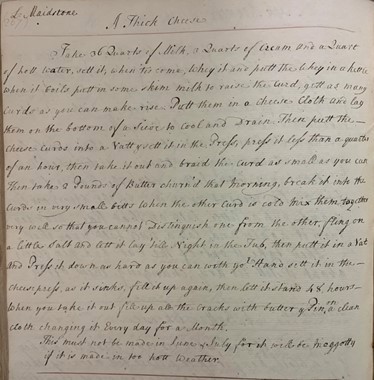
A thick cheese
Cheesemaking was a way of turning surplus milk into a food that could be stored and eaten throughout the winter months. It is thought to date from around 8000 BCE, when sheep were first domesticated. As animal skins and inflated internal organs were used to store foodstuffs, it is likely that cheese was discovered accidentally by storing milk in the stomach of an animal, resulting in the milk being turned to curd and whey by the rennet from the stomach. Gloucestershire has two very famous cheeses – Single Gloucester and Double Gloucester. The difference was that Single Gloucester was made at the beginning and tail-end of the season (spring and early autumn) when animals were often fed on hay, so produced less milk which resulted in smaller, less-acidic, wetter cheeses that matured quickly (just 8 weeks) and didn’t keep. Double Gloucester was made at the height of the season (May to July), when there was a surplus of milk, which resulted in larger cheeses (twice the size – hence ‘double’) that were more-acidic, drier and matured more slowly (typically 4 to 8 months) that kept well. However, lots of other cheeses were made using family recipes. The archive of the Hyett & Dickinson families includes a fantastic volume that has numerous cheese recipes (including ones for making rennet). It was probably the work of Sarah Hunt, wife of Doctor William Adams of Oxford and was written around 1740. The thick cheese here was pressed in a cheese press and was wrapped in cloth, changing it every day for a month. Some of the cheeses have the months/seasons that they could be made – this recipe for example says that ‘This must not be made in June or July for it will be maggoty if it is made in hot weather.’
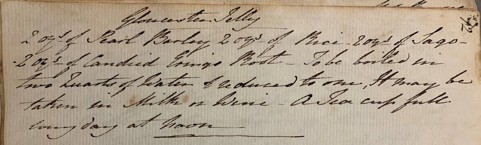
Gloucester jelly
Our collections include have a couple of recipes for this preserve, which was used primarily as a tonic or food supplement for the sick. The ingredients were Isinglass (a form of collagen obtained from the dried swim bladders of fish and used for the clarification of beer…or as a glue!), Sago, Whole Rice, Pearl Barley and Eringo Root – aka Sea Holly (Eryngium maritimum), this was used as an ingredient, a vegetable, or, candied as an aphrodisiac. The ingredients were mixed with 3 pints of water and then boiled down to 2 pints, which formed a jelly when cooled. In use, a teacupful was dissolved with milk, sugar or wine and it was taken 2 or 3 times a day.
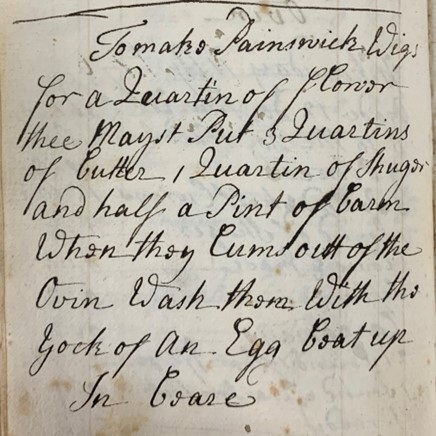
'Painswick Wigs'
‘Painswick Wigs’ are a type of sweetish bread roll made using flour, butter sugar and barm – the old term for 'yeast’, usually the yeast-rich froth leftover from brewing beer. This recipe comes from the pocketbook of William Barrett of Cheltenham, a journeyman baker who moved to Gloucester in 1746, although he seems to have retained an interest in Barrett’s Mill in Cheltenham, possibly baking on the premises. He recorded all manner of things in the pocketbook, including the price of corn, cost of ingredients and recipes for different types of cakes, horse ailments and human remedies.