
Frontiers & Pioneers in Gloucestershire’s Archives: Display 10 of 20
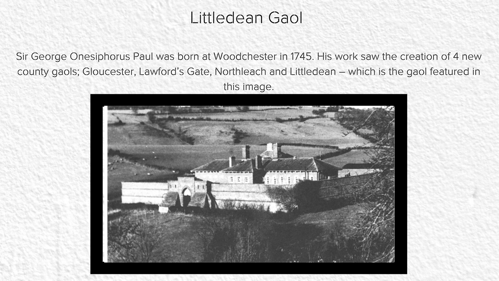
Littledean Gaol (GPS231/4)
Sir George Onesiphorus Paul was born at Woodchester in 1745, the son of textile manufacturer Sir Onesiphorus Paul, Baronet Paul of Rodborough, and his first wife, Jane, Onesiphorus graduated from St. John’s College at Oxford in 1766. Like many wealthy young men of the time, he then went on a ‘Grand Tour’, spending 2 years travelling around Europe before returning to a life of leisure. Things changed upon his father’s death in 1774, for he not only inherited the baronetcy and estate but was catapulted into county politics and local government. In 1780, for unknown reasons but possibly just to distinguish himself from his father, he took on the additional Christian name of George. In the same year was appointed High Sheriff for Gloucestershire – following in his father’s footsteps. As High Sheriff, he was responsible for the county’s gaols and their poor state soon caught his attention. He very quickly became an advocate for the improvement of prisons and the driving force behind the reorganisation of Gloucestershire's judicial system basing it more on a programme of rehabilitation rather than punishment; the first scheme of its kind in the country. His work saw the creation of 4 new county gaols; Gloucester, Lawford’s Gate, Northleach and Littledean – which is the gaol featured in this image. Only the latter two survive today, although not as prisons. Paul continued to work for reform for the rest of his life – most notably becoming involved with the Stroud society that provided free medical advice and medicine. In addition he became involved in the cloth industry, where he helped in reducing ‘slingeing’ – the embezzlement of, and fraudulent dealing in cloth. He died unmarried aged 74, on 16 December 1820 and was buried in Woodchester.
Last reviewed: