
Display 11 of 20
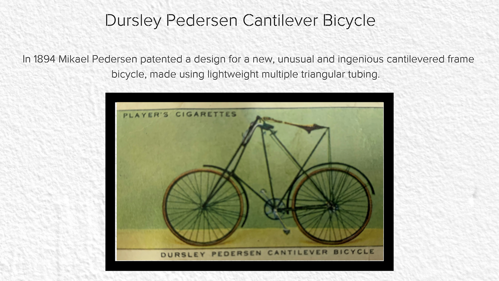
Dursley Pedersen Cantilever Bicycle (D7442/6)
Mikael Pedersen was born in Marbjerg, Denmark on 25th October 1855. He proved to be a natural engineer and became an apprentice at the Maglekilde Maskinfabrik (Maglekilde Machine Factory) in Roskilde, which made farming equipment. In 1878 he designed a new type of centrifugal cream-separator which transformed the Danish dairy industry but when he wasn’t named on the patent, he left and joined a rival firm, designing a new improved separator. This was licensed to a Copenhagen form, Koefoed & Hauberg and when they looked for a market abroad, they linked up with Listers of Dursley. In 1889, a contract was signed with Listers to make the machines under licence, which led to Mikael moving to Dursley to set up local assembly with parts shipped from Denmark. Listers later broke the contract with the Danish firm (which cost them just £100) and hired Pedersen to work for them. Pedersen grew to be a wealthy man from sales of the cream separator and he became a benefactor to many local organisations around Dursley, especially those linked to helping the poor. In 1894 he patented a design for a new, unusual and ingenious cantilevered frame bicycle, made using lightweight multiple triangular tubing. It was highly advanced and he founded the Dursley Pedersen Cycle Company to make it, but sadly he lacked business acumen so the company never prospered. By 1918 he was suffering from ill health and alcoholism and one day he vanished, abandoned his wife and family in Dursley. No-one knew what had happened to him until, by chance, he was seen by a friend in London in 1920, living as a tramp and selling matches. The friend paid for him to return to Denmark where Mikael lived for a time with his brother but later moved out. However by this time his health had gone and he died in 1929, poor and unknown. In 1995, his remains were exhumed from their unmarked grave in Denmark and re-interred in Dursley cemetery.
Last reviewed: