
Display 17 of 20
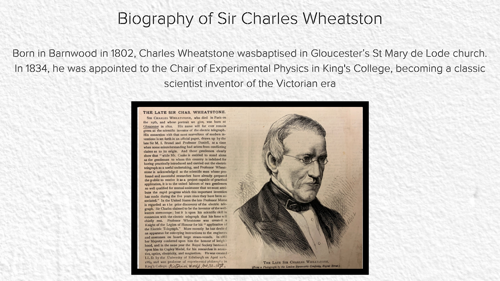
Biography of Sir Charles Wheatstone (SRPort-Wheatstone(1)GS)
Born in Barnwood in 1802, Charles Wheatstone was baptised in Gloucester’s St Mary de Lode church. The family later moved to London where – from a young age – Charles conducted experiments on musical instruments (his father was a music teacher) and studied the scientific principles involved, as well as being an avid reader of fairy tales, history and science. In 1834, he was appointed to the Chair of Experimental Physics in King's College, becoming a classic scientist inventor of the Victorian era, making many scientific breakthroughs including the English concertina (patent No.5803, 19 December 1829), the stereoscope (a device for displaying three-dimensional images), the Playfair cipher (an encryption technique) and was a major figure in the development of telegraphy. Today he is best known for his work on the ‘Wheatstone Bridge’ an electrical device that was actually invented by Samuel Hunter Christie. The bridge device is basically an electrical circuit used to measure an unknown electrical resistance by balancing two legs of a ‘bridge’ circuit, one leg of which includes the unknown component. It can provide extremely accurate measurements and be used to measure capacitance, inductance, impedance and other quantities. Wheatstone died in Autumn 1875 of a lung infection while on a visit to Paris and he was buried in Kensal Green Cemetery. London.
Last reviewed: