
Display 18 of 20
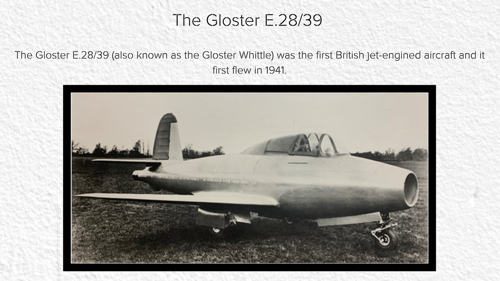
The Gloster E.28/39 (D12580/5)
The Gloster E.28/39 (also known as the Gloster Whittle) was the first British jet-engine aircraft and it first flew in 1941 (it was the 4th jet to fly – the first being the German Heinkel He 178 in 1939). It was built to Air Ministry Specification E.28/39 as a suitable aircraft to test the jet engines that Frank Whittle’s company Power Jets Ltd had been developing during the 1930s. The Gloster Aircraft Company won the contract to build 2 prototypes and the company's chief designer, George Carter, worked with Whittle to develop an otherwise conventional aircraft fitted with a Power Jets W.1 turbojet engine. Manufacture began at Brockworth but then moved to Regent Motors in Regent Street, Cheltenham (now the site of Regent Arcade), which was considered safer from bombing. In April 1941, the first prototype was completed but a flight-worthy engine was not available so a non-flight capable one was installed instead. The aircraft was then sent to Brockworth for a series of ground tests and taxying trials and it was during these (probably on 8 April) that a series of short ‘bunny hops’ of about 6 ft in height from the grass airfield were made – the first flight of a jet aircraft in Britain. Subsequently, the aircraft received a flightworthy engine and was transferred to RAF Canwell where on 15 May 1941, Gloster's Chief Test Pilot, Flt-Lt Gerry Sayer flew it in a 17 minute flight.
Last reviewed: