
Display 20 of 20
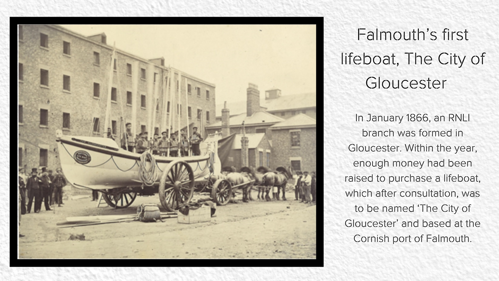
Falmouth’s first lifeboat, The City of Gloucester (SRPRints/A154-35)
By the middle of the 19th century, over a thousand ships a year were being lost or wrecked around the coasts of Britain. Thankfully for the crews of these vessels, the Royal National Lifeboat Institution (RNLI) - which had been founded in 1824 - was entering a new phase of expansion. A critical part was a newfound ability to generate public awareness of the institution and its work, which led to increased public donations and higher revenues for, like today, the institution relied solely on public donation to fund its activities. One manifestation of this was that a growing number of RNLI branches were being formed in inland cities to raise money to purchase new lifeboats. In January 1866, an RNLI branch was formed in Gloucester (partly as a riposte to Cheltenham, which had funded its own branch a year earlier). Within the year, enough money had been raised to purchase a lifeboat which, after consultation, was to be named ‘The City of Gloucester’ and based at the Cornish port of Falmouth. Built by the London lifeboat builders, Forrestt of Limehouse, she was a typical lifeboat of the time; a double-ended, 10-oared, self-righting sailing lifeboat, 33ft long with a beam of 8ft 6-ins. Upon completion (and after ‘sea-trials’ at Regent’s Canal Dock, London) she visited Gloucester in order to take part in a naming ceremony at The Docks. This ceremony was a huge celebration and was preceded by a large parade through the city streets. Afterwards, in front of a crowd numbering around 8,000-10,000, the lifeboat was launched into Victoria basin. Once afloat, she gave a demonstration of her nautical capabilities including her self-righting capability (which required the use of a crane to capsize her) and recovery of persons in the water (additional crew members who leapt into the water from the dockside). This photograph shows the City of Gloucester on its carriage just before the ceremony took place.
Last reviewed: