
Display 3 of 20
Whitfield Example Farm and Uley Cultivator
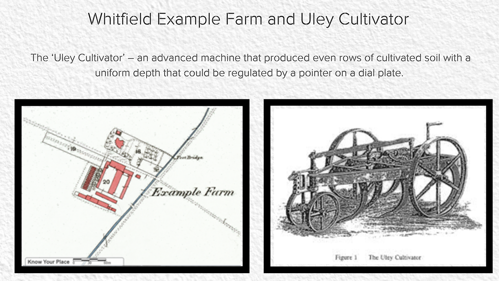
(Map: Reproduced from 1881 Ordnance Survey map with the kind permission of the Ordnance Survey. Image: Gloucestershire Society for Industrial Archaeology Journal 1998)
Yorkshireman Richard Clyburn (1796-1852) was, like Edwin Beard Budding (who he knew), an engineer in the agricultural and textile industries in Somerset and then Gloucestershire. By 1836 he was a partner in the Uley Iron Works with George Lister but in 1841, when the Earl of Ducie bought the works, Clyburn became engineering manager. Ducie’s aim was to create new, modern agricultural machinery for his Example Farm at Whitfield near Falfield. Clyburn obliged with his ‘Uley Cultivator’ – an advanced machine that produced even rows of cultivated soil with a uniform depth that could be regulated by a pointer on a dial plate. It even recorded the results as a paper printout! Clyburn designed numerous machines (often working with Budding), including chaff-cutters and a portable smith's forge but his most famous invention came in 1842, when he designed the adjustable spanner – a pioneering spanner design with open end jaws moved by a rack and worm adjuster. He died in Tetbury on October 18th 1852 but today his spanner is used worldwide – in Europe it is usually referred to as the 'English key' (Clé anglaise - French) or simply a 'Clyburn Spanner‘, while in Canada and the US, it is a ‘crescent wrench’ or an ‘adjustable wrench’ and in Australia (and the UK) it is a ‘shifting spanner’ or ‘shifter’.
Last reviewed: