
Display 7 of 20
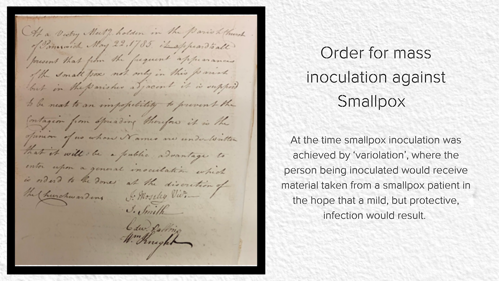
Order for mass inoculation against Smallpox (P244/VE/2/7)
This 1785 note from the vestry minutes of Painswick parish, orders a mass inoculation against smallpox to be undertaken in the parish and it reads;
At a Vestry meetng holden in the parish church of Painswick May 22nd 1785 it appeared to all present that from the frequent appearances of the small pox not only in this parish but in the parishes adjacent it is suppos’d to be next to an impossibility to prevent the Contagion from spreading therefore it is the opinion of us whose names are underwritten that it will be a public advantage to enter upon a general inoculation which is ordered to be done at the discretion of the Churchwardens.
At the time smallpox inoculation was achieved by ‘variolation’, where the person being inoculated would receive material taken from a smallpox patient (or a recently variolated individual), in the hope that a mild, but protective, infection would result. The procedure relied on inserting/rubbing powdered smallpox scabs or fluid from smallpox pustules into superficial scratches in the skin of the person being inoculated. However the use of live smallpox virus made it a risky procedure and it not only often led to the inoculated person developing full-blown smallpox, but frequently caused collateral outbreaks in the rest of the immediate community. Jenner’s breakthrough in 1796 was that he inoculated people by using cowpox (a much less virulent infection related to smallpox) which was much safer and gave the inoculated person immunity against smallpox
Last reviewed: