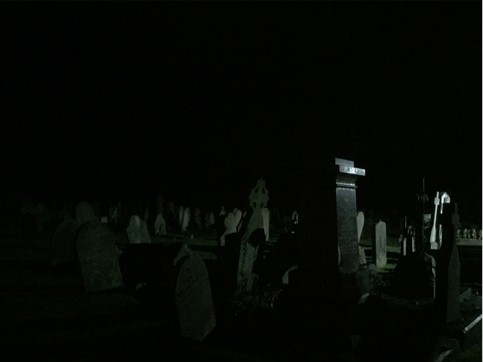
Leckhampton Parish Churchyard at night
‘Tis now the very witching time of night, when churchyards yawn and hell itself breathes out Contagion to this world.’
This popular line from William Shakespeare’s 'Hamlet' (Act 3, scene. 2, l) sums up our views of graveyards at night. Gloucestershire Archives holds a lot of information about graveyards in the county – who’s buried in them (which can be found in parish registers), graveyard plans (found in parish collections) and dedications and expansions (usually in parish collections but also in the Diocesan and parish council records).
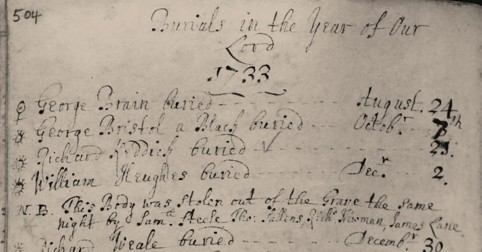
Grave robbing, Awre Parish Register
Body snatching is the secret removal of corpses from burial sites. A common purpose of body snatching, especially in the 1800s, was to sell the corpses for dissection or anatomy lectures in medical schools. Those who practised body snatching were often called "resurrectionists" or "resurrection-men". It differed from grave robbery (which was the uncovering a tomb or crypt to steal artifacts or personal effects that had been buried with the deceased). It was more common in the cities than in the countryside simply because towns and cities had a higher rate of burials and therefore more bodies, but it wasn’t totally unknown. This example, from the parish register of Awre, records the removal of the body of William Hughes’ body by four men – all of whom are named. We don’t know why the men did this or what happened to them –we can only guess what their purpose was….
Burials in the Year Of Our Lord
1733
William Hughes buried ………………………………. Dec 2
N.B. This body was stolen out of the grave the same
night by Sam. Steele, Tho. Sallens, Rich. Newman, James Lane.
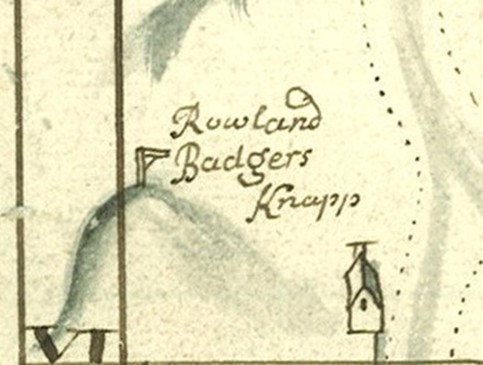
Birdlip & the Devil, Manor of Witcomb, 1711
Once upon a time, a shepherd had walked down from Birdlip to Gloucester to get some medicine for a sick sheep. On the way back up Birdlip Hill, he spotted the devil in the woods waiting to catch passers-by. The shepherd was in a quandary for he didn’t want to get caught by Old Nick but had to get back to his sick sheep. He had a flagon of cider so he had a sip to give himself some Dutch courage then had an idea! So, he drank all the cider then poured the sheep medicine into the flagon and set off up the road. The shepherd was about half-way up, just passing Rowland Badger’s Knap by Black Dog Lane, when the devil leapt out and grabbed him,
“It’s hell for you lad!” said the Devil.
“If you say so Sir,” replied the shepherd, “but how about some nice spiced cider for you first?”
Before he’d even finished speaking, the Devil had snatched away the flagon and downed it in one go. But the foul-tasting medicine burned the devil’s throat and, coughing & spluttering, he leapt straight into the nearby Witcombe reservoirs to try and quench the sensation while the shepherd ran off and escaped up the hill!
Gloucestershire goblins
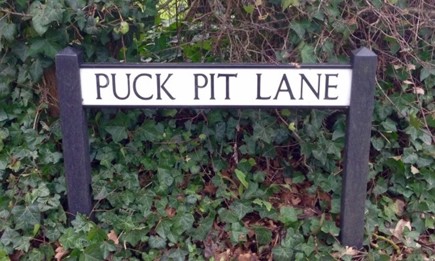
Gloucestershire has lots of goblins! We know this because there are lots of places with the name ‘Puck’ in them. This word comes from Old English and means ‘goblin’, so places with ‘puck’ in the name always refer to places where goblins are found. The above example, Puck Pit Lane in Winchcombe, means ‘goblin pit’ and there is an old quarry along the lane. Many of these places are close to old quarries and this is because people thought that goblins lived underground and cracks in rock faces and caves in quarries were how they came up above ground. The famous author J R R Tolkien probably new about this and it is conceivable that he heard about it while in Gloucestershire. In 1929 Tolkien worked at Lydney Park Estate as part of an archaeological dig, run by the famous archaeologist Sir Mortimer Wheeler. Tolkien advised on the site of an old Roman temple, known as Dwarf's Hill, and whilst there no doubt was aware of a local tale that said that the crumbling ruins were the homes of little people, dwarves and hobgoblins. Was Tolkien was inspired in some way by the folklore attached to the hill…it seems very likely for it is known he liked the area and so may have immortalised it as The Shire from The Hobbit and The Lord of the Rings. In addition, with the eerie landscape of The Scowles at nearby Bream, it must have been easy for him to visualise this into a goblin-infested landscape. Among the goblin place names we have in the county are;
• Pucklechurch – a ‘goblin-haunted’ church!
• Puckham Farm, Brockhampton – a ‘goblin-haunted meadow’.
• Puckrup, Tewkesbury, which means a ‘goblin-haunted farmstead’
• Puckpool Farm, Arlingham – a ‘goblin-haunted water’
The Witch of Berkeley
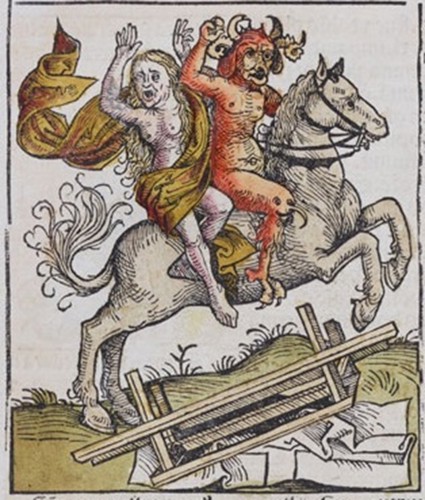
This medieval legend was first written down by William of Malmesbury in his ‘Chronicle of the kings of England - From the earliest period to the reign of King Stephen’. It tells of a witch who lived in Berkeley and had sold her soul to the devil to get power. One day her pet raven died and she knew it meant that she’d die soon. Knowing that Satan would try to claim her, she gave instructions that her body should be wrapped in a stag skin then put in a stone coffin bound by iron chains that had been cooled & blessed by holy water. Then, it was to be put into the church and psalms were to be sung over the coffin for 3 days and nights. If it had not been disturbed in this time, she could be safely buried in the churchyard.
On the first night demons came and attacked the church but the door held firm.
On the second night they returned and got into the church but couldn’t undo the coffin’s chains.
On the third night, the Devil himself came, riding a massive black horse. He smashed open the church doors, rode into the church and spoke, "I have come for the witch of Berkeley. Are you there my love? Follow me!"
The terrified monks then heard a voice then came from the coffin, "I cannot come my lord for I am bound." to which the Devil replied "I will unbind you, to your great loss."
The Devil then smashed open the coffin, picked up the now living woman and galloped off with her into the night. It was said that her screams were heard by many before they faded into silence. To this day it is said that if you are about at night in Berkeley, beware of the ghostly apparition of a raven who will scream like a woman…
The Cheltenham ghost
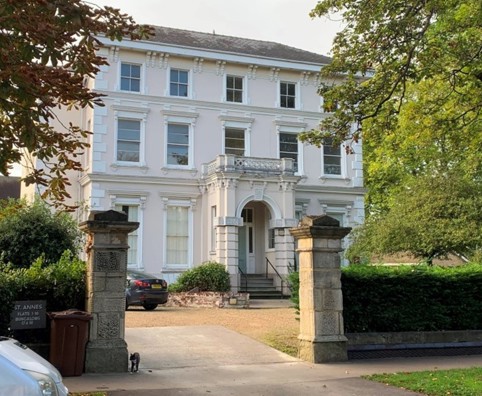
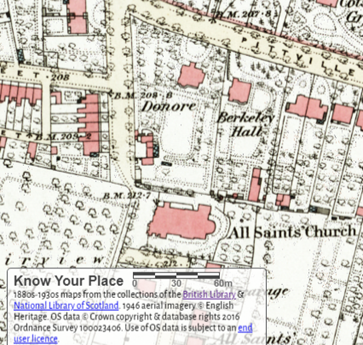
Also known as ‘The Morton Case’, this classic ‘Woman in Black’ haunting was the first major study undertaken by the Society of Paranormal Research in 1886. It concerned a persistent apparition seen in ‘Donore House’ (now renamed St. Anne’s) on Pittville Circus Road. At the time, the house was owned at the time by the Despards, a typical large middle-class Victorian family, affluent enough to run a good-sized house with several live-in servants. The haunting involved hearing footsteps and the appearance of a woman dressed in black mourning attire with her face partly concealed by a handkerchief. The main witness to the haunting was Rosina Clara Despard, 19 years of age when the phenomena began (and who later qualified as a doctor of medicine). She wrote that “I saw the figure of a tall lady, dressed in black, standing at the head of the stairs. After a few moments she descended the stairs, and I followed for a short distance, feeling curious what it could be. I had only a small piece of candle, and it suddenly burnt itself out; and being unable to see more, I went back to my room.” The sightings began in 1882 and stopped around 188 and were not always inside the house.
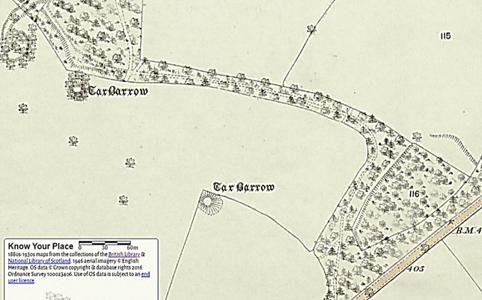
Tar Barrow and its history
In the Bodleian library is a 1685 account of a scary tale of the opening of one of the Tar barrows on the edge of Cirencester. Two brothers were digging gravel in Colton’s Field, on the edge of one of the barrows when the side of the pit gave way, revealing a dark, gaping hole that the men described as ‘an Entrance into the Belly of the Hill‘. Cautiously the men went inside with a lamp and found several rooms with furniture (which, on being touched, crumbled to dust) and dozens of urns, some with ashes, others full of golden coins. In another room, they saw a man in armour, with a spear in one hand and a lamp burning before it. However as they approached the figure, it moved to attack them, smashing the lamp and the terrified men turned and fled back through the barrow. As they reached the entrance they heard a loud, hollow noise like a groan behind them and immediately the earth fell in all around burying all the treasure. One version of the tale says that only one of the brothers escaped and if you visit Tar Barrows on a full moon and listen quietly you can hear scrabbling and sobs as this brother tries to dig himself out…..
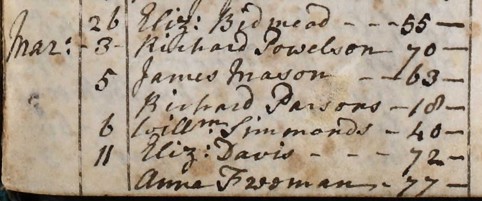
The Strange Tale of Richard Parsons, Bisley Parish Register
Sometimes, these old tales contain a grain of truth. This is one such instance for there is evidence of the eventual outcome. In February 1766, a Minchinhampton gentleman called Richard Parsons visited a friend’s house in Chalford to play cards. The evening apparently went well until around 11pm, when a fierce dispute arose between the players about the number of hands
played in the game. Parsons said six, while the others said five. Furious, Parsons accused his fellow players of cheating and shouted aloud that he “might never enter heaven and that his flesh might rot upon his bones if there were not six in the game!” The next night the men played again and all went well, except that during the evening Parsons kept complaining to his fellow card-players of pain and swelling on his limbs. Over the next few days his whole body began to suffer and he went to a doctor who gave him some medicine but this didn’t help. Parsons deteriorated quickly and those who saw him thought he’d become a zombie with his flesh simply rotting off his bones. He died within the month and was buried on the 5th March 1766 at Bisley as the above entry in the Bisley parish register shows.