
Display 4 of 8
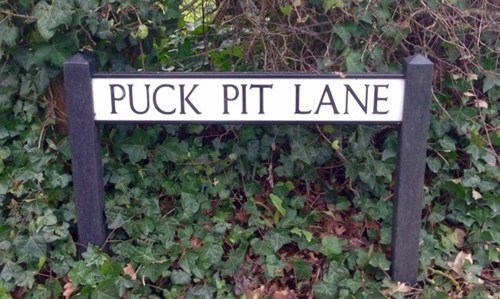
Gloucestershire Goblins
Gloucestershire has lots of goblins! We know this because there are lots of places with the name ‘Puck’ in them. This word comes from Old English and means ‘goblin’, so places with ‘puck’ in the name always refer to places where goblins are found. The above example, Puck Pit Lane in Winchcombe, means ‘goblin pit’ and there is an old quarry along the lane. Many of these places are close to old quarries and this is because people thought that goblins lived underground and cracks in rock faces and caves in quarries were how they came up above ground. The famous author J R R Tolkien probably knew about this and it is conceivable that he heard about it while in Gloucestershire. In 1929 Tolkien worked at Lydney Park Estate as part of an archaeological dig, run by the famous archaeologist Sir Mortimer Wheeler. Tolkien advised on the site of an old Roman temple, known as Dwarf's Hill, and whilst there no doubt was aware of a local tale that said that the crumbling ruins were the homes of little people, dwarves and hobgoblins. Was Tolkien inspired in some way by the folklore attached to the hill… it seems very likely for it is known he liked the area and so may have immortalised it as The Shire from The Hobbit and The Lord of the Rings. In addition, with the eerie landscape of The Scowles at nearby Bream, it must have been easy for him to visualise this into a goblin-infested landscape. Among the goblin place names we have in the county are;
- Pucklechurch – a ‘goblin-haunted’ church!
- Puckham Farm, Brockhampton – a ‘goblin-haunted meadow’.
- Puckrup, Tewkesbury, which means a ‘goblin-haunted farmstead’
- Puckpool Farm, Arlingham – a ‘goblin-haunted water’
Last reviewed: