Roman Colonia Nervia Glevensium
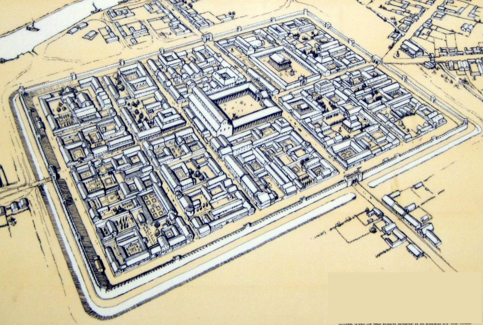
Roman troops of the XXth Legion established a large fortress on what was to become Gloucester around 66AD. About 30 years later, the legionaries moved on into South Wales and the fortress was designated a colonia by the Emperor Nerva, being known as COLONIA NERVIANA GLEVENSIS. These were self-governing Roman towns set up to settle ex-soldiers who received grants of land inside and outside the city as part of their retirement package. Administration was by a town council (curia), led by elected magistrates, who were responsible for settling local disputes, undertaking civic works, and collecting taxes from the population, passing the monies on to the state. The curia administered the colonia from the first civic building in Gloucester’s history, the Basilica, which was built on the site of the old legionary headquarters building in the centre of the town, on the south side of the forum or town square. From finds of stamped roof tiles, we know the curia was called REI PUBLICAE GLEVENSIUM (literally ‘Republic of Glevum’, abbreviated to ‘RPG’) and it governed the city for over 300 years, erecting public buildings including the forum, temples and bath houses and provided services such as piped water, drains and sewers.
Kingsholm Saxon Royal Palace
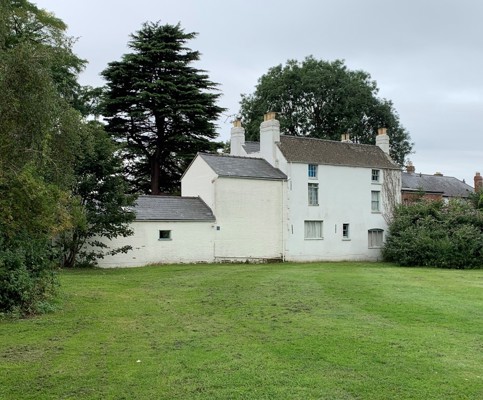
After the Roman military left in AD 407, Romano-British traditions continued, but the daily life of the city could not be supported, and it gradually fell into decay. By the 600s, the Hwicce, a sub-tribe of the Mercian dynasty, had taken control of the region and in 679 their king Osric, founded a monastery at Gloucester dedicated to St Peter (on or near the site of the cathedral). At this time an Anglo-Saxon great hall – described as a ‘palace’ – existed at Kingsholm. Ancillary buildings included a chapel and by the time of Edward the Confessor, the ‘great hall of the Royal Manor at Kingsholm’ was a meeting place of the King’s Great Council - the Witanagemot - raising Gloucester’s status to that of Winchester and London. Although not listed in the surviving Anglo-Saxon records as a Burgh (fortified settlement) it seems likely that it was and administration of the growing town was from this structure. Archaeologists think that the Great Hall complex is located on the Kingsholm Close and Kingsholm Square area as evidence of timber settings dating to the Saxon period have been found. The last green space in Kingsholm – shown here behind No.13 Kingsholm Square – is a prime target for future archaeology.
Gloucester Castle & Keep
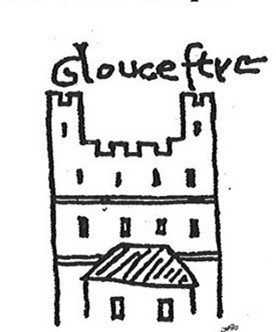
Initially the early Norman kings used the Kingsholm Great Hall as a royal residence but by 1086 a motte & bailey castle had been built in the SW corner of the Roman walls, roughly where the now-closed prison is situated. By 1100, the motte & bailey had been replaced by a large stone keep or donjon which, within a century, had been enlarged into a true castle with a bailey, curtain walls, towers & gatehouses. The Norman kings entrusted the castle and county to Roger de Pitres who was the Sheriff of Gloucester under William the Conqueror and constable of Gloucester Castle. His family, as hereditary castellans and sheriffs of the county, came to dominate Gloucester for the next 100 years and the castle that de Pitres had built became the new administrative centre for the shire, although Gloucester itself was technically governed by a reeve appointed by the Crown – styled as Sheriff (a shire reeve), although how much control he could actually yield is debateable.
The Gildehall
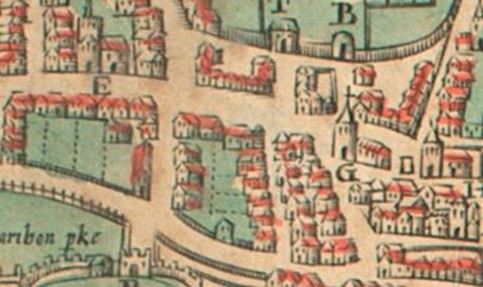
The reeve administered the town in a hundred court, as Gloucester was a separate hundred in the shire. This court met in the Gildehalle, a building used by merchants and tradesmen for business and located in Westgate Street between Upper Quay Lane and Berkeley Street. Gloucester’s true civil government began in 1155 when Henry II granted the town a charter giving it borough status – which gave it various privileges such as exemption from feudal dues, the right to hold a market and levy taxes, etc – in return for an annual rent to the Crown. A group of merchants and traders – who were all freemen and keen to gain more control over their affairs in the town – promptly became burgesses of the borough. Other charters followed, confirming these rights, and adding more privileges: In 1194 Richard I granted the borough to 'the burgesses of Gloucester of the merchants' guild’ and in 1200, King John granted the burgesses the right to elect 2 of their own reeves to govern, along with 4 stewards to oversee the reeves. From this time, the borough jealously guarded its privileges and rights to administer the town.
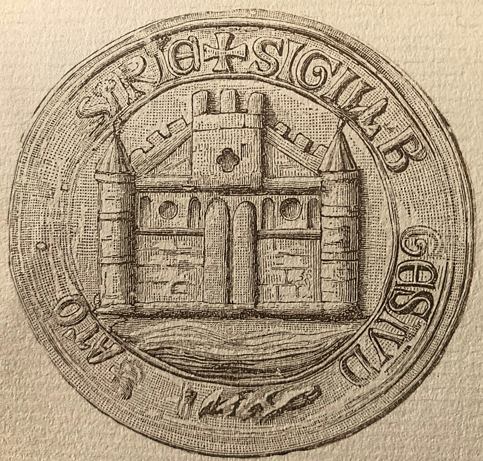
Seal of the burgesses of the Gloucester merchants guild
By 1240, a common seal of the borough was in use to validate official documents. This had the legend: 'sigillum burgensium de gilda mercatorum Gloucestrie’ – the 'seal of the burgesses of the Gloucester merchants' Guild’. By the late 1300s, this guild had expanded into a group of 12 burgesses; the 2 bailiffs, the 4 stewards, and 6 others who acted for the town and these were sworn in as 'burgesses' to the 'merchants' guild'.
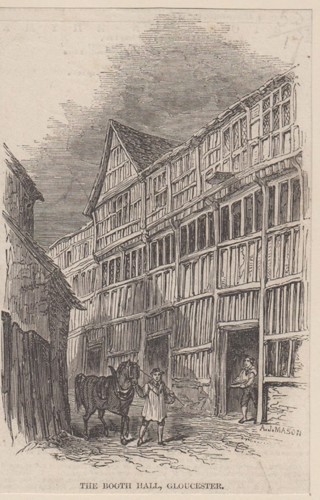
The Boothall
Described as 'the Boothall of the community of the town of Gloucester’ this was situated on or near the Gildehalle – it was possibly a separate building within the same block of buildings or, even the same building as the two names were used indiscriminately for well over a century. By 1349, the Boothall was being used for the sittings of the hundred court and was also acting as the borough’s civic offices. In addition to its administrative functions, the Gildehalle/Boothall were also used as market halls. One or both of these buildings also acted as the principal leather market by 1273 and by 1396 wool was also sold there, being weighed on the official weighing beams. By the 1300s, an inn was part of the buildings, possibly called ‘The Bear’, but later known as ‘The Boothall Inn’. Around 1532, the Boothall was rebuilt, after which the Borough granted it to private individuals on long leases, although it reserved the use of the main hall and great chamber respectively for the sittings of the hundred court, the city assizes and quarter sessions, and also for the election of the city officers at Michaelmas (and possibly also for the election of the M.P.s).
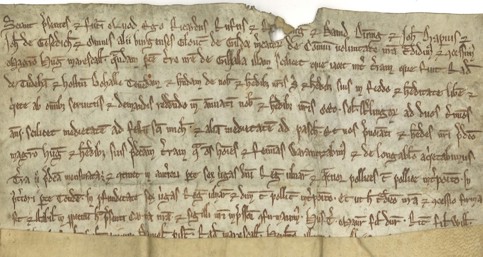
Gloucester City property – ‘City Lands, West Ward': Part of the land of the Guild Hall extending to Boothall door, c.1230’
The Boothall is first recorded in 1230, when it is mentioned in the above demise - a term used to describe a property rented to someone for a specific period of time or until the renter dies. This document was drawn up between the burgesses of Gloucester and Master Hugh the Farrier and relates to ‘land of the Gildehalle lying between the land that belonged to Ralph of Tudeham and the door of the Bothall’. It names five of the city’s then current burgesses; Richard the Red, Richard the burgess, David Dunning, John the Draper and John of Goseditch (these names start midway on line one).
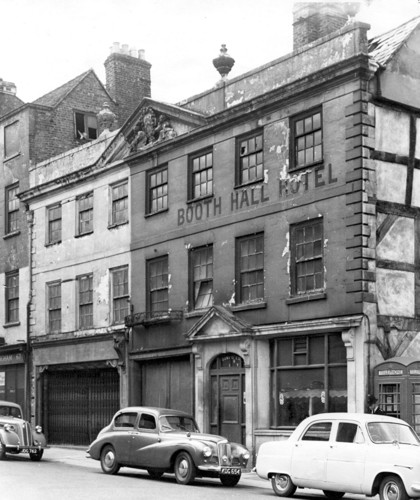
Booth Hall, Westgate Street, Gloucester
From the mid-1500s, the Booth Hall was also used by visiting companies of players and concerts and performances by travelling showmen were regular events until the early 1800s. In 1607 the building was enlarged and given separate courtrooms so that the city and county assize courts could sit at the same time. In 1742, the building was refaced in brick although soon afterwards the city courts and offices moved to the Tolsey due to concerns over space. In 1868, the entire site was sold by the borough being taken over by the Boothall Hotel, which used the space as a coach house and stables. Subsequently it was used as an entertainment venue, becoming the Alhambra Music Hall in 1869 and, from 1876, the Royal Albert Hall when it was often used as for circuses and even as a skating rink. From 1907 it was a cinema. It survived until 1957 when it was demolished and incorporated into the new Shire Hall. This photograph was taken just prior to demolition.
The Tolsey
The Tolsey was located on the south-west corner of the Cross. In this image it is the building on left. The name derives from the Middle English, tol- meaning ‘toll’ and -sey meaning ‘hall’ or ‘house’. Most towns had a ‘tolsey’ and they were used as town halls, tollbooths, law courts and merchants' meeting places and exchanges. In Gloucester the city stewards were using it for town business by 1455. It seems that both the Tolsey and the Boothall were used for council business at the same time – but we don’t know if there was any differentiation in what went on at each one. In 1507, the Tolsey was seemingly being used as a repository to store property deeds of the borough (the city’s first archives?) and by 1603 it was the venue for all council meetings. It was rebuilt several times, the most significant being in 1648 when All Saints' church (which adjoined its east side) was incorporated within it. The ground floor of the new build was used by the sheriffs' court, while the upper floor – which jettied out over a colonnade – was used for the council chamber.
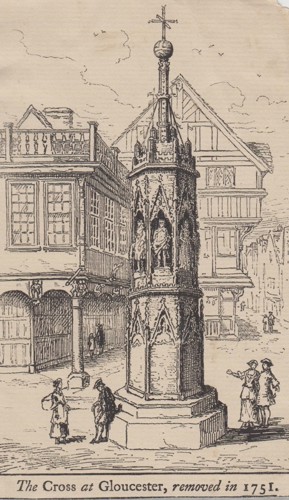
The Tolsey & City Post Office, 1800s
In 1751, the Tolsey was rebuilt as a classical building in brick with stone dressings and a large pediment with a carving of the city arms and insignia. From 1843 it was home to the city post office but within 40 years, the city council had outgrown the building – at this time the town clerk and other officers were working in the nearby corn exchange, and traffic noise from the streets was disturbing the councillors' meetings. In 1890 work began on a new building for the council and in 1893, the Tolsey was sold whereupon it was promptly demolished and new premises for the Wiltshire & Dorset Banking Co. were erected on the site.
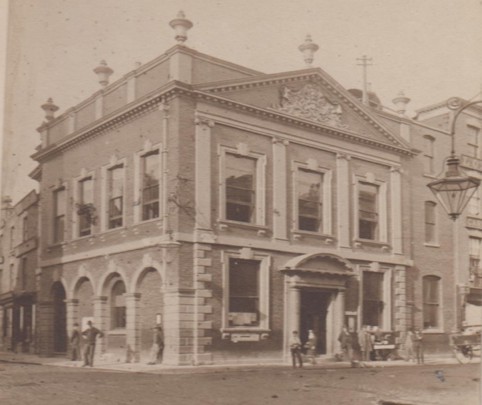
The new Guildhall
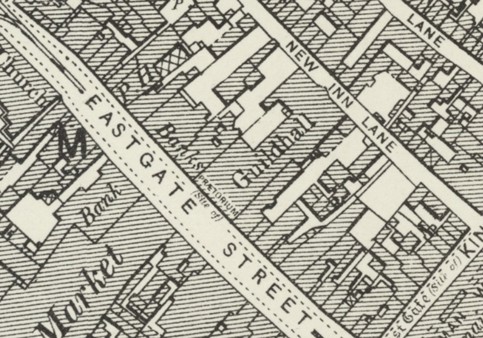
The new city hall, called the Guildhall, was opened in 1892, on the north side of Eastgate Street on the site formerly occupied by Sir Thomas Rich's school. It was designed by G. Hunt in a Renaissance style and extended back from Eastgate Street as far as New Inn Lane. It included offices for the town clerk, accountant, surveyor and other officials on the ground floor while the council chamber, committee rooms, mayor's parlour, and public hall were on the first floor. The city council headquarters remained at the Guildhall until 1985, when the ground floor was leased to the Cheltenham & Gloucester Building Society (C&G) and the council moved into the newly converted Herbert Warehouse at the docks. The upper floors remained in city council hands and were converted into a highly popular arts centre; the council chamber became a cinema with capacity to seat 100 people in 1991, while the main hall, which has a capacity to seat 400 people, is still available for public use.
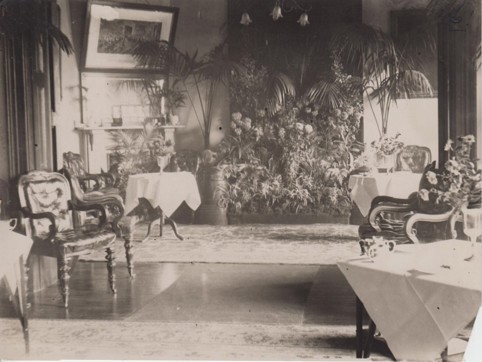
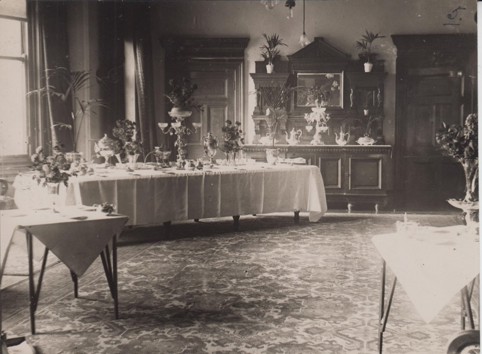
Guildhall interior, around 1924
These two photographs taken in 1924, show the plush interior of the main reception room in the Guildhall.
The Shire Hall
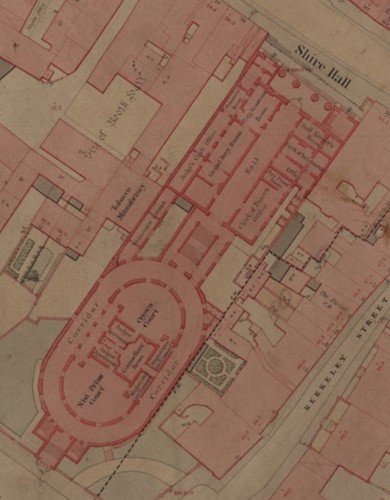
The Shire Hall was originally built in 1815 as a new court complex for the county Quarter Sessions and Assizes, but it became the County Hall following the formation of Gloucestershire County Council in 1889 (after the Local Government Act 1888). Designed by Robert Smirke (famous for designing the British Museum), the frontage consisted of a tall Ionic portico said to be inspired by the temple on the river Ilissus in Greece. The building included a grand jury room, two courtrooms, the office of the clerk of the peace and a large public room which was used for concerts in the Three Choirs festival.
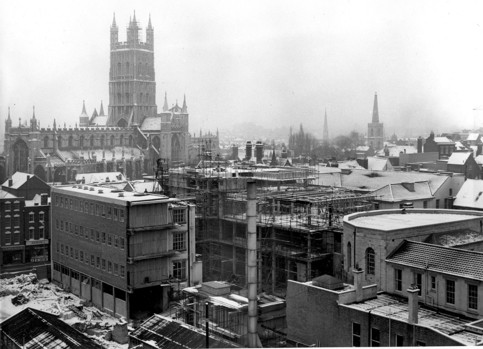
Shire Hall: photograph of the view across new blocks, 1962
Subsequently Shire Hall has undergone several alterations. In 1896, the front part was altered internally to create a county council chamber and new offices for the clerk of the peace, county treasurer, and county surveyor. In 1909, the east side was extended along Berkeley Street. In 1961-2, a major rebuild took place when the front of the building was rebuilt (except for the portico), and the entire complex enlarged by the addition of office blocks on the west and south sides, the latter extending over Bearland to connect to another new block – which also incorporated the county police headquarters. This image shows the latter rebuild looking north-east.
The King's Board
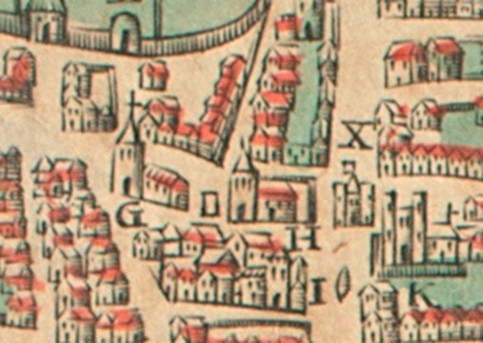
This was supposedly given to the town by Richard II and was originally sited in Westgate Street between Holy Trinity and St. Mary Grace churches. Its original use is uncertain but by the 1580s it was used as a butter market. Around 1693 its roof was altered to house a cistern for water pumped up from the Severn from Westgate. It was taken down under the improvement Act of 1750 and re-erected in the castle grounds, but in 1780 it was moved to Barton Street and then, in the 1850s to Tibberton. In 1937 it was returned and placed in the public gardens at Hillfield in London Road.
Scriven's Conduit
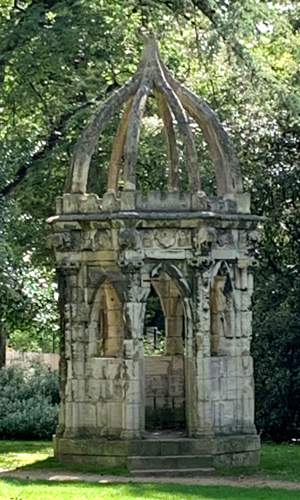
This structure was paid for by Alderman John Scriven and erected in Southgate Street in 1636, where it supplied clean water piped down from Robins Wood Hill. It is an open octagonal structure with a mix of Gothic and classical decoration with depictions of the resources of the Vale of Gloucester around the entablature. The top, which was rebuilt in 1715, is an ogee-open canopy, with carved with allegorical figures, one representing the River Severn. In 1784/5 it was moved to a garden in Dog Lane (now under King’s Walk precinct) and in 1830, went to Edgeworth Manor, the home of Edmund Hopkinson. It was returned to Gloucester in 1937 (at the same time as the King's Board) and placed in Hillfield gardens. Sadly, the stone is heavily weathered and little of the original stone carving remains in good condition.
Two views of the High Cross
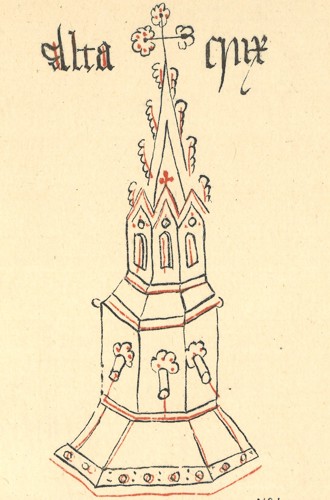
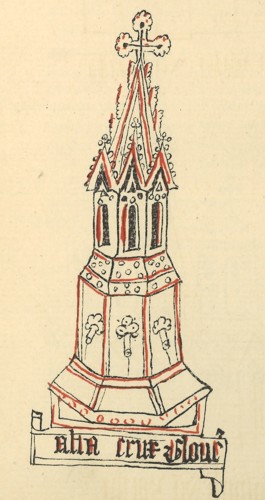
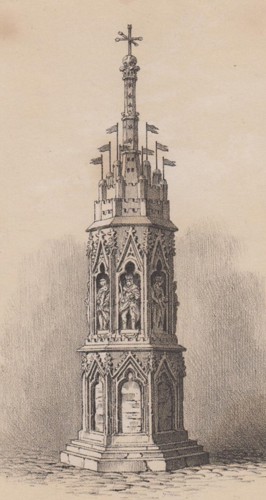
A cross stood at the main crossroads in the centre of Gloucester by the mid-13th century. By the mid-1400s it was known as the ‘high cross’ and was being used as a conduit for water piped from Robins Wood Hill. It was depicted as an octagonal structure over 10.3m/34ft high with a crocketed spire and had two storeys. A lower storey had blind crocketed arches (pierced by water pipes) while the upper storey had eight crocketed niches containing statues of sovereigns. The cross was rebuilt several times, the last being in 1712.
The High Cross, drawing published 1806
The statues in the niches were listed as King John, Henry III and Eleanor his queen, Edward III, Richard II, Richard III, Elizabeth I, and Charles I. The latter was removed from in 1650 or 1651 after soldiers had defaced it but had been replaced by a new one at the Restoration – no doubt in an attempt to curry favour with Charles II. These monarchs were probably based on the charters of liberties granted by those kings, and of Queen Eleanor by her lordship of the borough during her widowhood. The cross was demolished in 1751 as part of city’s measures taken for clearing obstructions from the streets.
The Pillory
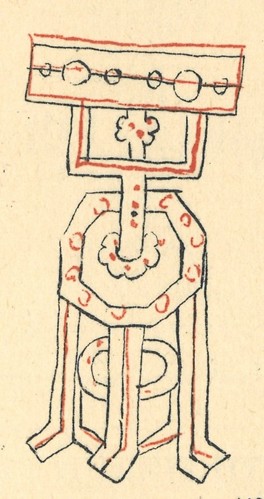
Imprisonment for crimes was rare in medieval times and most convicted criminals were punished by fines and/or seizure of goods & chattels, but there were exceptions, including the pillory. This consisted of a wooden post and frame fixed on a platform raised several feet from the ground. The head and hands of the offender(s) were held fast in holes in the frame, so they were exposed in front of it. The offender(s) would then be subjected to abuse and refuse thrown from the crowd.
The city also had stocks, which were similar but held offenders by the ankles. People were sent to the pillory by a ‘Court of piepowders’, a special court held by the borough on fairs or markets. This court had unlimited jurisdiction over personal actions for events taking place in the market, including disputes between merchants, theft, and acts of violence. Punishments typically included fines, the pillory, the stocks.
One other item of city property was a tumbrel, a two-wheeled cart that was used to carry offenders around the town to humiliate them. In Gloucester’s 'Red Book’ of official memoranda, there is an entry in 1504 concerning the reputation of the town, “which is too abominably spoken of in all England and Wales of the vicious living of divers persons, spiritual as well as temporal, with too excessive a number of common strumpets and bawds dwelling in every ward of the said town and which it is feared the Almighty will otherwise soon punish.” This ordered that ‘common queens' (prostitutes) and clients – both lay and clerical! – were to be placed in a 'hutch' [cage] in the market-place. Notorious 'queens’ were also to be carted around each ward in the tumbrel with 'frontlets of paper’ (a sign) and hoods over their heads.