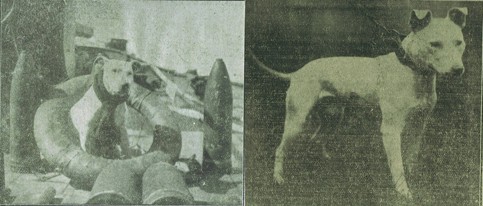
HMS Gloucester’s Bouncers
In 1911, the famous city fundraiser, Mr ‘Picturedrome’ Palmer organised a collection to buy HMS Gloucester a mascot and the result was a bull terrier named Bounce. Bounce took to life at sea easily, killing cats and poultry and fighting with dogs of other nations whenever the ship called into port – with Gloucester’s crew often having to pay fines to release him! After the Battle of Jutland, George V visited the battlecruiser fleet at Rosyth and witnessed Bounce attack a German bull terrier that had been rescued by another Royal Navy ship - the King offered a bet of 10:1 on Bounce. However, Bounce was showing his age, and was retired, going to a suitable home with one of the ship’s officers. When word of this reached Gloucester, Mr Palmer fundraised again and in January 1917 HMS Gloucester received Bounce II, who very quickly earned a reputation every bit as bad as his namesake. In 1921, when HMS Gloucester was decommissioned, Bounce II went to HMS Warspite but, in 1924, he died after falling into a dry dock in Malta, ending the tale of Gloucester’s maritime canine terrors!
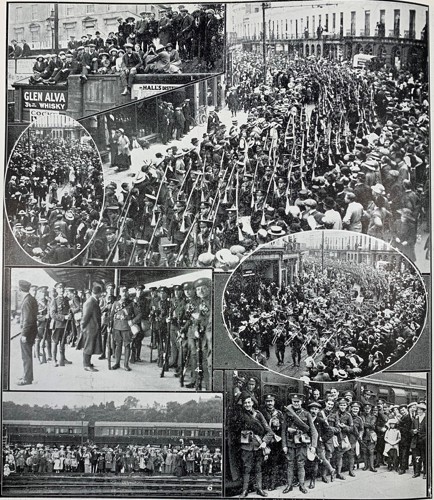
Call up of the Territorial Battalions at Cheltenham
When war was declared, although many people were shocked and fearful, it was largely greeted with popular acclaim and the public rallied around what they perceived to be a just cause. The first troops to be called up were the territorials and volunteer reserve units. This photomontage was taken on 5 August 1914 and shows E & F companies of the 5th Battalion Gloucestershire Regiment marching through Cheltenham to St. James’ Station where they boarded special military trains. Initially, most of the units that were called up didn’t go straight to France but to barracks in Chelmsford or Wiltshire, where the whole regiment could be assembled and training undertaken before leaving for France and Belgium.
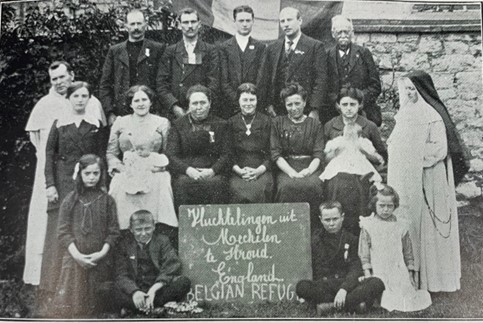
Belgian refugees
Apart from the calling up of the Territorials, one of the first signs of the war were the arrival of Belgian refugees, who’d fled their country after the German army had invaded. These refugees were from Mechelen – which is known as Malines in France and English, is a Dutch-speaking city in the province of Antwerp, Belgium. They arrived in Stroud – thanks to arrangements made by the Catholic Church of the Immaculate Conception and the Convent of Poor Clares at Woodchester (which had a sister convent at Princehof near Bruges) – this photograph shows the Rev. Father Fitzgerald of the church and the Sister Superior of the convent with the group. When children accompanied the adults, they were given places in local schools and several of the county’s schools have admission registers with such entries in them.
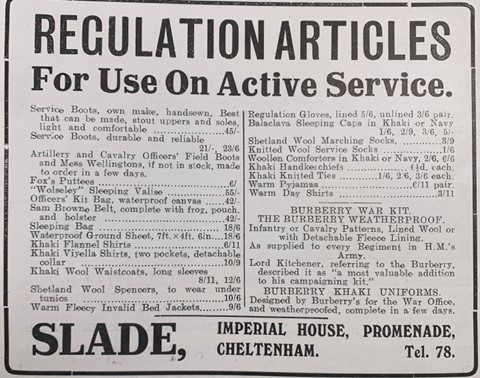
Advert for Slade outfitters, Imperial House, The Promenade, Cheltenham
Commercial shops and suppliers were not slow to see the potential to be made from selling their goods to new servicemen going overseas.
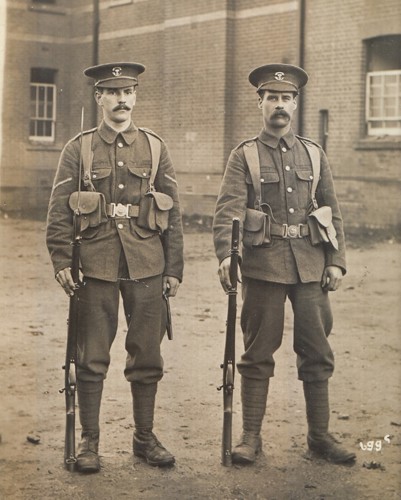
Lance-Corporal R. Humphries, North Camp, Aldershot, November 1914
After joining up, many soldiers got a portrait of their selves in their uniform for family and friends. Many of the parishioners of St. Pauls parish in Gloucester sent photographs of themselves to the vicar, the Rev H E Hadow, who placed them all into an album. This picture postcard was sent to the vicar by Lance-Corporal R. Humphries, who’d joined the Somerset Light Infantry. He wrote the following note on the reverse:
'To Rev H.E Hadow, St Pauls Vicarage, Gloucester, 9 November 1914. 10511, D6, Block H, Somerset LI, North Camp, Aldershot, [...] Evening.
Dear Vicar
This is just a rough photo of me in equipment which has "crumpled" my coat a little, but it shows the rifle-bayonet. I do not know when we move yet. We are getting on with the fireing now. I must not stop now or I shall be late for 6th. Dear mother is here paying me a visit just now. With our kind regards to Mrs Hadow & yourself very sincerely yours
Rupert L Humphries
Ora pro nobis [pray for us]
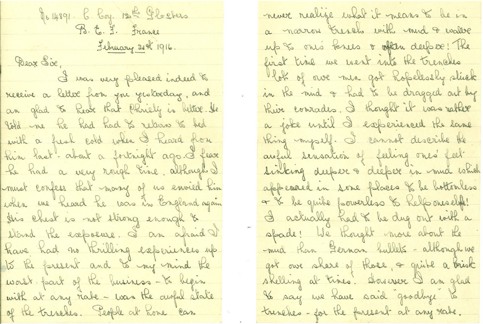
Letter to Rev. W. W. Blathwayt from Pvt. James Hedges, 12th Glosters February 1916
Conditions in the front-line trenches were squalid – scraps of discarded food, empty tins and other waste, a latrine (a deep pit covered by wooden planks), plus rats, lice and flies (which thrived on the remains of decomposing human and animal corpses in No-Man’s Land). Mud was a feature of life in the trenches – especially in winter – and this letter sent to the Rev. W. W. Blathwayt in February 1916 by his parishioner Pvt. James Hedges of the 12th Glosters pulls no punches. He writes of ‘the awful state of the trenches’ and that ‘people at home can never realise what it means to be in a narrow trench with mud and water up to your knees and often deeper!’ James also wrote about the ‘awful sensation of feeling one’s feet sinking deeper and deeper in mud’, and how on one occasion he had to be ’dug out with a spade!’ after being trapped in mud. Men wrote letters (usually in pencil) in spare moments, sometimes from front line trenches or while at rest behind the lines and they offer a powerful and highly personal insight into the experience of war.
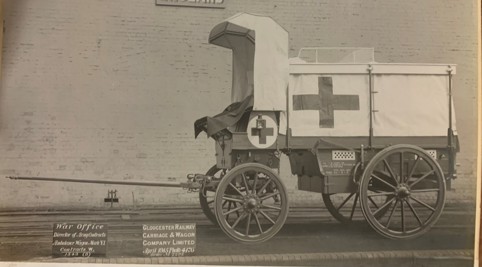
Gloucester Railway Carriage & Wagon Company War Office Ambulance Wagon, Mk VI, 1915
The Royal Army Medical Corps (RAMC) were responsible for soldiers' health and medical aid. Treatment for wounded soldiers began at a Regimental Aid Post about 200 yards behind the front line where they received immediate first aid to casualties – but getting them there was often difficult and dangerous as it had to be done on foot. They were then evacuated to Advanced Dressing Stations (ADS) , where minor wounds were treated so that men could return to their units or sent to a Field Ambulance (FA) Station. At the FA stations the wounded would be placed onto horse-drawn ambulances and taken onwards to Casualty Clearing Stations, which were fully equipped (usually) tented hospitals situated several miles behind the front line. The Gloucester Railway Carriage & Wagon Company Ltd (GRCWC), built many ambulances for the War Office, with the design being based on ambulance wagons built by the company for the Boer War. This photograph shows a Mk VI wagon with is sides raised to provide the wounded with some shelter.
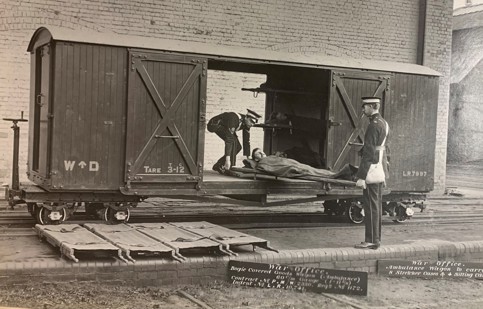
Gloucester Railway Carriage & Wagon Company War Office Bogie Covered Goods Wagon (Ambulance), 1918
One aspect of the static Western Front was that all the combatants were able to build narrow-gauge railways that linked their standard gauge railway networks (which were safely beyond the range of enemy artillery) to the frontline trenches. These narrow-gauge railways used steam locomotives and petrol railway tractors and had two main functions. Firstly, they were used in a logistical role supplying the men at the front with all the requirements for fighting (ammunition, timber, water and food). Secondly – and especially in large offensives – they were used to evacuate seriously wounded soldiers straight to the Casualty Clearing Stations and, they could carry far more wounded, far faster than individual horse-drawn or motor ambulances. The GRCWC built numerous narrow-gauge ambulance wagons for the army. This 1918 model is a bogie wagon (which allowed the wheel sets to rotate to cope with tighter curves on the narrow track) with a gauge of 60cm (1 ft 115⁄8 inches) that was equipped for 8 stretcher cases and 4 sitting casualties.
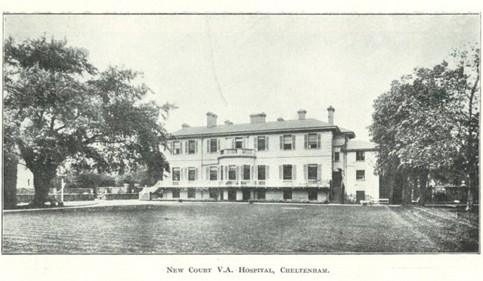
New Court VA Hospital, Cheltenham
As the war progressed it was realised that there was a need for more hospitals to care for the ever-increasing numbers of wounded soldiers arriving in the UK from the Western Front. At the start of the Great War, the British Red Cross joined forces with the Order of St John Ambulance to form the Joint War Organisation (JWO). They pooled resources and formed Voluntary Aid Detachments (or VADs) with members trained in First Aid, Nursing, Cookery, Hygiene and Sanitation. These detachments all worked under the protection of the Red Cross, working in hospitals, rest stations, work parties and supply centres. As well as the VAD’s the JWO also set up numerous Voluntary Aid (VA) hospitals across the UK and 24 were created in Gloucestershire. Many were based in large residential houses loaned to the Red Cross by their owners, while others used public buildings and even Cheltenham racecourse! New Court house in Cheltenham was offered to the War Office soon after the declaration of war by its owner, the late Mr J. Fleming, and as a result it opened as a hospital of 55 beds on October 21 1914, the first of the Red Cross Hospitals opened in Cheltenham. At its peak, it had 102 beds (25 of these were at Cleeve Convalescent Home) and during the war it treated 1,697 patients with just 8 deaths. It closed on 18 December 1918. During the course of the war, Gloucestershire VA’s treated 38,649 patients during the war, of which just 372 died. The busiest VA was Gloucester, which treated over 4800 service personnel.
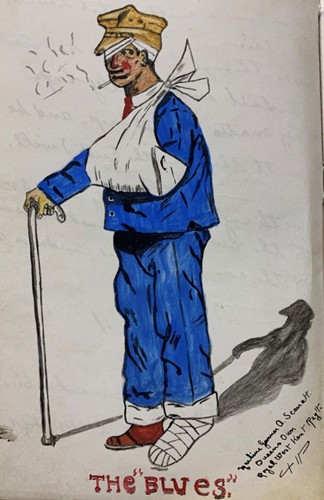
Self-portrait of A Scarrott, Queens Own Royal West Kent Regiment, Leckhampton VA.
This self-portrait of Machine Gunner A Scarrott, of the Queens Own Royal West Kent Regiment, was drawn in an autograph book of E Gladys Duckworth, a cook at Leckhampton Court VA hospital. It includes photographs, jokes and messages from wartime soldiers who were convalescing at the hospital – many of whom were from the 'Spud Brigade', a group of soldiers who peeled potatoes for the meals at the Hospital. It also includes several hand-drawn pictures of soldiers and animals.
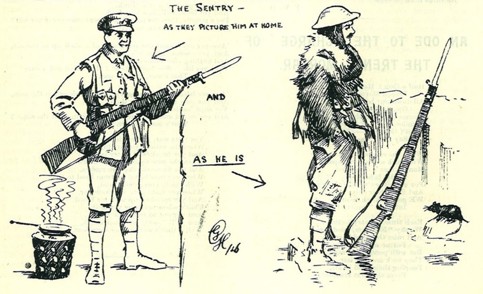
Cartoon from 5th Gloster Gazette, 1916
At the front, soldiers received little news from ‘Blighty’ unless their officers passed it on, or they received it in letters from friends and family. When ‘at rest’ they might get to see weekly newsreels in the cinema. Newspapers were only available if they had been posted from home, so were weeks old at best and but most soldiers distrusted them because of the prominent jingoism. To maintain morale and pass on information, some units began to write and print their own newspapers, which were known collectively as ‘Trench newspapers’. The most famous was ‘The Wipers Times’, but the very first one was ‘The 5th Gloucester Gazette’ which was published by the 5th Battalion of the Gloucestershire Regiment in April 1915. The gazette contained a mix of poems, reflections, wry in-jokes and lampoons of the military situation, plus war news (mostly international), gossip, rats, drawings and inter-regimental sports. Contributions came from the men, but it was mostly compiled and written by local Forest of Dean poet and solicitor, F W Harvey, until he was captured in August 1916.
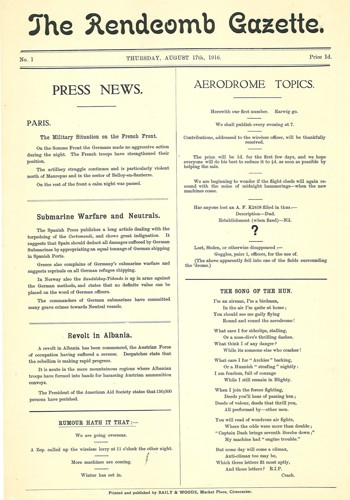
The Rendcomb Gazette, No.1, 17 August 1916
Such publications were not restricted to the trenches, as numerous newspapers were produced by other military units including the Royal Navy and Royal Flying Corps. This example is the ‘Rendcomb Gazette’, which was produced at the RFC airbase at Rendcomb. Only 15 editions – numbers 1 to 16 (number 13 hasn’t survived or wasn’t printed) – are known to exist, all of which are part of the Bingham Collection. As might be expected, it was a little more ‘high-brow’ than the 5th Gloster Gazette, but covered more or less the same topics.
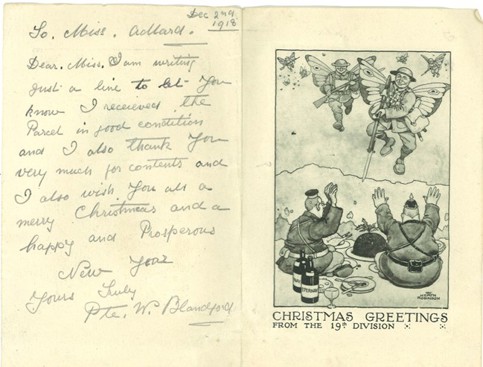
Thank you card to Miss E Adlard from Private W Blandford, December 1918
In the run-up to Christmas 1914, families sent foodstuffs to their men abroad and many well-wishers formed groups to send parcels and presents to local troops serving overseas. One such person was Eleanor Adlard of Winchcombe, who was a member of the Gloucestershire Red Cross Society. Each war year, she rallied local townsfolk folk to purchase gifts such as tobacco, soap, cakes and Christmas puddings. In addition, she also organised a team of around 70 local knitters to make socks and scarves for the troops. The above card was sent to Miss Adlard at Christmas 1918 by Pvte W Blandford as a ‘thank you’ after he received a parcel from her.
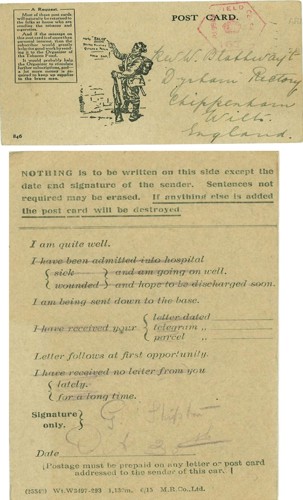
Field Service Postcard from G Shipton to Rev W Blathwayt
Any letters that soldiers wrote to send home were censored, which was very time consuming and following a major battle or offensive it was clear that a faster system of communication was required. The Field Service Postcard (Army Form A.2042) was a simple piece of card with space for an address on one side and pro-forma phrases for the soldier to strike through to let his family know he was safe. These cards were free to send and therefore were very popular especially as they could be delivered to the recipient in the UK within twelve hours of being posted. They gave much needed piece of mind to families back in Great Britain, especially after news of large offensives had taken place, as they would know that a soldier was alive or sick or wounded or – optimistically – that they would be ‘discharged soon’!
Turkish Officer with Royal Gloucestershire Hussars Prisoner of War.
The main group of Gloucestershire soldiers serving abroad away from the Western Front were the Royal Gloucestershire Hussars. In August 1915 the unit (without its horses) went from Egypt to the Dardanelles where they fought as infantry until the Allied withdrawal. Back in Egypt they were became part of the British forces guarding the Suez Canal. The regiment fought several engagements – including the disastrous Battle of Katia and the victory at the Battle of Rumani in August 1916. The latter action ended the Turkish threat to the Suez and the RGH then took part in the British advance through Sinai and Palestine – at the end of the war the Gloucestershire unit had reached Aleppo in Syria. The Battle of Katia had witnessed the 108-strong ‘A’ Squadron of the RGH overwhelmed in a surprise attack by a force of over 600 Turks – and although it put up a gallant defence, 4 officers and 16 other ranks were killed, 15 other ranks wounded and 64 were taken prisoner. Only nine of those surviving escaped capture. This image was taken at a later date by the Turkish captors and shows Staff Sergeant-Major G. Hyatt (we don'
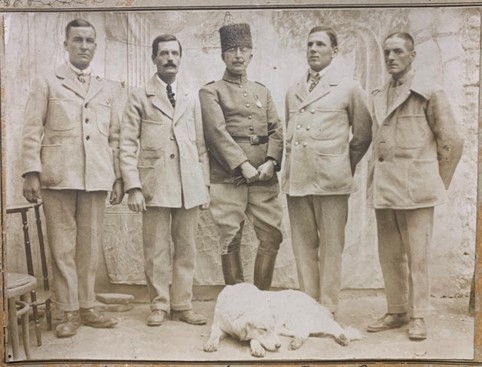
t know which man he was) and other PoWs with Turkish officer (and Labrador dog).
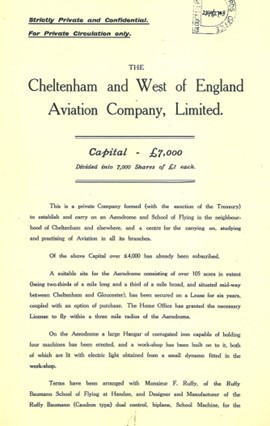
Prospectus of the Cheltenham & West of England Aviation Co. Ltd
At the outbreak of war, Britain possessed just over a hundred military aircraft and the Royal Flying Corps (RFC) – the air arm of the British Army – consisted of only seven squadrons equipped with a miscellany of aircraft types, none of them armed. As the air arm expanded, as well as non-flying units in Cheltenham, Yate and Tetbury, new airfields were established in Gloucestershire at Rendcomb (opened in 1916 with No.48 Sqn flying Royal Aircraft Factory B.E.12s, then Bristol F.2a ‘Brisfit’ fighters), Minchinhampton (opened in February 1918 as No.1 Station Australian Flying Corps with Nos 5 & 6 Training Sqns AFC – became RAF Aston Down in WW2) and Leighterton (opened in February 1918 as No.2 Station AFC, with Nos 7 & 8 Training Sqns AFC). By 1916, the life expectancy of a new pilot on the Western Front could be as little as 10-15 days or 17½ hours flying time. With such a high rate of attrition rate, the RFC training organisation couldn’t keep up with demand and so private firms began to appear to train pilots. One such firm was the Cheltenham & West of England Aviation Co. which opened in September 1916 at a site at Hunt Court Farm at Brockworth, where it built an iron hanger, workshop and a grass strip. It had four Caudron dual-control biplanes and a Petrol Control Board licence to use 3,000 gallons a month. The school took 18 cadet pilots at a time and received £100 per pupil plus a £25 bonus if the pilots passed their Royal Aero Club Certificate. Post-war it was used by Westgate Motor House of Gloucester, who sold aircraft as well as cars.
Military Service Tribunal Application for Herbert Britton, farmer, 28 December 1915
As the war progressed recruitment into the army fell and by late September 1915, not only were fewer men joining up but almost two out of every five of these were found to be unsuitable for military service on health grounds – many suffering from malnutrition. In March 1916 the Military Service Bill was passed introducing compulsory conscription for the first time in Britain's history. The Act also introduced the right to refuse military service, allowing men to be exempted from combat with the option of performing civilian service or non-combatant roles in the army. Applications for exemptions were decided locally by Military Service Tribunals, which were run by Borough and District Councils. Each tribunal comprised four local men of good standing (often councillors) and a Military Representative. If an applicant disagreed with the decision of the local tribunal, they could appeal to the County Appeal Tribunal. This document records an application made by Mark Britton, a farmer, on behalf of Herbert Britton, his employee. The farm milked cows to make butter and also fished in the estuary and the tribunal granted Herber
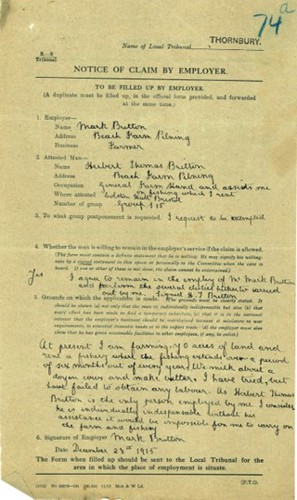
t an absolute exemption.
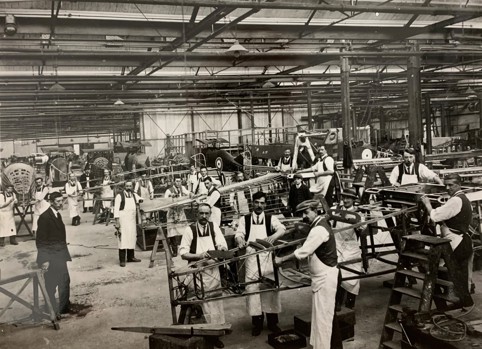
H. H. Martyn & Co. workers in the Plane Shop, Sunningend Works, Cheltenham
Founded in 1888, H. H. Martyn & Co. were stone, marble and wood carvers making gravestones, memorials and church decoration from their Sunningend Works in Cheltenham. By 1900, their work included decorative plaster work, joinery, cabinet making, wrought iron work and metal casting. Their war work began with wooden ammunition boxes, but they soon received a trial contract from the Aircraft Manufacturing Company (AIRCO) for spares for Maurice Farman Longhorn and Short aircraft. Such was the quality of their work that more orders quickly followed and by 1915 they were building wings and fuselages for Maurice Farman’s, D.H.4s, D.H.5s, D.H.6s, D.H.9s and later, Short Admiralty Type 184 seaplanes and Bristol F.2 ‘Brisfit’ fighters. From 1916, with demand increasing, they began manufacturing aircraft at Cheltenham’s Winter Gardens and subcontracting some manufacture out to the Gloucestershire Railway Carriage & Wagon Co. Ltd. Later in the war, Martyn’s AIRCO’s boards formed a new company just to manufacture aircraft, the Gloucestershire Aircraft Company, which later became the Gloster Aircraft Company.
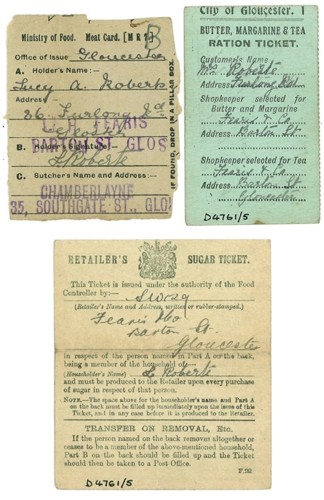
Ration cards for Meat, Butter Margarine & Tea, and Sugar
When the Germans began unrestricted submarine warfare in January 1917, shipping losses suddenly escalated – in March, over a quarter of ships heading for Britain were sunk by U-boats and by April the country had just six weeks’ worth of wheat. Shop prices soared and queues for food became common and there started to be growing resentment of the rich upper classes (who could afford the rising prices). In June 1917 the Navy finally adopted the convoy system and though shipping losses began to immediately fall, they were still high and food stocks remained critical. Faced with rising civil unrest and no prospect of extra food coming into the country, the government decided to introduce rationing. It was introduced in stages and everyone received a ration card. By war’s end, meat, butter, lard, cheese, jam and sugar were all rationed, as was coal.
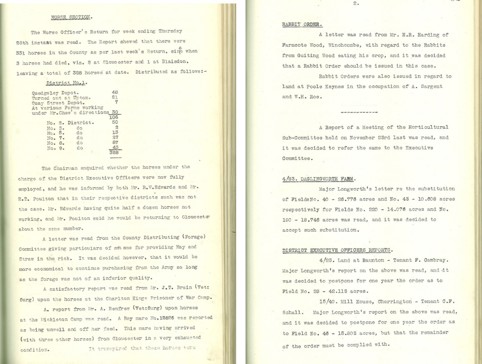
Extract from Cultivation Committee of Gloucestershire War Agricultural Executive Committee, 29 November 1918
Established in Autumn 1915, the War Agricultural Executive Committees (or War Ags) were government-backed organisations tasked with increasing agricultural production to try and increase the nation’s food supply. They were set up by County Councils and comprised council members, farmers and representatives of agricultural groups. They looked at all aspects of food production and how to increase it, as well as reporting on shortages of feed, fertiliser, the use of horses and machinery, pest control and other supplies, and how the labour supply might be organised. These pages from a committee meeting give a flavour of their work. The left-hand page is from the Horse Section and lists the number of animals available and where they were stabled. There were a n umber of vets checking on the animals – which were all numbered – and any potential issues were quickly addressed. The right hang page shows details about a request for some pest ‘rabbit’ control and also reports from farms where land had ordered to be ploughed up, regarding substituting certain fields.
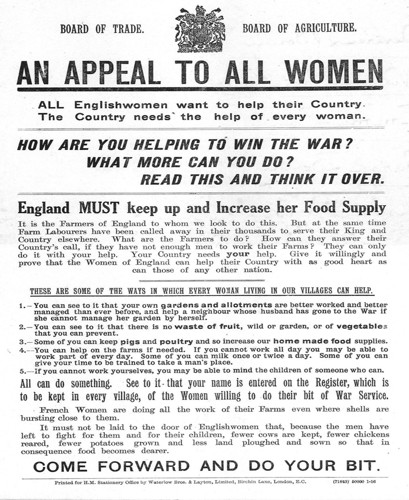
An Appeal to All Women poster, 1916
Farm labour was one of the great problems which held back increased production. In addition to losing farm workers who had joined up to serve the colours, many others had left farm work to go obtain employment in munitions factories (which offered better wages and better hours). As a result, women were called upon to come forward and do war work, especially in agriculture. Several organisations were set up to persuade women to undertake agricultural work, but none were very successful until January 1917 when the ‘Women’s Land Army’ was established. By the end of 1917 there were 20,000 women in the ‘Land Army’ itself and over 250,000 women working as farm labourers.
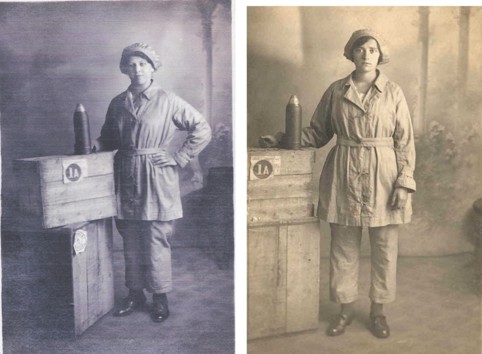
Munition workers Edith Powell and Nelly Slatter
As the war progressed, munitions factories were needed to supply the war effort. National Filling Factory No.5 was built at Quedgeley and started production in March 1916. At its height, it had 6,364 workers, mainly women, of which 1000 came from Cheltenham every day on the train. Female workers were known as ‘Tommy’s sisters’ or ‘Munitionettes’, but those whose skin turned yellow from working with TNT dust were nicknamed ‘Canary girls’. One result of the upsurge in female workers was that it was decided that female police officers were required to manage any issues with them, and this marked the beginning of female police officers in local constabularies. At war’s end, NFF No.5 Quedgeley produced over 10 million 18-pdr shells and over 8 million TNT bags.
Entry in logbook of Archdeacon School, Gloucester January 1916
Apart from male teachers leaving, school life was largely unaffected by the war, and surprisingly it was
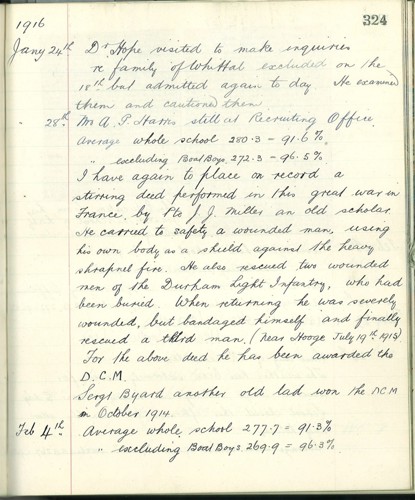
rarely mentioned in school logbooks. One thing that does occur is where staff received news of the deaths of teachers or relatives or where soldiers on leave called into their old schools. Sometimes however head teachers recorded notes about acts of valour performed by ex-pupils or teachers that reached them. The head of Archdeacon School in Gloucester recorded this incident where an ex-pupil, J. Miller, rescued three wounded men at Hooges in the Ypres Salient in July 1916, despite being severely wounded himself
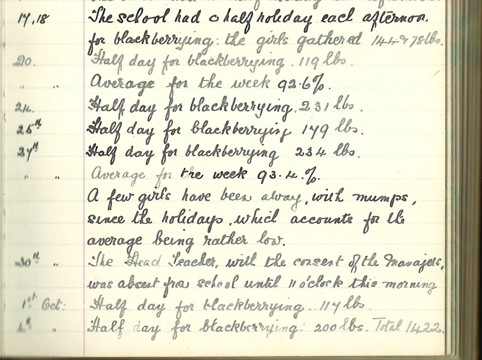
Logbook recording blackberry picking at Watermoor School, Cirencester, 1918
In 1917, a government committee, the Food Production Department, was set up to look at the ways of using any available natural resources in the land. One abortive scheme involved collecting conkers (in the belief that they could be made into explosives by a simple chemical process….the process didn’t work). However, a better idea was that rural schools in six selected counties were invited to ‘employ their children in gathering blackberries during school hours’ for a government jam making scheme. The fruit was packed into specially provided baskets of a regulation size and sent immediately by train to special factories where it was made into blackberry jam for soldiers. Schools were paid for the children’s efforts at a rate of £2 a pound with cheques being sent to the teachers who were authorised to pay a proportion to the pupils! In Gloucestershire, the county council’s education committee reported that in 1917, 223 schools had taken up the scheme and they had collected just under 82 tons of blackberries and had earned £1,270. In 1918, the scheme expanded, and in Gloucestershire 312 schools and they collected over 313 tons. The price per pound rate was better too, at £3 a lb, and the county received a total of £10,040 of which the children received £8,770 and the teachers £1,460 for supervising them. This page from Cirencester’s Watermoor School records school children being sent out blackberry picking seven times and collected a grand total of 1,422lbs of blackberries!
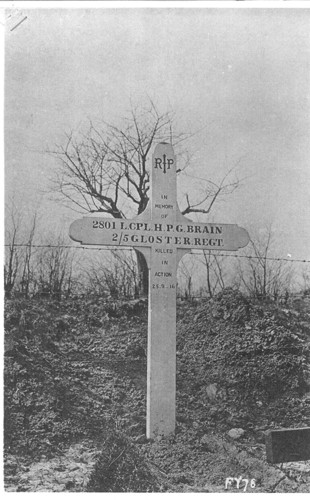
Temporary Grave of L.Cpl Harold Brain, 2/5 Gloster Regiment, 1916
Over the course of the war, 880,000 members of British armed forces died, which equated to approximately 6% of the adult male population and 12.5% of those serving. On the Western Front, most soldiers received temporary graves before being moved into military cemeteries, but many men were never found. This is the temporary grave of Lance-Corporal Harold Brain, 2nd Battalion of the 5th Gloucestershire Regiment. He was killed in the trenches at Le Sars on 25 September 1916, one of five soldiers who died on that day during operations as part of the Battle of the Somme. He was subsequently reburied in a permanent grave at Adanac Military Cemetery at Miraumont, north-east of Amiens.