
Register of baptisms, marriages and burials for the parish of Coberley, 1695-1778
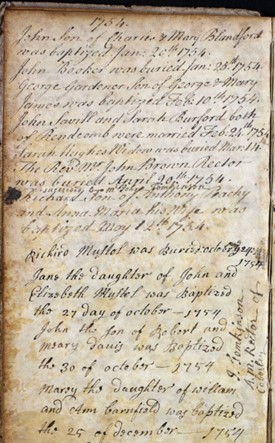
P105/IN/1/6
Parish registers were formally introduced in England & Wales on 5 September 1538 as part of the Protestant Reformation and shortly after Henry VIII’s formal split with Rome. Henceforth, parish priests were required to keep registers of all persons baptised, married and buried in their parish. Early registers usually contain only basic details and pre-1754 registers typically contain baptisms, marriages and burials in one volume – as here in the Down Hatherley register – but they can be on separate pages, reversed or upside down or mixed throughout the whole book!
Thornbury parish register for 1768-1812
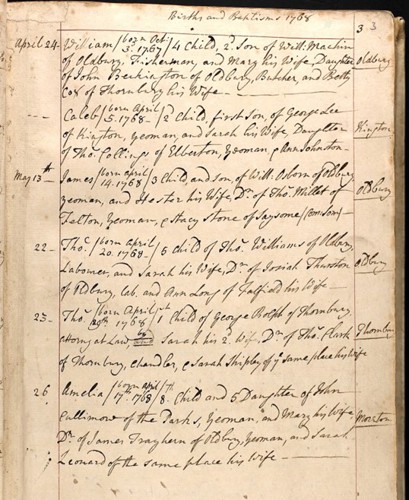
Parish registers rarely give the birth dates just the date of the baptism of the child. But there are exceptions – this is a page from the Thornbury register for 1768-1812 and here the vicar has gone overboard and given lots of biographical notes. Has well as the basic details of child’s name, baptism date and the name of the father and mother, the father’s occupation, he has recorded the number of the child in the family, the child’s birth date, the mother’s mother and father plus the mother’s father’s occupation.
Bastardy Bond for the child of Makepeace Brown, Minchinhampton, 1771
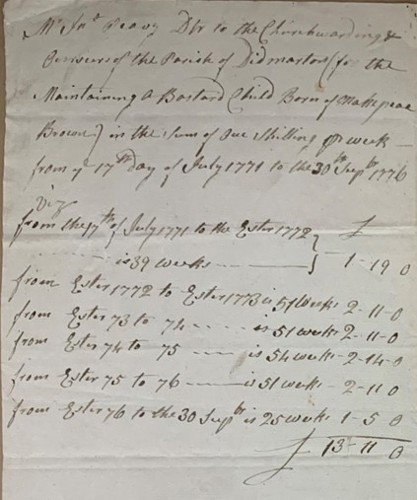
P114/OV/5/1
Perhaps surprisingly, illegitimacy was never common, and the number of illegitimate births was typically under 3% before the 1600s. It slowly increased to around 7% by the 1840s (when about a third of women were pregnant at marriage), before dropping back to 4% in the 1890s, then back to around 2%. Baptisms of illegitimate children were usually recorded as ‘Base child’, ‘Base born’ (often abbreviated to ‘B.B.’ ), ‘Natural child of…’ or simply ‘Bastard child of….’. If the mother was unable to support herself (or if her parents refused to) she would become chargeable to the parish overseer of the poor or, after 1835, the Poor Law Unions. If identified, the father (or his parents) would be served with a Bastardy Bond to pay for the mother’s lying-in and subsequent maintenance of the child, indemnifying the parish against any future costs. After 1835, the Boards of Guardians would also pursue errant fathers. This 1771 bond relates to John Pavey of Minchinhampton, for the child of Makepeace Brown of Didmarton. The bond was for a shilling a week for 5 years – a total of £13 11s, which is around £1,200 today.
Register of baptisms, marriages and burials for the parish of Down Hatherley, 1563-1698
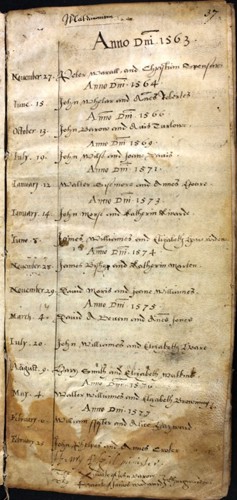
P167/IN/1/1
Marriage registers give different information depending on the date. Before 1754 they typically, record just the name of bride and groom and date of the marriage. Some vicars however recorded the name of the parish they were from if it was different to the place of marriage.
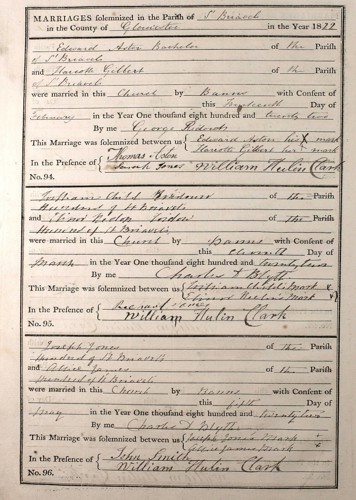
Register of marriages for the parish of St Briavels, 1813-1834
P278/IN/1/10
Between 1754-1837, pro-forma registers – such as this example from St. Briavels in the Forest of Dean – gives the following information: Name and parish of abode of bride and groom, Date of the marriage, Whether married by banns or licence, Name of minister, Signature or mark of bride and groom plus the names and signatures (or their mark) of the witnesses.
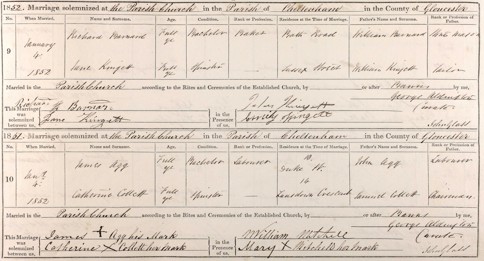
Register of marriages for the parish of St Mary, Cheltenham (volume "7"), 1851-1854
P78/1/IN/1/37
From 1837 onwards the marriage registers record the following: Date and place of marriage, the Names of the groom and bride, their ages (usually recorded as ‘full’, meaning of a legal age to marry), their marital status (bachelor or spinster or widow), their occupations and the residence of groom and the bride at the time of the marriage plus the occupations of their fathers, whether the couple were married by banns or licence and the name of the officiating minister, plus the Names and signatures of bride and groom and the witnesses.
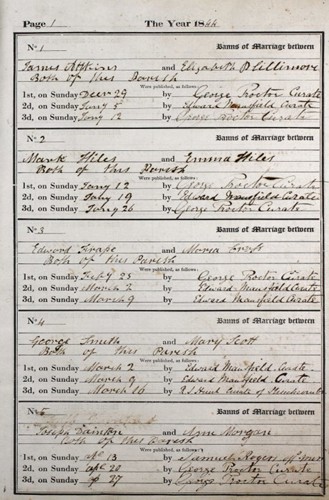
Register of banns for the parish of Dursley, 1844-1925
P124/IN/1/15
After Lord Hardwicke’s Marriage Act of 1753, marriages were formalised and had to occur in a church. Couples also had to have either: Banns of marriage published or a Licence from the Diocese. If neither of these were applied for or obtained, then the marriage would be void. This example, from the parish of Dursley for 1844, is typical banns register. It gives the name of the bridge and groom, their abodes and the dates of the Sundays when the banns were read.
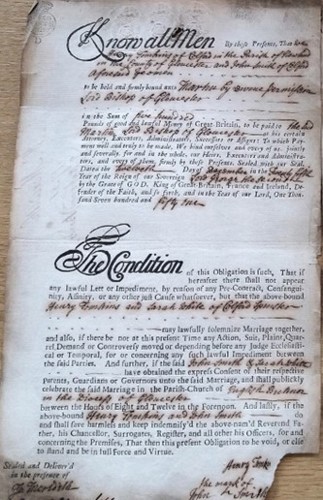
Marriage licence allegation for Henry Tomkins, of Newland, yeoman, and Sarah White of Coleford, spinster, 12 December 1751
GDR/Q1/1751/entry number 245
There were two types of marriage licence, those that were sworn in front of the bishop of the diocese, or those sworn before one of his surrogates. The former usually took place in Gloucester cathedral, while the others took place in the parishes around the county. To get a licence (or allegation), the couple had to allege before the bishop or his surrogate, that there was no lawful barrier to the marriage. Marriage licences could be obtained the day before a wedding, so were popular for quick marriages. Although anyone could apply for a licence, as a fee was charged, they were more common with the upper and middle classes, especially as a bond would be created so that if the couple failed to marry, a fine would be payable. The example here is a marriage licence bond for Henry Tompkins and Sarah White John that was sworn before the Bishop. The conditions imposed were that Henry and John Smith (Sarah’s father) were bound to the sum of £500 that Henry and Sarah would marry at the parish church of English Bicknor between 8am and 12 noon – probably on the following day, although this isn’t specified. It only gives the name and abode of the bride and groom.
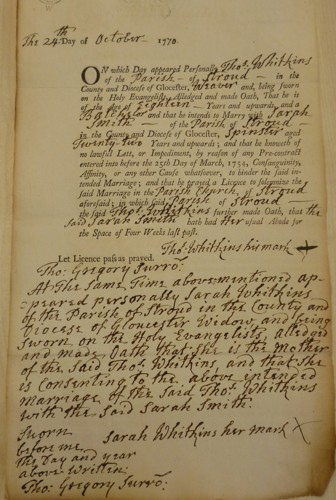
Marriage licence allegation for Thomas Whitkins, of Stroud, weaver, and Sarah Smith of Stroud, spinster, 24 October 1770
GDR/Q1/1770/entry number 187
This marriage licence is for Thomas Whitkins and of Stroud, weaver, and Sarah Smith of Stroud, spinster and was sworn before the bishop’s surrogate, Thomas Gregory. It was required because Thomas was just 18 and therefore underage. The paragraph at the bottom was a statement made by Thomas’ mother, Sarah Whitkins, that she consented to the proposed marriage.
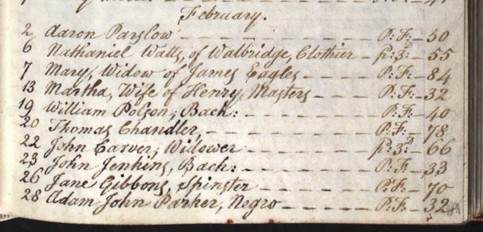
Register of baptisms and burials for the parish of St Lawrence, Stroud, 1774-1802
P320 IN 1/6
The burials in the registers usually provide just basic information. Early registers usually give the name and the date of burial – but as noted in the first slide, the pre-1754 registers typically contain baptisms, marriages and burials in one volume on separate pages, reversed or upside down or mixed throughout the whole book! Sometimes other information is given – such as spouse, abode, age, condition or occupation. Post-1813 pro-forma registers give name, abode, date of burial, age of the deceased and the officiating minister. In the latter volumes, extra information is sometimes given in the margins.
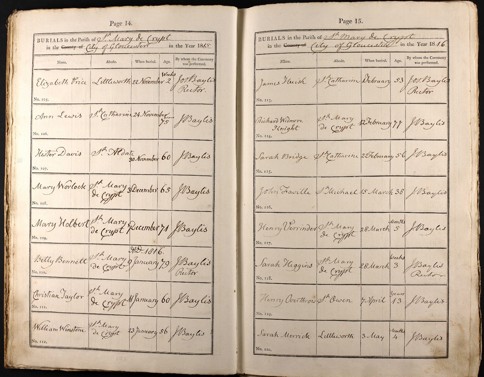
Register of burials for the parish of St Mary de Crypt, Gloucester, 1813-1849
P154/11/IN/1/13
Post-1813 pro-forma burial registers give name, abode, date of burial, age of the deceased and the officiating minister. In these volumes, extra information is sometimes given in the margins.
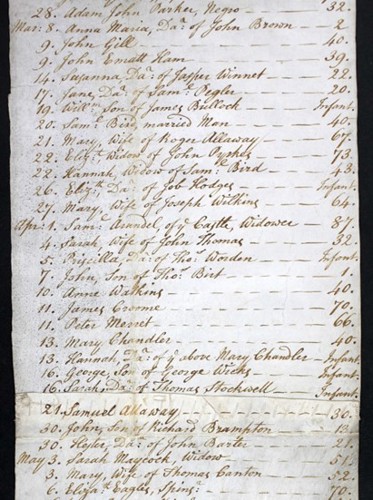
Stroud Bishop's Transcripts, 1578-1812
GDR/V1/235
The Bishop’s Transcripts are copies of the entries in a parish register and were made by the churchwarden or minister. They were sent to the Diocesan Registry in Gloucester each year and so are part of the diocesan records (GDR). Some churches began making transcripts in 1562, but they were not officially required until 1597. At first the churchwarden signed the copies and sometimes they were also signed by the minister, but from 1813 the minister alone was responsible. The Bishops Transcripts can be easier to read than the parish registers because they were written by different people and kept in year order, but not all years survive for every parish. Once civil registration of births, marriages and deaths started in 1837, the bishops' transcripts became less important and most parishes stopped keeping them – the last parish in Gloucestershire to keep them was North Cerney, which didn’t stop until 1929. The BT’s (as they are usually known) do have drawbacks as they were often written on scraps of parchment or paper.
Register of baptisms, marriages and burials for the parish of Newland, 1560-1667
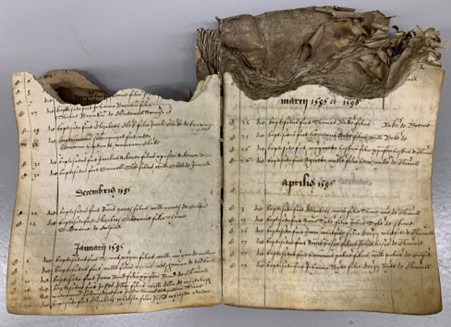
P227/IN/1/1
Since the BTs were stored separately to the parish registers, they can survive when the original register has been lost or damaged. Perhaps the best example in Gloucestershire Archives is the first parish register of Newland This was stored in the church but in one deep dark cold Forest of Dean winter, rats got into the church and into the parish chest where they began happily munching upon the parchment pages of parish register, completely eating away the upper part of the volume. Well, to a rat, parchment is probably very much like a packet of crisps and the iron gall ink is possibly the equivalent of soy sauce!
Will of Anne Vaizey, Bisley, 1779
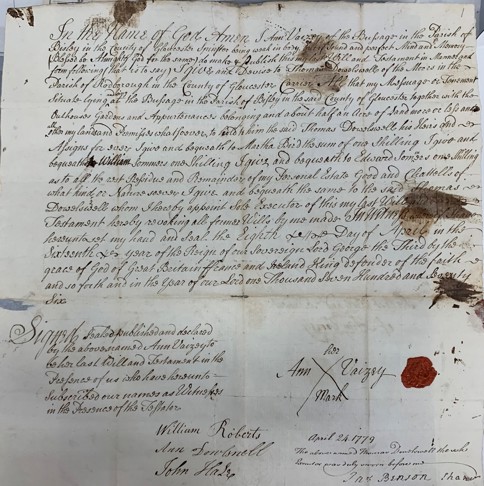
GDR/R8/1779/61
The early history of wills is complex but from the mid-1500s, a will enabled a person (the testator if a man or testatrix if a woman) to specify how they wanted their property and possessions to be divided up after their death. Gloucestershire wills were proved by the Diocese of Gloucester and they’re all on Ancestry, but they can be tricky to read even if the handwriting is good and the language English because they can be highly complicated.! Wills were often written on the testator’s death bed, they can include information about close family – spouse, children and grandchildren as well as their wider family and even friends, neighbours and servants. They normally start with the preamble ‘In the name of God Amen…’ then typically have something along the lines of ‘I, (testator’s name), being of sound mind but weak in body…’. Then start with their wishes, usually starting as ‘I give and bequeath….’. Wills can be itemised – when a line starts with ‘Imprimis’ or ‘Imp’ (‘First of all’ or ‘item’) or simply written as one large body of text. One point to remember is that there is usually little punctuation, but a new paragraph or phrase usually starts with Bold text.
Inventory of Robert Alsopp of Littleton, Tormarton, Gent, 1663
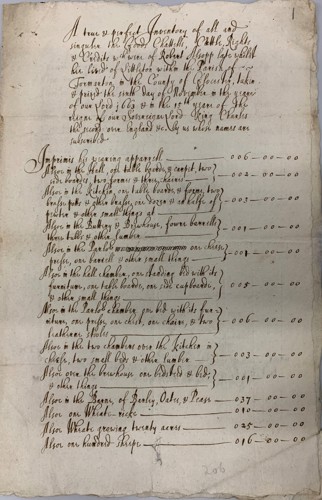
GDR/R9/1663/265
From 1530 to 1782 every executor had to appoint three or four local men to appraise or value the deceased’s personal estate and provide the probate court with a full inventory or list of goods and their value – less any real estate (land and property). They typically start with ‘wearing apparel and money in purse…’ then go onto to list household items both large and small. Usually each line begins with ‘Imprimis’ or – as in this example, the inventory of Robert Alsopp of Tormarton, 1663 – ‘Also’. After 1782 they were not legal requirements (though an interested party could request one) which means that fewer inventories survive for the later period. Inventories are a marvellous resource that can reveal information about the testator’s lifestyle, providing real ‘flesh on the bones’ for family historians.
Settlement examination for Mary Stevens, Wotton-Under-Edge, 1831
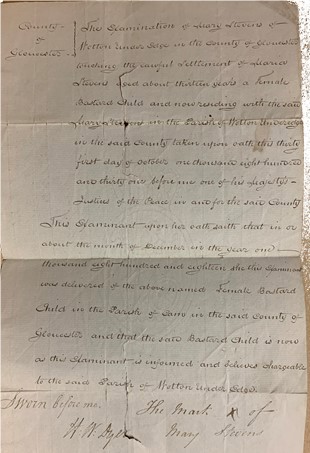
P69/OV/3/3/1/1
If a parishioner fell on hard times, then they could look to the parish Overseers of the Poor for help – but only if they were entitled to it. To obtain relief, people had to be officially settled in the parish, while newcomers had to meet certain conditions (resident in the parish for 40 days without complaint or employment in the parish for a year and a day). If unable to meet these conditions, they would face a settlement examination – such as this example for Mary Stevens, described as ’a female bastard child, aged about thirteen’. Examinations were carried out by two justices of the peace, and they sought to determine a person’s settled residence so they can (but not always) contain a useful amount of biographical information. This examination decided that although Mary was at the time residing in Cam, she was chargeable to Wotton-Under-Edge, where her mother lived.
Court Book, court leet and view of frankpledge for the Manor of Kingsholm, 1783-1835

D936/M11
A manor is a large estate, usually dating from medieval times which was owned or held by the lord of the manor. He would collect rents from tenants and hold manorial courts, to preserve his rights, his tenant’s rights and to regulate the running of the manor. There were two types of court – the Court Baron and the Court Leet. Courts Baron dealt with maintenance of property, changes of tenancy and other estate matters, while Courts Leet dealt with minor breaches of the peace and public order. Both can have useful amounts of information for family history or at the very least, good lists of the names of the manorial inhabitants but beware – for manorial records are written in (usually highly abbreviated) Latin until 1733!
1801 census for Ashleworth, from Register of baptisms and burials for the parish of Ashleworth, 1782-1812
P20/IN/1/2
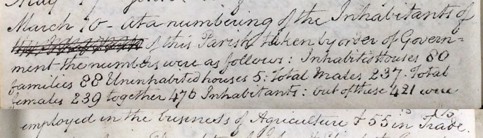
The census are perhaps the most useful resources for family history. The first official census took place on 10 March 1801 with the information being collected by the Overseers of the Poor, aided by parish constables and other officers of the peace. This is the 1801 census for Ashleworth, recorded in the parish register by the vicar:
March 10 – At a numbering of the Inhabitants of this parish taken by order of Government the numbers were as follows: Inhabited Houses 80 families 88 Uninhabited houses 5: Total males 237. Total females 239 together 476 Inhabitants: out of these 421 were employed in the business of Agriculture & 55 in Trade.
Since 1801 there has been a census every 10 years except in 1941 (due to WW2) and the information recorded has increased over time. The 1841 census (the first useful census) recorded: name and surname; age; sex; occupation and whether born in the county where they were enumerated or elsewhere. The 1901 census recorded: Name of street, house number or name; whether or not the house was inhabited; number of rooms occupied if less than five; name of each person that had spent the night in that household; relationship of persons to the head of the family; each person's marital status; age at last birthday; sex; each person's occupation; whether employer or employee or neither; person's place of birth and whether deaf, dumb, blind, or lunatic. All the census returns are available either the subscription websites Ancestry or Find My Past.
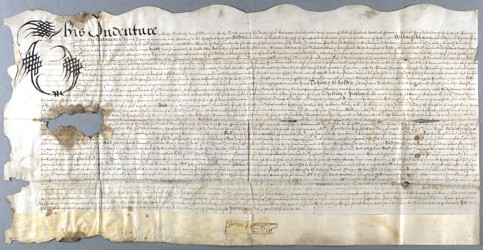
Lease (99 years/3 lives) of messuage and 2 yardlands (detailed) in Dunfield with garden, orchard and close of pasture (1a.), 1634/5
D4431/2/67/
Census returns can enable the researcher to identify title deeds. These are documents used to legally prove the ownership of a property or piece of land and include conveyances, mortgage and “indentures”. When a property was sold, the old deeds were passed to the new owner. If the property was mortgaged, the mortgage provider would hold on to the deeds until the mortgage was paid off – which still happens today. From 1925 the owner only had to keep deeds showing ownership over the last 30 years and in 1970, this decreased to 15 years – which resulted in many older deeds being destroyed as they were no longer needed. Deeds are typically written in legalese (solicitors and clerks were paid by the word….) and they are large - this is a typical example. It’s written in indelible iron gall ink on parchment (cured animal skin) and is roughly 2½ft wide and 1½ft tall (0.75 x 0.45m). It has a chirograph – a wavy or spiky top edge – which as a way of proving authenticity; the deed was drawn up twice on one sheet of parchment, which was then cut in half and if the pieces matched, the deed was deemed authentic. A large bundle of deeds can be quite unwieldy and – to be honest – crunchy, as old parchment can be difficult to unfold….
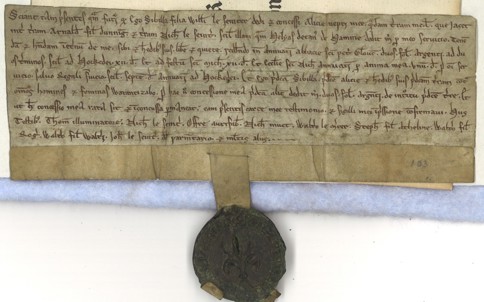
Gloucester City deed: Grant of land of from Sibilla, daughter of William the Girdler, to Alice, her niece, c.1190
GBR/J1/86
Some early deeds have large seals attached – this 1190 deed pertains to a grant of land from Sibilla, daughter of William the Girdler to her niece Alice. It is written in Latin and illustrates one issue that many deeds suffer from, namely that they describe the land in question as lying between other land, which are typically identified only by the names of their owners. This deed identifies the land being given to Alice as lying between the land of Arnald Dunning and William the Girdler, and it had been originally given to Sibilla by Helyas the Dean of St. Peter’s Abbey for her service.
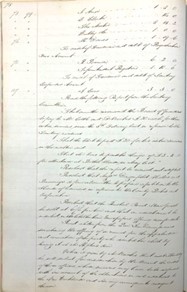
Cheltenham Poor Law Union , Minutes of the Board of Guardians, 1849-1851
G/CH/8a/7
Between 1597 and 1834, each parish had to look after their poor, either in their own homes (out relief), the parish workhouse (in relief) or in alms-houses (the latter funded by parish charities). This system generated the Overseers of the Poor records (such as removal orders and settlement examinations as shown above) but by the early 1830s it was clear that this system was expensive and inefficient so in 1834, the Poor Law Unions were created (21 in Gloucestershire alone). These worked by grouping together parishes to make managing and funding the poor more efficient. The Unions worked on a system of ‘No Out-relief’ with assistance only given in Union workhouses that were run on a ‘no work, no help’ policy with segregation, less support for mothers of illegitimate children and standard treatment for paupers. Under the new Poor Laws, each union had to build a workhouse if they did not already have one. This triggered a mini-construction boom began as new union workhouses were built – all of which looked like prisons…this was deliberate for the intention of the new system was to make being in a workhouse worse than being outside one, so that only those who were desperate for help would ask for it. For family historians, the survival of Poor Law Unions records are fairly good and often Minute books, Admission and discharge Register and Registers of deaths and births/baptisms. The minutes books survive for almost every union until the late 1920s and they often record items in detail – from whether to take in families, special dietaries, pursuit of absent fathers, apprenticing, inmates work, expenses and much else besides. Unfortunately, the survival of the other records are far more erratic.
Dutton Family of Sherborne, Appointment of gamekeepers, 1806-1821
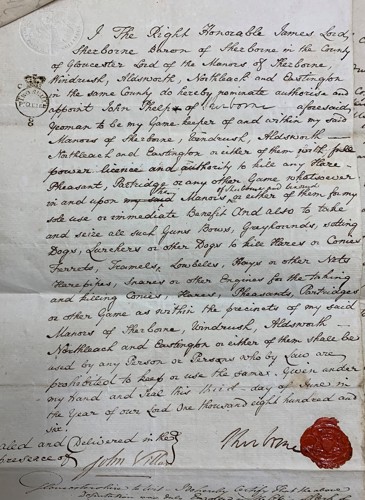
D8045/E11/3
Officialdom can be a handy resource – and where individuals had to interact with any kind of officialdom it usually generated some kind of record. This is just one example, an application in 1806 by Lord Sherborne to appoint John Phelp of Sherborne, yeoman (1806) as his gamekeeper for the manors of Sherborne, Windrush, Aldsworth, Northleach and Eastington.
City of Gloucester Apprentice register, 1765-1834
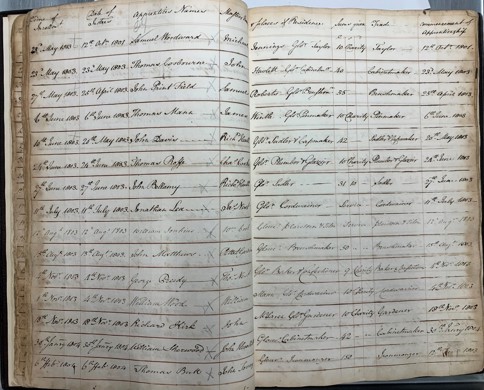
GBR/C10/4
Apprenticeships were often controlled by Boroughs, and this is the register for the City of Gloucester. As well as the apprentice’s name, it sets out in columns 'Time of Inrollment', 'Date of the indenture', 'Master's name and place of abode', 'Sum given', 'Trade etc. the apprentice is to learn' and the 'Commencement of the apprenticeship'. It also notes whether any charity money was used to set up the apprentice ship.