
Roll of landgavel rents in Gloucester
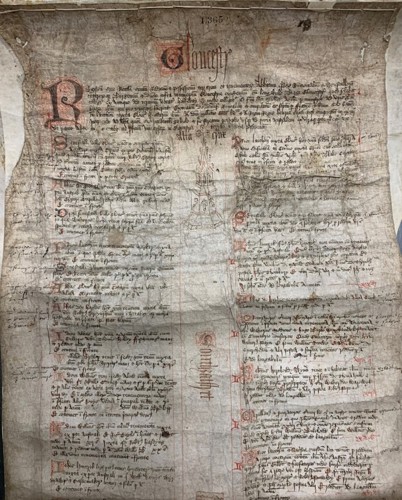 GBR/J5/1
This is arguably the earliest ‘map’ held in the archives. It was compiled in 1455 by the Canon of Llanthony, Robert Cole, who was employed by the city bailiffs as a collector of landgavel (land rents). It records the amount due for each tenement and the owners and occupants are given, along with a brief history of the property from earlier rolls (the earliest dating from the 1300s). Although it is not a map as we know it, its layout - two columns representing opposite sides of the four ‘gate’ streets in Gloucester – allows it to be read like a plan.
Map of Lydney meades
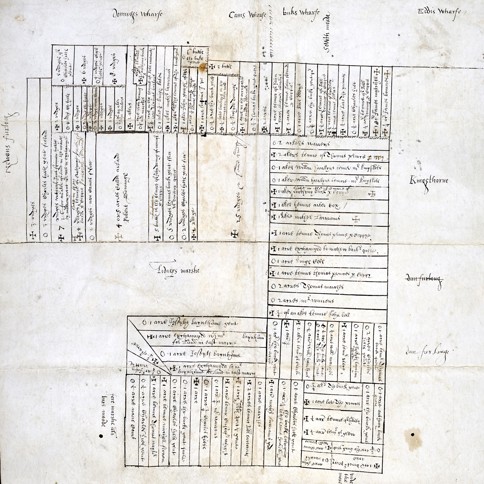 D421/A1/4
This fascinating image is the earliest recognisable map held in Gloucestershire Archives. It is dated to 1574 and is a diagrammatic plan of an area around Lydney Marsh in the Forest of Dean. The strips shown represent selions - an open strip of land used for growing crops, usually owned by or rented to manorial residents. A legend on the reverse gives the names of the people with selions, which were listed as being usually 1 acre in size. This ties in with the fact that a selion of land was typically one furlong (660 ft) long and one chain (66 ft) wide, so making them an acre in area – although exact measurements could vary depending on the lie of the land and local tradition. The area on the map is probably south of Tutnalls in Lydney for although this is land today, in in the 16th century, the Severn shore was close to the modern A48, and it is known that there were shipyards not far from St. Mary’s Church. Today, Lydney Marsh still survives to the south of Lydney railway station.
Where be north? In-Shire map of Gloucester, 1624
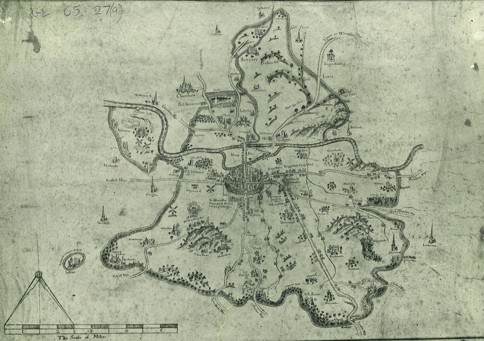 GBR/Acc7380
One issue that early – and some later - cartographers had was where to put North. Today, by convention, maps have north at the top, but it hasn’t always been so. This wonderful 1624 map of Gloucester’s In-Shire does have north…but it’s to the right!
Willersey Parish Map, 1897
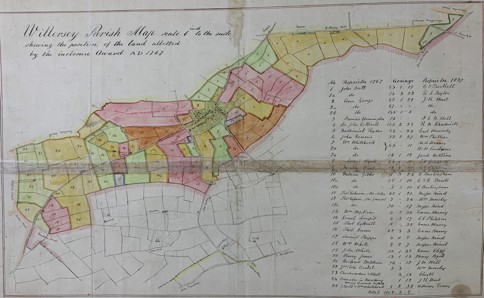 P367a/PC/50/1
This parish map of Willersey, drawn in 1897, which shows the position of land allotted by the Inclosure Award of 1767. It is accurately drawn, has good colour and a table of reference comparing the proprietors in 1767 to proprietors in 1897 which also gives the acreage of each numbered plot. What it has not got however is a marked north – which is actually to the upper left.
Compass roses
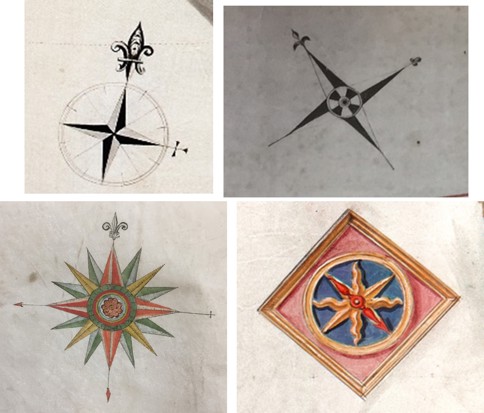 Clockwise from top left: D6/E4, D1541, D1099/P2, D1799/P3
If they showed north, most maps used a compass rose, which could be highly decorated. English maps typically had a fleur-de-lis as the north mark and a cross pattée as east mark. The reason for the latter isn’t known but on medieval maps was possibly to indicate the direction of Jerusalem, and it remained as an anachronism in later maps. The most common roses were 4-point, followed by 8-point then 16-point.
Scales & dividers
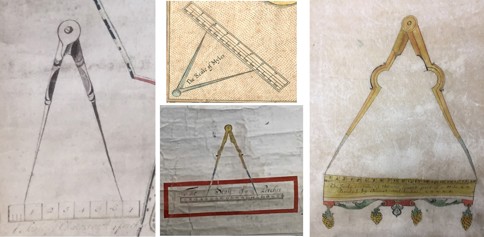 Image credit: left to right D1541, SR85 (top), D1655 (bottom), D179
The scale of a map is the ratio of a distance on the map to the corresponding distance on the ground – it could be miles, perches, chains or any unit! Dividers are typically used to measure distances on maps, and these were often shown, usually drawn very ornately.
Title Cartouches
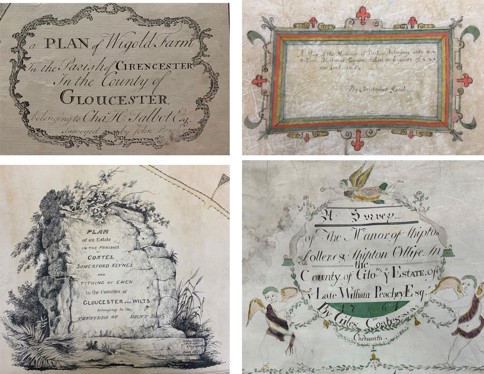 Image credit: clockwise from top left D646, D1655, D1930, D2525/P35
These may contain the title, the printer's address, date, the scale and legends, and a dedication. They had their heyday in the Baroque period (1650-1700) but toward the end of the 1700s ornamental effects in cartouches became less popular, and their style settled to more simple designs.
Birds-Eye Block Plan or Elevation?
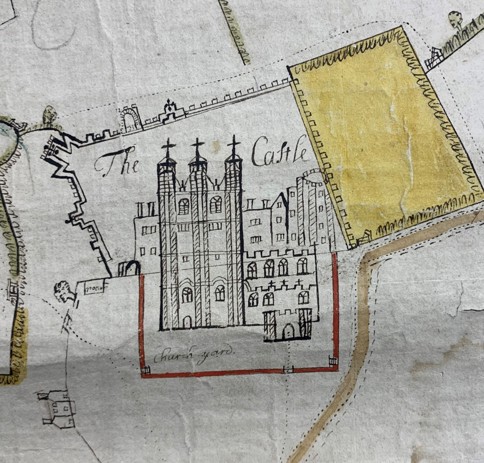 D1655
D1655
One of the great issues that early cartographers had was how to show buildings. Today we are used to the fact that all buildings are shown in ‘block-plan’ or ‘birds-eye’ view, where you look down on buildings as if you are flying above them to see their footprint. However, in the past, an elevation view – showing the building itself was considered best, as seen in this view of Thornbury Castle.
Milton End House, Arlingham
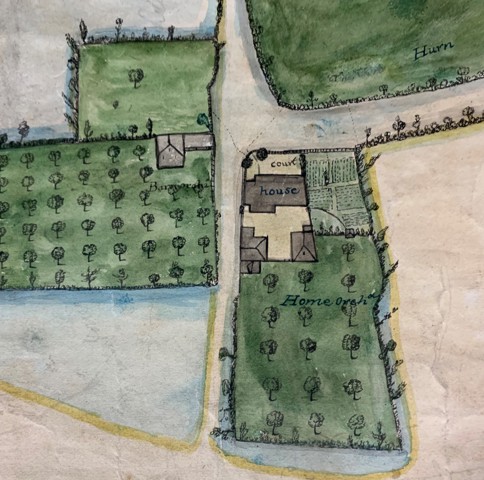 D1577/1
Some surveyors fudged the issue… This is an undated – but probably early 1800s – map showing Milton End House in Arlingham. The surveyor who drew it obviously wasn't sure how to portray the buildings so although he showed the buildings in block plan, he made the roofs of the ancillary buildings in elevation so you can see some end gables! Just to be sure he also drew the house in elevation – but interestingly, it doesn’t appear to match the footprint on the map!
Land inclosed in Dyrham Park, c.1815
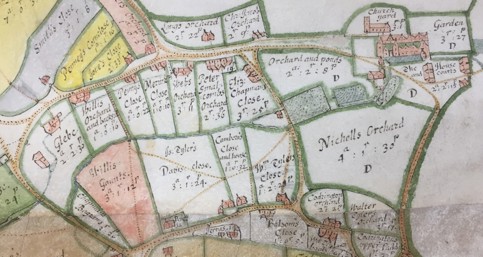 D1799/P3
Where road circled a village caused another problem – which way should you portray the buildings! This 1815 map showing enclosed land in Dyrham Park has got the buildings facing all directions! This was presumably done so that the buildings were orientated correctly to the road in front of them. Interestingly the map is dated c1780, but a watermark on the paper suggests that the paper was printed 1815, making this a terminus post quem for the map.
Plan of Wotton House, Gloucester showing the gardens, lawns, shrubberies and premises, property of C B Walker Esq., 1877
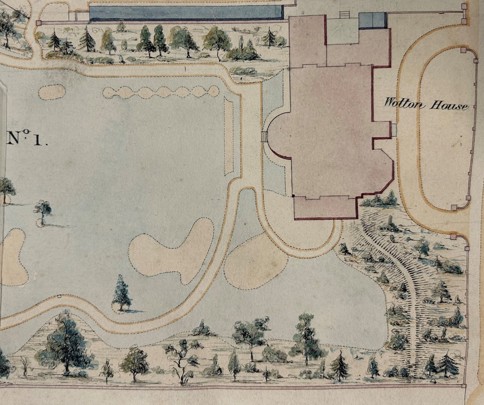 K1131/4/3
As time passed it became the norm to show buildings in block plan. However, sales particulars, often used a mix – usually showing buildings in block plan, but gardens in elevation – primarily to show them off and make them look more attractive to potential purchasers. This is the 1877 plan of Wotton House, on Horton Road (then Asylum Lane) in Gloucester showing the house, building, lawns and garden trees and shrubberies. The house and ancillary buildings are all shown in block plan but the shrubs and trees were portrayed in elevation!
‘Since my letter of 23rd inst. referring to the subject (to Mr Lane) Mr Brunel with others have been seen going over the line of proposed rail road along this valley, which I consider as indicative of the report having some foundation.’
The railway to Swindon eventually opened in 1845 and although the two canals cut tolls to try and stay competitive, revenue on the Thames & Severn fell from £11,000 in 1841 to just £2,874 by 1855. Faced with ongoing water problems and the railway taking massive amounts of business from it, the Thames & Severn declined rapidly and in 1927, it was abandoned. The Stroudwater Navigation faired better and it continued but ultimately declined and eventually closed in 1941.
Gates on Plan of Wotton House, Gloucester, 1877
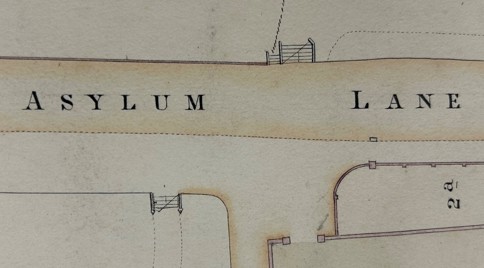 K1131/4/3
Also, for some unknown reason, gates were also shown in elevation – as these 5-bar gates on the plan of Wotton House are shown. The road named here, Asylum Lane, is now Horton Road.
Survey of Certain Estates belonging to Benjamin Hyett Esquire in the County of Gloucester, 1780
 D6/E4
D6/E4
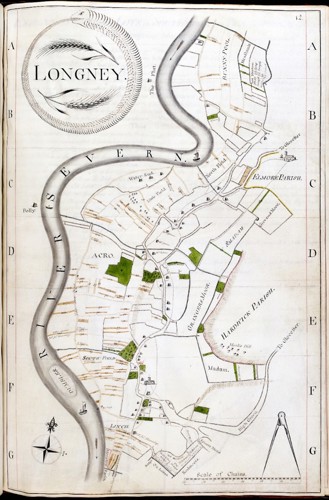
Estate maps were maps that were commissioned by individual landowners to show their landed property, typically including fields, parkland and buildings. They began to be produced in large numbers during the 1500s as the number of new estates grew following the Dissolution of the Monasteries, which made more estates available for the upper classes to purchase. Although ostensibly used for estate management, they were also used for display, reaching a fashionable heyday in the late 1700s until the mid-1800s. They were however expensive to commission and produce so their production declined after the Ordnance Survey maps began to become available. This map is from a survey of property belonging to Benjamin Hyett made by John Merrett, surveyor. It is contained in a large volume and includes shaded contours, buildings in perspective, land use as well as field names, acreage, land use, value per acre and total value. It also shows various types of river craft on the Severn, which bordered some of Hyett’s land.
Post-enclosure map of Homestallend, part of the Manor of Todenham, 1592/3
 D1099/P1
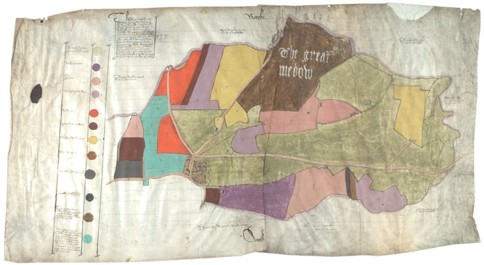
Inclosure created the patchwork of hedgerows and fields that exist today. Prior to inclosure, agriculture was a community-based activity with a few large fields in each village for growing crops and common or waste land was used for grazing animals. Inclosure rearranged this so that all the land owned by an individual was in one block – initially it was achieved by private agreement, but later public Acts of Parliament were used which made it easier to overrule local opposition as the changes favoured the better-off while the poor lost most of their rights to use the common land. This is a post-enclosure map of Homestallend, part of the Manor of Todenham, which was inclosed in 1592/3. It was accomplished by private agreement as a note on the map’s reverse state described the land as that "which laye dispersed by ridges amongst the tenauntes and nowe by consente every mans portion layed togethers".
Tidenham (Woolaston and Lancaut) - official inclosure map with award, 1815
 Q/RI/144
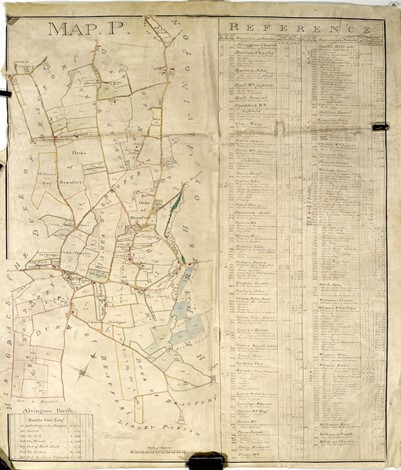
Commissioners appointed under the terms of an Inclosure Acts allegedly conducted a thorough survey of land ownership and rights in the common fields in the parish in which they drew up:
-
A map to show the existing system – open fields divided into individual strips – these rarely survive.
-
A map to show the new arrangements.
-
An award describing the individual allotments and other important features like new roads.
The maps and awards are legal documents which set out how common land was to be allocated to individual landowners and then enclosed by fences or hedges. An official copy of each award and map was given to the County’s Quarter Sessions Clerk of the Peace. Large parishes might require several maps. This is ‘Map P’ from the 1815 official inclosure map with award for Tidenham (including Woolaston and Lancaut). In total, this award comprises 19 maps drawn to varying scales, but all worked to fit a size of 33 x 24 inches (0.8 x 0.6m).
Shipton Oliffe and Shipton Sollers parish Inclosure award and accompanying map, with schedule of common rights
 GDR/T1/69
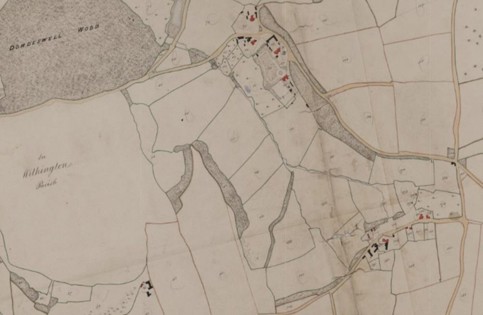
Tithes were a 1/10th contribution given to the church from 855 onwards. A tithe was levied on anything that produced an annual increase such as crops, livestock and also profit from mills, forests and fisheries, etc. Churches had to build places to store it, typified by the tithe barns at Ashleworth, Hartpury, Frocester, and Postlip. In 1836, money replaced goods. Maps & schedules were created to determine who owned/occupied what. These included field names, creating a valuable snapshot of the countryside at the time. Tithes were abolished in 1936 – partly due to pressure from non-conformist religions. The final payments however were not made until 1977.
Plans of crops at Whitfield House "example farm", 1842
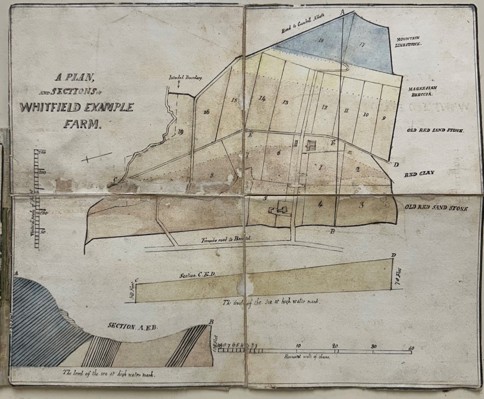 D149/P1
Maps showing crops are rare, because as crop rotation was used, maps changed. This map however shows crops planted at Whitfield Example Farm in 1842. It includes a geological cross-section, as by this time, the science of soil and their effects on crops was starting to grow. As well as the map, there is a table of reference naming the crops – all of which were classic Victorian ‘agricultural revolution’ crops: wheat, carrots, peas, clover, turnips, oats and mangel worzel.
Plan of drainage of lands of Church Farm, Frampton-on-Severn, 1881
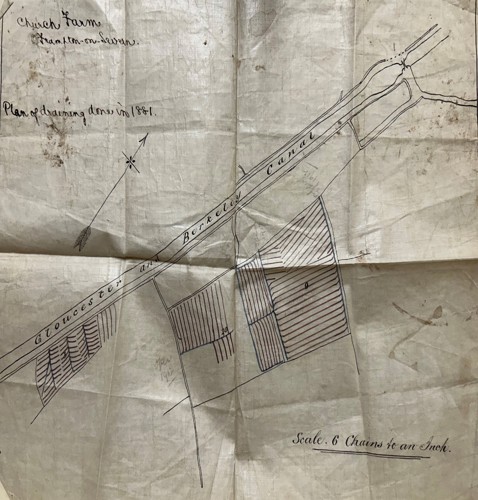 D149/P6
Land drains are used to drain excess water that sits above ground – as seen here on a plan of drains in Church Farm, Frampton. Most consist of trenches dug to allow water to drain away. These are filled with faggots (bundles of hazel, chestnut and willow), rubble or from the early 1800s, clay tile drains. The latter are efficient and very rarely need any maintenance. Today it is thought that about 6,000,000 acres of land farmed in England and Wales is equipped with these invisible networks.
World War II German maps showing Luftwaffe bombing targets in Gloucestershire
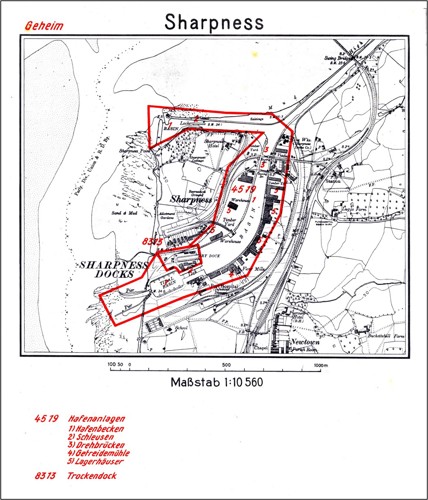 D3558/114
Even before the start of WW2, the German Luftwaffe was making overflights of the UK for reconnaissance purposes – they even got the UK public to pay for it by selling the aerial photographs they took! To add insult to injury, the Germans also used the Ordnance Survey’s One-Inch to the Mile Popular edition mapping of 1926 as the basis for their bombing maps! These were later used by German aircrew flying bombing raids and many places in Gloucestershire were targets - including Ashchurch, Bishops Cleeve, Cheltenham, Dursley (Lister), Gloucester (docks), Hucclecote (GAC), Minchinhampton, Moreton-in-Marsh, Quedgeley, Sharpness (seem here), South Cerney, Stonehouse (Sperry) and Yate (Parnall).
Hardwicke Home Guard hand-drawn map of approaches to Moreton Valance aerodrome, 1944
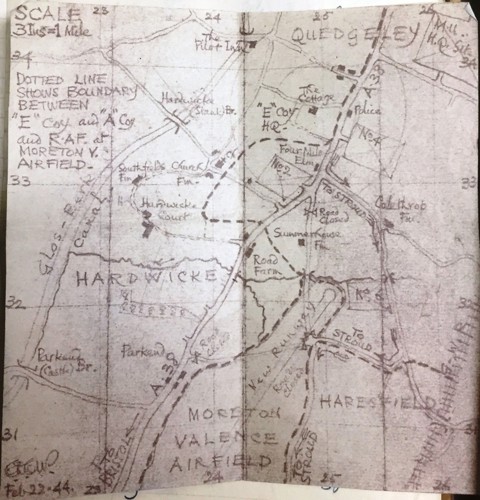 D286/7
Local Home Guard units often made their own maps, showing what their tasks were in the event of a German invasion. This map was compiled by the Commanding Officer of Hardwicke Home Guard (at this date it was Colonel A.B. Lloyd-Baker) and showed the defensive positions that they would take up to defend RAF Moreton Valence. Originally, the Army – with support from the Home Guard – defended RAF airfields but in 1942, the RAF Regiment was formed to take over the task at home and abroad. By the date of this map, February 1944, the threat of a German invasion was long gone, although airborne commando raids were still thought a possibility, hence the airfield defence plans.
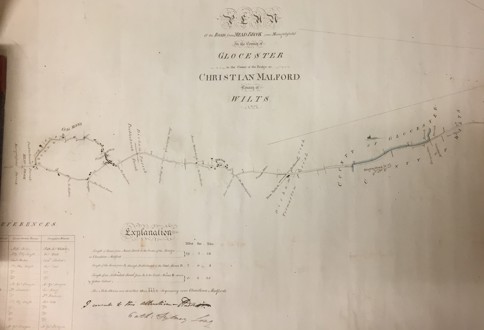
Turnpike from Mead Brook, Gloucestershire to the Bridge, Christian Malford, Wiltshire, 1808
 Q/Rum/28
The main source of railway, road and canal plans are the Quarter Sessions, as plans of schemes for public undertakings involving capital investment from private sources had to be deposited with this public body. The plans relate to schemes for canals (from 1792), horse or tram-railroads (from 1801), docks (from 1802), rivers (from 1805), turnpike roads (from 1808), water supply (from 1810), town improvement (from 1824), Severn ferries and bridges (from 1825), steam railways (from 1830), gas schemes (from 1863) and tramways (from 1871) – but not all schemes were carried out. They tend to show the object of interest and little or nothing else. Many are large and unwieldy – most are undergoing some TLC with our conservation department.
Insurance plan of the city of Gloucester, September 1891
 NX3.4(39.7)GS
Goad maps are street plans named for Charles E. Goad, a Civil Engineer who worked in the UK and Canada. He drew up detailed maps for cities, mostly for insurance companies and the maps generally name the companies in each building. Building materials were colour-coded for flammability and some editions show building heights and construction materials, wall thickness, types of roof, proximity to fire hydrants and fire-extinguishing appliances, as well as the locations of doors, windows and skylights.
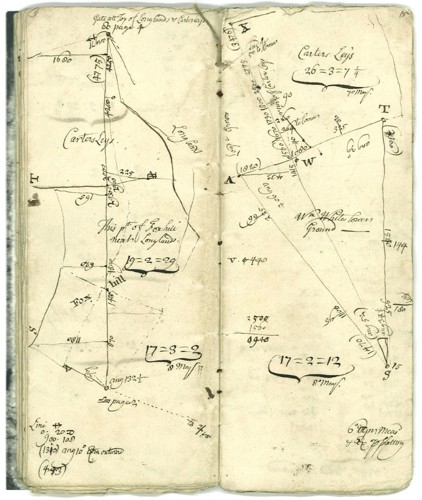
Survey of Mickleton Hills part of the Mannour of Mickleton .... the lands, of the Rt. Hon. Gilbert Earl of Coventry, 1714
 D303/Z7
Maps were made by surveyors, who were typically commissioned or appointed to the role in question. They essentially determined the position of objects by measuring angles and distances. Most surveyors used a field book to record the initial surveys – such as this one, which was used in the inclosure of Mickleton. They then used this data to create plans and maps.
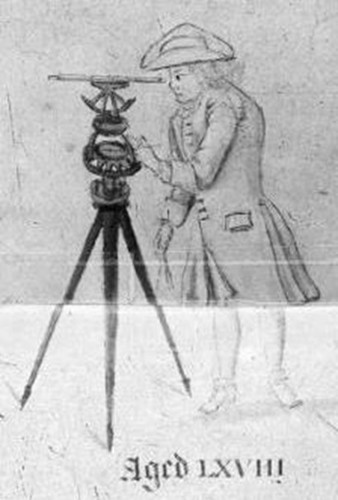
A plan of an Estate Situate in the Parish of Long Newnton... The Property of Thomas White, Gent., 1822
 PC/907
This is a self-portrait of the surveyor, Stephen Jefferys of Minchinhampton (aged 68) using a theodolite to survey the manor of Long Newnton in 1748. A theodolite is a precision optical instrument for measuring angles between designated visible points in the horizontal and vertical planes. The traditional use has been for land surveying, but it is also used extensively for building. They were first introduced in the 1600s as a development of the plane-table but it wasn’t until the mid-1700s that they became practical accurate surveying devices.
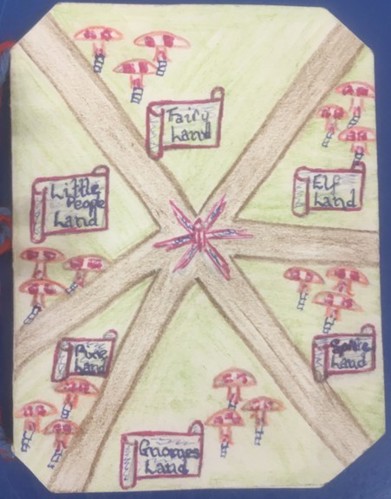
1st Stratton Brownies Little map of Fairy Land, nd
 D7107/6/7
Not all maps are as serious as others. This colourful map of fairyland is from the logbook of the 1st Stratton (Cirencester) Brownies for 1952 with a finger signpost showing the directions of Fairy Land, Elf Land, Sprite Land, Gnome Land and Pixie Land.