Introduction
This online exhibition focusses on entertainment in the county, and takes a look back at different aspects of rest, recreation, and relaxation. As well as the ‘regular' entertainments such fairs, fetes, music, theatre and sports, it dips into some of Gloucestershire's more quirky entertainments such as cheese rolling, river football and woolsack racing!
Archery
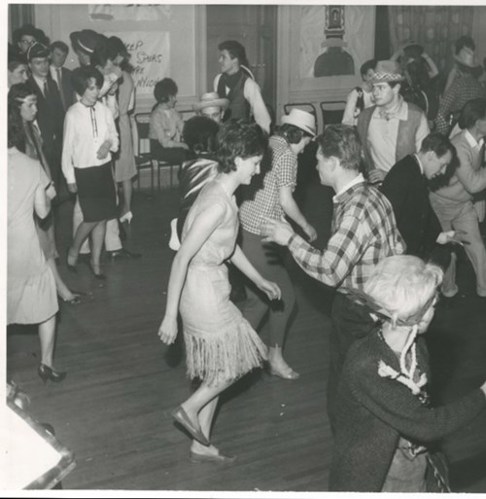
Archery was a widespread aristocratic sport, which had been revived during the romantic period and was felt suitable for both women and men. Photographed in 1870, this is Mrs J R Yorke, Mdm. de Brienen and Mrs Langhorne practicing archery in the gardens of Forthampton Court. Given the restrictions on movement caused by the volume of material in dresses and petticoats and (no doubt), the formidable corsets underneath, archery was one of the few sports in which ladies could participate. Even then, it can have been neither easy nor particularly comfortable – especially with the length of the bows, much longer than those used today.
GPS/146/64
Angling
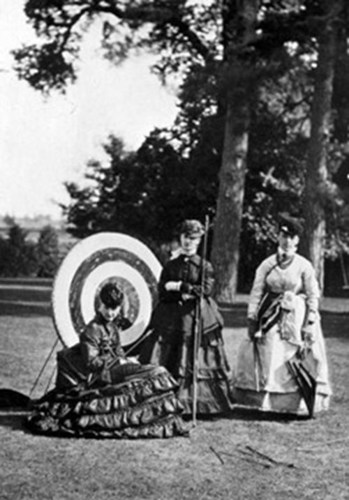
Angling is the art or sport of fishing with a rod and line and either a fly or bait, where the object is to have fun catching fish that are not always going to be eaten. This scene at Saul Junction – shows an old boy fishing on the Stroudwater Canal….you can feel the tension waiting for the float to dip!
D9746/2/301/13
Boating
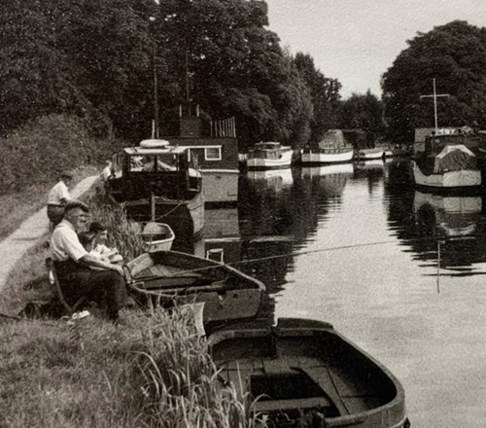
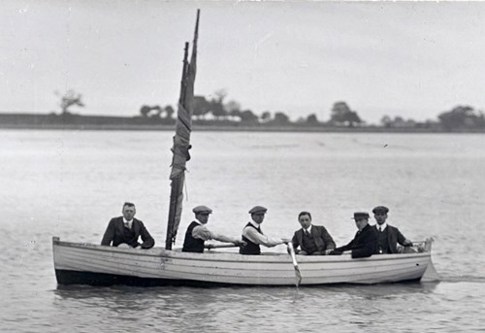
As befits an island race, many of us are never happier than when in, on or under water – and boating has long been popular in the county, thanks to our rivers – the Severn, Warwickshire Avon, Bristol Avon, Wye – and the local canals. This is a group of men (possibly recuperating soldiers) rowing a boat on the Severn – given the width of the river, it is probably near Broadoak or Newnham, although as the photograph came from the collection of a family at Littleton, it may well be in the southern half of the estuary.
D4764-4-31
Bonfire night
“Remember, remember, the 5th of November. Gunpowder, treason and plot. I see no reason why gunpowder treason should ever be forgot.”
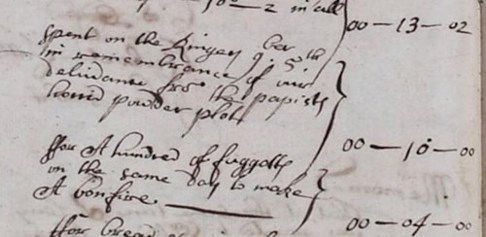
In January 1606, Parliament passed the Observance of 5th November Act, making public thanksgiving for the gunpowder plot’s failure an annual feature of English life, with church ministers having to hold a special service of thanksgiving on 5th November. The Prestbury Churchwardens accounts records 14s (£83 today) being spent on bellringers and wood faggots for a bonfire to commemorate ‘the papists horrid powder plott’ in 1684. Though Fawkes’ legacy is complicated – with some rejoicing his attempted actions and others celebrating his capture and defeat, ‘Gunpowder Treason Day’ has been with us ever since - accompanied by festivities where effigies of the ‘bad guys’, aka the Pope and Guy Fawkes were burnt on bonfires and fireworks let off.
P254 CW 2/1
Bowls
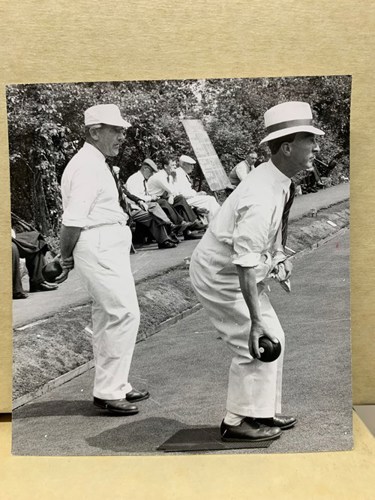
This photograph was taken at the Gloucester Bowls Tournament played at Gloucester's The Spa ground in 1959. Popular from the 1400s onwards, bowls can be played on either flat greens or crown greens (which have a raised centre). The two versions arose due to the bowling greens – wealthy players with large gardens made bowling greens on flat lawns, while the less affluent played on rougher common ground and parks close to inns and taverns, which became the forerunners of the crown greens. There were several bowling greens in Gloucester and Cheltenham from the 1700s onwards.
D10638/1/1959/33/50
Brass bands
Brass bands may owe their roots to medieval waites – watchmen who patrolled at night, using musical instruments to show they were on duty and to mark the hours.
As their musicality grew, extra instruments were added and they became more like town bands – welcoming Royal visitors by playing at the town gates, and leading civic processions.
Brass bands became popular during the Industrial Revolution – one reason for this was that employers actively financed work bands to distract workers away from political activity.
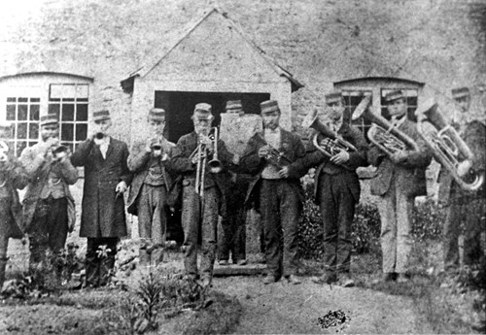
By 1860, there were around 750 brass bands in England, the oldest probably being The Stalybridge Old Band which formed in 1809. This photograph from the collection of Rev. C. H. Pickthorne, shows the Bourton-on-the-Water band members, around 1900.
GPS/55/38
Carnivals
Carnival is a Western Christian festive season that occurs before Lent and originated via religious processions for Saint’s Day celebrations, Parish Feasts, with a smattering of pagan celebrations, civic processions and ceremonies thrown in. It virtually died out with the Reformation, though celebrations such as Bonfire Night often had a form of processionary (which survive as the ‘West Country Carnivals’ today) as did fairs and some traditional pagan celebrations such as May Day. This is Tetbury Carnival in Long Street, Tetbury in 1910, showing the band, carriages, onlookers, policemen and flags.
GPS/328/27
Circuses
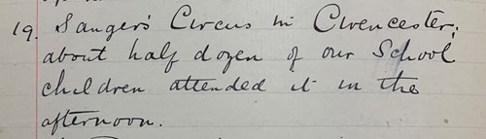
In July 1913, Sangers Circus visited Cirencester and several local schools – such as Ampney Crucis here – gave children half-day holidays to go and see it. The modern Big Top circus has a complex history, and no-one agrees on its origins – although the first true ‘circus’ in Britain opened in 1768. Typically made up of diverse entertainments including clowns, acrobats, trained animals, trapeze acts and much more, the arrival of a circus in towns drew immense attention. Sangers Circus, which ran from 1854 to 1911, was perhaps the greatest circus in Britain – its road train alone was said to be two miles long and number over 100 wagons!
S15/1/2
Cockfighting
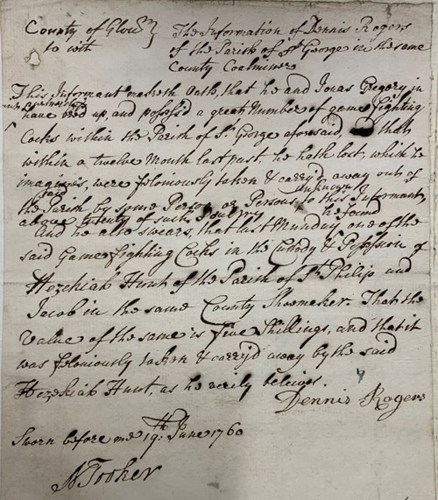
However abhorrent it is to us today, cockfighting was once extremely popular. It generally took place in inns where the urban and rural élites could gather to watch – one example was in the spring of 1743, when the Bell Inn in Gloucester advertised an inter-county cockfight between Shropshire and Monmouthshire. Many places had public cockpits, but private houses could also be used – an example being Yew Tree House in Painswick, where illegal cock fights were held in its cellar. Cockfights were popular on holidays and feast days especially Shrovetide - the last chance for good food and unrestricted ‘fun’ before the long period of lent. Most archives pertaining to cockfighting relate to the theft of birds, such as this example in the Gloucestershire Quarter Sessions – a deposition made by Dennis Rogers of St. George's (Bristol), coal miner, concerning the suspected theft of fighting cocks by Hezekiah Hunt of St. Philip & Jacob (Bristol), shoemaker, heard by Justice N Tooker on 19 June 1760. Rogers swore that over the previous year, he’d had around 20 cocks stolen – valued at 5s a bird or £5 in total (roughly £42 today) and that he’d subsequently found them at a cock fight in Hunt’s possession.
Q/SD/1/1760(part)
Croquet
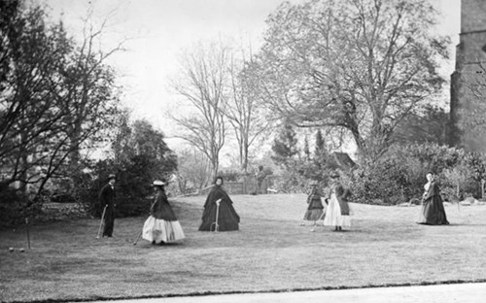
Introduced from France at the Restoration, croquet became highly popular as a social pastime for both sexes in the mid-Victorian period – one reason may be that Budding invented his lawn-mower around the same time, making creating flat pitches easier. In 1868, the first official croquet all-comers tournament was held at Moreton-in-Marsh – the same year that the All-England Croquet Club was formed at Wimbledon, London. This is the croquet lawn at Kemerton Upper Court in 1861– looking at the undulations it’s safe to say it looks quite challenging!
D13194
Fairs
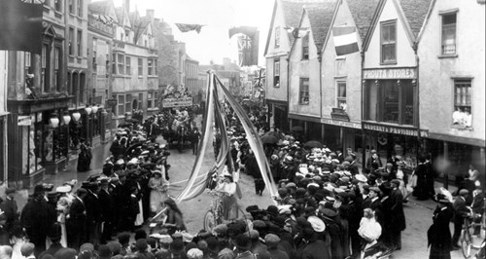
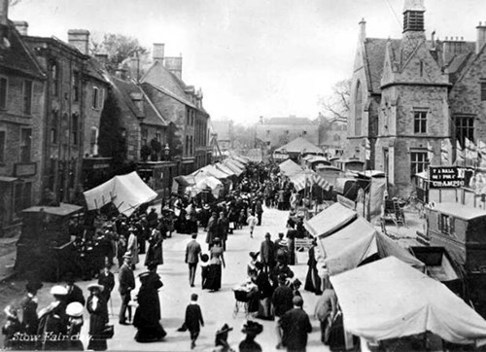
Fairs are a gathering of people for a variety of entertainment or commercial activities – this is Stow Fair c1900. They were often held on religious festivals and the right to hold a fair was usually granted by royal charter and they had pye powder courts to judge offenses and disputes. As the trading element of fairs declined, entertainment grew and by the 1900s most fairs were fun fairs - all about fun rides, stalls, and food. Hiring fairs, also called statute or mop fairs, were regular events where labourers (often with the tools of their trade) were hired for fixed terms. They arose from Edward III’s attempt to regulate the labour market by the Statute of Labourers in 1351 after the Black Death. Typically, they would take over a town centre for two days and workers of both sexes would gather in order to bargain with employers to secure a position for the coming year. The yearly hiring included board and lodging for single employees for the year with wages being paid at the end of the year’s service. These fairs attracted all the other trappings of a fair and attracted poor reputations for the drunkenness and immorality involved. Today mop fairs have morphed into fun fairs with fast, brightly lit and very noisy entertainments including traditional rides such as carousels and helter-skelters.
D3559
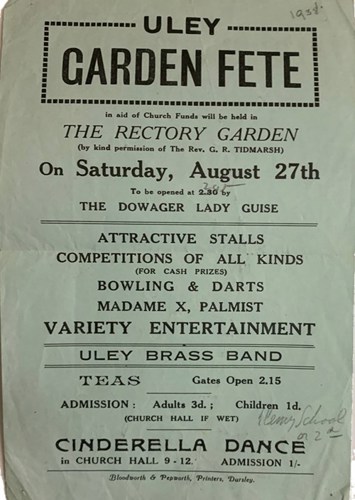
Fetes
Fêtes are traditional public festivals, held outdoors and organised to raise funds for a charity, usually the local church – the name comes medieval Latin ‘festus’ - ‘holiday’ or ‘party’. They include entertainment such as tombolas, raffles, coconut shies, bash a rat, white elephant stalls, cakes, tug-of-war, games and home produce such as jams and pickles. Competitive baking and vegetable shows are part of the classic British fête and hot beds of contention!
P345/VE/3/3
Football, rugby and association aka soccer
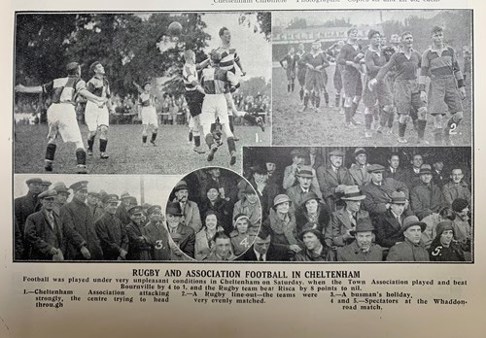
Rugby and football have always been popular entertainments – especially on Saturday afternoons. We won’t start the debate about which is more popular in Gloucestershire…as we all know it’s rugby!
Cheltenham Chronicle & Gloucestershire Graphic 1934
Gambling, dicing & carding
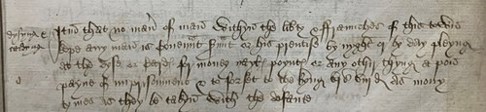
Gambling dates back to pre-history – six-sided dice dating to around 3000 BCE have been found in Mesopotamia. In Britain it has been a main recreational activity since the Roman times, but by the medieval period, it had begun to become regulated – primarily so the regulatory authorities could get their cut from it. Games like knucklebones (jacks), teetotum/put & take, were all popular in streets and taverns but the most common were dice and cards. This is an extract from the Red Book of Gloucester that lists official memoranda for the citizens of the town and this particular entry bans servants or apprentices from playing at dice or cards and it reads:
Dicing and carding
Item: that no manner of man within the liberty and franchises of this town keep any man his covenanted servant or his apprentice by night or by day playing at the dice or cards for money, nails, points or any other thing upon pain of imprisonment and to forfeit to the King vis 8 pence as many times as they have taken by default.
GBR/B2/1
Lidos
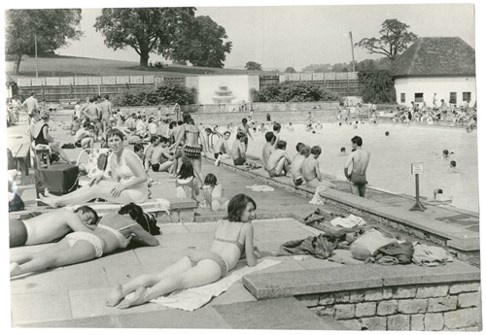
Technically a lido is an outdoor pool near a body of water (e.g., a beach or sea), but in the UK it tends to mean any outdoor pool. The golden age of lidos was in the 1930s, when outdoor swimming became popular, and 169 pools were built across the UK as recreational
facilities by local councils – today just 98 are left. This is Stroud’s Stratford Park Lido which opened in 1937 as a heated pool. In WW2 however, the heating system was dismantled and taken away for the war effort, so it is now a cold-water pool. There are several other outdoor pools in the county – notably Broadway and Lydney, but the most well-known is Cheltenham’s Sandford Park Lido, which opened in 1935). Although it is unlisted, it is regarded as a nationally important example of its type due to its Art Deco architecture.
D10638/1/1967/28/43
Pleasure boating
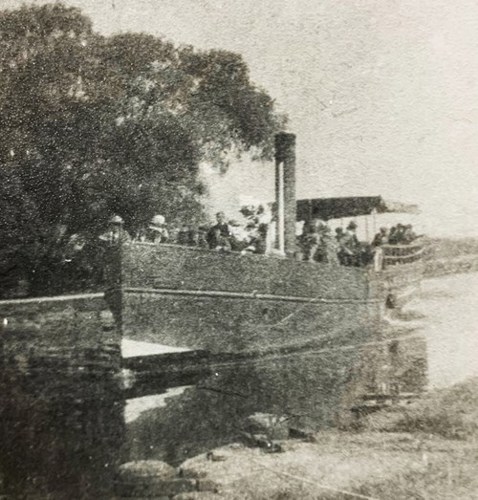
Pleasure cruises on rivers and canals have been popular since the early days of steamboats. Regular trips went from Gloucester to Wainlodes and Tewkesbury on the Severn and on the Gloucester-Sharpness Canal, from Gloucester to Saul and Sharpness, calling at places enroute such as Saul Junction, Frampton and Purton. This is the steamer S.S. Wave on the Gloucester-Sharpness Canal c.1905.
D9746/2/358/4
Punch & Judy
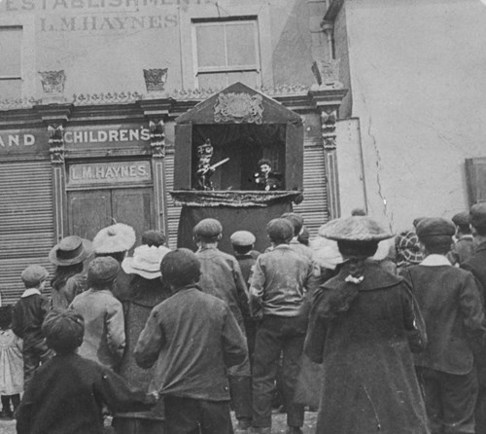
The Punch and Judy show has roots in Italian commedia dell'arte of the 1500s – professional comedy theatre, often performed on the streets. Mr Punch is derived from the stock character Pulcinella – anglicised to Punchinello and is a variation on the Lord of Misrule/Boy Bishop. Punch & Judy began became popular during the Restoration, when art and theatre reemerged after the years of puritan rule. Originally, they were marionettes, but were reinvented as glove puppets to cope with the violent action without the obstruction of marionette strings. The show was originally for adults, but it changed into a children's entertainment in the late Victorian era – as can be seen in this show at Stroud around 1900. One reason for the change was that other members of the show's cast – the Devil, the hangman and Punch's mistress ‘Pretty Polly’ – were seen as inappropriate for young audiences!
GPS/320/67
Skittles, indoor & garden
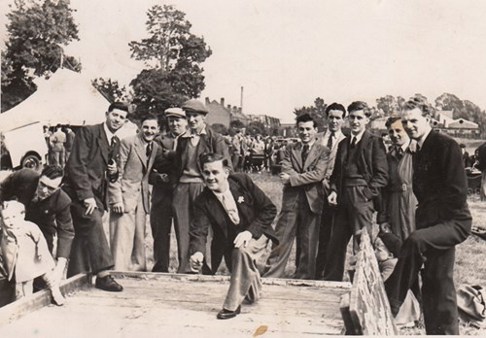
Skittles is a historical lawn game and target sport of European origin, from which the modern sport of nine-pin bowling is descended. Most skittle alleys were located adjacent to public houses and inns as can be seen in the town plans of both Gloucester and Cheltenham in the 1850s. In many regions – including Gloucestershire – skittles remains as a popular indoor pub game and many local firms have their own teams and compete in local leagues. Lawn skittles often seen at fetes is also very popular, although only played outdoors and on the day.
Fielding & Platt archive
Shooting
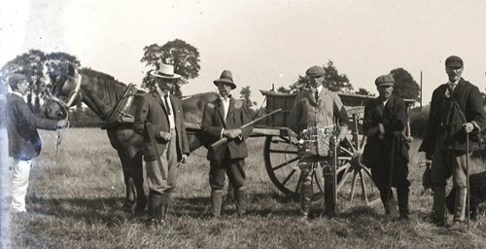
This is a posed photograph of a shooting party at Foxcote, Ilmington. There were three types of shooting practiced for recreational entertainment: target shooting on ranges, rough shooting on farms or open country (including poaching) and organised driven shoots on estates, aka ‘Shooting Parties’. The former typically used pistols or rifles while the latter pair usually involved using shotguns for game – either games birds or rabbits. Shooting on estates could account for enormous quantities of game in any single year – Tibberton Estate outside Gloucester was typical. It held around 5 shoots a year with an average of five invited guns. For the year 1925-26 the game killed on the estate on the included 70 partridge, 90 pheasants, 2 woodcock, 4 hares, 816 rabbits, 13 wood pigeons, 2 moorhens and a water-rail. Most large shoots relied on ‘beaters’ to drive game towards the guns – this was a popular pastime for local male agricultural labourers who were rewarded with a hearty lunch and on the larger shoots some of the killed game to take home for the pot. Shooting parties for the upper classes reached their zenith prior to WW1, after which due to lack of shooters and beaters many estate shoots died out.
D11554/1113
Theatre
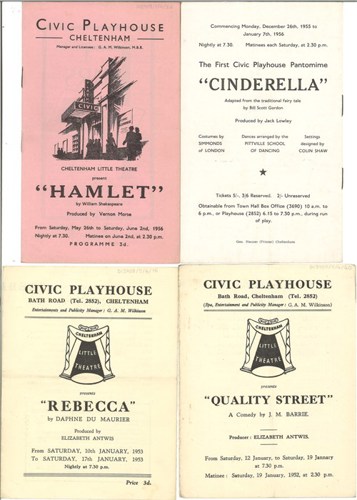
In ‘Shakespeare in Love’, Mr Henslowe says that “The natural condition of the theatre business is one of insurmountable obstacles on the road to imminent disaster” but despite this view, theatre has been popular since Tudor times. In Gloucester, the city’s Boothall was used by visiting companies of players for concerts, plays, and performances from the mid-1500s onwards. Apart from a decline under the Puritan regime, theatre remained popular and most towns (and many villages) had ‘AmDram’ companies by the early 1900s in various theatres and village halls. These are programmes for Cheltenham’s Civic Playhouse and are among many such programmes that the archives have from other theatres and companies.
D13905/5/4/1
Works outings
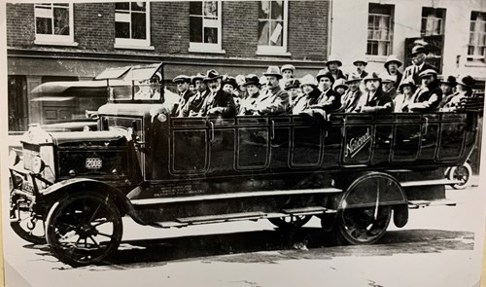
Before the evolution of the dreaded ‘team building days’ so beloved of HR (human resources) and middle management, works outings used to be considered a fun treat with employers laying on day trips for their staff. These usually included a journey to somewhere other than the place of work, food and drink. This is a National Omnibus and Transport Co. Ltd charabanc in London Road, Stroud, which appears to be on just such a trip. The name charabanc comes from the French char à bancs (“wagon with benches”) and they were long, four-wheeled vehicles with several rows of side-entry forward-facing seats that made them ideal for taking parties of people to one destination.
D9746-7-273
Cheese-rolling
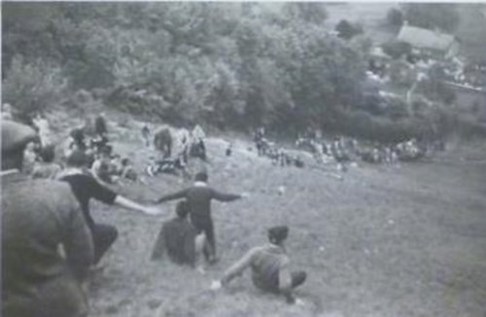
Cheese rolling is an annual race held at Cooper's Hill, near Brockworth that involves people chasing a 6-8lb/3-4Kg Double Gloucester cheese down the 45-degree 200-yard-long hill. At the bottom, the cheese is travelling at around 80mph. The first written evidence of the custom is in a note sent to the Gloucester town crier in 1826, but even then, it was thought to be at least six hundred years old. However, no-one really knows how or why it started but one current view is that it is linked to a village celebration – also known as a ’wake’ – possibly linked to reinforcing common laws surrounding grazing on the nearby common. The term wake comes from the church. Every church at its consecration received the name of a patron saint, whose feast-day or festival subsequently became the festival day of that church. However, the day on which the church was dedicated was also celebrated as the feast day of the parish. These two events ran until the Reformation, after which the dedication day (known as ‘the church's holiday) was ordered to be kept, while the saint’s festival was dropped. The dedication day is kept in many places today. Originally every feast day or festival had two components: the vigil or eve of the feast (commencing on Saturday at sunset), while from midnight on the Sunday, it was known as the wæccan or wake. After the church services had finished on the Sunday, parishioners would start celebrating with food and drink. However, such celebrations – both for the Saint’s Day and Church holiday – soon began to be abused (even in the church services, many people started drinking). As a result, many wakes were suppressed by the Puritans, but morphed into commercial markets, which became fairs – often located close to the parish or town church.
D3135
River football
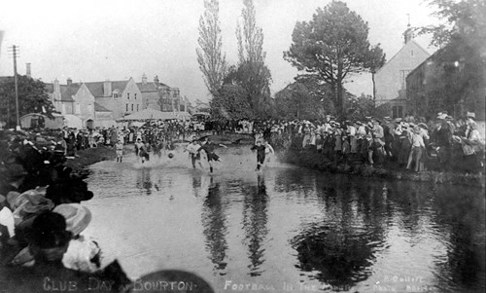
Little is known about the history or origins of this football match other than it began around 1900 – possibly as a fund-raiser for the Bourton-on-the-Water Football Club. This photograph was taken in 1902. The games is played every August Bank Holiday as part of the village fete between two 5-a-side teams, one from the club’s 1st XI and one from the 2nd XI teams. The game is 15 minutes each way with no rules apart from that if the goals (which are anchored in the river are moved or collapsed) penalties are awarded. It attracts large crows who often get wet. The riverbed through the village is Cotswold gravel, so there is little in the way of obstacles.
GPS/55/31
Tetbury woolsack races
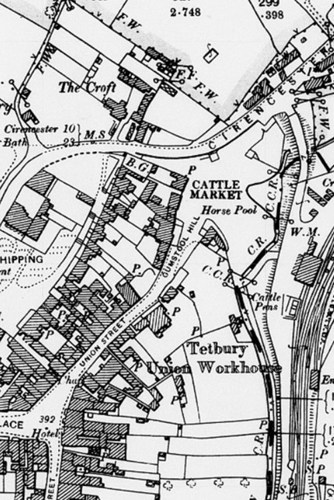
Thought to originate in the 17th century, this involves competitors drinking beer then running up the steep Gumstool Hill in Tetbury carrying a sack of wool! The men’s woolsack weighs 60-pound (27 kg) and the women have 30 pounds (14 kg)! An official race day has been going for over 30 years now on Whitsun Bank Holiday and world records are entered in the ‘Guinness book of Records’. The race events are complemented by a street fair featuring varied stalls, a funfair, musical entertainments, and roving entertainers.
1902 2nd Edition OS map (Courtesy Ordnance Survey via Know Your Place – West of England)