
Introduction
South Gloucestershire has some notable, historic country house estates such as Dodington Park and Dyrham Park. But what was life like for those who lived and worked in these large country houses? If you have ever wondered what life was like on a historic country house estate, now is your chance to explore our records of some of the most important country houses of South Gloucestershire!
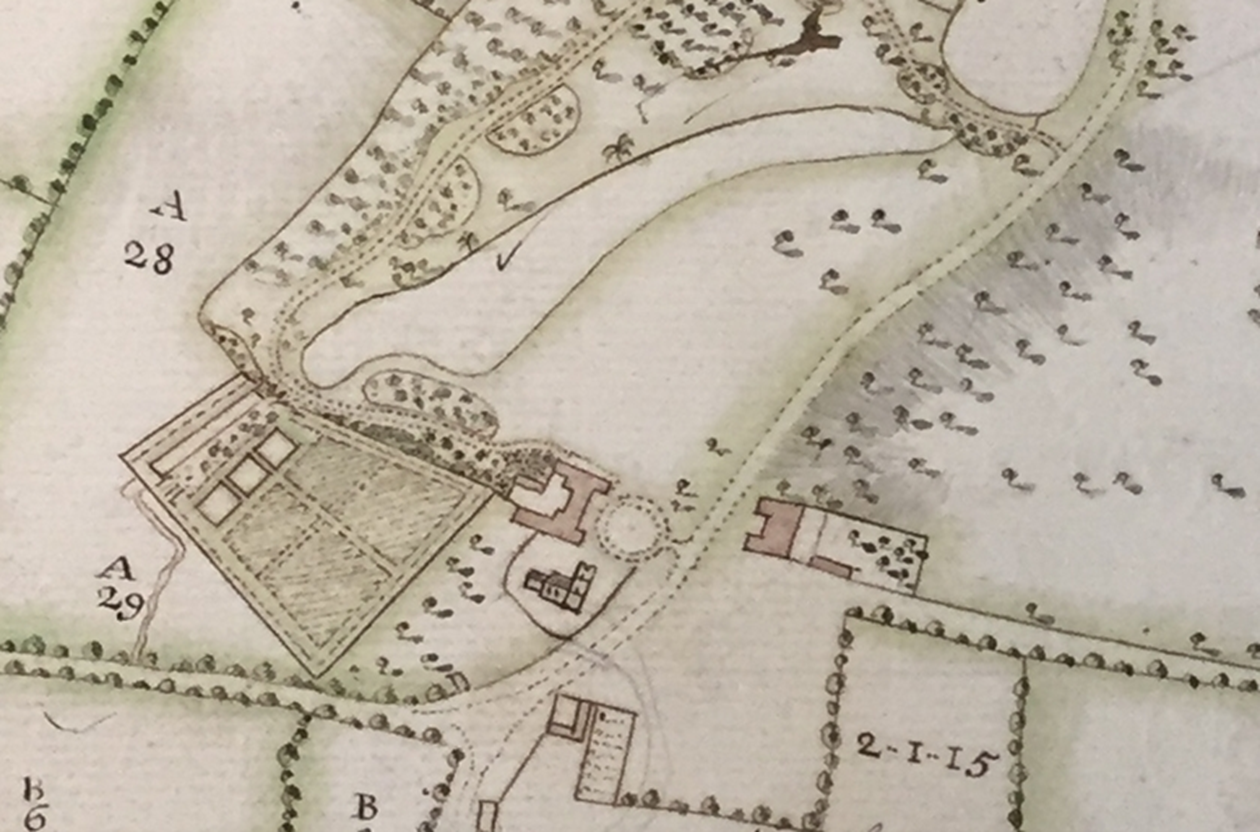
Estate plan of Dodington House
This image comes from the Estate survey of the Codrington Family estate which contains maps of the manors of Marshfield and Dodington, lands in Old Sodbury and Yate and the family’s slave estates in Antigua. The maps were drawn between 1768 and 1771 and this section shows the old Dodington House, the adjacent church and part of the Park. It is included here to show that when these country houses were remodelled, the old buildings were very often totally demolished and new footprints were created. As such these old maps provide a snapshot of what was present before as today, little or nothing survives. This map was surveyed by James Maule and also gives tenants' names, field-names and acreages, making it very useful for family and local historians. James Maule is reputed to have been an illegitimate son of Viscount Maule, 1st Earl of Panmure. He came from Brechin, Scotland and, after making this survey, founded a nursery at Filton, becoming known mainly known as a gardener, rather than a surveyor.
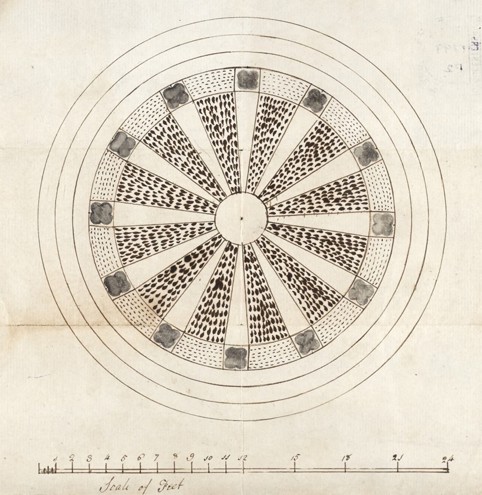
Plan of a flower bed at Dyrham Park, c.1715
Gardens fell into two categories; formal gardens and kitchen gardens. While the latter were usually hidden away within walled enclosures, the former were often lavish and always on full display for residents and guest to stroll through at their leisure. Formal gardens were often planned down to the last detail; as shown by this plan of a flower bed at Dyrham Park. Such work often had input from famous garden and landscape designers of the time such as Lancelot ‘Capability’ Brown, William Emes, William Kent, John Webb and Humphry Repton (Dyrham). Sadly, although plans of these gardens have sometimes survived or can be gleaned from estate maps and plans, the planting regime rarely does and we have few indications of what plants were grown.
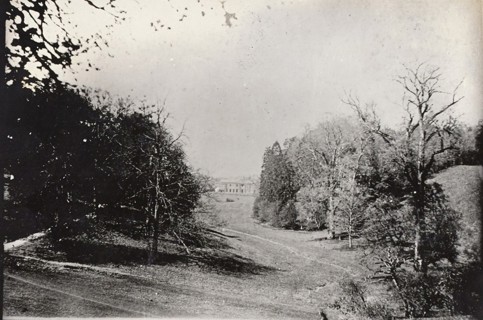
Grounds of Dodington House
This image comes from an album of photographs taken between 1883 and 1917. This particular view, looking roughly south-west from near Coomb’s End, shows the scale of landscaping that could be undertaken. The edge of one of the twin lakes can just be made out in front of Dodington House. Known as ‘rides’ – simply because they offered scope for riding horses along - these long open access ways often provided sweeping vistas of the landscape and also of the country house, a relatively easy way of demonstrating wealth.
Plan of Dyrham and Hinton with West Littleton
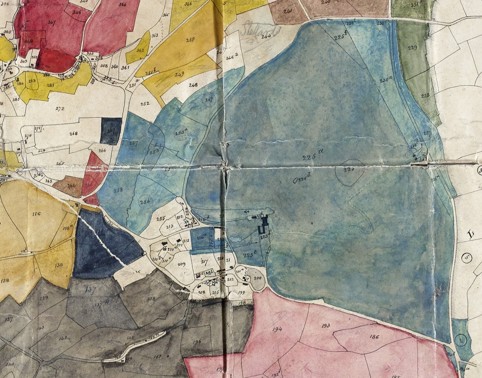
The blue section in this image shows the extent of the parkland at Dyrham and is taken from an 1844 estate map drawn for the estate. The area was surveyed by Thomas Weaver of Bath and the full map shows the whole of the parishes of Dyrham and Hinton and West Littleton. Tenants' holdings and their farms are shown in different colours, although there is little other detail.
Dyrham House estate was a relatively small estate – about 4,500 acres or 7 square miles. The Badminton estate is around 52,000-acres – nearer 81 square miles!
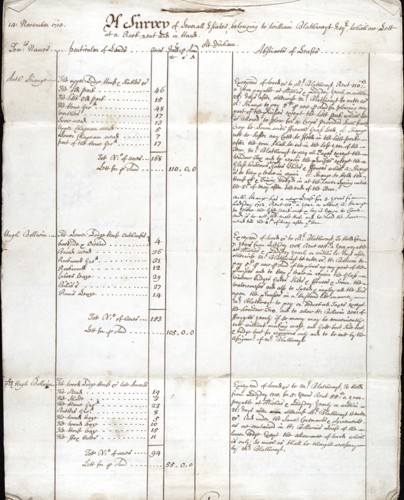
Estate survey
Estate surveys were undertaken at fairly regular intervals and can contain a wealth of details, although sometimes the information is fairly basic. This survey of the Dyrham Estate in November 1710 is one of the more comprehensive surveys and provides information on tenants, buildings (including new or repaired ones), field names and the rents paid.
Photograph album of the Codrington family of Dodington Park
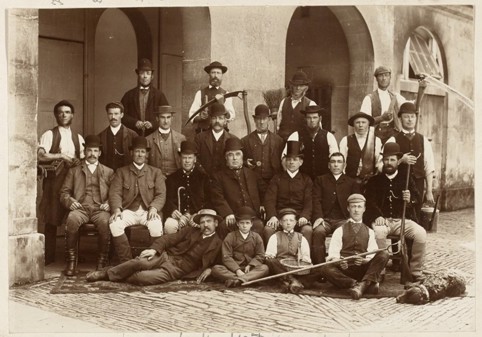
This wonderful photograph shows the outdoor estate workers of Dodington Park in 1890. As well as being good quality, what helps make it one of the jewels in the Archive’s crown is that all those shown are named (with one exception) and their roles are identified – an all too rare occurrence.
On the back row (from left to right) are; Jenkins (blacksmith), Balman (cowboy), Selman (gardener), C. Woodman (stableman), W. Uzzle (gardener), Williams (keeper), W. Greenaway (Head Gardener), W. Chandler (gardener), Hurcom (carter), J. Angell (woodman), J. Uzzle (Park labourer) and T. Woodman (gardener). In the middle row are; J. Fitchew (keeper), R. Payne (keeper), J. Fitchew (Head Keeper), H. Woodman (no occupation given), H. Hilsom (Groom), A. Tanner (helper), R. Sweet (keeper – with shotgun). Finally, in the front are: Perry (cowman), White (stable boy), Jenkins (gardener) and lastly the only unnamed man, who was listed as a gardener.
Some of the men are holding tools relevant to their role; including English scythes (and well-worn boat-stones for sharpening), a wicker basket, a nail tray with horseshoes, a saw, a watering can, a besom, a Dutch hoe and a shotgun with outside hammers. The only unknown item is a wooden truncheon like object with a metal cap that is being held by William Greenaway, the Head Gardener. If anyone knows what it might be please let us know!
Ice House at Dodington Park
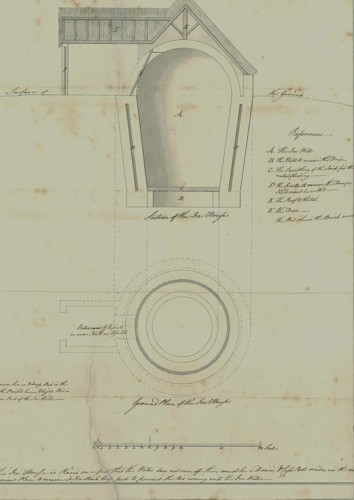
Before refrigeration, using ice was the only way to cool things, so country houses often had ice-houses to store ice year round. These were underground pits or tunnels with small entrances that were filled with ice/snow in the winter from where it could be taken as required for the rest of the year. This is the plan of the ice house at Dodington House which was drawn by Capability Brown, the famous landscape architect and gardener. It was conical in shape and utilised cavity wall construction in brick with a brick dome over the top. The dome itself had a timber and hatch roof to keep the sun off and so it could be wetted in hot weather to enhance cooling. This ice-house also had a bottom well that acted to catch melting water. Although it is not known for certain whether Capability Brown was employed to build it, it’s known that the roof was subsequently altered to accommodate a dovecote which is still present.
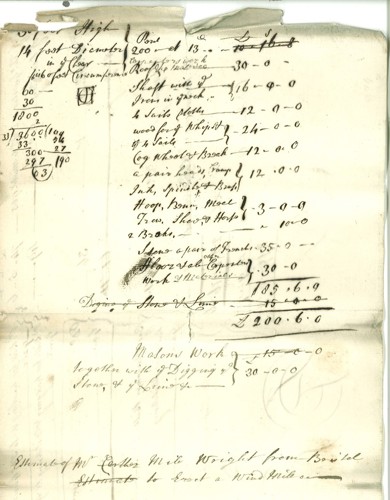
Estimate for a corn mill, Badminton estate
When required, estates would fund specialist buildings, such as sawmills, watermills and windmills. This document from the Badminton estate details the costs involved to build a corn mill in 1766 and was prepared by Mr Carther, a Bristol based millwright. This mill was to be a windmill, as one of the entries is for ‘4 sail cloths’ costing £12 (about £1,200 today). The mill tower was to be 30-something feet high and 14 feet in diameter and use a pair of ‘French stones’ costing £35 (£3,500 today to grind the corn). The ‘French stones’ were probably French Burrstones; a composite grinding stone, made up from blocks of chert in a cement matrix held in place by shrink-fit iron bands. Despite being more expensive than the traditional solid Derbyshire ‘Grey’ stones, they were popular because they needed less re-cutting than solid ‘Grey’ stones and were less prone to discolour the flour, resulting in a much whiter product. They were named ‘French stones’ because originally they came from the Marne Valley in northern France, although some were also manufactured in England. The whole mill was priced at over £230 (around £24,000 today); a considerable investment.
Estimate for a water mill, Badminton estate
As well as erecting new buildings, older buildings had to be repaired and or modernised. This is part of an estimate for replacing the machinery in a water mill on the Badminton estate. Accompanying documentation indicated that the water wheel was to be 2ft wide and 18ft in diameter (0.61m by 5m). The stones were to be 4ft 8ins (1.42m) in diameter and interestingly one was to be a composite ‘French’ stone and the other Welsh – presumably a one-piece solid stone. The total cost was £110 (£11000).
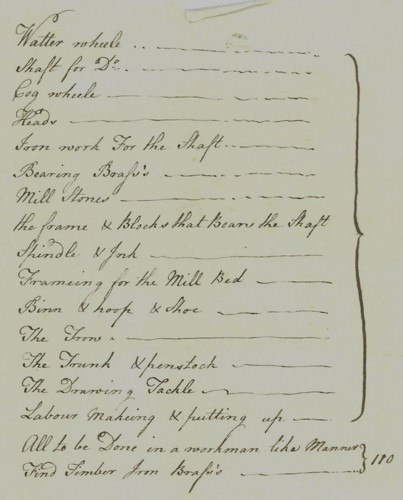
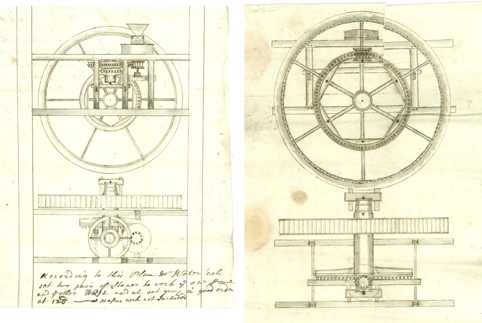
Diagram of water mill machinery
These are plan and side elevations of two options for the arrangements of the machinery that was to be used in the water mill. The side elevations are at the top and the plan views at the bottom. In both drawings the large circular wheel is the pit-wheel rather than the actual water wheel and the drawings show two different possible arrangements for the drive train and the grinding stones. The left hand drawing shows an offset grinding stone (with the triangular grain hopper being visible) while the drawing on the right side shows the grinding stones set directly above the wheel shaft. There are many variations of mill machinery but typically, as a waterwheel rotated the motion was transmitted through the wheel-shaft to the ‘pit-wheel’, which was the first gear wheel and set inside the mill. This drove a smaller bevelled ‘wallower’ which in turn drove the ‘spur wheel’ which turned a ‘lay shaft’. As the lay shaft rotated a ‘crown wheel’ or ‘drive wheel’ turned a ‘stone nut’ which rotated the runner stone (the upper millstone). A typical waterwheel rotated at about 10 revolutions per minute (r.p.m.) but by the time this had passed through all the gears, the speed of revolution had increased so that the runner-stone rotated at about 120 r.p.m.
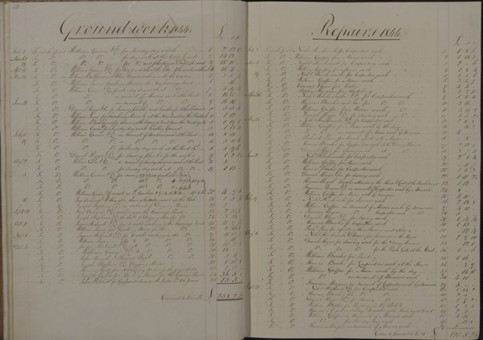
General estate accounts, Dodington Park
All estates kept good accounts usually in bound volumes, showing summaries of receipts, expenses on garden and repair work, as well as house, stable and farm payments. Some kept separate household and estate accounts while others combined them. At the same time, some produced annual accounts in separate books while others had multiple years in the same volume. This is one such example of the General Estate Accounts from the Codrington Estate. It shows summaries of receipts, and expenses on garden and repair work, with briefer entries for house, stable and farm payments.
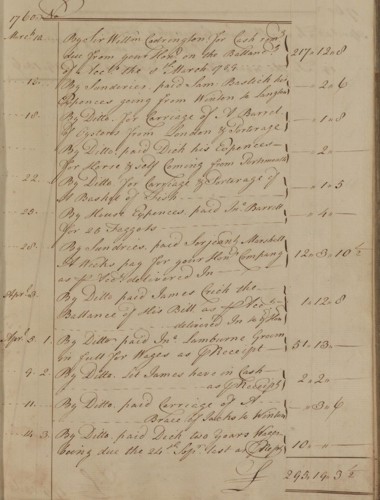
Details from general estate accounts, Dodington Park
This page, from the same set of Codrington estate accounts for March-April 1760, contains details of expenditure with the most interesting being: Travel expenses for John Bastwick going from Winton to Langton, 2s 6d (£11 in today's money); Carriage of a barrel of oysters from London & porterage, 1s 8d (£7); Paid Dick his expenses for horse & self coming from Portsmouth, 2s (£8); Carriage of a basket of fish from Portsmouth & porterage, 1s 5d (£6); 26 faggots for the house, 4s (£18); Delivery of a brace of sacks, 3s 4d (£15) and Paid Dick 2 years wages, £10 (£873). Perhaps the most intriguing entry is ‘By sundries, paid Sergeant Marshall a weeks pay for your Hon.Company as if delivered receipted; £12 8s 10½ d’ (approx. £1,100), which was probably pay for a militia company.
Housekeeper's monthly accounts, Dodington Park
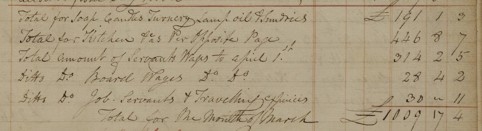
This again comes from the general estate accounts. It gives the summary total for the month of March, 1815:
Total for soaps, candles, turnery, lamp oil, sundries £191 1s 8d Total for Kitchen as per opposite page £446 8s 7d
Total amount of servants wages to April 1st £314 2s 5d
Ditto ditto Board wages ditto ditto £28 4s 2d
Ditto ditto job servants & travelling expenses £30 - 11d
Total for the month of March £1009 17s 4d
This is approximately £52,000 in today’s money!
Housekeeper’s monthly accounts for kitchen, Dodington Park
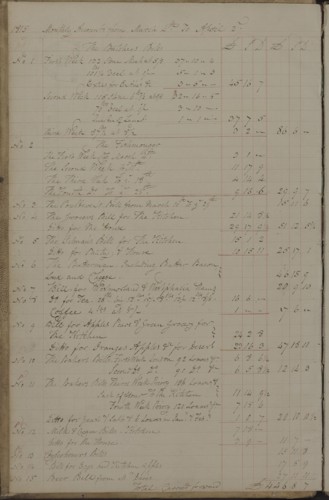
This follows on from the previous image and although feint, it shows the breakdown of the £446 8s 7d of food purchased for the month! It includes:
Butcher’s bill for store meat, veal entrees and lamb, £86 6s;
Fishmonger (no fish named) £29 9s;
Poulterer £15 11s 6d;
Grocer (kitchen & house) £51 12s 5½ d;
Oilman (kitchen & house) £25 17s 1d;
Butterman (including bacon, lard & cheese) £46 15s 9d;
Westmoreland & Westphalia ham £20 9s 10d;
Tea 16s 6d; coffee £1;
Apples, pears, oranges, and desert apples £47 18s 4d;
Baker’s bills (309 loaves, 1 sack flour, yeast & salt) £20 10s 10d;
Milk & cream (kitchen & house) £11 7s;
Confectioner’s bills £15 11s 8d,
Eggs & kitchen apples £17 5s 9d
And lastly...
Beer bill from Mr Davis £37 11s 11d.
A birthday banquet, March 1826
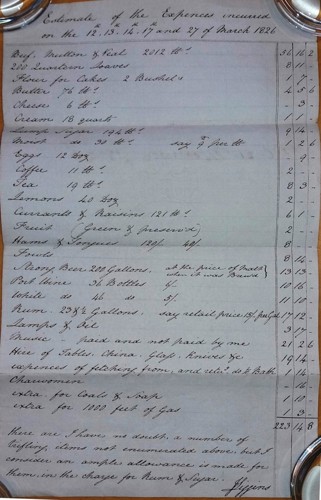
This five-day banquet to celebrate the 21st birthday of Sir Christopher William Codrington in March 1826 cost a staggering £223 14s 8d (around £13,000 today)! The quantities of food involved are equally astounding – just under a ton of beef, mutton and veal, followed by 200 loaves of bread, 76lbs of butter, 194lbs of sugar and 18 quarts of cream! In addition, there’s all the usual party things; flour, eggs, lemons (40 dozen!), currants & raisins, fruit (green and preserved), hams & tongues, fowls, tea and coffee. Oddly, only 6lbs of cheese was purchased. Partying obviously went on into the early hours as £3 17s of lamp oil was used. Tables, chairs glass & cutlery were hired from Bath at a cost of £19 14s (collection and delivery was £1 14s extra) and a charwoman was hired at accost of 16s. Coal and soap cost £1 10s in addition to 1000 feet of gas. Obviously, a 21st birthday party requires alcohol and this starts with 36 bottles of port wine and 36 bottles of white wine – which pale into insignificance when set against the 23½ gallons of rum and 200 gallons of beer!
Gloucestershire Archives reference D1610/A91
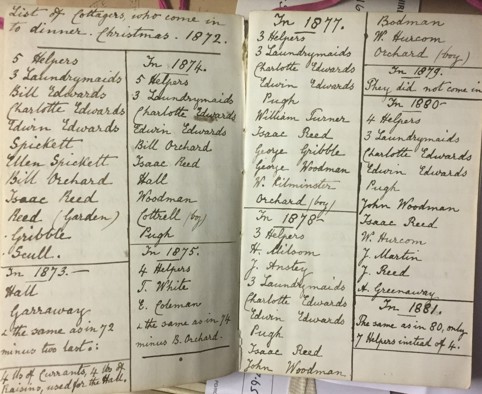
List of Cottagers who came to dinner, Christmas 1872
The Dodington Estate invited local villagers to an annual Christmas dinner. Some appear to be house staff while others are presumably estate workers and their families. For some reason the event did not take place in 1879, as it is recorded that ‘They did not come in.’ – one cannot help but wonder why?
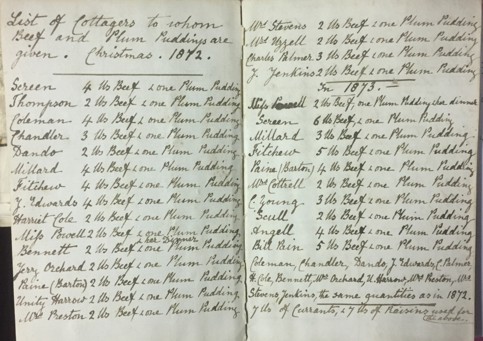
List of Cottagers to whom Beef and Plum Puddings are given, Christmas 1871
As well as inviting cottagers to a Christmas dinner, the Dodington Estate also gave out to other cottagers a Christmas food donation, typically a quantity of beef (2-6lbs) and a plum pudding. In 1872, this amounted to 48 lbs of beef and 19 plum puddings!
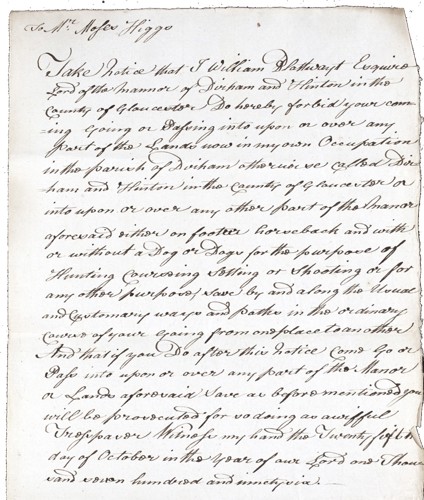
Notices against trespassing on lands at Dyrham, 1796
Poaching was an ever present annoyance to the landed gentry. Estates would issue private ‘Notices against trespassing on lands’ to those suspected of poaching, warning them that they would be prosecuted if caught on estate land. This example issued by the Dyrham estate names Moses Higgs as the offender, forbidding him from entering estate lands ‘on foot, horseback and with or without or a dog or dogs for the purpose of hunting, coursing, setting or shooting or for any other purpose’ under threat of prosecution if caught.
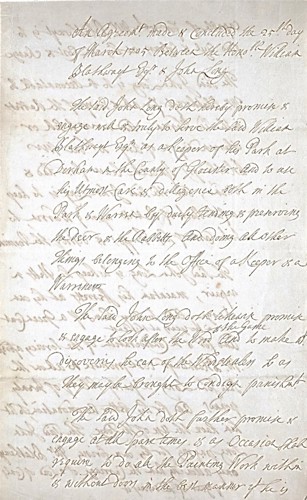
Agreement with John Long to serve as keeper of the park at Dyrham, 1715
To counter poachers, all estates appointed game keepers. This is an agreement with John Long to serve as keeper of the park at Dyrham in 1715, where he swore to use ‘utmost care & diligence both in the park and warrens and doing all other things belonging to the office of a keeper & a warrener.’ The main task was to protect the game – typically deer and rabbits – and the woods (and any felled timber) from thieves and other predators but keepers were also expected to seek out and apprehend trespassers and poachers. He was given an annual wage and use of The Lodge as a home, paying only for his own fires – although he was to receive a ‘load of coal’ once a year.
Photograph album of the Codrington family of Dodington Park
As well as the ‘official’ records of estates, family records can also be found. This is a random page from the Codrington Family’s photograph album, 1883-1917. As well as various views of the house and estate it shows other interesting photographs, including as seen here – World War 1 Belgian refugees.
