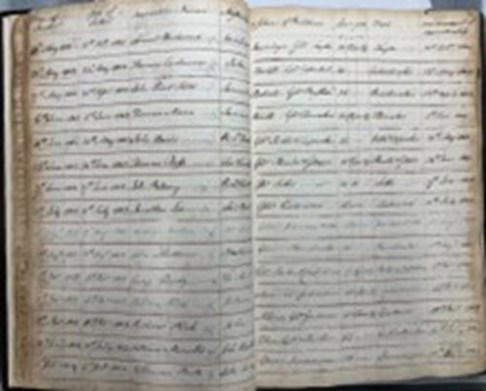
Gloucester Borough apprenticeship register, 1765-1834
Most skilled tradesmen in the past had probably served an apprenticeship. This usually began between the ages of 10-14 and typically lasted for 7 years or until the apprentice was 21. The master would house, feed and train the apprentice, for which they would receive a payment from the child’s parent, legal guardian or a charity such as the parish overseers (usually for orphans or children of paupers). At the end of the apprenticeship, the apprentice would have the skills required for the trade (although not always the tools).
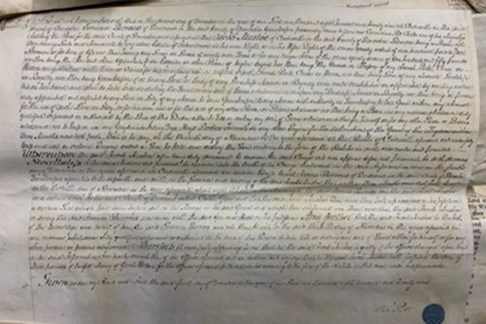
Some apprenticeships were drawn up under an indenture – a legal document containing the terms, cost and duration drawn up as an agreement between the master and parents or guardians of the child. They can often give a lot of information about the family of the child.
Apprenticeship registers survive for the City of Gloucester Corporation (from 1595 to 1834) and for Tewkesbury Corporation (1540 to c1850). They set out the information in columns headed 'Time of Inrollment', 'Date of the indenture', 'Apprentice's name', 'Master's name and place of abode', 'Sum given', 'Trade etc. the apprentice is to learn', 'Commencement of the apprenticeship'.
The use of charity money noted is also given.
GBR/C10/4
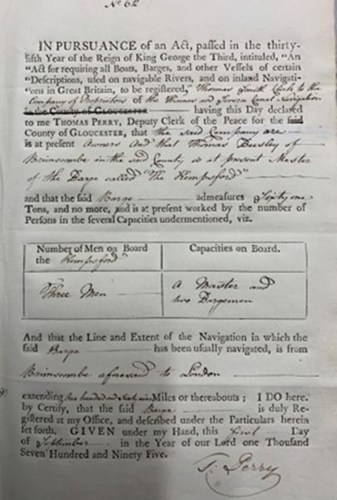
Canal boat register, 1795
The Registry of Boats etc. Act 1795 ordered that all vessels using navigable rivers and canals be registered with the Quarter Sessions. This was primarily so that they could be quickly requisitioned as auxiliary troop transports in case of emergency (such as invasion) in the Napoleonic Wars.
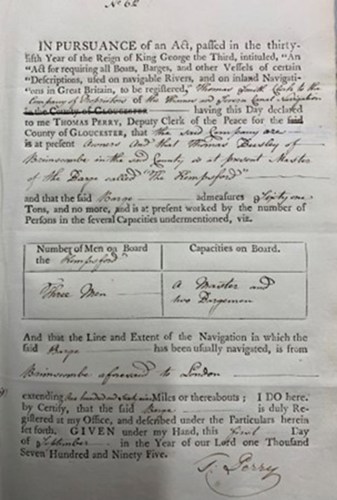
This image shows the entry for the inland barge Kempsford, which was owned by the Thames & Severn Canal Navigation. She was 61 tons and her master was Thomas Beesley, who had two bargemen as crew. She was based at Brimscombe and undertook voyages to London, extending to 169 miles or thereabouts. To achieve this, she would travel east along the Thames & Severn Canal to Lechlade and then lock into the River Thames and continue eastwards downriver to London, a journey that would take from 3-5 days.
Q/RR/1
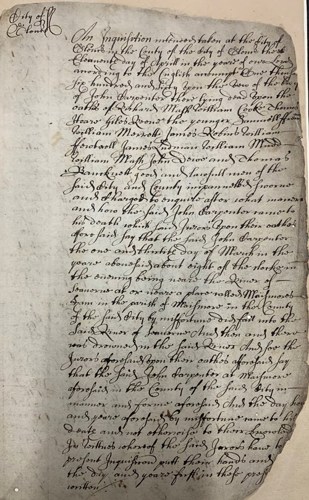
Record of coroners' inquisitions (inquests) for the borough of Gloucester, 1642-1660
This is a page from the borough of Gloucester's Record of Coroners' Inquisitions (inquests), 1642-1660. It shows the inquest into the death of John Carpenter, who drowned at Maisemore 1660.
The office of Coroner began in 1194 and it was the coroner’s task – with the help of a jury of 12-23 people – to investigate any unexpected death, be it unknown cause, accident, suicide or murder.
Before the 1844 Coroner’s Act, there were four Coroners in Gloucestershire who travelled around the county to hear inquests except for the borough towns of Gloucester and Tewkesbury, which had their own Coroners.
After 1844, coroners were grouped into districts, with individual coroners appointed for each district and they only held inquests in their own district. The survival rate of coroners’ records is varied, mainly because many records were sent for salvage during the war years. However, potentially there are: inquest papers, minutes of inquests, registers of deaths and official correspondence.
GBR/G2/1
Quarter Sessions register of debtors, 1868-1879
“Annual income twenty pounds, annual expenditure nineteen nineteen and six, result happiness. Annual income twenty pounds, annual expenditure twenty pounds nought and six, result misery.” Wilkins Micawber, David Copperfield.
People who fell into debt would be served with a court-ordered judgement (requested by their creditor) and failure to pay would result in imprisonment in a debtors’ gaol until the debt was paid.
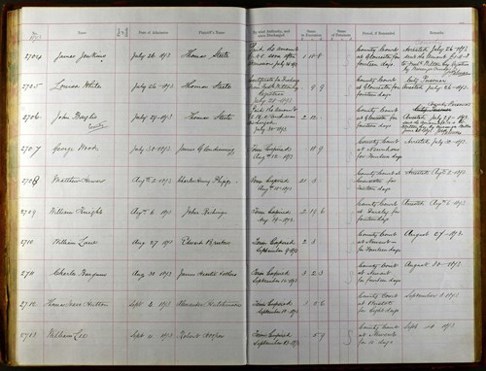
This is a page from the Gloucestershire Quarter Sessions Debtors’ Register for 1873 . It showing the debtor’s name, date of admission, plaintiff’s name, reason for imprisonment, the sum, the term served and remarks.
Debtors’ gaols were usually large, single room cells in town gatehouses or other gaols. During the 1700s/1800s over 10,000 people were imprisoned for debt each year. Aside from the Marshalsea Gaol (famous because Charles Dickens’ father was imprisoned there for 3 months for debt), the most famous debtors’ gaol was the Clink prison, which had a debtor's entrance in Stoney Street. It gave rise to the slang terms ‘in the clink’ and, due to its location, ‘stoney broke’.
The prison term served by the debtor did not alleviate their debt and an inmate was typically required to repay the creditor in full before being released. When the Fleet Prison in London closed in 1842, two debtors were found to have been there for 30 years!
Q/GC/8/2
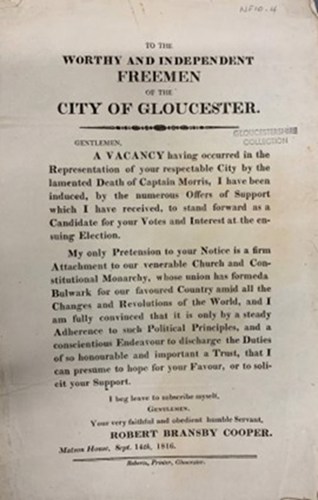
Election flyer for Robert Bransby Cooper, September 1816
Just like today, prospective candidates for local and national elections issued flyers and pamphlets advertising their beliefs and willingness to serve.
This flyer, issued by Robert Bransby Cooper of Matson House, was printed for a parliamentary by-election after the death of the elected incumbent Captain Morris. A self-styled ‘independent’ candidate (though aligned with the Whigs), Robert Morris of Barnwood Court, was first elected as Gloucester’s MP on 7 August 1805 and held the seat until he died on 6 September 1816. Bransby lost this particular by-election to Edward Webb, but went on to win the 1818 General Election and thereafter retained the seat until 1830, when he didn’t contest the election.
Local newspapers always reported the results of local and national elections…some of which were challenged due to fraud. One thing to remember is that elections took place over several days. This meant that results took longer to finalise, and so could take a while to appear in the local press. Another point to bear in mind is that – again like today – newspapers were politically biased.
NF10.4GS
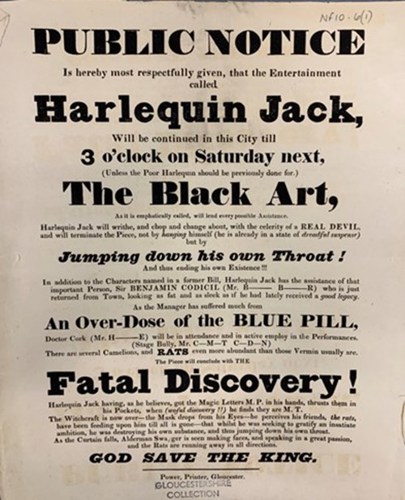
Election poster for 'Harlequin Jack'
Unlike today, broadside songs for candidates featured prominently in early elections but just like today, election candidates and politicians were subjected to satire! This is a poster of an entertainment called ‘Harlequin Jack’ which was to run until the next Saturday at 3pm. W know from the phrase 'Magic Letters M.P.’ in the first line of the bottom paragraph, that this poster must be referring to an election that was running. Sadly we do not know precisely what date, although the poster is thought to date to 1820.
NF10.6GS
Poll book for the election of 1780
Want to see how an ancestor voted? Look at the Poll Books. These are lists of voters’ names, recording the candidates for whom they polled – this is an example for 1780 General Election (narrowly won by Lord North’s ‘Tories’ against the liberal Whigs) for the City of Gloucester, although the addresses given are from Uley and Dursley. Prior to the introduction of the secret ballot in 1872, electors had to attend elections in person and verbally state their vote – at noisy, boisterous and unruly hustings and from the late seventeenth century onwards, these votes were increasingly a matter of public record. Not too many survive but they are always worth a look!
D9125/1/3952
Gloucestershire Court of Sewers general minutes, 1583-1607
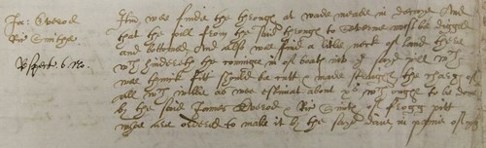
Over the years there have been many floods in many areas of the county; the most famous being in 1947, 1964 and 2007. The largest single collection relating to flood defences is the Gloucestershire Court of Sewers, which from the 1500s oversaw the maintenance and repair of drainage works near the River Seven from King Road to Longney on the east bank and in Awre and Westbury on Severn on the west bank. The 'presentments' to the commission comprise orders for the cleaning and repair of various types of water channels and maintenance and repair of the sea wall. The presentments have a nomenclature all their own, water channels for example are classified as being ‘reens’ (a drainage ditch), ‘gouts’ (artificial ditch or channel) or ‘pills’ (a tidal creek or stream, usually capable of holding a small barge or vessel) while a ‘through’ refers to a sluice. The presentments typically name those responsible for the repairs, the extent for which they are responsible and the date by which they should be completed, usually on pain of a fine or having it done at their own expense. Repair materials and cost are also sometimes recorded in the minutes. Details of rates levied are also given, with the acreage rated and amount due from each tything. The extract shown here is typical and orders the straightening of a channel at Berkeley Pill.
Item we find the through at Wade Meade in decay and that the pill from the said through to Severne must be digged and bottomed. And also we find a little neck of land there which hindereth the coming in of boats into the said pill, which we think fit should be cut and made straight. The charge of all which will be, as we estimate, about 10s. Which ought to be done by the said James Everod & Richard Smith of Frogg Pitt who are ordered to make it by the said day in pain of 20s.
D272/1
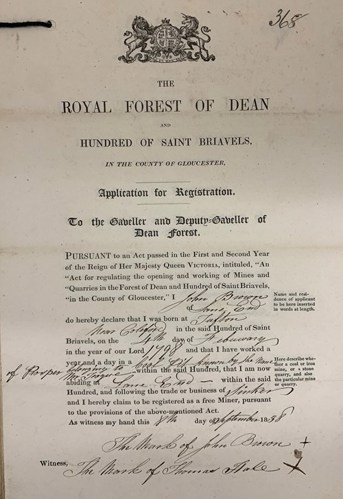
Forestry Commission - application to be registered as free miner, No.368
Since the 1300s, under a royal decree, any man over 21 born within the Hundred of St Briavels who has worked a year and a day underground can become a freeminer. Freeminers have the right to mine coal, iron and stone anywhere within the Hundred of St Briavels. To open a personal mine or ‘gale’ the miner must apply to the Forest Gaveller, the official who represents the Crown (as the Forest of Dean is a Royal Forest). This image is an application to be registered made by John Brown of Lane End, near Coleford, who had worked for a year in nearby Prospect pit and wanted to open his own. Interestingly he gave his occupation as a ‘sinker’ – someone who excavated mine shafts from the top down, where there is initially no access to the bottom – rather than a miner. Known as ‘drift mines’, most Forest mines are worked by just one or two miners. However, because the Dean Forest Mines Act of 1838 allowed freeminers to sell their gales to industrial miners, seven larger collieries did exist, the last one closing in 1965. Freemining continues to this day on a small scale.
D5947/1/1/1
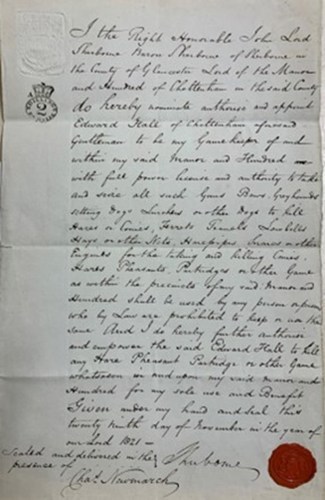
Appointment of Edward Hall as gamekeeper to Cheltenham Manor, 1821
Gamekeepers were engaged by landowners or estates to prevent poaching, to rear game birds, control predators, manage habitats for game, and to monitor the health of the game. From 1710 onwards, gamekeepers had to registered with the Quarter Sessions and from 1785 they had to apply there for an annual licence.
This is the licence for Edward Hall to act as Baron Sherborne’s gamekeeper on his Cheltenham manor in 1821 and is a typical example. Licensing brought in revenue but was primarily intended to kerb poaching - in which it was largely ineffective. Most gamekeepers lived in tied cottages on the estate where they worked and had the power to apprehend trespassers and suspected poachers and seize all hunting paraphernalia. These records are useful not least as they determine who was the Lord of the Manor at the time of the licence being issued, which can otherwise be hard to ascertain.
D8045/E11/3
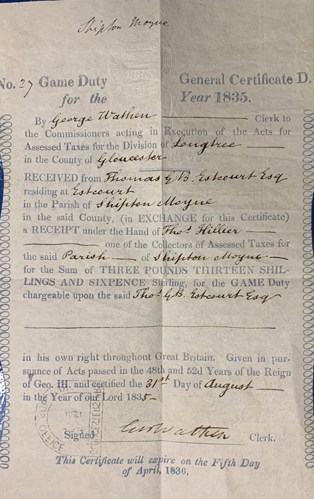
Game duty certificate for Thomas Grimston Bucknall Estcourt of Shipton Moyne manor, 1835
Before the Game Acts of 1784 and 1785, no-one could legally hunt game unless they possessed a freehold property worth £100 a year or a leasehold property worth £150 a year. This essentially restricted any kind of hunting to the wealthy upper classes. The Game Acts introduced licencing for those who wanted to hunt and everyone who kept 'any dog, gun, net or other engine for the taking or destruction of game' whether for sport or in the capacity of a gamekeeper, had to register each year with the Clerk of the Peace, and on payment of a fee, receive a certificate.
This is the 1835 Game Duty Certificate for Thomas Estcourt, owner of Shipton Moyne manor (although he resided mainly at New Park, near Devizes) and M.P for Oxford University from 22 February 1826 – 1847. Anyone caught killing game without a licence or refusing to show their certificate could be fined £50.
D1571/F295
Land tax assessment: annual return for the hundred of Bisley, 1782
Land tax was first introduced in 1692. The amount of tax was decided on the ‘assessment’ principle, whereby the government gave each county a fixed sum (or ‘assessment’) to raise, leaving it to the county to share that out between the county’s administrative units (hundreds, parishes, hamlets and tithings). The records are mostly held within the Quarter Sessions archive. They typically contain names of landowners and the amount of tax owed for the land they owned. Survivals of land tax assessments before around1780 are relatively rare.
Q/REL/1/Bisley/1782
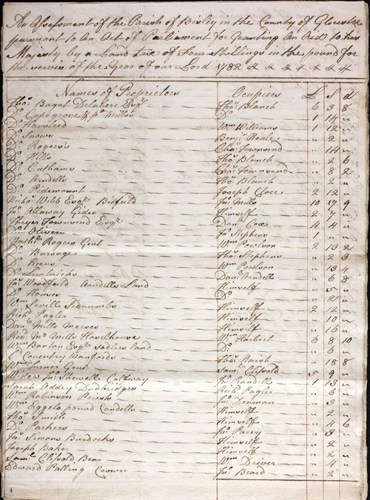
Copy return of number of men liable to serve 'as sent to Mr Wilson', 27th February 1813
The militia was once the principle military reserve force of the Kingdom of England. Militia units were repeatedly raised from the Anglo-Saxon period onwards for internal security duties and to defend against invasions. The 1757 Militia Act re-established militia regiments as the beginnings of a modern territorial force and as a counter to the perceived threat of French aggression. Recruitment was by means of conscription. Men were drawn by ballot from lists of able-bodied men (aged 18-50 from 1758 to 1762, then 18-45 from 1762 to 1831), though drawn men could delegate substitutes to serve in their place.
This image shows a list of the numbers of men that were liable to serve in the militia from the various parishes in the hundreds of Brightwells Barrow and Bradley.
The history of the local militias is quite complex, but full details of the records that we hold can be found in the ‘Sources for Military History’ which you can download from our website.
D1070/VII/66
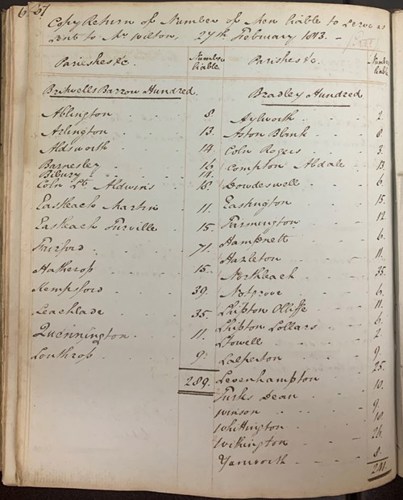
Order for payment to James Stanley's family, Chipping Campden, 1803
When men were called up into the militias, there was a very real threat that their families could suffer hardship due to lack of wages coming in. Because of this, the Overseers of a parish could give money to the families of enlisted men – or the families of their surrogates – and then claim it back from the county, although 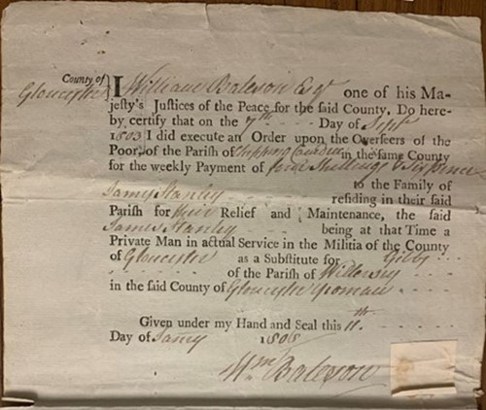 it appears that more frequently the wife of the man in the militia applied to the Quarter Sessions, probably to the local Justice of the Peace.
This example records a regular weekly payment of 4s 6d to the family of James Stanley of Chipping Campden, who had gone into the militia as a substitute for a man called Gibbs of Willersley.
P86/OV/6
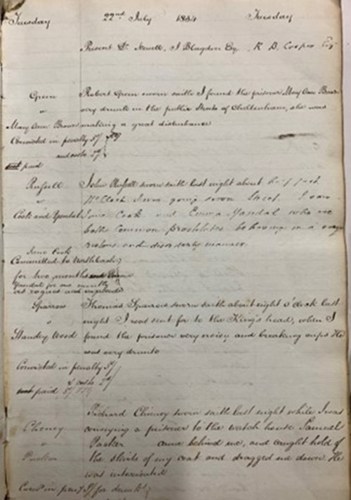
Cheltenham Petty Sessions minute book, July 1834
Petty Sessions courts (now known as Magistrates courts), dealt with minor criminal cases, licensing, and civil matters. The minor crimes dealt with were typically ‘drunk & disorderly’ offences and prostitution – such as those on this page from the Cheltenham Petty Session minute book for July 1834.
We usually hold a good set of records for the various petty session divisions, comprising summary jurisdiction & court registers, minute books (a more detailed account than the summary jurisdiction registers), registers of explosives stores, registers of clubs, registers of the juvenile court and domestic court and alehouse licences. They are arranged in 30 districts based largely on towns. Data protection restrictions will apply to the more recent material.
PS/CH/M1/1
Memorandum of summary jurisdiction for Jacob Mustoe, labourer of Chedworth, 4 December 1829
Of all the reported crimes in a country parish, the most common historically was poaching – the constant battle of wills and wits played out between men determined to put dinner on the table, and the hated landowner and their gamekeeper enforcers. If caught by gamekeepers or police, poachers were dealt with by 'summary jurisdiction' – where a justice of the peace (either singly or with a colleague) could hear cases. If found guilty (and most were) offenders received fines, such as here, when Jacob Mustoe, labourer of Chedworth, was fined £5 for using a gin to kill a hare in Chittle Grove, Rendcomb, when not qualified.
Hares and rabbits were considered as a staple in the country diet and were regularly caught to be made into pies or stews. Gins were small metal foot hold traps that were the mainstay of trapping for gamekeepers, farmers, smallholders, and gardeners in the United Kingdom until they were banned in 1958. With toothed jaws that snapped shut when triggered by an animal putting its foot on a plate, the devices had a chain attached which anchored them to the ground. This ensured that traps could not be dragged or moved by the trapped animal.
It is believed that the name ‘gin’ comes from the word ‘engine’, meaning a device that did not require human intervention to make it work.
Q/PC/2/49/A/12
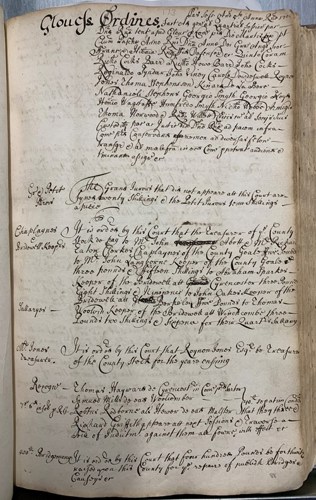
Quarter Sessions order book, 1702-1713/4
One of the largest but least used collections we hold is that of the Quarter Sessions. These were local government and local justice rolled into one until the County Councils were established in 1888 and Crown Courts took over local courts in 1971. The Justices of the Peace who presided over the courts of Quarter Sessions were local men, often appointed from the gentry or church. They were responsible for civil administration in a county and dealt with a range of lesser criminal cases such as petty theft, poaching and assault. More serious cases, such as murder, which might result in the death penalty were passed up to the Assizes court in London. The Justices sat four times a year at Epiphany, Easter, Midsummer and Michaelmas at different locations in rotation.
The Sessions order books are a summary record of the business of the court and of the judgements made. They include information on the appointment of officials (such as constables, coroners, Inspectors of Weights and Measures and customs officials), descriptions of disputes between parishes concerning the settlement and removal of paupers and which parish should be liable for their upkeep, and details of disputes over maintenance in bastardy cases. In addition, they record orders made for the upkeep and repair of highways and bridges together with inspections of gaols and lunatic asylums.
Q/SO3
Port of Gloucester account of voyages and crew of the home trade ship Sabrina, 1869
The Board of Trade Crew Agreements, Lists and Logs, were official six-monthly returns that gave details of the vessel, crew and any voyages made during the preceding 6 months; cargo (not always given); and any births, deaths, and marriages on board. They acted as contracts of employment for seamen serving on a particular ship and provide basic biographical details, such as position on board, last ship, rate of pay, rations to be issued (rarely) and conduct on voyage. The log is not a navigational log but a form in which the master can record any incidents affecting crew, such as desertion or discharge through ill health or death. These papers were filed by the year of voyage and the official number of the ship – and they often survive in excess of 10 or more returns – and so give an unprecedented account of the activity and frequency of its sailings that together with other vessels comprise an irreplaceable history of maritime trading around the Severn Estuary and Bristol Channel.
D3080/11349 Sabrina

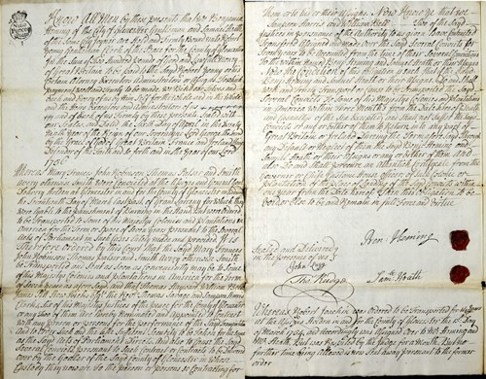
Transportation bond, 1756
Transportation of convicted felons – which was practised from the early 1600s – was a statutory sentence for various crimes and convicts were transported in large numbers to 'some of his Majesty's plantations in America’ (until 1775) and then to Australia (from 1787 to 1840). Contractors were employed to carry out the transportation and they received a bounty, usually £5 per head, from the justices of the peace but they had to deposit a bond – typically £200 – as a surety. The contractors then bound themselves to transport the convicts, to obtain certificates of landing them from the Governor of the colony, and not to allow the convicts to return before the end of their sentence (although exactly how they did this is unknown). This bond is one for the contractors Mr Benjamin Heming and Mr Samuel Heath, for transporting Mary Frances, John Robinson, Thomas Palser and Avery Smith for Severn years on 6th April 1756. The prisoners had been convicted ‘of grand larceny for which they were liable to the punishment of burning in the hand’ but instead they were sentenced to transportation.
Q/CB/1
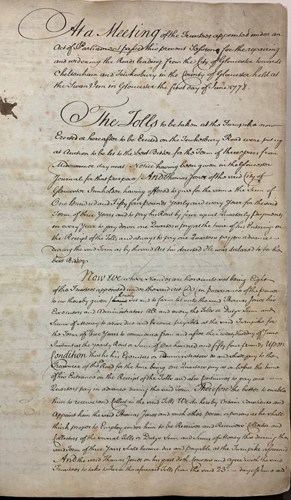
Cheltenham and Tewkesbury Turnpike Trust minute book, 1778-1797
Turnpike trusts were bodies set up by individual acts of Parliament, with powers to collect road tolls for maintaining roads in Britain from the 1600s, but mostly from the 1700s onwards. At the peak of their activity, in the 1830s, over 1,000 trusts administered around 30,000 miles (48,000 km) of turnpike road in England and Wales, taking tolls at almost 8,000 toll-gates and side-bars. In Gloucestershire there were around 60 turnpike trusts, covering the whole county. This is a sample page of the minute book of the Cheltenham and Tewkesbury Turnpike Trust, which record the minutes of trustees under the 1778 Act. These meeting minutes mainly relate to the appointment of trustees, surveyors, toll-keepers and the letting of tolls and they include names of those liable to do statute duty in Wotton, Staverton, Boddington, Uckington, Arle, Swindon, Twigworth, Down Hatherley, Priors Norton, Bishops Norton and Churchdown. They also cover incidental items, such as orders for the erection of weighing machines near the turnpike house at Wotton in 1787 and Kingsholm in 1791. At the end of the volume the accounts of the trust for the years 1778 to 1797 are given.
D204/1/1