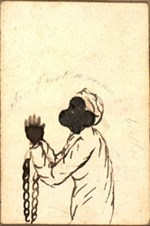
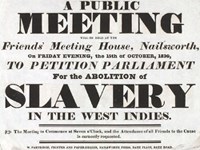
Slavery was a feature of many ancient and traditional societies. However, the enslavement of Africans by Europeans in the 18th century was carried out on a previously unknown scale.
A slave is a person:
- Forced to work - through physical or mental threat
- Owned or controlled - by an "employer"
- De-humanised and treated as a commodity to be bought and sold
- Physically constrained - or who has restrictions placed on their freedom of movement
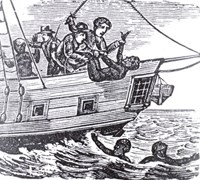
The transatlantic slave trade was the enforced removal of men, women and children from their African homelands to the Americas (both north and south and the West Indies), a journey of thousands of miles across the Atlantic Ocean. The trade developed because of the need to provide labour to work on plantations of tobacco, coffee, cotton and, above all, sugar.
All the major European sea-faring powers were involved in the trade which was based on ancient trading routes. England did not start the trade and played little part in its development, but by the 18th century had come to dominate it. The slave trade brought great prosperity to Britain and other European countries but at an enormous cost - the human suffering of an estimated 12 million Africans.
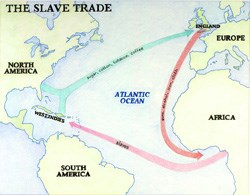
There were three strands to the trade, often thought of as a triangle:
English ships sailed to the coast of West Africa carrying goods such as cloth, iron and trinkets. These were exchanged for enslaved Africans who had been captured inland and taken to the coast where they were held in readiness for the ships
in the notorious "middle passage" of the trade, the slaves were then taken across the Atlantic ocean to the Americas where they were sold to plantation owners
the ships then returned to England with luxury produce from the plantations such as tobacco and sugar.
Download a list of related documents (PDF, 46.4 KB) and a timeline of events (PDF, 78.9 KB) leading up to the abolition of slavery.