
Let's go for a Beer!
If there’s one thing you cannot say about Gloucestershire it is that it was a ‘dry county’. William Marshall, the 18th-century English agriculture writer, once wrote that while farm workers of Gloucestershire were ’simple, inoffensive, unintelligent and slow’, they were ‘shamefully exorbitant’ in their drinking abilities, which he alleged extended to 6 quarts a day or more!
Search for ‘brewery’ on the archive catalogue and you’ll get over 5,500 hits – search for ‘inn’ and you get over 8,000! With that many records relating to brewing, breweries and inns/pubs, it's amazing that anything got done in the county at all. This presentation will look at some of the records pertaining to brewing, cider, spirits and wine. Cheers!
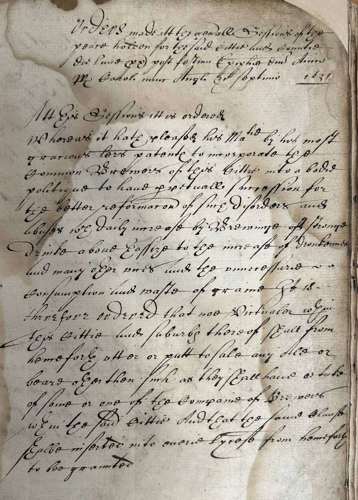
1. Order not to make malt without a licence, 1631
GBR/G3/SO/3
Raw materials for beer are barley, hops, sugar, yeast and water. The first stage in brewing was malting – where barley grains are seeped (soaked) in water and then spread on a floor until they germinate (releasing enzymes), whereupon the grains are dried in a special kiln, known as a malt house, or maltings. The early 1600s saw the Northern Hemisphere entering the ‘Little Ice Age’, which ruined grain crops and caused poor harvests across consecutive seasons, forcing massive food inflation. Because malting used grain that could otherwise be used for making bread, when there was a poor harvest, ‘maltsters’ could be ordered to stop making malt. In 1631, the Gloucester Borough passed several such orders – including this one; ordering that ‘Luke Nurse, Henry Holman, Robert Taylor, Richard Edwards and Henry Mercer make no more malt without a licence.’
2. Earliest reference to drink – Grant of lands c1190
GBR/J1/87
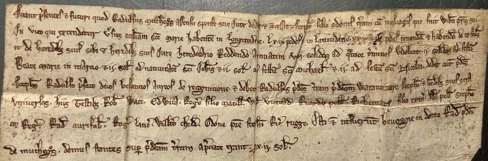
The earliest reference to drink in the archives is found in this c1190 grant from Ralph Muchegros of the ‘land and messuages that belonged to Wilbert, father of the said Ralph, in the street going towards the church of St. Mary’ to Stephen, son of Odo. There were 13 witnesses and the reference to booze comes because when the grant was signed, everyone was ‘present at the drinking in the house of the said Ralph Muchegros’ – written as ‘beveragie in domo Ralph Muchegros’ on the right of the penultimate line and left of the bottom one. Cheers!
3. Order not to make ale or beer unless a member of a guild, General Sessions of the Peace for the City of Gloucester, Epiphany 1631
GBR/G3/SO/3
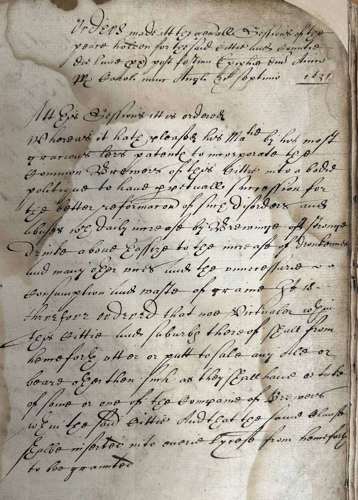
At the General Sessions of the Peace for the City of Gloucester, Epiphany 1631, an order was passed limiting the amount of beer that could be brewed in the city – aimed at curbing excessive drinking! It stated that ‘For better reformation of the increasing disorders and drunkenness caused by brewing strong drink and the unnecessary consumption and waste of grain it is ordered that no victualler in the city or its suburbs shall sell ale or beer other than that they shall make within one of the Company of Brewers of the city.’
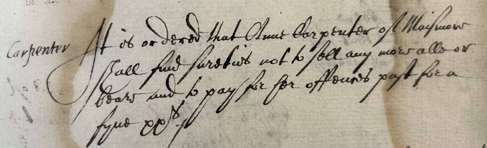
4. Order against Anne Carpenter, Gloucester Borough Quarter Sessions recognizances and orders for 1630
GBR/G3/SO/3
Brewers who broke the assize faced public punishment, recurring licensing fees, asset forfeiture, or judicial fines called amercements. This is an entry in the Gloucester Borough Quarter Sessions recognizances and orders for 1630 ordering that Anne Carpenter was ‘not to sell ale or beer and pay 20s for past offences’, so clearly, she was a repeat offender! The 20s is about £120 in today’s money.
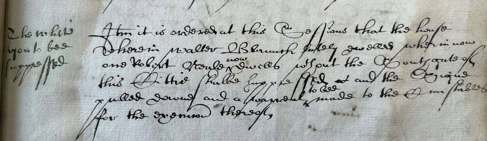
5. ‘Sign of the White Lion to be pulled down’, General Sessions of the Peace for Gloucester, Epiphany 1632
GBR/G3/SO/3
As well as fines and public punishments offenders could lose their licenses altogether – at the General Sessions of the Peace for Gloucester at Epiphany (January) 1632, it was ordered that the White Lion, run by the innkeeper Richard Neale was to be supressed and the sign pulled down by the city constables.
‘Item it is ordered at these Sessions that the house wherein Walter Blaunch lately resides and wherein now one Richard Neale now dwells without the Southgate of this citie shall be supressed and the Signe pulled down by the constables.’
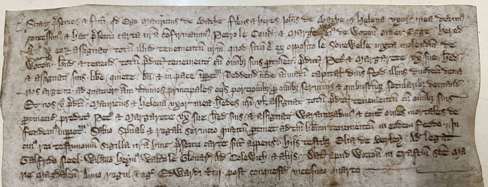
6. Earliest inn deed, c1350
D1193/16/1
The earliest original record in the archives relating to an inn is this deed from Wotton-Under-Edge, dating to 1350 – there are some earlier ones, but these are copy deeds made in the 1700s. This records that on 23 July Maurice & Joan de Bath granted a messuage at Sinwell, near Cloud Mill to Peter & Margaret le Couk. The building on the site was later known as the Tan House (presumably a tannery) but later became The Ram Inn.
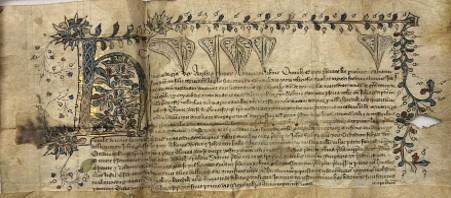
7. Royal Licence for an Inn & a cemetery, St. John the Baptist Parish, Gloucester, 1407
D3117/61
This is a Royal licence of November 1407 granting land near the church of St John the Baptist in Gloucester to build an inn and make a cemetery – it is the earliest record in the archives for building an inn. The fee was paid by Robert Bateman, parson of the church, on behalf of Thomas Barse of Gloucester, while it was witnessed by the churchwardens John Foliot and Richard Bore, and parishioner's John Bisle, John More, Thomas Dyster and John atte Halle.
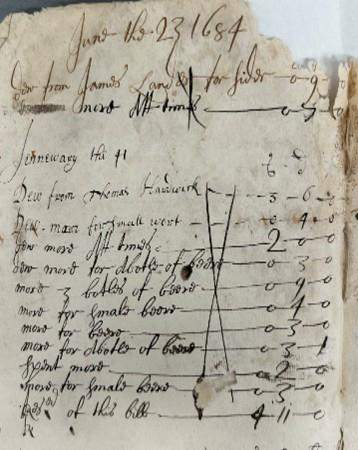
8. Accounts of a Westbury-on-Severn beer-seller, 1684
P354/MI/2/3
Just like today – beer sellers were businesses. This is a page from the accounts of a Westbury beer-seller – possibly called John Hunter – for ‘Jennewary’ in 1684. It’s a rather scrappy bill book but includes bottled beer, small beer, cider, tobacco and grain. Small beer was a weak beer brew used as a general daily drink for adults and children, primarily because local water couldn’t be trusted. It also lists ‘small wort’ - wort is the liquid extracted from the mashing process and ‘small wort’ refers to small volumes (1-3 gallons) that was used in home brewing. Although the seller has itemised the prices, sadly he hasn’t included the quantities. It seems that this page lists the amounts sold in over a month. So, for example, Thomas Hardwirk, at the top of the list, purchased £3 6s of something. In today’s money, that is about £378 – that’s a lot of beer!
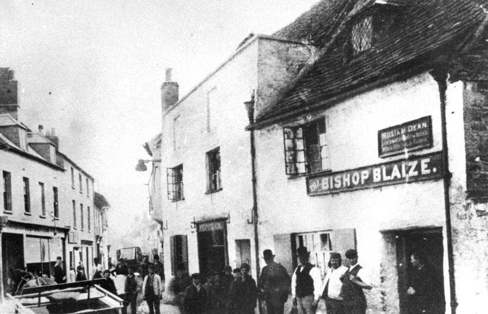
9. The Bishop Blaize Inn, Cirencester, c1900
GPS/86/100
This is ‘The Bishop Blaize’ inn in Cirencester, c 1900. The odd name seems to originate from Saint Blaise of Sebastea, who was the patron saint of wool combers and wool workers. The landlord was William Dean, who was had a standard license that allowed him to sell beer, wine, spirits and tobacco.
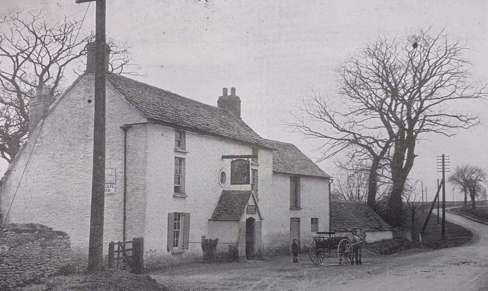
10. The Three Magpies, Meysey Hampton, 1910
Cheltenham Chronicle & Gloucestershire Graphic, 1910
Sadly, derelict today, this was on the London Road near Meysey Hampton, between Poulton and Fairford and was built in 1830 to serve passing traffic. It was a tied house owned by Cirencester Brewery and was unique in that it was located at the most northerly point of Wiltshire – it was said that one end of the bar was in Wiltshire and the other end in Gloucestershire!
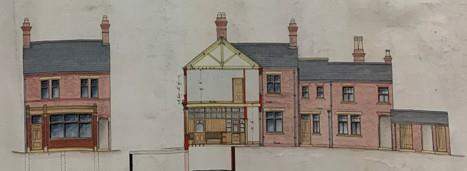
11.Elevation and section of The Oddfellows Arms, Tewkesbury, 1897
D2079/VI/15
Originally known as The Abbey, this was located on the eastern side of the High Street between Trinity Street and (Old) Sun Street. It sold beer from the Crown Brewery in Gloucester, which traded as Gardner & Branch. In 1856, the landlord was fined by Tewkesbury quarter sessions for allowing drunkenness on the premises.
12. The New Inn, The Camp, Miserden, c1900
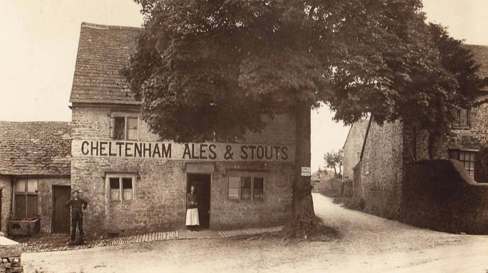
GPS/219/31
Taken c1900, this is The New Inn, a classic two-storey Cotswold stone building that was built in 1694. Standing on the busy crossroads in the village it was recorded as a public house from 1781 until it closed in 1939. Curiously, the outhouse on the left was once used as a Baptist chapel!
13. Sales Particulars The Pelican, 1890
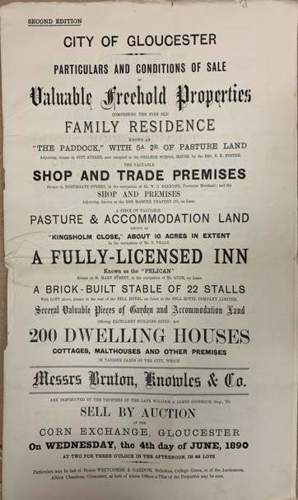
D3117/3662
The earliest reference to The Pelican is from 1679. In the 1850s, it brewed its own beer- possibly on the upper floor. These sale particulars for a ‘fully-licensed inn’ are from 1890 when it was sold by the landlord Alfred Gyde, who was retiring. One rumour about the pub is that some of the timber beams come from Sir Francis Drake’s ship, the Golden Hind – it is probably a folk-tale, but may have some truth in it, for when Drake set off on his global circumnavigation in 1577, he did so on a galleon called Pelican, which was renamed to the Golden Hind mid-voyage!
14. Grant of a moiety of the land, Gloucester, c1200
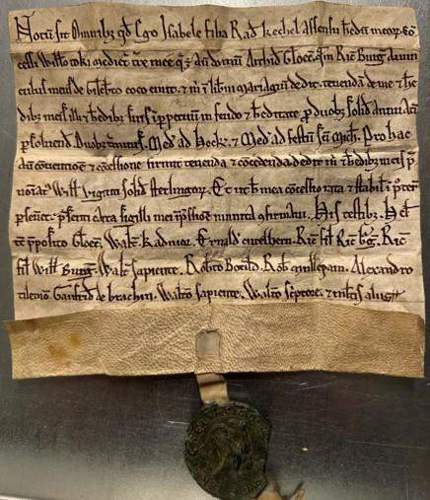
GBR/J1/114
The earliest reference to a brewery in the archives is this Grant dating to around 1200. It comes from Isabelle, daughter of Ralph Kechel, to Geoffrey of the Brewhouse (de Brachino) of a moiety of the land before the house of the Archdeacon of Gloucester, which Richard Burgess, her uncle, bought of Gilebert the Cook and gave her in marriage. Geoffrey appears in two other deeds of this time, and these reveal he was obtaining land in the same area, presumably to extend his brewing operation.
15. Plan of site of Albion Brewery from Abstract of title, Cheltenham, 1747
D2216/Box 53/11
This was opened in 1747 by John Curtis Vipan as a malthouse and brewery. By 1826, it was owned by Richard Masters Christie & Co., who were trading as porter, ale, and table beer brewers. By the late 1860s, it was owned by Messrs Harris & Leighton, and it was supplying beer to at least eight tied pubs across the town. It ceased operations and was demolished around 1873, when the site was redeveloped to serve as Cheltenham’s Cattle Market.
16. Sales Particulars for Forwood Brewery, Minchinhampton, 1897
D2299/2/6/30
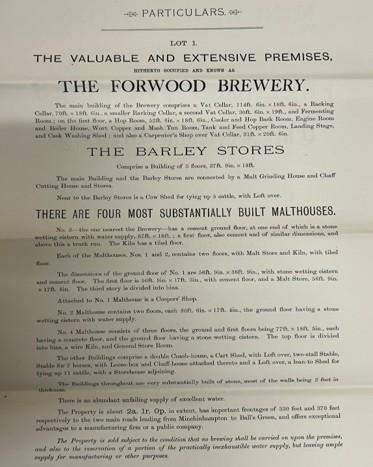
This brewery was founded in 1809 by George Playne, and it grew quickly – helped because it was close to a spring, that provided an ample water supply. In 1830, a survey for the Minchinhampton Poor Rate assessed that the site – which had a house, bakehouse, brewery, malthouses and stables, was valued at £9. When George died in 1847, the brewery continued under his sons and then his grandson, Edward. In 1897, Edward sold to Stroud Brewery Co. (of which he was a director) at which time, the Forwood Brewery had 30 tied houses, many in the town but some as far away as Wotton under Edge and Bisley.
17. Demise of land, Gloucester, 1210
GBR/J1/119
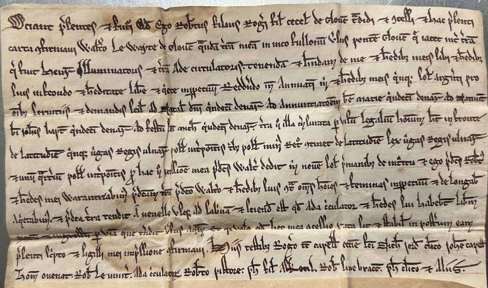
The earliest reference to wine in the county archives is in a demise dated to 1210 from Robert, son of Cecel of Gloucester, to Walter Wayte of Gloucester. It concerns a parcel of land in the Walkers’ Street that lay between the land formerly belonging to Henry the Limner (a painter or illuminator of medieval manuscripts) and the land of Adam the Hooper. This document has ten witnesses, including ‘Robert the Vintner’ – a vintner was a person who makes wine or a merchant who buys and sells wine. It is likely that ‘Walker’s Street’ refers to a street where cloth fullers operated. Walter Wayte may have been a musician, as the word ‘wayte’ often referred to players of musical instruments.
18. Borough Quarter Sessions order against vintners, Gloucester, 1632
GBR/G3/SO3
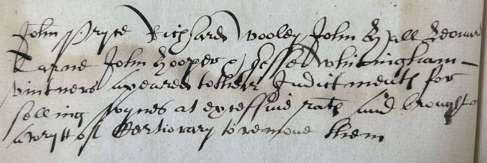
Overcharging for booze isn’t new – in 1632, the vintners John Pryce, Richard Wooley, John Hall, Leonard Tarne, John Hooper and Jesse Whitingham, were brought before the Borough Quarter Sessions for selling wine at excessive rates. The court ordered a writ of certiorari for the Borough’s petty sessions court to send up the evidence which indicated that the men had been indicted several times for the same offence. As a result, they were each ordered to pay a bond of £20 (about £2,450 today) and bound over for to keep the peace and maintain correct prices.
19. Cider mill, Bottomley Farm, Woodmancote, c1937
D15345b/2
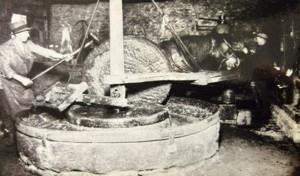
Cider making was brought to Britain by the Normans using a process based on olive oil pressing and the earliest production was in monasteries, who had the land, knowledge and time to produce it. Post-dissolution, many itinerant monks turned to farms to continue their craft, with farmers planting small orchards for the purpose. This picture shows apples being crushed in a horse-powered cider mill. This results in an apple pulp – known as ‘pomace’ – that can then be pressed to extract the juice.
20. Cider making, Stroud area, c1910
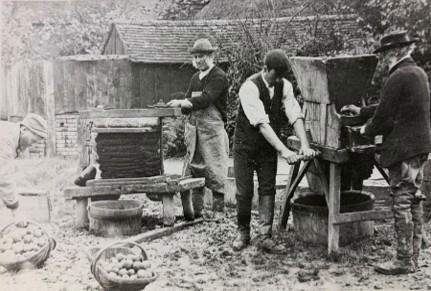
D9746/2/373/2
This photograph – taken at an unknown location but thought to be in the Stroud area – shows the two main processes in cider making. If a cider mill (or a horse) was unavailable, then the apples would be broken up using a hand-powered ‘scratter’ – seen here on the right. Apples would be tipped into the hopper and when the handle was turned, it rotated blades that mashed or pulped the whole apples into pomace, which would fall into the tub at the bottom. The pomace is then wrapped in sack cloth to form oblong blocks known as ‘cheeses’, which are then placed on the apple (or cider) press. This consisted of a stout timber or metal frame with two threaded spindles (early versions had wooden spindles but later ones used threaded metal bar), a crossbeam and a winding lever. Once the cheeses had been stacked in the press, a stout board would then be placed on top and the crossbeam tightened by the winding lever. This compressed the cheeses and the juice would be squeezed out of the pulp, where it ran down into a tub. This liquid would then be transferred to a barrel, sealed and left to ferment. Initially no yeast was used in the process, but modern cider makers do add yeast to ensure good fermentation.
21. Account of Sider made, John Prinn, Charlton Kings, 1724
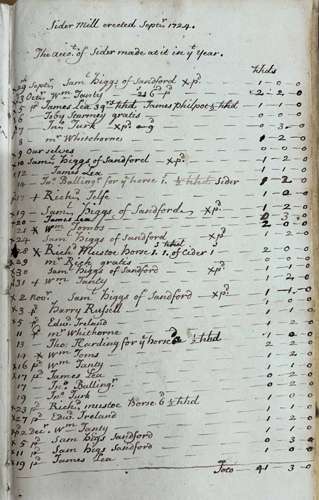
D7661/Box3/1
This is a list of sales of ‘sider’ made by John Prinn of Charlton Kings, after erecting a new cider mill in 1724. It is from a parchment bound hard backed notebook recording all sorts of agricultural accounts. There are two different volumes listed: ‘hogsheads’, which are a more-or-less standard unit being a barrel holding 52½ gallons (238.5 litres). The other is the ‘horse’. This words probably refers to a ‘puncheon’ or ‘tertian’ barrel, which are larger and hold 1/3rd of a tun (this being the largest barrel used) and is equivalent to 70 gallons (318 litres). All told the cider mill made a cool £41 3s for the year – about £4780 today!
22. Purchase of cider press, Bond Family of Newland, 1665
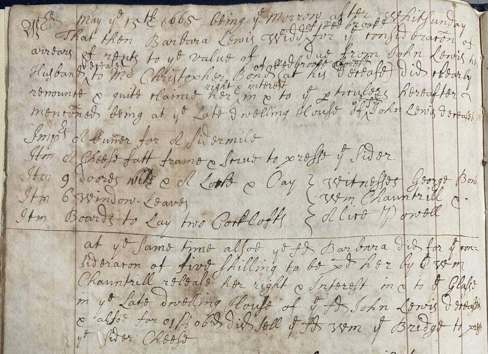
D2026/A1
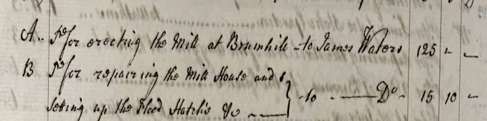
This page from is taken from the Bond Family of Newland’s estate accounts and memoranda, 1653-99. It records – in sadly rather scribbly writing – their purchase of a cider press and equipment (boards, cheeses and frames) from Barbara Lewis in 1665.
23. A receipt for clearing sider, Bond Family of Newland, 1665
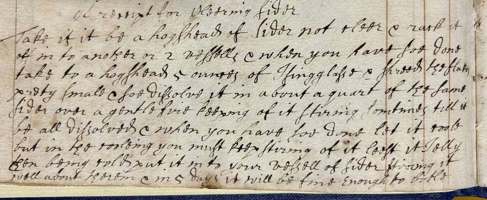
D2026/A1
Farm brewed cider – aka ‘scrumpy’ – is renowned as be full of bits and pieces…. allegedly it adds flavour! This is from the Bond Family’s Newland’s estate accounts and memoranda, 1653-99 and is entitled ‘A receipt for clearing sider’. The word ‘receipt’ was used instead of ‘recipe’ in many accounts of this time, possibly for no other reason than ‘recipe’ was French! The main ingredient was isinglass - form of collagen obtained from the dried swim bladders of fish. This acted similar to gelatine and the instructions note that you had to stir it as it cooled or it would form a jelly! There are numerous recipes for clearing sider.
A receipt for Cleering Sider
Take if it be a hogshead of sider not clear & rack it
off in to a nother [another] or 2 vessells & when you have soe done
take to a hogshead 5 ounces of Isingglasse & shreed the flakes
prety smale & soe dissolve it in a bout a quart of the same
sider over a gentle fire keeping of it stirring somtimes till it
be all dissolved & when you have some done let it coole
but in the cooleing you must keep stirring of it leest it Jelly
then being cold put it into your vessell of sider stirring it
well about therein & in 5 days it will be fine enough to bottle