Introduction
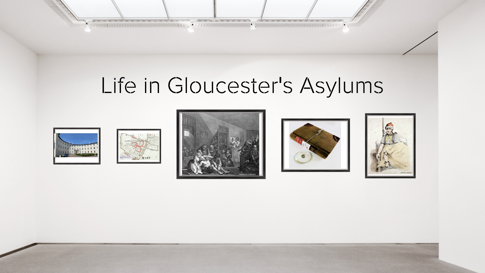
Welcome to this online exhibition, about “Life in Gloucester’s Asylums”. At one point, Gloucester had 3 asylums; the First County Asylum (Horton Road), Barnwood House Asylum and the Second County Asylum (Coney Hill). All three opened in the nineteenth-century, and all three were closed during the last 50 years, well within living memory.
Gloucestershire Archives is the repository for the records from these 3 former asylums. In this online exhibition, we look at some of these fascinating and very detailed records. We hope you find the exhibition both interesting and informative.
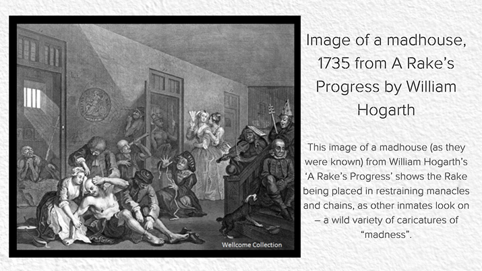
Image of a madhouse, 1735 from A Rake’s Progress by William Hogarth
For much of history, people living with mental illness have been treated very poorly. It was believed that their condition was caused by any number of things, from demonic possession, witchcraft or simply an act of God. Care for the mentally ill was almost non-existent: the afflicted were usually relegated to prisons, almshouses or inadequate supervision by families. Treatment, if provided, paralleled other medical treatments of the time, including bloodletting and purgatives. This image of a madhouse (as they were known) from William Hogarth’s ‘A Rake’s Progress’ shows the Rake being placed in restraining manacles and chains, as other inmates look on – a wild variety of caricatures of “madness”. By the early 1700s the so-called “trade in lunacy” was well established. Daniel Defoe, novelist, and a critic of madhouses, estimated there were 15 in London in 1724. The "madhouses" were simply private houses whose proprietors were paid to detain those sent to them and they were run as commercial concerns with little or no medical involvement. This led to two forms of abuse: the first was the keeping of actual mentally ill people in atrocious conditions and the second was the detention of those who were falsely claimed to be insane – in effect, private imprisonment.
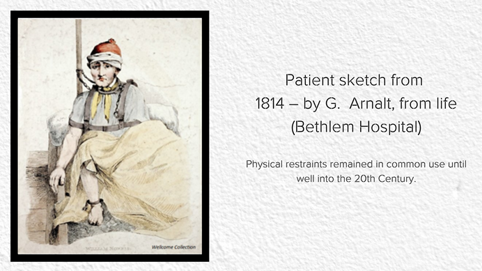
Patient sketch from 1814 – by G Arnalt, from life (Bethlem Hospital)
The subject of “lunacy” was prominent in the imaginations of people in the early 1800s – although by this time a moral approach to care had emerged, coupled with new medical treatments, albeit still primitive by modern standards. Physical restraints remained in common use until well into the 20th C. A major advance in treating the mentally ill was the Lunacy Act 1845, which made counties legally obliged to provide asylum for the mentally ill within their boundaries. However of greater importance perhaps, was that this Act changed the status of those suffering from psychiatric disorders and henceforth they were to be treated as patients and not prisoners.
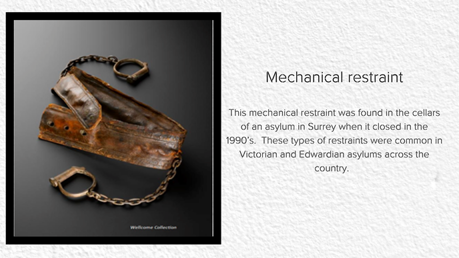
Mechanical restraint
This mechanical restraint was found in the cellars of an asylum in Surrey when it closed in the 1990’s. These types of restraints were common in Victorian and Edwardian asylums across the country. There were also “padded jackets” or what we would call straightjackets. Although barbaric by modern standards, it must be remembered that in most cases these devices were mainly used to try to prevent patients injuring themselves or others. Some establishments were however more forward thinking; in 1841, mechanical restraints were withdrawn at Gloucester’s Horton Road Asylum. At that time only a handful of asylums had taken this step and it was seen as enlightened and humane.
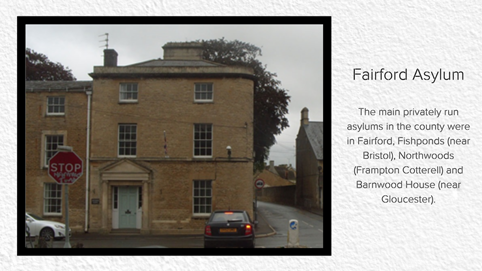
Fairford Asylum
The treatment of mentally ill patients began to change with the Madhouses Act 1774, which was the first legislation in the United Kingdom addressing mental health and it introduced licensing which limited the proliferation of such establishments. The Act required that all madhouses be licensed by a committee of the Royal College of Physicians. This license would permit the holder to maintain a single house for accommodating lunatics and would have to be renewed each year. All houses were to be inspected at least once per year and outside London, this task was undertaken by the county Quarter Sessions. The main privately run asylums in the county were in Fairford, Fishponds (near Bristol), Northwoods (Frampton Cotterell) and Barnwood House (near Gloucester).
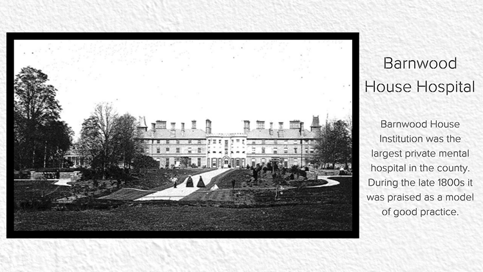
Barnwood House Hospital
Barnwood House Institution was the largest private mental hospital in the county. It was founded by the Gloucester Asylum Trust in 1860 as an asylum for wealthy and charity patients as by this time, general and pauper patients were being treated at the First County Lunatic Asylum at Horton Road, Gloucester. Barnwood House went on to become popular with the military and clergy – at one time, it even boasted an Archbishop amongst its patients. During the late 1800s it was praised as a model of good practice. After the First World War former soldiers , including war poet and composer Ivor Gurney, were treated with a regime of what we would call psychotherapy, and recreations such as cricket. It closed in 1968 although its park is maintained by the County Council as an arboretum.
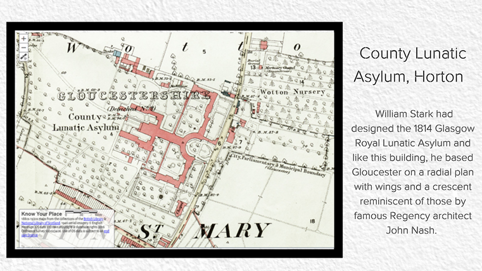
County Lunatic Asylum, Horton
In 1808, the County Asylum Act was passed, which allowed counties to levy a rate in order to fund the building of County Asylums. The intention was to allow Justices of the Peace to remove the mentally ill from within the parish work houses and gaols and to provide them with a dedicated care system. However, due to deficiencies in the Act, only 20 County Asylums were built around the country. Gloucester though was ahead of the game and original proposals for a lunatic asylum in the city came in 1793 in the form of a subscription fund which was supported by many, including philanthropist, prison reformer and former High Sheriff of Gloucester, Sir George Onesiphorus Paul. The subscription fund was superseded by county funding (the original fund was used to provide the private Barnwood House Asylum) and the architect William Stark was engaged to begin work. Stark had designed the 1814 Glasgow Royal Lunatic Asylum and like this building, he based Gloucester on a radial plan with wings and a crescent reminiscent of those by famous Regency architect John Nash. Stark died before the hospital plans were finalised though and his replacement, local architect John Wheeler, continued the work. Although Wheeler saw construction begin, he died before building work finished, so it was left to his replacement, John Collingwood, to finally complete it and the hospital opened in July 1823 – 30 years after it had been first proposed and 9 years after construction had started.
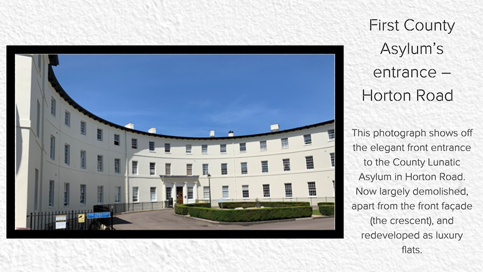
First County Asylum’s entrance – Horton Road
This photograph shows off the elegant front entrance to the County Lunatic Asylum in Horton Road. This 3-storey central crescent section contained the accommodation for fee-paying wealthy patients, described at the time as ‘opulent’, whereas the charitable and county cases were accommodated in the less attractive wings – two-storey detached ward blocks on the north and south linked by long covered arcades for male and female inmates respectively. The crescent also provided the home of the asylum superintendent and included the main entrance to the complex, set back from the road by a circular driveway. The block also had a basement which was where padded cells were located (under the road or driveway in front of this photo). Now largely demolished, apart from the front façade (the crescent), and redeveloped as luxury flats. Although very modern in its treatment and outlook, when it opened in 1823 there were public viewing galleries in place.
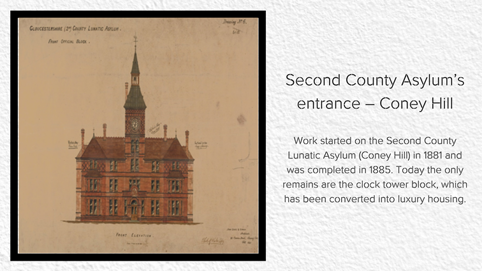
Second County Asylum’s entrance – Coney Hill
Work started on the Second County Lunatic Asylum (Coney Hill) in 1881 and was completed in 1885. Intended to provide “overflow” accommodation for those from the First County Asylum (Horton Road) who could not be “cured”; instead of being discharged, they were transferred to the newer more “modern” facility. It was surrounded in farm land and open countryside with views of the Cotswold escarpment. The new asylum was designed by John Giles & Gough and was revolutionary as it was the first asylum to be built in echelon plan. Instead of operating as an independent institution, Coney Hill’s undeveloped site meant that it was operated as an annexe of the First County Asylum at Wotton. The Superintendent remained located at Wotton and the magistrates covered both sites. Some of the new accommodation at Coney Hill was set aside for private fee-paying patients whose costs could be offset against the costs of the upkeep of the pauper population. It remained in use for 6 years after the closure of Horton Road Hospital but finally closed on 31st December 1994. After closure most of the complex was demolished with the exception of the administration block, and housing was constructed on the surrounding land with any remaining buildings subsequently gutted by fire in 1999. Today the only remains are the clock tower block, which has been converted into luxury housing.
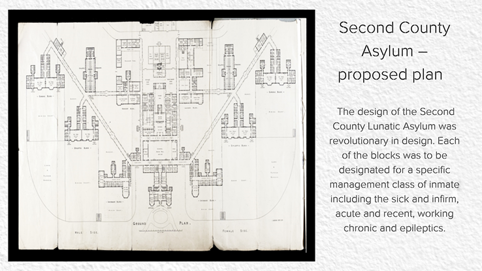
Second County Asylum – proposed plan
The design of the Second County Lunatic Asylum was revolutionary in design. Male and female 3-storey ward blocks were to be arranged to either side of a central service and administrative area and linked to the main single storey corridor network by short spur corridors. Each block of the three blocks lead away from the centre and was set back from the first, and otherwise fully detached from each other and set in their own airing courts. Each of the blocks was to be designated for a specific management class of inmate including the sick and infirm, acute and recent, working chronic and epileptics. The central service area comprised the administrative block to the south and behind this stood the recreation hall, kitchens and scullery, central stores, power house and gasworks with gas holder. To the west stood the workshops, whilst to the east was to be located the laundry and sewing room. Each was located conveniently for those accommodated in the epileptic and working chronic blocks to find useful occupation. In the event, the full plan was never built. After the First World War it became the Gloucestershire County Mental Hospital and it joined the National Health Service as Coney Hill Hospital in 1948.
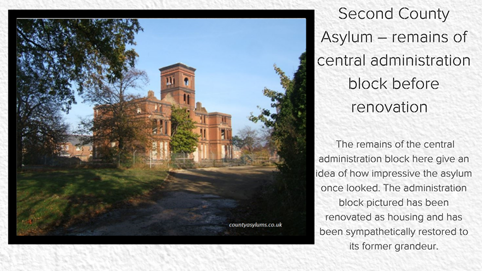
Second County Asylum – remains of central administration block before renovation
The remains of the central administration block here give an idea of how impressive the asylum once looked. Each block was constructed with red bricks, with the uppermost level decorated with blue brick to give a mock Tudor appearance. Since closure, little now remains of Coney Hill Hospital. The lodges, staff housing, farm and ward blocks have all been demolished. The entrance gateway from Coney Hill Road is no longer recognisable and just forms part of the road junction providing access to part of the Abbeymead housing estate as does much of the former grounds. The administration block above has been renovated as housing and has been sympathetically restored to its former grandeur.
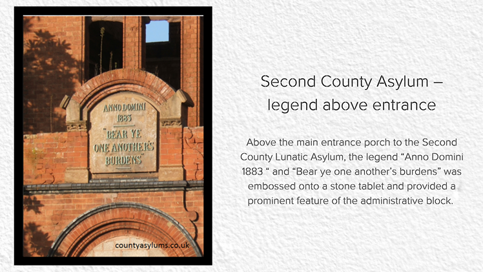
Second County Asylum – legend above entrance
Above the main entrance porch to the Second County Lunatic Asylum, the legend “Anno Domini 1883 “ and “Bear ye one another’s burdens” was embossed onto a stone tablet and provided a prominent feature of the administrative block. Not withstanding medical advances in the understanding of mental illness, there were often moral overtones to “treatment”, which often focussed on moral instruction rather than anything we would regard, today, as proper care and treatment. Asylum inmates had few, if any, rights. This plaque almost certainly comes from the scriptures and was typical of the Victorian moral approach. It was similar to the legends that were sometimes placed above entrances to work houses.
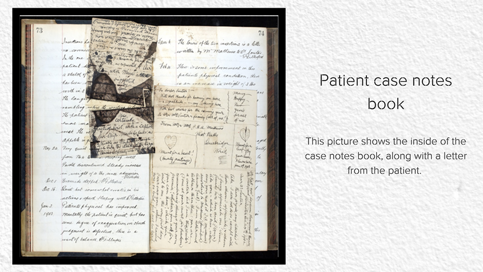
Patient case notes book
Case notes were written by hand until well into the 20th C. There are different categories depending on the asylum but are often split into Male Case Books, and Female Case Books, in alphabetical order according to surname. These volumes are like large ledgers, detailing weekly (occasionally daily) updates from the Medical Superintendent or other Physician. They are fairly large items and the photo shows a CD disc by way of scale.

Patient case notes book
We rarely hear the patient’s voice in the case notes, but very occasionally there are letters from the patient, as in this case, protesting they are not insane, or being held against their will, or are not guilty of a crime.
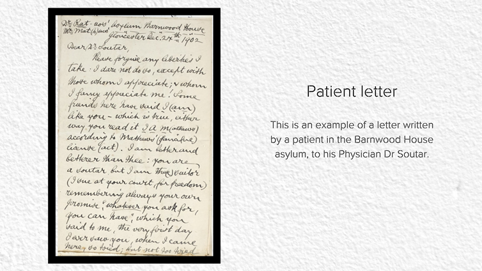
Patient's letter
This is an example of a letter written by a patient in the Barnwood House asylum, to his Physician Dr Soutar – identified by the patient by a nickname, Dr Rat-nots – on Christmas Eve 1902. The patient points out that the Doctor had said to the patient “whatever you ask for, you can have” but whether this is complaint or comment is not clear.
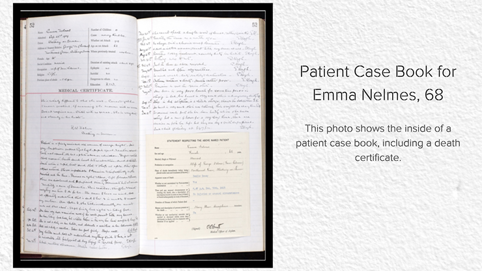
Patient Case Book for Emma Nelmes, aged 68
This photo shows the inside of a patient case book, including a death certificate. This particularly tragic record is for Mrs Emma Nelmes, who died of ‘senile decay’ on 20th December 1912, aged 68. The notes indicate that this was her second stay in the hospital and that it was believed the cause of her illness was worrying over ‘money troubles’ that brought on ‘a chronic case of dementia’ as on admission, she could not speak a ‘single word of sense’. Whereas this patient’s stay in the asylum was very brief; often, patients would stay in back wards of the asylums for decades and would become “institutionalised”.
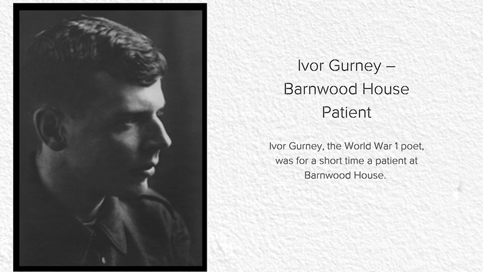
Ivor Gurney – Barnwood House Patient
Ivor Gurney, the World War 1 poet, was for a short time a patient at Barnwood House. In his youth he possessed a dynamic personality, but had been troubled by mood swings that became apparent in 1913 when he suffered his first breakdown. He served in WW1 with the 2/5th Gloucestershire Regiment, twice being hospitalised as a result of the fighting (once shot, once gassed). Although he recovered from these physical injuries, his depression never left him and he was honourably discharged from the Army in October 1918 after threatening suicide. Amazingly, he received a rare diagnosis of nervous breakdown from "deferred" shell shock. Outwardly Gurney appeared to thrive but his mental distress continued to worsen and in September 1922 at the instigation of his brother, Gurney was certified as insane and then duly confined in Barnwood House, where he stayed for three months before he escaped during the night and had to be returned by the police. He was then transferred to the City of London Mental Hospital at Dartford in Kent. On admission he pleaded only to be allowed to return to farm work. He died at this hospital 15 years later on Boxing Day 1937.