Introduction
At this time of year, one of the things that people often do is decide to start keeping a diary or journal. Usually – and sadly – however, this resolution falls by the wayside as the year progresses. This is desperately sad for diaries are a wonderful historical resource, allowing you to almost step into the life of the diarist. You may not think your diary of this year will be of interest – but think of how interesting it might be 100 or more years in the future. Enter the term ‘diary’, ‘diaries’ or ‘diarist’ into the online catalogue of Gloucestershire Archives and you will return around 4,000 hits, a real mix of personal, professional, and other day-to-day records from the past. While some are diaries such as you and I might write, others are official records, such as prison journals, ship’s logbooks, and school logbooks, that record the daily happenings in a gaol, onboard a ship or in a school. The details contained in diaries can be as varied as the type of dairies themselves, from simply one-line (or less!) entries to multi-page missives, recording detail in minutiae. This expo is a selection of just some of the diaries that are held at Gloucestershire Archives to give you, the viewer, a flavour of some of the wonderful things that people have recorded in the past. If you keep a diary or journal, then please think about depositing them here with us – and if you’ve just started…keep it up and then deposit them! We’ll leave the last word here to John Osborne of Monk’s Mill, near Wotton under Edge, who in 1746, gave his journal the following title (which still holds true for many of us today): ‘Observations on the many trivial, as well as material, occurrences of my life, committed to writing mainly for the assistance of my memory being by no means so good as I could wish and may be of some advantage to those that succeed me.’
Pocket diary of Thomas Estcourt, 1833
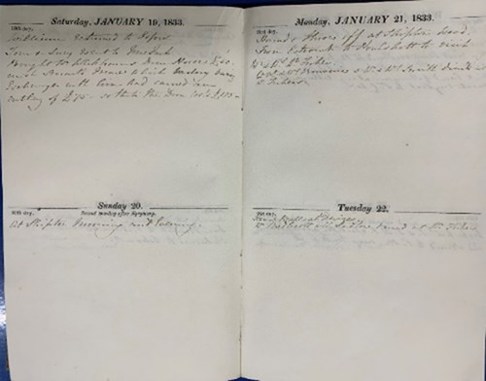
This is a page from the pocket diary of Thomas Grimston Bucknall Estcourt (1775-1853), of New Park, near Devizes, Wiltshire. He was the eldest son of Thomas Estcourt and was MP for Devizes 23 January 1805 – February 1826 and for Oxford University from 22 February 1826 – 1847. There are over 50 similar diaries and although there is a reasonable amount of space for daily entries, Estcourt has kept entries very short, with only brief mentions of family affairs, estate business and parliamentary matters, although he has included numerous references to shooting, hunting, and guests he entertained. Like many personal diaries, the handwriting here is not easy to read, as it tended to suffer from speed as the diarist wrote down what they considered of importance. The main items of interest in these four days is that he bought a draw horse from a Mr Wickham for £50 on Saturday 19, a hunt at Shipton Wood on Sunday 21 and the Hunt Ball at Devizes on Tuesday 22 January.
Reference: D1571/F292
Diary of Richard Holford, relating to Avebury Estate, 1712
This is a page from the estate diary of Sir Richard Holford (1650-1719), businessman and Master in Chancery, who owned Westonbirt manor and estate in what is now South Gloucestershire as well as an estate in Avebury, Wiltshire. In the days when proforma diaries were not available, journal writers would use plain bound books and so the entries tended to wander up and down across the page. The left-hand margin has headings indicating what the text on the right is about (i.e., Stable door, Garden wall coping, etc) but few dates are mentioned. This top part of this page is a fantastic example of the treasures that diaries can hold, as it describes ’My journey from London’ to Avebury on 31 August 1712. It includes the names of the travelling party – Sir Richard, his wife, her maid, Holford’s sister-in-law (Mrs Hickes), her son, as well as Sir Richard’s coachman (William Goady) and footman (John Hitching) who was riding Holford’s ‘new nag’. The diary describes the journey by naming inns at places where they made overnight stops – starting at the ‘Crown at Bow’, then ‘the Bow at Reading’, the ‘Boar at Spinhamland‘ (Speenhamland near Newbury) and ‘the Angell at Marlbrough’ and ends with ‘God bee thanked came safe hither’. The rest of this page has references to repairs on the garden wall, and the replacement of the stable door. Sadly, Sir Richard’s 1700s handwriting isn’t the easiest to decipher.
Reference: D1956/E2/8
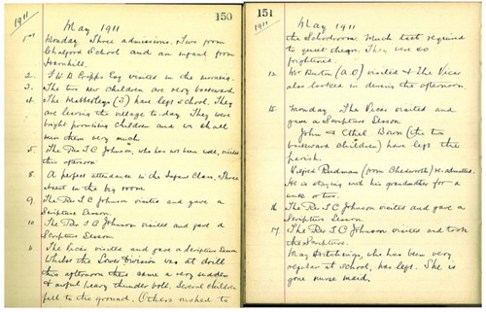
Ampney Crucis School log book, May 1911
School logbooks are dairies that record the day to day events that took place at a school. This example from Ampney Crucis school, records events from the 1 May 1911 to the 17 May. It is a typical example, noting admissions of new pupils, departures of others, visits by the vicar to give scripture lessons (a very regular occurrence) and what was obviously a brief albeit terrific thunderstorm that terrified the pupils and even stunned some who fell to the ground.
Reference: S15/1/2
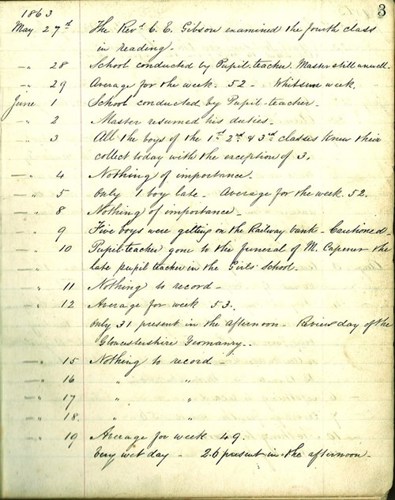
Christchurch School log book, 27 May to 19 June, 1863
This is a page from the logbook of Christchurch school in Cheltenham, for 27 May to 19 June, 1863. It has interesting entries for things such as a pupil-teacher taking charge of the school when the headmaster was ill, attendance and on 9 June, a note regarding five pupils ‘getting in the railway track’. The latter was always a problem for the school was built at the top of a cutting on the Great Western Railway’s Cheltenham branch, which ran from Lansdown Station to St. James’ Station and male pupils were often getting onto the overbridge by the school or onto the embankment by the tracks to watch the locomotives. Such incidents were usually followed by punishments although on this occasion, the pupils were merely ‘cautioned’ – although later in the log book, they are punished for the same offence. Another item of note is that the headmaster was not afraid to make ‘Nothing of importance’ or ‘Nothing to record’ entries!
Reference: S78/6/1/1
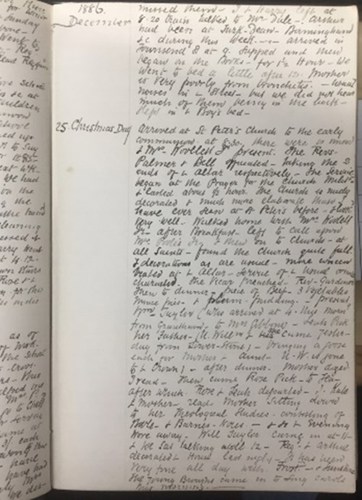
Diary of Thomas Swift, Schoolmaster, Christmas 1886
Born in Cheltenham on 14 July 1841, William Thomas Swift became the Headmaster of the new Churchdown School when it opened on 5 January 1874. He had kept a daily diary from 31 December 1859 when he was eighteen years old, until 5 February 1915, just five days before his death at the age of 73. The entries are initially brief, but as time goes on, they become more and more comprehensive. They invariably give an account of the weather, the time he arose in the morning, what books he read and whom he met. He often gives details of what food was taken for the main meal. The diaries give a very full account of local happenings of all kinds and of the people concerned in them, who attended local gatherings, who subscribed to funds and in what sum, who failed to pay their rates, and so on. There are frequent references, as would be expected, to members of his and his wife's families, but national events are mentioned relatively infrequently unless they are of great importance (e.g., the Boer and Great Wars) or have an impact on the life of the village (e.g., the Diamond Jubilee and death of Queen Victoria, General Elections, etc.). The diaries give a clear picture of an educated schoolmaster in the life of a village community, who was on good terms with all its members from the highest to the lowliest. He often gave help and advice to those who needed it and was accorded the respect and affection of the community. For social historians, they are an absolute gold mine.
Reference: D3981/15
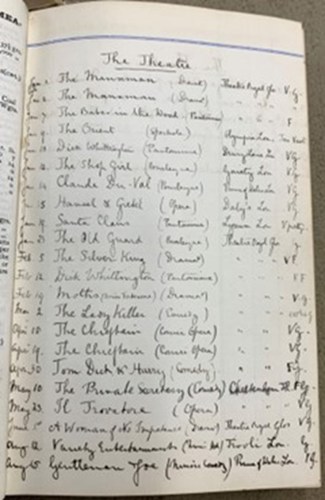
Diary of John Wilton Haines of Hucclecote, poet, botanist and solicitor, 1895
This is a page from the 1895 diary of John Wilton Haines of Hucclecote (1875-1960), a poet, botanist, and solicitor. He clearly enjoyed the theatre as this page lists the shows that he attended – a total of 22 in just seven months – in both Gloucester and London. He also had a broad taste for there are opera and theatre performances (of drama and comedy) as well as burlesque and pantomimes! The name of each show is given, as well as where it was being performed and his opinion of each. Most are given a ’VG’ or ‘VF’ (presumably ‘Very Good’ and ‘Very Funny’) and the only negative one was for ‘The Orient’ at London’s Olympia on 9 January. Haines described this as ‘Too vast’ and no wonder, for ‘The Orient’ was an aquatic extravaganza laid on in Olympia by Bolossy Kiralfy, one of the famous Kiralfy Brothers. These were a pair of showmen, performers, producers, writers, and creators of musical extravaganzas in the late 19th and early 20th centuries. With costumes alone costing over £20,000 and a cast that numbered around 2,500, ‘The Orient’, was Bolossy’s latest spectacular and opened on Boxing Day 1894. Despite record-breaking opening day attendance of 34,000 people, bad weather and a flu epidemic ultimately limited attendance, and the show was forced to close in July 1895
Reference: D10828/3/5
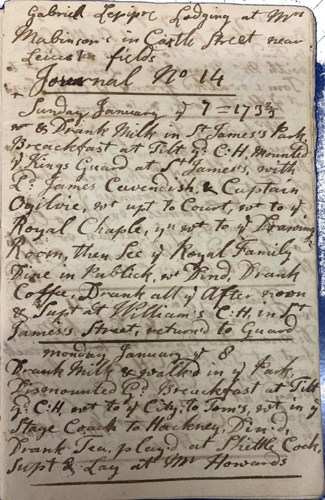
Diary of Gabriel Lepipre of London
This is the front page from ‘Journal No.14’, one of the diaries of Gabriel Lepipre of London, which is contained within the archive of the Blathwayt family of Dyrham. Lepipre was an army officer, probably in the Scots Guards. Born in 1705 to Peter Lepipre and Sarah Roberts, he married Elizabeth Clark (possibly at Chelsea) but died in July 1754 in Grosvenor Square, London. In 1758, his widow married William Blathwayt, which is why Gloucestershire Archives holds Lepipre’s diaries. Despite the diaries being an incomplete series, they make for fascinating reading, containing entries relating not only to military duties, but also the life of a man-about-Town. In his off-duty time, Lepipre visited clubs, went to plays and enjoyed gambling in London. The diaries are full of interesting nuggets of information – on this page for instance, for the 7 January, he records drinking milk in St. James’ Park (which reminds us that at this time cows were grazed there and were milked by local milkmaids who sold the milk). He also writes about seeing ‘the Royal Family dine in publick’, which appears to have become a ‘drinking session’ for he writes that after seeing the Royals he ‘drank all afternoon’!
Reference: D1799/F313
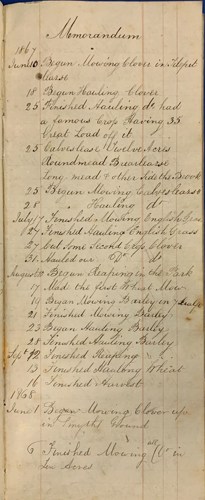
Acton Court Farm diary, 1867-1876
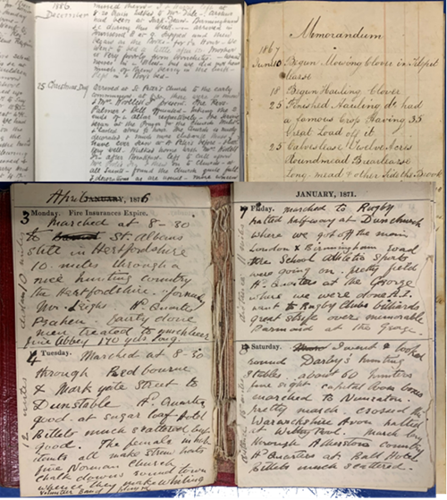
This memorandum book acts as a farm diary for Acton Court Farm in Iron Acton. It contains daily memorandums of work done on the farm, lists of crops planted in fields, remarks and records of livestock, names of livestock when sold. This page is from 1867 (although it includes one entry for June 1868) and covers the critical time from June to September 1867 – haymaking and harvest. The entries include mowing and hauling clover, ‘English Grass’ (hay or forage grasses), wheat and barley. Harvest began on 10 August and was finished on 16 September. The clover was apparently a good crop for this year as the farmer has written ‘had a famous crop having 35 Great load off it’.
Reference: D1588/1
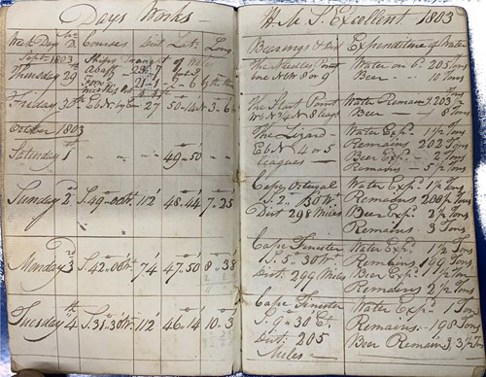
Logbook of Admiral Frank Sotheron (1793-1835)
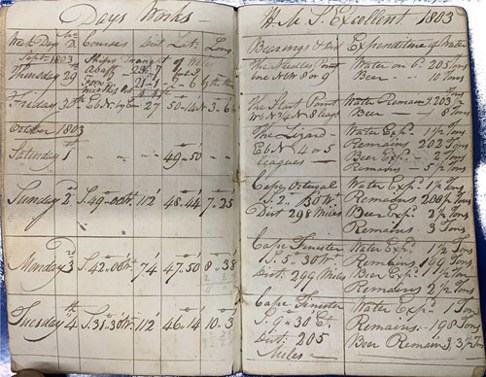
Among the archive of the Sotheron-Estcourt family of Shipton Moyne, are the papers of Admiral Frank Sotheron (1793-1835). He was born in 1765 and entered the naval service in 1776. He had an active naval life, seeing action in the Battles of Ushant, St. Vincent and several others. In the summer of 1803, Sotheron was appointed to the command of the 74-gun HMS Excellent, and it is from this time that this logbook belongs. It covers part of voyage from Portsmouth to Gibraltar, while Excellent was escorting an outward convoy bound to the Mediterranean. Such convoys needed protection not only from the French and Spanish navies, but also from the numerous foreign privateers that cruised the area. Covering six days from 29 September to 4 October, the logbook records the ship’s daily position – in latitude/longitude and in terms of the bearing to various places (i.e., The Needles, Start Point, The Lizard, Cape Ortegal and Cape Finisterre). The right-hand column details the quantities and usage of water and beer that the ship carried, which started at 205 and 10 tons respectively. On average the crew drink or used 1½ tons of water a day, while the beer consumption was more erratic, ranging from 2½ tons to 1 ton! Although these quantities might seem excessive, it’s important to remember that at this time the official complement of a 74-gun ship was 650 (typically 40 officers, 490 sailors and 120 marines). Although placed under the command of Vice-Admiral Lord Nelson, Excellent missed the Battle of Trafalgar, being stationed at Naples at the time. On 8 July 1805, Excellent departed the Mediterranean for home, and Sotheron left this ship shortly after. He never saw active service again, but was promoted rear-admiral on 1 August 1811, vice-admiral on 12 August 1819, and admiral on 22 July 1830. He died in February 1839, outlasting the Excellent, which was broken up in 1835.
Reference: D1571/F810
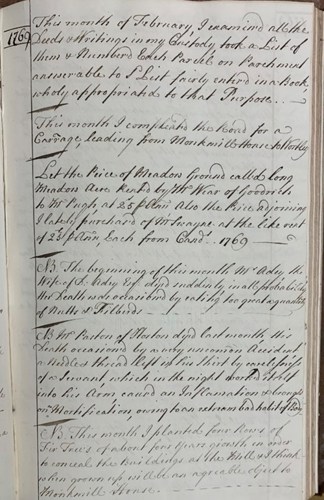
Diary of John Osborne of Monk's Mill, Wotton-under-Edge, February 1769
This diary is more of a ‘month to view’ rather than a daily diary. It came to the archives as part of the collection of John Letal of Tetbury, a solicitor of Wotton-Under-Edge. We know little about the author, John Osborne, other than what is contained within this diary. He lived at Monk's Mill House near Wotton-under-Edge but also owned property at Goodrich in Herefordshire. Osborne entitled this diary ‘Observations on the many trivial, as well as material, occurrences of my life, committed to writing mainly for the assistance of my memory being by no means so good as I could wish and may be of some advantage to those that succeed me.’ The diary rarely months or dates, but generally devotes a page to a month – the page here is for February 1769. In this month, Osborne records that he listed and numbered his property deeds, let a piece of land called Long Meadow and purchased an adjoining piece of land, completed a road at Monks Mill and put in a hedge of fir trees to hide the unsightly mill buildings below his house. He also recording two unusual deaths. The first was that Mrs. Adey died "by eating too great a quantity of Nutts & Filberds" (filberds or filberts being an old name for hazelnuts). A rather scarier death was that of Mr Paston of Horton, who died by "a needle thread left in his shirt by carelesness of a servant, which in the night work'd itself into his Arm, caused an Inflamation and brought on a Mortification, owing to an extream bad habit of Body".
Reference: D2930/1
Touring diary of Thomas Lloyd-Baker, 1832
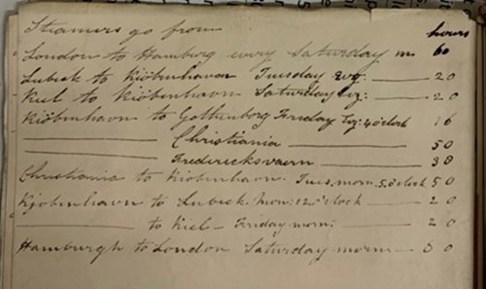
By the mid-1800s the Baker family of Hardwicke Court, was established as one of the most prominent families in the county. As reflected in their papers, they were extremely active within their local community and had a strong family tradition of holding public office, serving as magistrates, guardians of the poor during the 1800s and later becoming involved with the County Council. The papers of Thomas Barwick Lloyd Baker are of particular interest. He was the model of a well-to-do English squire with a social conscience and gained international recognition for his pioneering school for young offenders, the Hardwicke Reformatory, founded in 1852. He compiled annual diaries for the years 1832-1886, although some years are missing. Entries are recorded in pocket diaries from 1832-1856 and in larger volumes for years 1861-1886. The earlier volumes also contain cash accounts. Sadly, the entries are very brief, mentioning walks, visits, hunting and shooting and (particularly in the later years) public engagements, poor law meetings and lists of people to whom he has written letters. Some of the entries in the early volumes are written in pencil and are very faint making them very difficult to read. In 1832, he took a trip to Denmark, particularly Copenhagen, and attended a great ball. This exhibit is the inside cover of one of the diary notebooks he took with him and lists the departures/destinations of various steamships that he needed to know about along with the duration of the various passages. In the days before the internet, this sort of note would have been vital!
Reference: D3549/25/8/2
Diary of Lt. H Maclaine, Royal Horse Artillery, 1876
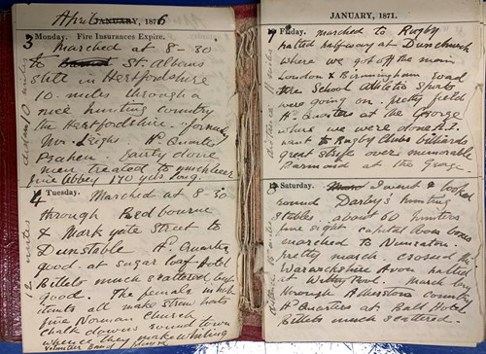
Originating from Thornbury, but from Isle of Mull stock, Hector Maclaine joined the Royal Horse Artillery and after time at the Royal Military College, he served as a 2nd Lieutenant during the Afghan Wars. His entries for 1876 here are written in an 1871 diary! This recalls a march from London (probably Woolwich) through St. Albans, Dunstable, and Rugby, then onto Nuneaton. Maclaine was a hunt follower and this page notes that they passed through ‘nice hunting country in Hertfordshire’ and five days later, the territory of the Atherstone Hunt.
D3330/Box21/H
Farm diary of Player Family, Stoke Gifford, 1819
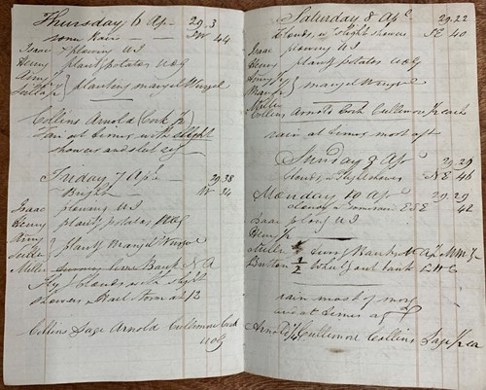
This farm diary from the Player family of South Gloucestershire, is interesting because it gives (brief) details of the weather and identifies the names and tasks of individual farm labourers. It covers the Thursday 6 April to Monday 10 April during which time the weather was ‘some rain’, ‘Bright’, ‘Clouds, or slight showers’ (two days) and ‘Clouds, some rain’. Among the labourers named are Isaac, Henry, Amy, Julia, as well as Miller, Button, Collins, Arnold, Cock and Cullimore. The tasks at this time of year were ploughing and planting potatoes and mangelwurzel. The latter, also called wurzels, mangold, mangel beet, field beet and fodder beet, are cultivated root vegetables primarily grown as feed for cattle and pigs, although it can be eaten – especially when young – by humans.
Reference: D5090/10
Diary of Rob Gregg, Vicar of Ashleworth, January 1761
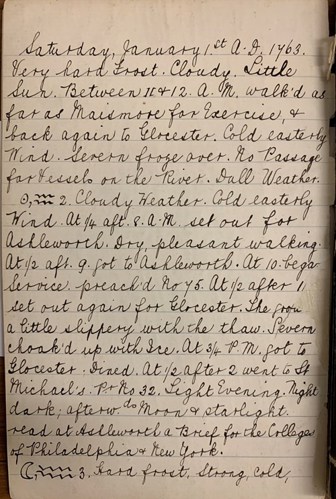
Although he was the Vicar of Ashleworth, Robert Gregg lived in Gloucester and so walked to Saint Andrew & Saint Bartholomew’s Church to take services and then back again. He also preached at St. Michael’s in Gloucester. His service on the 2 January lasted an hour and a half. On this page, he relates how the Severn was frozen over and there was no passage on the river for shipping. Even when a thaw had started, he noted that the Severn was ‘choaked up with ice’.
Reference: D9125/2/4681
Professional diary of Dr Boisragon of Cheltenham, 1830
Dr Henry Charles Boisragon came from a family of French aristocrats that had both military and landed connections. Born in 1778, he spent his early years in Ireland before entering Edinburgh University in 1795. He qualified M.D. in 1799 and lived in London but in 1805 he moved to Bath, where he opened a practice. However, by this time Bath’s popularity with the elite was declining and so in 1807 Boisragon moved to Cheltenham, which was growing in reputation as a fashionable spa town. Initially based in Winchcomb Street, in 1811 he moved onto Royal Crescent, close to where Dr. Edward Jenner and Dr. T. Howell (surgeon extraordinary to the king) conducted their practices. He then proceeded to build a large and lucrative practice that lasted over 40 years; during which he became an extra physician to the Prince of Wales (later George IV) and treated celebrities such as Princess Esterhazy and Lord Byron. He was also involved with establishing Cheltenham’s General Hospital and Dispensary, the town’s Philosophical & Literary Institution and helped promote and establish the spa as a medical centre for treating ailments. After retiring he resided for some years in Paris and was a friend of King Louis Philippe before he died in 1852, aged 74. His professional diary featured here contains details of patients visited, accounts, and observations on the singing career of his son Conrad (whose professional name was Conrad Borani). Medicine was very lucrative at this time and the figure given on this page here, £1,966 16s is around £133,300 today. Sadly, like most medical writers, his handwriting is bordering on atrocious! The clearest entry here (in the middle of the page) isn’t medical - it is an account of his going to see the racing. ‘Went to the hill with Salt to see the Gold Cup run for; won by Mr Sadler’s Jocko. Attended at 7 and saw patients. Thermo 82° shade,’
Reference: D11867/1
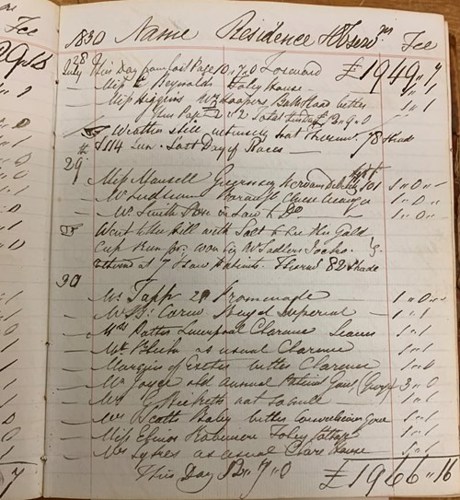
Sapperton Police Station Diary, 27 April 1844
This page lists a typical day’s duty for the officers at Sapperton Police Station in 1844. It is split into Day duty and Night duty and begins by noting that Constable Rudge was assigned as ‘Barrack Guard’ (presumably duty in the station), while Sergeant Hawkins proceeded to Coates to serve a summons on Eliza Smith and Susan Smith, before returning to the station at ‘4¾ o’clock’ – this is presumably an unusual way of writing 4.45pm! At 6.30 pm Sergeant Hawkins went back to Coates to serve another two summonses, this time to Harriet Howse and June Smith, returning at 8.15pm. Whether these Smiths were all from the same family or related we do not know – the fact that they were all inhabitants of Coates, suggests that this was a possibility. The station’s Night duty appears to begin at ’10 O.C.’ (10.00pm) when PCs Charmley and Rudge went on patrol to Frampton Mansell, serving tickets to John Blackwell, then Henry Playne of Down Farm, and William Matthews of Hayley Farm. By tickets, it is likely to be more summonses for court appearances. The two constables headed back towards the station via the ‘Tunnel works’ – this must refer to the Sapperton Railway Tunnel. This is a railway tunnel near Sapperton, which carries the Golden Valley Line from Stroud to Swindon through the Cotswold escarpment. It was begun in 1839 and completed in 1845, so it was obviously possible for these two officers to walk through or along it. An amusing incident occurred before the officers reached the station, for they came across ‘George Tiler lying down drunk in a field and as sleep’ and upon waking him, he claimed that they had taken his watch! They returned to the station at 4am….presumably with George Tiler destined for an hour or so in the cells.
Reference: Q/Y/2/4/101
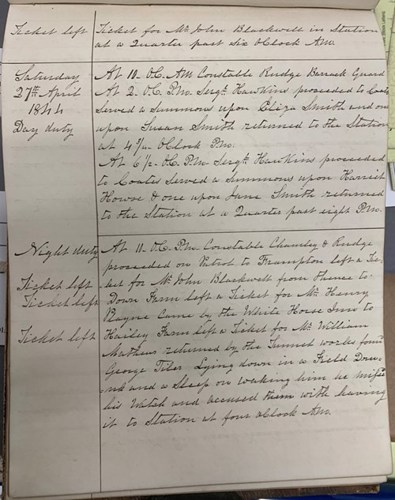
Detective’s diary notebook, 1916
This is a page from the diary of Detective-Sergeant Frank Hallett, who was based at Gloucester. It has two entries, one for receiving into custody William Milligan, who been arrested by Detective Wayman in Cheltenham on 9 April 1916. Milligan was accused of larceny (the unlawful taking or theft of the personal property of another person or business) from the Saracen’s Head Hotel and Royal Hotel on 8 April and was remanded into custody for trial at the assizes. The second entry was for James Westlake alias ‘Bristol Jimmy’ who was arrested in Bristol for larceny of a pony worth £7.
Reference: Q/Y/2/6/1
Lucille Moore’s cat diary
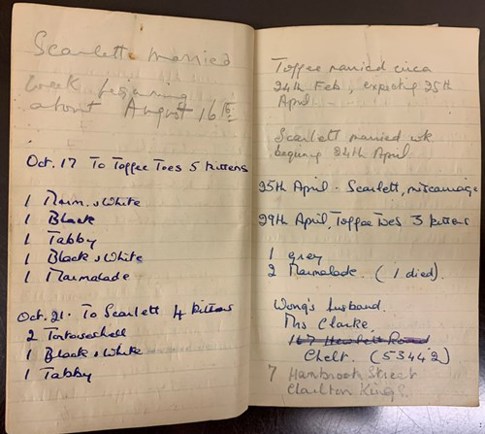
John Cecil Moore (10 November 1907 – 27 July 1967) was a best-selling British writer and pioneer conservationist, famous for his best-selling trilogy of books, published in the years immediately after the Second World War – Portrait of Elmbury, Brensham Village and The Blue Field. In the Second World War, he served as a carrier-based pilot in the Fleet Air Arm and it was whilst serving, he happened to meet Lucile Douglas Stephens, a daughter of noted Australian paediatrician, Henry Douglas Stephens and they married on 1 April 1944. After the war, the couple moved to Kemerton Village, near Bredon outside Tewkesbury, living firstly at Kemerton Lodge (now Chapel House) before moving to Lower Mill Farm in 1961. Surrounded by a stream, with a stable block and ample land for horses, Lower Mill Farm allowed for a relaxed country lifestyle and the couple indulged in countryside passions such as fishing, bird watching and hunting, whilst keeping and breeding ducks, horses, and cats, all of which they recorded in animal diaries. This is a page from one of Lucille’s cat diaries and includes details of the cats with information concerning kitten births, wormings, marriages and deaths. Quite what a cat ‘marriage’ was isn’t known for certain but was probably when cats were caught mating!
Reference: D8451/2/1/9