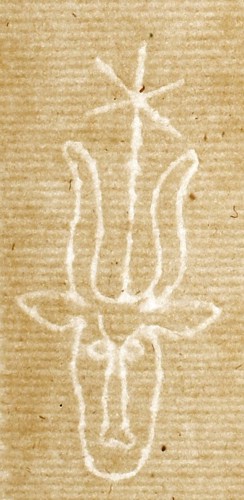
Bull watermark
Before you can print a newspaper, you need paper. Prior to the 1500s paper was expensive and hard to obtain. When Gloucester Borough needed high-quality paper for its Official memoranda 'Red Book‘ which was begun in 1486, it used paper that was made in Italy, probably from the municipality of Caselle in Piedmont, Northern Italy. We know this because one particular Caselle paper manufacturer used a ‘bull’ water mark, which also appears in Gloucester’s Red Book. Similar paper was used by the pioneering printer, Gutenberg, who invented the mechanical printing press, allowing printers to rapidly reproduce multiple copies of the same work – which was essential for newspaper production.
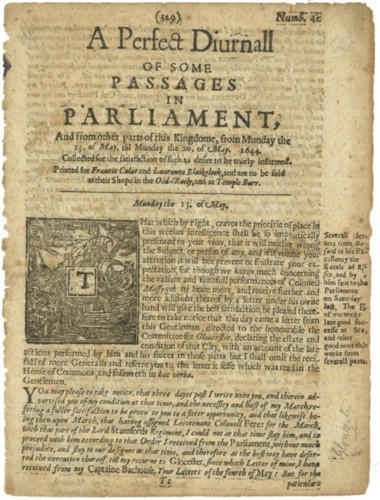
'The Perfect Diurnall' – an embryonic newspaper
The political crisis of the 1640s proved a fertile breeding ground for printing, with broadsheets and chapbooks being printed in large numbers. The former were single sheets of paper of various sizes printed on one side only. Chapbooks used single-sheets that were cut or folded to make them into small pamphlets, so were much more like newspapers as we know them. The Civil war also presented a new challenge in that the opposing sides now had to win people to their side rather than simply summoning them, so both Royalists and Parliament employed propaganda to achieve it. The two main opposing chapbook publications were the Royalist Mercurius Aulicus and the Parliamentary Perfect Diurnall.
A new newspaper
On 10 March 1722 an advert appeared in Gloucester. It announced the imminent publication of “a News Paper, entitled the GLOUCESTER JOURNAL, which will contain not Only the most authentick Foreign and Domestick News, but also the Price of Corn, Goods, etc, at Bear Key in London, and all other Trading Cities and Market Towns 50 Miles round.”
The man behind the newspaper was Robert Raikes the Elder and the Gloucester Journal was a spin off from the Northampton Mercury which Raikes already published in partnership with William Dicey. Raikes has gone down in history as a pioneer of the press who was instrumental in bringing news printing out of London and to the provinces.
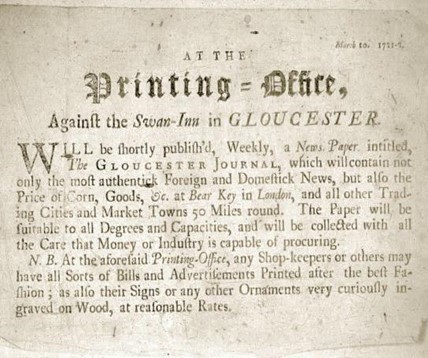
Gloucestershire Archives reference NV26.4
The Gloucester Journal – first edition
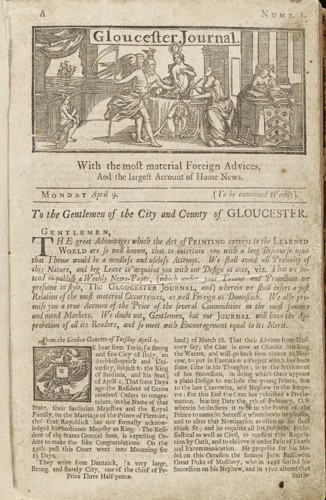
On Monday 9th April 1722, the first Gloucester Journal was published. It had a woodcut title-page image – one of the few times any illustrations were used. The newspaper was thin (only 4 pages) and like many newspapers (then and now!) it was largely a ‘cut & paste’ job; as it took news from other papers, notably the London Gazette. It cost the grand sum of 3d – about £1.50 today. The headline stated ‘To the Gentlemen of the City and County of GLOUCESTER.’ While the cover image portrayed the God Mercury with the City of Gloucester arms lower right. Mercury is the god of financial gain, commerce, eloquence, messages, communication (including divination), travellers, boundaries, luck, trickery and thieves; he also serves as the guide of souls to the underworld. He probably still works for today’s tabloids!
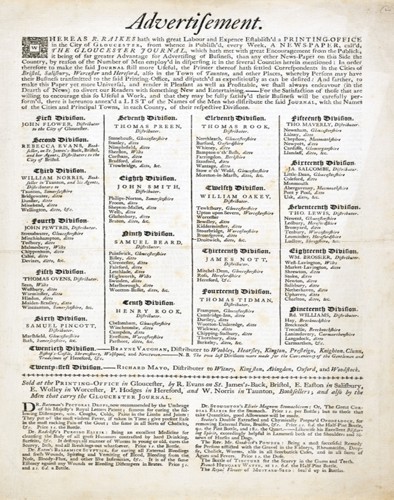
Gloucester Journal circulation poster
The Journal had a large circulation area – much larger than that of modern local newspapers. This advertising poster reveals that the geographical limits were as follows Stourbridge (Worcestershire) in the north, Farringdon (Berkshire) in the east, Carmarthen in the west and Salisbury (Wiltshire) to the south.
The reason for this large area was primarily because in order to reach a sustainable sales level of around 1,000 copies a week, the paper needed to reach the same number of interested people and, with limited levels of literacy, it therefore had to be sold over a wider geographical area.
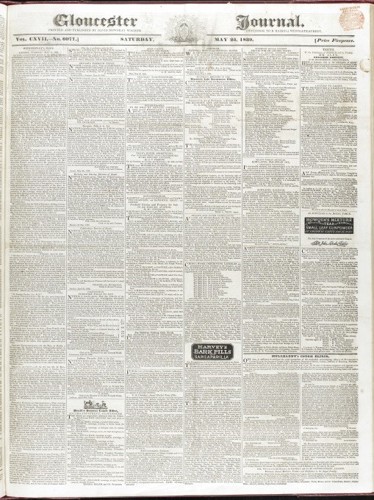
How big is a newspaper?
The 1700s saw the establishment of many newspapers - by 1725 there were 12 London newspapers and 25 provincial papers, including the Gloucester Journal. Governments soon grew resentful of them due to their criticism of official policies and so they tried to subdue them by various means including censorship, licensing, taxation, bribery and prosecution. The Stamp Act of 1712 was an act passed to create a new tax on publishers, particularly of newspapers. It levied a tax of a penny per whole newspaper sheet, a halfpenny for a half sheet and one shilling per advert contained within. To counter the tax, newspaper publishers simply increased the size of their papers and reduced the number of pages. Although the tax hit cheaper papers and popular readership harder than wealthy consumers (because it formed a higher proportion of the purchase price) it didn’t really slow circulation and by 1753 the total number of newspapers sold yearly in Britain amounted to just under 7.5 million.
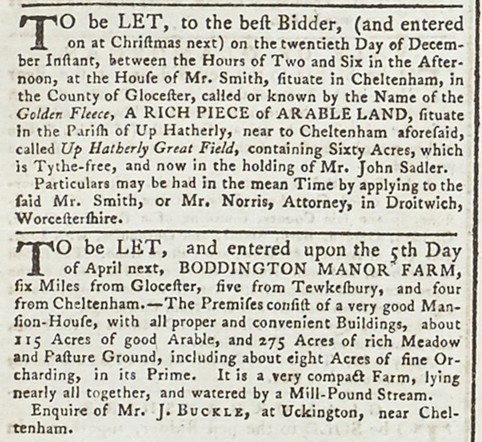
Typical land adverts
Of most interest in the early Gloucester Journal (and other local newspapers that are held at Gloucestershire Archives) are the local adverts. This is a typical advert for property to be let. These adverts usually contain a wealth of local information, not just about the property to be let, but the details of process. The first advert here is for Up Hatherley Great Field (roughly where Morrisons supermarket is in Cheltenham) and it gives precise details of how and where interested parties could bid. As such it provides the names of the current tenant and the solicitors. This can be vital information for researchers today because at this time, there were few trade directories.
Lost (& found)
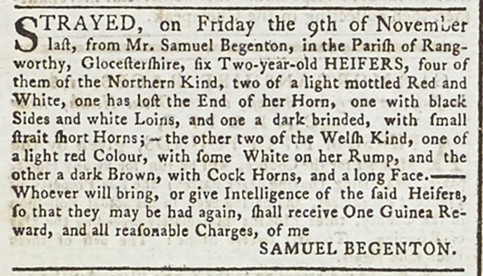
Adverts for lost, strayed or stolen farm livestock or animals are common. Most give details of when the animals were last seen and the reward the finder could expect. This advert reports the loss of six cows – and although they may have been stolen, it is more likely that they strayed and have been taken in by another local farmer.
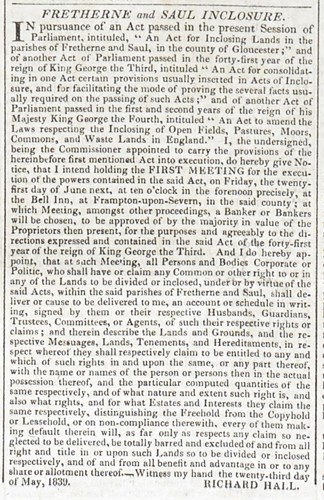
Inclosure Acts
This notice, published on 25th May 1839, is relating to the enclosure of Fretherne and Saul. This enclosure (‘inclosure’ is the archaic spelling) comes towards the end of the enclosure movement. The notice amply demonstrates the complex language used in the process, all of which went against the ability of commoners to put forward their views or to get their voices heard. The powers granted in the Inclosure Act of 1773 were often abused by landowners: the preliminary meetings where enclosure was discussed, intended to be held in public, often took place in the presence of only the local landowners, who regularly chose their own solicitors, surveyors and Commissioners to decide on each case. In 1786 there were still 250,000 independent landowners, but by 1810 that number was reduced to 32,000.
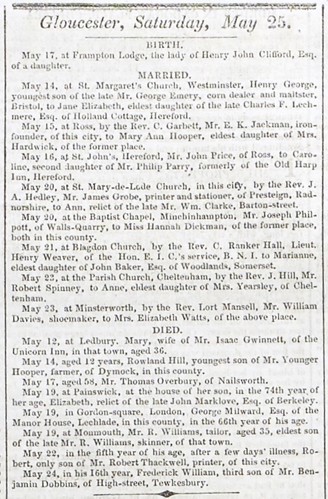
Births, marriages and deaths
One of the mainstays of local newspapers are the birth, marriage and death notices and the Gloucester Journal was no exception. The column was started in in the early 1800s and it went on to become a regular feature until the newspaper went to a pictorial publication in the 1930s. The notices presumably operated in the same fashion as do the modern newspapers, so a fee would have been paid to have the information placed and it is probable that there was also a limit of the number of words or characters.
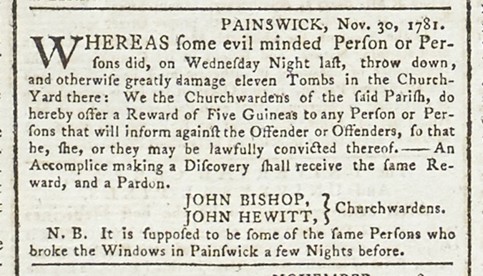
Vandals!
This news item was contained in the 30th November 1781 issue of the Gloucester Journal. It echoes acts of vandalism that sadly still occur today and shows that such actions are not new.
Port of Gloucester
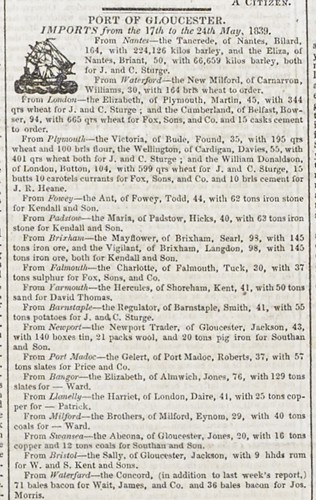
Being the country’s most inland port, the arrivals and departures of merchant ships always had a regular column in the Gloucester Journal. This image shows a typical set of arrivals from the 17th to 24th May. These notices offer a wealth of information as they list the port of departure, the name of the vessel and its home port, the master, the cargo and usually the cargo’s owners. The departing vessels – usually grouped under ‘Cleared out’ – just gave destination, the cargo and the cargo’s owner. Usually the notice also included vessels sailing from Sharpness and a ‘Shipping Intelligence’ section. The latter listed information about vessels leaving ports bound for Gloucester and news of shipwrecks, etc.
Stage coach travel
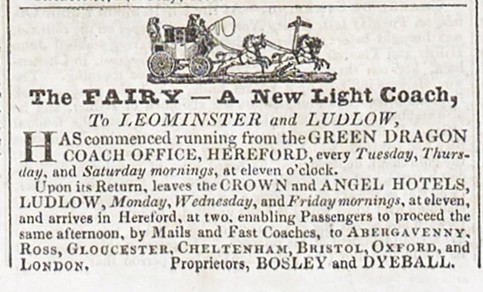
Information about local and national stage coaches were crucial for travellers and the newspapers provided coach names, routes, times and place of departure and usually, the same information about return journeys.
Medicinal adverts
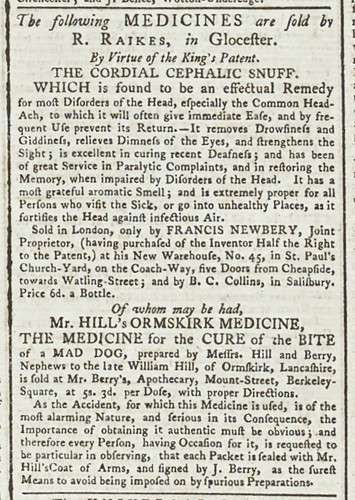
The Gloucester Journal and most other newspapers were always full of adverts for medicines for all sorts of ailments. Most were of the ‘quack’ variety and were probably of little use, although the amounts of opium and/or alcohol may well have helped control symptoms and their effects. Robert Raikes the Elder had a vested interest in this way of advertising as he and his business partner, William Dicey, were also sole proprietors of ‘Dr Bateman’s Pectoral Drops’ and this featured prominently in the Gloucester Journal’s pages. The medicine was a tincture of opium and camphor used for disorders of the chest or lungs and was marketed as a remedy for ‘all Rheumatic and Chronic complaints, in pains of the limbs, bones, and joints, for influenza, and in violent colds’
Gloucester Infirmary patients
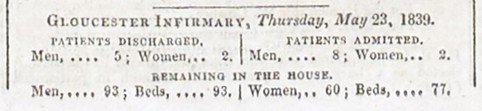
The Gloucester Journal typically reported on the numbers of patients in the Gloucester infirmary both those admitted and those discharged. Only in times of epidemics did these figures include what conditions the patients were suffering from.
In other news..
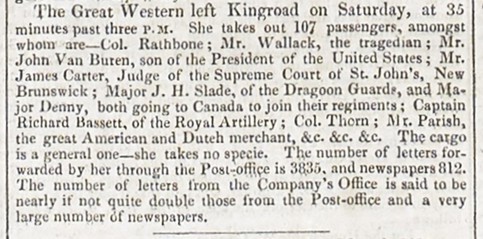
Most newspapers often included items of news that, while not of direct interest to local people, were of semi-national interest and this is one such example for the Gloucester Journal, a news story regarding the sailing of Brunel’s SS Great Western, then just a year old. This news report provides the number of passengers and those who were classed as ‘gentry’. They Great Western averaged 16 days, 0 hours (7.95 knots) westward to New York and 13 days, 9 hours (9.55 knots) home.
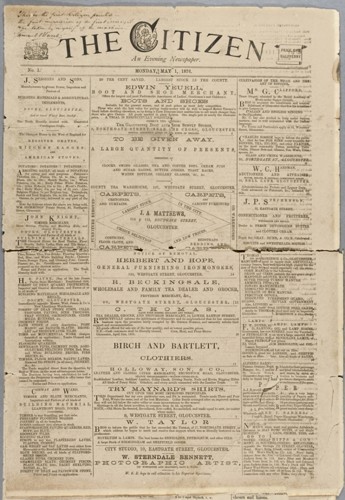
Gloucester Citizen
The Citizen was Gloucester’s first daily newspaper and it was launched on May 1, 1876. It was a four-page newspaper that cost ½-penny and was launched after a clever advertising campaign: during the previous month placards had appeared all over the city bearing just one word – ‘CITIZEN’, which aroused a lot of interest when if finally hit the streets. It was owned by Gloucester businessman, Samuel Bland and was published in St John's Lane where it remained until 2006. In January 1879, it joined forces with the Gloucester Journal and this merger permitted both papers to expand - on February 25, 1879 The Citizen achieved record sales of 10,000 copies. It typically had several editions (6 maximum) plus a Saturday edition. There were also local editions and a Saturday sporting supplement called ‘The Pink ‘Un’ (printed on pink paper). It eventually shrank to ‘tabloid’ size but remained popular until modern times – in October 2017, the daily edition came to an end and it went to a weekly newspaper.
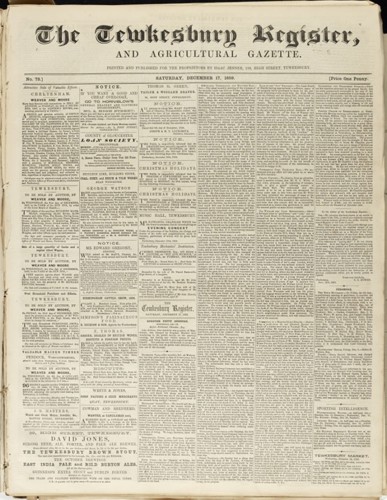
Tewkesbury Register
Established in July 1858, this was a Conservative newspaper that took the name from the annual Tewkesbury Yearly Register & Magazine which had ceased publication in 1856. It circulated in Tewkesbury and its local neighbourhood. It was absorbed into the Evesham Register in 1930 (though it retained its name) and eventually ceased publication in 1984. These were extremely large newspapers, larger than the usual broadsheets.
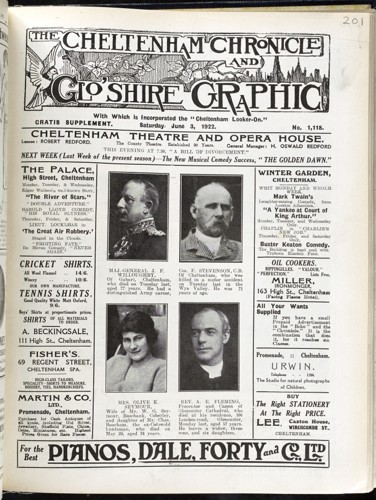
The Cheltenham Chronicle and Gloucestershire Graphic
Established as the Cheltenham Chronicle in 1809, this circulated in Cheltenham, Gloucester, Tewkesbury, Winchcombe, Stroud and as far as Wiltshire and Somerset. It was advert heavy and patronised by wealthy families – whose family announcements, weddings & social events featured prominently in its pages. It became the Cheltenham Chronicle and Gloucestershire Graphic from 12 January 1901 (incorporating the Cheltenham Looker-On) and ran until 1942. In World War 1 it featured thumbprint images of many local servicemen who lost their lives.
No news!
What happens if there is no news?
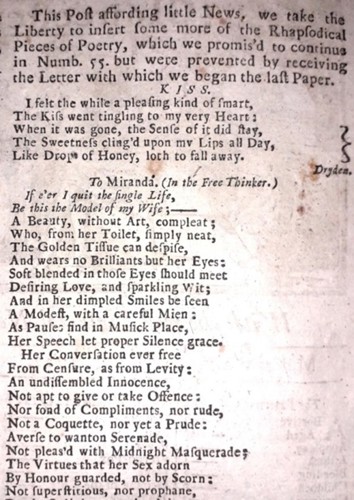
Today’s tabloids usually resort to so-called ‘celebrity’ news but it wasn't always so. From 1722 to 1726 the Gloucester Journal made at least five ‘apologies’ for having no news to provide. They typically printed poetry instead, prefixing it with wording such as: ‘this post affording little news, we take the liberty to inse’rt…’ or ‘As this Day’s Post affords but little News, we hope the following lines will be acceptable to our Readers…‘ or ‘This Post bringing nothing material of Foreign News, we cannot better entertain our Readers, than the following small Poems…..’
It's hard to imagine this happening in today’s media!