
Red in Tooth and Claw: Gloucestershire's Glorious Wildlife
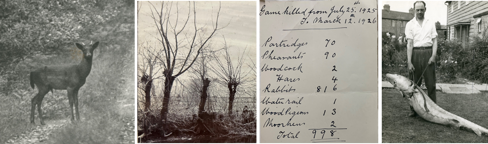
With our three different landscapes – Forest, Vale & High Blue Hill – and a major river and estuary, Gloucestershire has an array of different ecological niches that attract different forms of wildlife. This exhibition will look at these landscapes and the flora and fauna that they contain – as well as looking back to what we have lost.
Scroll through the virtual slides for an insight into Gloucestershire's varied, surprising wildlife history.
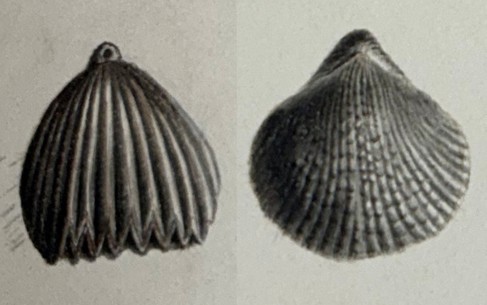
Palaeontology – Jurassic Brachiopods by John Jones, c. 1830
D9125/14758
Fossils are found almost everywhere in Gloucestershire – the earliest fossils are mostly Silurian, dating from around 443 Ma (million years ago) and they range up into the late Jurassic about 145 Ma, which (with a few exceptions) cover the entire geological history of the county. These beautiful drawings were made by John Jones of Gloucester in the 1830s and feature two brachiopods, which are extremely common fossils found in the Cotswolds and the Forest of Dean. Over 12,000 fossil species are recognized, grouped into over 5,000 genera and some brachiopods can still be found today. Most brachiopods were stationary suspension feeders that lived on the surface of the seabed, rocks, or other submerged structures rather than burrowing into the sediment. On the left is a Rhynchonella, an extinct genus known from the Late Jurassic (Oxfordian) to the Early Cretaceous. On the right is Burmirhynchia, a genus of rhynchonellid brachiopods found in the Middle Jurassic (Bathonian) strata of Gloucestershire, particularly in the Cotswolds.
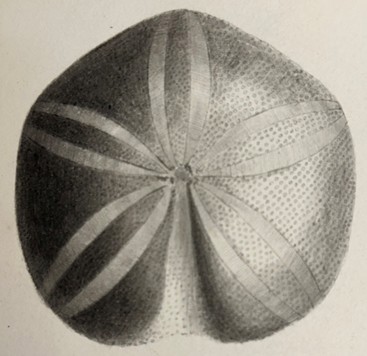
Palaeontology - Sea Uurchin Fossil Clypeus Ploti, by John Jones, c. 1830
D9125/14758
Another of John Jones’ drawings, this is Clypeus ploti, an extinct irregular echinoid (sea urchin) that lived during the Middle Jurassic period, and is a common fossil find in the Cotswolds. Also known as ‘Pound Stones’, these fossils were so common and uniform in size that they were used by milkmaids (to weigh butter) as standard one-pound weights. In 1389, a royal statute even incorporated ‘stones’ (the fossil) into trade measures and it is likely that this usage influenced the modern English weight unit of a “stone” (14 pounds). As well as this aspect, they were so common in the Chedworth area, that they became known as ‘Chedworth buns’. Folklore told that they were loaves of bread that had been made by faerie bit which had gone stale and turned to rock.
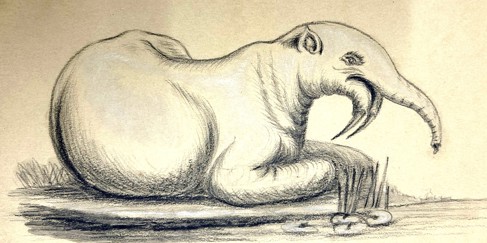
Palaeontology – Deinotherium by John Jones, c. 1830
D9125/14758
This drawing from the John Jones collection shows a Deinotherium – an extinct, elephant-like animal that lived from the middle Miocene to the early Pleistocene – roughly 13 million to around 6 million years ago. They were like modern elephants but much larger and had a more flexible neck, limbs suited for running, and tusks that grew down and curved backward from its lower jaw. We do not know why Jones drew it – presumably, he’d found a tooth or bone identified as being from the species.
Roman mosaic from Woodchester Roman Villa by Samuel Lysons, 1797
P375/MI/4/1
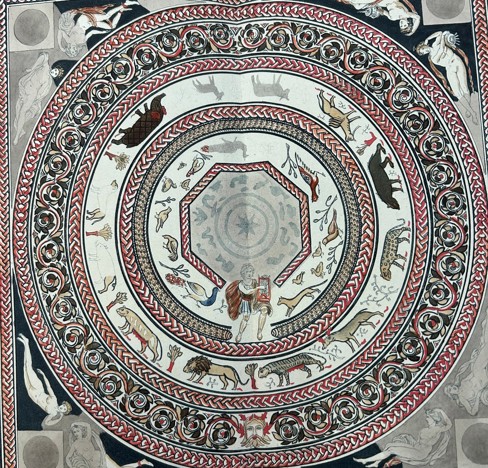
The 3,000 years between the Neolithic and the Roman period saw something like the modern present-day assemblage of British flora and fauna becoming established. It is possible that the Romans introduced Fallow deer – but this is disputed. However, they did introduce – at least in art – many other animals as this mosaic from ‘An account of the Roman antiquities discovered at Woodchester in the County of Gloucester’ by Samuel Lysons in 1797 shows. The famous ‘Orpheus’ mosaic from Woodchester Roman Villa shows lions, leopards, tigers, elephants (exotic/amphitheatre animals), bear, hunting dog, stag, horse, boar (common British animals) and a gryphon (mythical). It is thought that by this time, lynx and brown bears were on the verge of becoming extinct although lynx may have lingered on until the medieval. Wolves, beavers, wild boar and wild cats were all still present and were probably common.
Fallow Deer buck, Forest of Dean, c. 1970
D12187/3/12
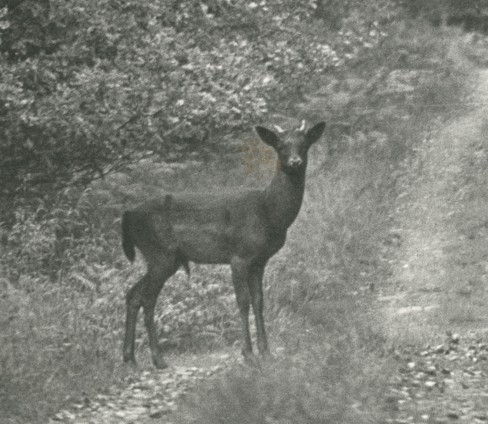
Fallow deer originate from the eastern Mediterranean and were possibly introduced by the Romans, as bones have been found at Fishbourne Roman Palace. However, in the immediate post-Roman period the population seems to have died out. They were reintroduced by the Normans, who brought them over from the Continent as sport for upper class men and women. To keep their Fallow deer, the Normans created deer parks, with most being created between 1200 and 1350. One of the main reasons for the popularity of Fallow deer in Norman and later medieval times was that as they were smaller than Red deer, so a smaller park could contain a larger herd of Fallow deer as opposed to Red deer. Over 3,000 deer parks once existed and they varied greatly in size, from a few acres to thousands – the latter being large enough to be used for hunting. Several existed in Gloucestershire – notably at Sherborne, Lydney, Dyrham and Berkeley. They were a prominent feature of the landscape but after the English Civil Wars, with many estates sequestered by Parliament, hunting became less popular, and many deer parks fell into disrepair – allowing the deer inside to escape into the countryside, where they have remained ever since. Today, they are the most widespread and abundant deer in lowland Britain – typified by this young buck from the Forest of Dean.
Rabbit Order, County War Agricultural Cultivation Committee, 8 November 1918 - 24 May 1919
GCC/ENV/3/4/7
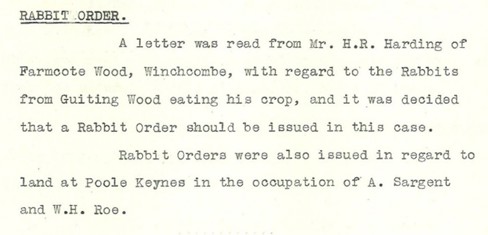
In both WW1 and WW2, the County War Agricultural Committee could and did issue rabbit orders, to enforce rabbit destruction to protect crops. These orders targeted rabbits as pests, authorising gassing with cyanide, alongside trapping, due to severe food production losses. Despite this, rabbit keeping at home for meat was encouraged and rabbits were allocating their own bran rations, issued by the Ministry of Agriculture and Fisheries.
Commonplace Book, Rooke Family of St. Briavels, 1666
D1833/Z3
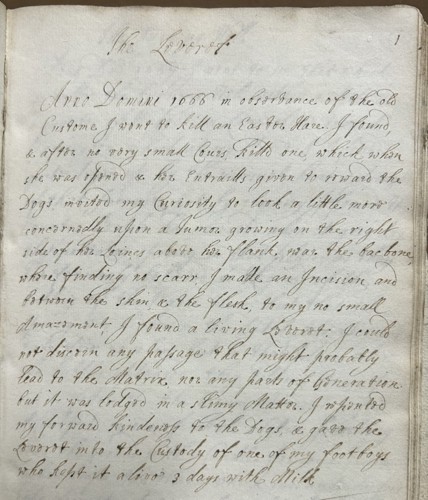
Another survivor from the Pleistocene Epoch, hares were classed as game animals. They lived on grassland and were popular targets for the pot. In an early example of the best-selling book ‘Raising Hare’ by Chloe Dalton, this item from a commonplace book in the Rooke Family of St. Briavels records how a pregnant hare was shot and killed, but when gutted, a leveret was found alive inside her. It was placed into the care of a footboy, who fed it milk and it apparently lived for a few days before dying.
CCLI ‘The Same’ (Coberley), Historia et Cartularium Monesterii Sancti Petri Gloucestriae, c. 1200
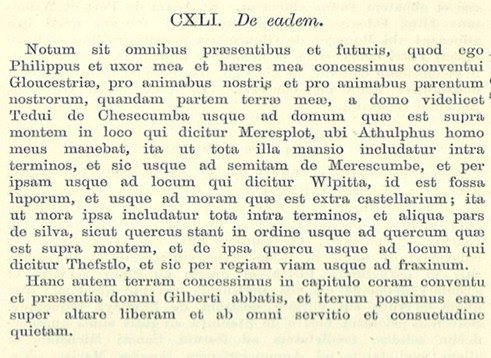
History and Cartulary of the Monastery of St. Peter of Gloucester
The abbey of St Peter at Gloucester had its origins in the seventh century and was re-established in the eleventh. It benefited considerably from Norman patronage, growing in importance, size and wealth and after the Dissolution, it became Gloucester Cathedral. The History and Cartulary of the Monastery of St. Peter of Gloucester was originally compiled in the late 1200s and included a history of the abbey and a comprehensive list of the lands held by the abbey containing 423 land charters, arranged by location rather than date. Chapter 141 details land that was given to the abbey in Coberley that includes a tantalising reference to a wolf pit – a pit to trap wolves. This suggests that at this time, wolves were commonplace and efforts were made to trap and kill them to reduce their numbers. Several of the places mentioned in this charter are still known to us today ‘Merescumbe’ (Mercombe Wood), ‘Chescombe’ (Chescombe Bottom), ‘the Castle’ (Norbury Camp earthworks) while Thefstlo – Thief’s mound or barrow – could be Lineover long barrow.
Let it be known to those in the present and the future that I Philip, and my wife and my heiress, have granted to the monastery at Gloucester, for the sake of our souls and those of our ancestors, a certain portion of my land, that is to say: from the house of Teduus of Chescombe as far as the house which is on the hill in the place called Meresplot, where my man Athulphus was living, so that all that dwelling should be included within the bounds, and then as far as Merescumbe lane, and along that as far as the place that is called Wlpitta, that is to say, the pit of wolves, and then as far as the heath which is outside the castle. The whole of that moor should be included within the bounds, as well as part of the wood, that is from the row of oak trees to the oak tree standing on the hill, and from that oak to the place called Thefstlo, and then along the king’s highway as far as the ash tree.
We have granted this land at the chapter house of the monastery in the presence of the abbot Gilbert and have placed it a second time on the altar, freely and devoid of any condition or service.
Writ of Aid for Peter Corbett, Calendar of Patent Rolls, Edward I, AD 1272-1281
 Calendar of Patent Rolls, Edward I, AD 1272-1281
More evidence confirming that wolves were present in Gloucestershire during this period comes from the Patent Rolls, the register of the letters patent issued by the Crown, expressing the sovereign's will on a wide range of matters of public interest, including grants of official positions, lands, commissions, privileges and pardons, etc. While at Westminster on 14 May 1281, King Edward I issued a writ to Peter Corbett to hunt wolves throughout Gloucestershire, Worcestershire, Herefordshire, Shropshire and Staffordshire.
Licence for Richard Talebot, Calendar of Patent Rolls, Edward I, AD 1272-1281

Calendar of Patent Rolls, Edward I, AD 1272-1281
On 30 March 1281, while at Clarendon, Edward I granted Richard Talbot a licence to hunt wolves in the Forest of Dean….in addition to wolves, he could take foxes, wildcats and hares…. but not deer or rabbits in the king’s warren. He was permitted to use nets to catch the wolves or to take them ‘in any easier way’.
Licence for John Giffard of Brimmesfeld, Calendar of Patent Rolls, Edward I, AD 1272-1281
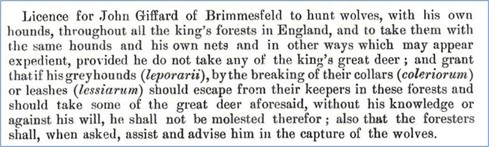
Calendar of Patent Rolls, Edward I, AD 1272-1281
On 6 November 1281, Edward I issued a licence to John Giffard of Brimpsfield to hunt wolves not just in the Royal Forests of Gloucestershire but across those in the entire kingdom – although a third of the 21 Royal Forests created by the Normans were in Gloucestershire. Like the licence issued to Richard Talbot is was not to permit any of ‘the king’s great deer’, although he was given a ‘get out of jail’ card for the licence noted that if Giffard’s dogs should break their leashes and escape and then run down any deer then he would not be prosecuted. Another factor in this licence was that the Crown’s Foresters – an official position in the hierarchy of the Royal Forests’ administration were to assist him in hunting the wolves.
Extract of Little Barrington Churchwarden’s accounts for 1771
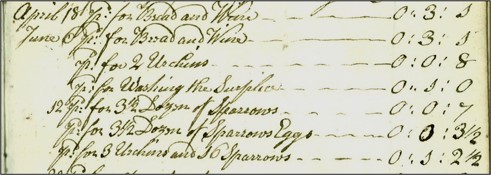
P37/CW/2/1
By the 1500s, the population of England was finally recovering from the Black Death. But agriculture hadn’t greatly changed and a mix of a growing population but low yields, meant food was scarce. To try and increase farm yields and fend off food shortages, the Tudor monarchs introduced a series of acts that designated species that were considered vermin. The most complete act was Elizabeth’s ‘An Acte for the preservation of Grayne, 1566’ which included a list of the species classed as vermin and the bounty (amount of money) people would receive for killing them. Henceforth, parishioners could legally kill any of the animals listed and present them to the Churchwardens to receive the bounty. This entry in the Little Barrington Churchwardens accounts lists ‘urchins’ – hedgehogs – as well as sparrows and sparrows’ eggs. At this date, a hedgehog was worth 8d (about £2.91 today) while 3½ dozen sparrows – 42 birds – was 7d (about £2.50) and the same number of sparrow eggs worth about half that amount. It cost more to wash the surplices of the choir. Sparrows were heavily targeted as they were deemed a pest on crops and damaged buildings (especially thatched ones). Between 1700 and 1930 an estimated 100 million sparrows were killed – it was still legal to catch and kill them up until 2005!
Extract from Cowley Churchwarden’s Accounts, June 1777
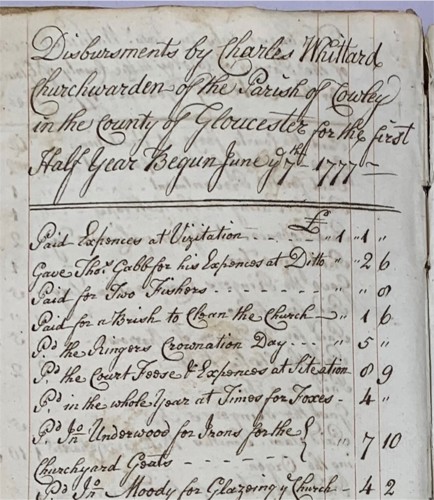
P102/CW/2/1
These partial accounts for the parish of Cowley for the second half of the year from June 1777 lists monies paid out by the Churchwarden Charles Whittard for ‘fishers’ (Kingfishers) and foxes. Kingfishers (Alcedo atthis) were deemed a pest because they ate small fish and this meant that such predated fish couldn’t grow into large fish which were eaten by humans and therefore, they were a legitimate species of vermin. However, the fish that kingfishers typically consume are small fry with a marked preference for minnows and three-spined sticklebacks, which do not grow to sizes for humans to eat. Kingfishers also eat tadpoles, and insects, diving from a low perch, and require about 60% of their body weight daily.
Badger killed by gamekeeper, Manor Farm, Alstone, c. 1910
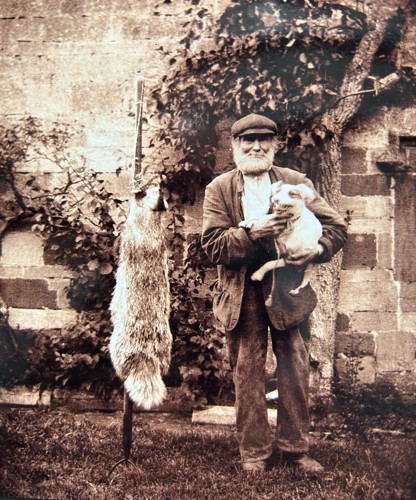
D15345b/2
Taken from an album of photographs of Bishops Cleeve, Woodmancote and surrounding areas, this sad image was taken at Manor Farm, Alstone (between Teddington and Toddington) sometime in the early 1900s. Badgers were hated as they were thought to steal chickens, kill young lambs and take eggs from birds’ nests and their setts could undermine the edges of fields and destroy land that could be used to grow crops. Consequently, a badger’s head was worth a high bounty 1 shilling (roughly £4 today). This badge was probably killed or at least trapped by the terrier held by the gamekeeper. Such dogs often suffered terrible injuries as badgers are powerful animals with strong jaws and large sharp claws. Killing badgers was still legal until in Britain until the introduction of the 1992 Protection of Badgers Act…. unless they are deemed to carriers of Bovine TB, when their slaughter is still permitted. It is an inescapable fact that gamekeepers alone are responsible for the current dearth of predators in the natural ecosystems of the British Isles having persecuted them since the 1600s.
Rook shooting at Brockhampton, 1909
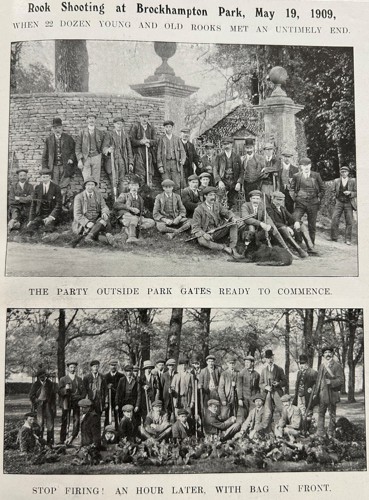
Cheltenham Chronicle & Gloucestershire Graphic, May 1909
Corvids were another species that were heavily persecuted. Traditionally, it was common rural practice to hold rook shoots in early May when juvenile birds, or ‘branchers’, were easy targets as they could be shot before they could fly. Huge numbers of rooks were killed – at this shoot at Brockhampton Park in 1909, 264 birds were killed in just one hour. Rook shoots were popular social occasions, and rook and rabbit pie was considered a great delicacy. Only the young birds were used as food as mature rooks are inedible. So popular was rook shooting that specialist single-shot small calibre rifles – called Rook rifles – were used, although these later gave way to 0.410 and 12-bore shotguns. Today, despite being protected, rooks can still be shot by landowners to prevent ‘serious damage to crops, livestock, or to preserve health and safety.
Fox, Forest of Dean, 1960-1979
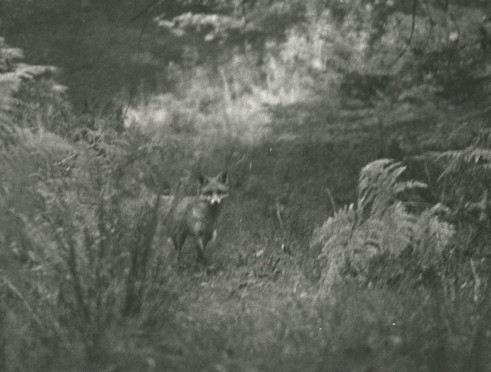
D12187/3/12
Despite having a huge back catalogue of medieval tales and folklore attached to them, foxes were never considered game animals but only vermin to be hunted. However, despite constant persecution in the countryside they are born survivors, ever adaptable, and today they are equally at home in our woods or city streets.
Fox cub with cuddly toy, The Citizen, 1961
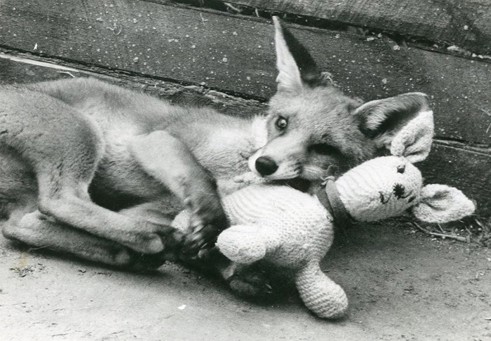
D10638/1/1961/32
In a countryside with no large predators, foxes sit on top of the food chain with a diet that takes in everything from birds and beetles to rabbits and rats. In towns, urban foxes are partial to takeaways….not to mention cuddly toys! This fox cub was orphaned and was looked after by a well-wisher.
Moles
D3471/350
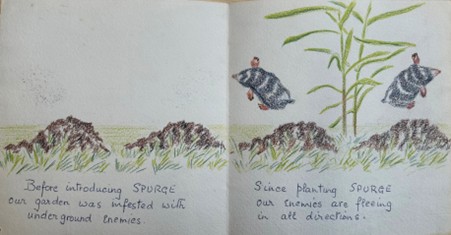
Ever since we have started having lawns, moles have faced a bad press from certain house-owners that usually leads to the death of the moles involved. In 1969, Major Cox of the Manor House at Blockley had an issue with moles but rather than use strychnine to poison them he tried planting Spurge (Euphorbia) …with mixed results, although it did create an attractive picture!
Game killed on Tibberton Estate, July-March 1925-26 & June- March 1926-27
D2176/2/3/3
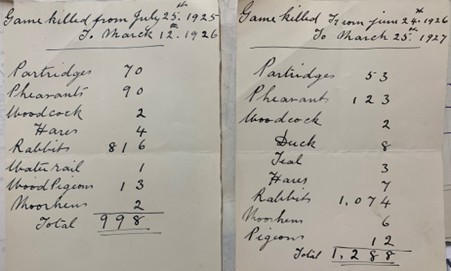
Most of country estates had managed shoots – some for sport, some for the pot and some for commercial purposes. These are two lists of game shot on Tibberton Court estate for 1925/6 and 1926/27 – the shooting was primarily in Rudford woods. Over the two years, the total number of animals & birds shot were 2,286 and, in ranked order, they were:
Rabbits – 1,890
Pheasant – 213
Partridge – 123
Wood pigeons – 25
Hares – 11
Moorhens – 8
Ducks (no species given) – 8
Woodcock – 4
Teal – 3
Water rail – 1
Domestic account book of Ann Beech the younger, 1746-1750
D2455/F2/5/2/2
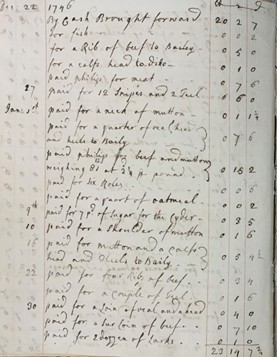
From the archive of the Hicks Beach family of Coln St Aldwyn this is an extract of the domestic account book kept by Ann Beach [nee Wither] the younger covering the period from 22 December 1746 to 30 January 1747. It includes accounts of receipts and expenditure on household items including food, paper, newspapers, letters, clothing and, for good measure, sums won and lost at cards. However among the items are entries for 12 Snipes, 2 Teal for 6s (about £10 today) and at the bottom of the page for ‘2 dozen of larks’ for 1s (about £5 today). Larks – and lark’s tongues – were historically consumed as a delicacy in Britain, particularly in the 1700s and 1800s, often roasted or used in pies. They were considered a light game meat and sometimes served as a symbol of wealth. Their consumption largely ceased due to population decline and conservation. Teal was highly prized by connoisseurs for its tender texture and rich, bold flavour. One made one small portion, often served pin and it was roasted quickly, paired with fruity sauces, or used in casseroles. Snipe were considered the finest eating and traditionally were roasted with the intestines intact (except the gizzard), and the head/wings left on. They were served on buttered toast to soak up the juices…..
Parts of the Hanger and Coneygar woods, with acreage and valuation of underwood, 1810-14
D1610/P47
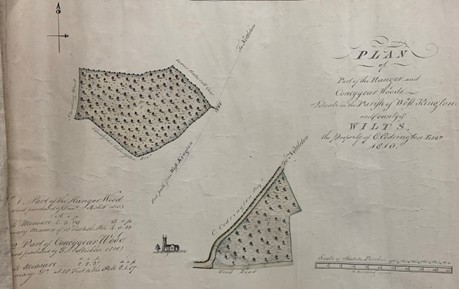
Significant woodland clearance began in the Neolithic (c. 3000 BCE), particularly in the south of England, totally altering the natural landscape. It continued throughout history so that today, less than 2.5% of the UK covered by ancient woodland – this term is used to describe woodlands that have existed since 1600CE. Almost all woodlands are managed to yield successive crops of produce in a perpetual succession with the trees replacing themselves by natural regrowth. In addition, most woodlands are mixed, with many species of trees and shrubs, making them the principal reservoirs of wildlife outside intensively farmed land. Owned by the Codrington family of Dodington, this map of 1810 shows a typical set of woodlands owned by an estate. The map depicts Hanger Wood (4 acres.) and Coneygar Woods (2 acres.) in the parish of West Kington in Wiltshire. The map marks hedges, gates and roads, a table of reference that gives acreages and a perspective sketch of W. Kington Church.
Fernley Plantation, Ozleworth, 1881
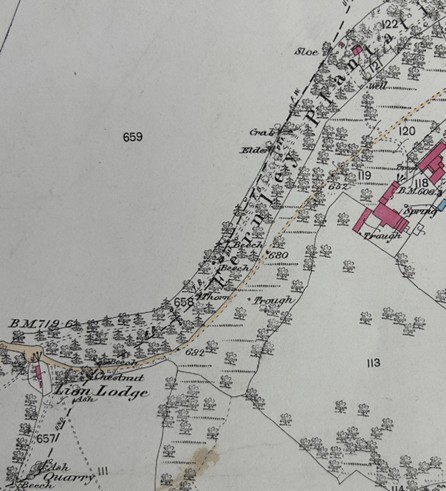
1881 1st Edition Ordnance Survey map
Plantations are where trees are not natural vegetation and are typically monocultures - just one or two species or exotics – such trees usually die after felling and are replaced by new, young trees. This plantation near Ozleworth is an oddity as it appears to be primarily conifers but has some deciduous trees – which, unusually for an Ordnance Survey map are identified – the list including beech, ash, chestnut, thorn, elder, crab apple and sloe.
An Account of coppice wood sold from Cold Aston Grove, 1826
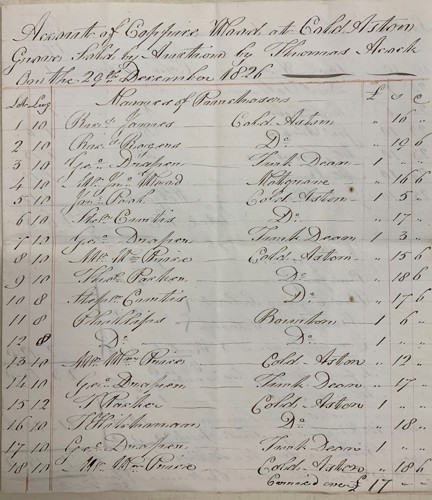
D245/I/41
The most common method of woodland management was to harness the self-renewing power of trees via coppicing. Coppicing is an ancient, efficient, sustainable technique for harvesting wood that involves cutting the underwood (small trees, i.e. hazel, sweet chestnut, ash, oak, lime, willow, alder, and hornbeam) down to ground level during winter dormancy to encourage new, fast-growing shoots from the stump (or ‘stool’). Larger trees (‘standards’) were left for later felling for timber. This is a typical page of accounts for a coppiced wood – in this instance The Grove in Cold Aston on the Manor estate. Coppiced wood was used for fencing, hedging, garden work, poles, charcoal and as fuel. It fell from fashion in the 1950s but is now making a comeback and is great for biodiversity.
Pollarded trees on riverbank, unnamed location & undated
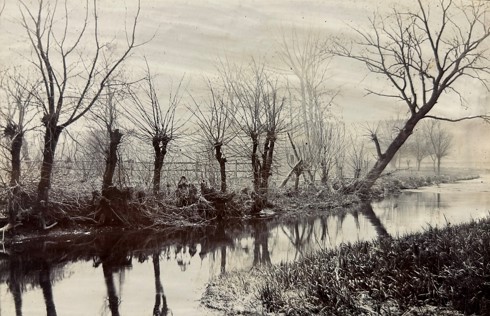
D2455/F3/11/3/3
A variation of coppicing was pollarding, where branches were cut around 10-15ft above ground to encourage new growth, leaving a permanent trunk – known as a ‘bolling’. It was primarily practised in wood-pasture where trees were accessible to livestock (so preventing them grazing new growth) and on riverside willow trees to provide ‘whips’ for basketry work. It is also used in towns to reduce the height and spread of mature trees. This photograph comes from an album in the Hicks-Beach Family archive and probably belonged to Victoria Hicks Beach. Although it’s location is not given, it is likely that it was taken on the Wiltshire River Avon on the family estate at Netheravon. It shows willow trees that have been pollarded the previous year.
Pressed wild flowers collected by Evelyn Walklet, 1924
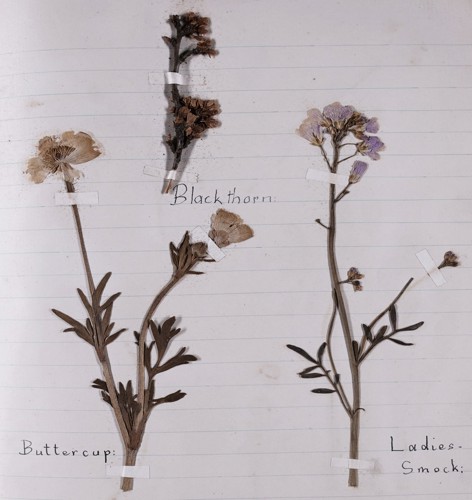
RQ300/22GS
We don’t know exactly how many different species of wildflowers are found in Gloucestershire. However, as there are around 1,600 wildflower species in the whole of Britain and Ireland, and Gloucestershire contains varied habitats from limestone grassland to floodplain meadows, it has been judged that our county hosts a significant portion of these. Pressing wildflowers was once a popular hobby – these were made by Evelyn Walklet, who was born in Tetbury in 1913 and lived much of her life there, although she may have lived an early part in Lechlade. It is likely that she collected the flowers in the Tetbury area when she was 11 years old (written on the front of book).
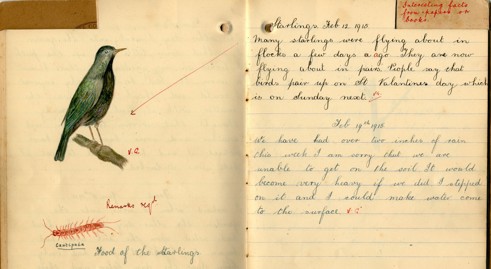
School exercise book by Charles Culley, 1915
D12405/1
The archives hold many diaries and records that contain references to wildlife. This is Charles Culley's exercise book from Church Street Boys Council School which mostly contains drawings and stories of wildlife encounters and gardening.
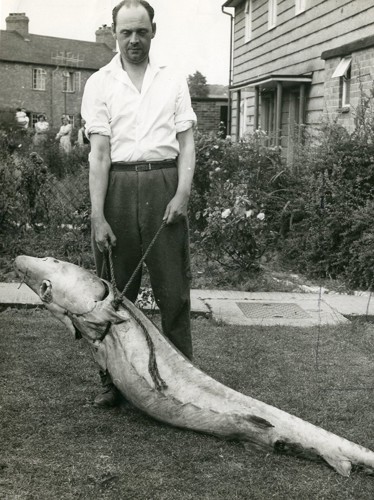
Sturgeon, The Citizen, 1961
D10638/1961/07/15
Sturgeons are ancient, bottom-feeding fish, known for their cartilaginous skeletons, lack of teeth, and, in some cases, immense size (up to 6m). They are amongst the most critically endangered species on Earth, threatened by habitat loss, overfishing (for caviar), and migration barriers. From The Citizen photo-archive, this is a small sturgeon that was caught in the somewhere in the Severn around Gloucester. The UK has two native migratory species—the European and Atlantic sturgeon — historically inhabiting British rivers and coastal waters. Due to overfishing and habitat loss, they are locally extinct, though conservation efforts are underway. They are protected by law, with any caught individuals still legally belonging to the Crown. In 1612, a sturgeon was caught at Arlingham and the Berkeley’s claimed it – the bill that resulted from cooking and preserving it came to £5 (about £670 today). It’s size is not recorded but it took 24 gallons of liquid (perry and verjuice) to boil the Berkeley sturgeon in and 24 gallons to fill barrels to souse it in after cooking!